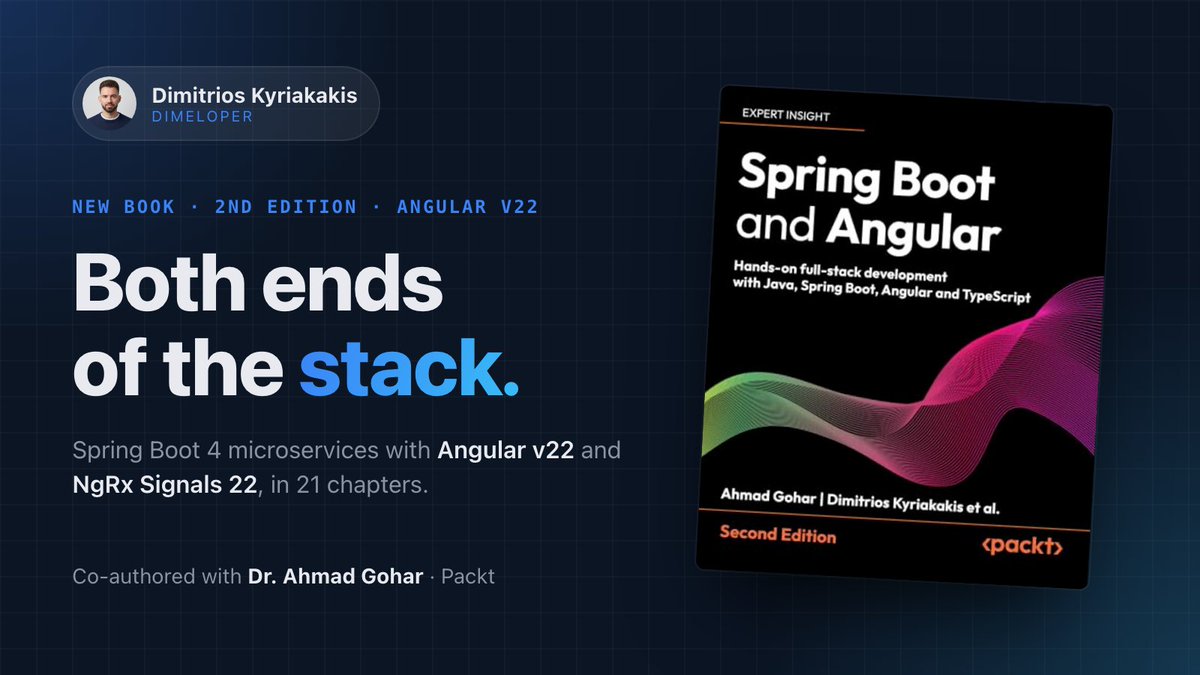
Yesterday I mentioned a book, so here it is: together with @ansgohar we wrote the 2nd edition of Spring Boot and Angular, and it's out now with Packt 📘
21 chapters, building a full-stack app, from Spring Boot microservices to the @angular front end. https://t.co/2iedGbi6Fo
@jsonpreet it's Apple's catch-all for files that fit no other category. worth checking Docker's disk image (docker system df) and local Time Machine snapshots (tmutil listlocalsnapshots /), they often hide there
@OBiblyi actually the Angular docs answer this one: if the rules live in one place, an inline function works just as well. schema() is for sharing them across forms or several paths, and a Schema object gets cached per form compilation. apply() takes either
@AtMemAi branch state tells them apart: merged and clean can go, anything unpushed or dirty needs a look. git branch --merged main and git status in each one cover it
I actually built a Mac app that sorts them that way 😄 https://t.co/pg8rSXHmDF
casually freeing 16 GB just from merged agent worktrees 😄
42 of my 69 were merged and clean, so nothing to lose. Most of it was node_modules and build folders inside them.
https://t.co/pg8rSXHmDF
Live updates in our book use Server-Sent Events, and two lines make them arrive on time.
Spring sends a “connected” comment as a client subscribes, so the response flushes before the first event. Nginx gets proxy_buffering off, or it holds the stream back.
SSE or WebSockets?
Yesterday I mentioned a book, so here it is: together with @ansgohar we wrote the 2nd edition of Spring Boot and Angular, and it's out now with Packt 📘
21 chapters, building a full-stack app, from Spring Boot microservices to the @angular front end. https://t.co/2iedGbi6Fo
@aketchel2 most of it is usually worktrees: each keeps its own node_modules and build output after the task is done. sort by branch state: merged and clean can go, uncommitted needs a look first
I actually built a Mac app that sorts them that way 😄 https://t.co/pg8rSXHmDF
@ArivuBuilds +1 on JWKS. in Spring Boot the resource server handles the rotation: point spring security.oauth2.resourceserver.jwt.jwk-set-uri at the auth server and it picks up new keys as they're published
@PatchOnChain a pre-commit hook the agent can --no-verify past unfotrunately isn't a gate. turn on GitHub's push protection too: it blocks a push with secrets on GitHub's side, whatever the agent did locally
@tylerangert one catch on a Mac: du and Finder count every APFS clone at full size, so the worktrees look much bigger than they are. df shows the real free space
@GauravBrief the one i see most: one signal holding the whole state object. every update() is a new reference, so everything reading it re-runs, even unchanged parts. split it by what changes together, or read slices via computed(), which only notifies when its own value changes
@brianshinsh worktrees + sims stack up: every checkout gets its own node_modules and Xcode DerivedData (keyed by path, outlives the worktree), and booted sims push swap onto the boot disk (sysctl vm.swapusage). I built DevSweeper (Mac) for this pile, scans are free: https://t.co/Qve9XccDhz
@civancza git has one: post-checkout also fires after git worktree add, so it can prune stale worktrees or wipe old .next before the new one builds. in Claude Code, WorktreeCreate/WorktreeRemove hooks replace its default worktree logic, so teardown can delete the whole folder
@oderajoseph light: it reads process stats once a second and makes no network calls apart from a daily update check. actually battery is one of its readouts: time left at your current pace, plus CPU per project
@AakashHarish03@claudeai docker system df first, it shows what's reclaimable before you prune anything. next run, have subagents share one container or image, 40 copies of the same env is the expensive part. I built DevSweeper (Mac) for exactly this pile: https://t.co/Qve9Xcc5s1
@JamesBuildsTech one that comes back after DerivedData: simulators. xcrun simctl delete unavailable clears devices for runtimes you no longer have, and xcrun simctl runtime list shows the old iOS runtimes, often several GB each. worth a monthly look even on 1 TB
@TravisLeeSwiftX the session flips to "needs you" and the prompt lands on my phone, so a wait can't pass for work. no auto-deny: after an hour it falls back to the agent's own prompt and stays flagged. would you want a timeout to deny, or just nudge you again?
Why I built AgentNod: three agents running, I step away for five minutes, and two are stuck on a permission prompt I can't see.
Now every pending prompt from Claude Code, Codex and Cursor lands in one queue on my Mac and phone, with the exact command.
https://t.co/JWrhCmGqvY
@MohakBuilds for the routine ones, yes. that's why on the Mac "Always" saves a rule for that command in that project, so the read-only stuff stops asking. what's left is mostly the stuff worth reading
@aiwithgriz one setup for all of them: first run finds the agents you have and adds a hook to each one’s config in one click. claude code and codex land in the queue straight away, cursor’s approvals need one switch flipped 😄