@SteveStuWill That pattern is very often found with outcome variables (e.g., job performance, social succes). The question is why would five presumably independent traits consistently show this specific pattern. The General Factor of Personality (GFP) seems a plausible explanation.
A recent article on Flow in the Guardian, that also discusses our work on this topic. Together with @Doria59054590 and @ProfABBakker .
https://t.co/g3RIrlnf8f
@DeBie_Hendrik@giladfeldman@ugent I like the idea. It is somewhat a return to the 'old' system in which departments could hire a PhD student every couple of years.
@julianetzel@wille_bart Great work! Here is a also paper that provides an additionele way to look at personality and vocational interest:
https://t.co/GGQdtv153f
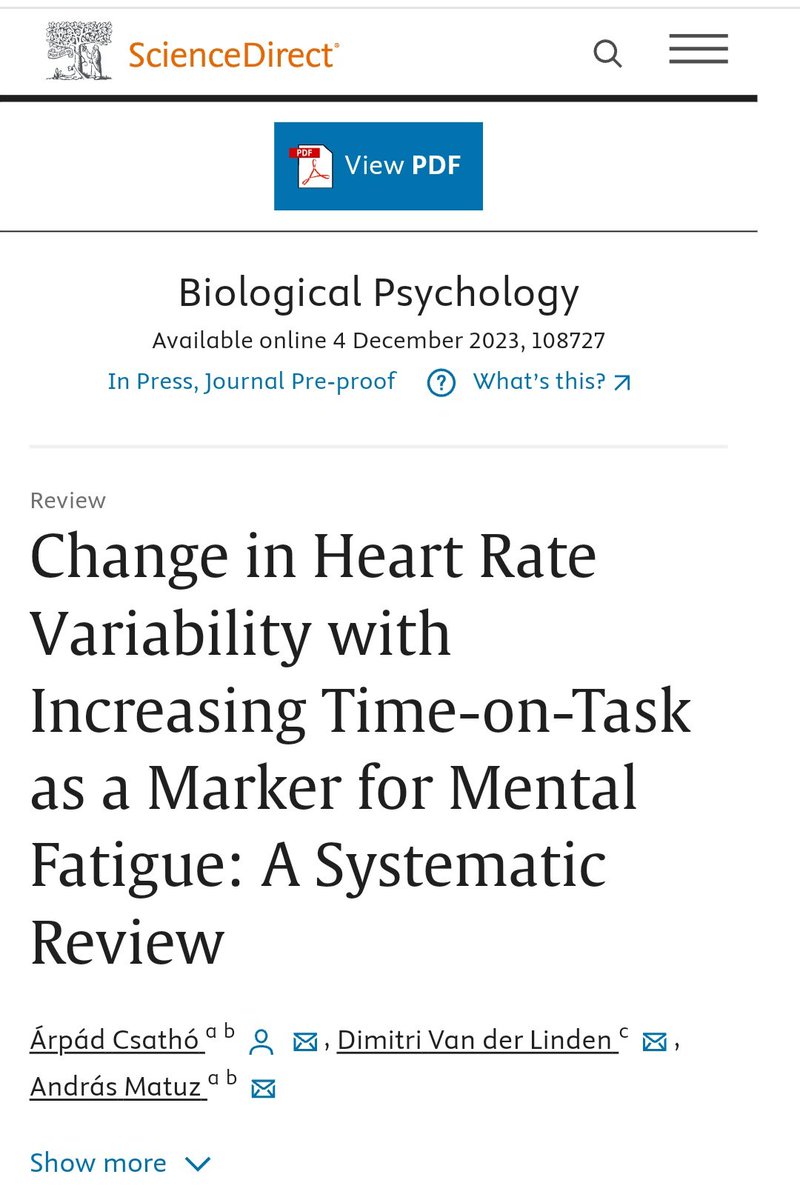
Our review on heart rate variability in mental fatigue is now online in Biological Psychology.
With Arpad Csatho and Andras Matuz.
https://t.co/oOh8ZCLHP1
Very excited to start this project in collaboration with several international experts including Susanne Becker (Düsseldorf), Dimitri van der Linden @Dimitri_329 (Rotterdam), and Nicolas Silvestrini (Geneva)!
Great news 🥳🥂! Our research project exploring the role of effort in the effects of pain on cognitive functioning was funded by @FWOVlaanderen. Looking forward to work on this with a fantastic team of collaborators: @Dimitri_329, Susanne Becker, and Nicolas Silvestrini.
@gmiller Yes, probably true to a large extent as a very low GFP relates to all kinds of problems. Although the GFP has a broader range as it also includes positive or, at least, social desirable traits.