🎬Screenwriter-director. Novelist: Dark Love, A Simple Love Story. Author and illustrator of Hercules+Hermes graphic novels. Join me on my cinematic journey.
Valle de los Templos en Agrigento, Sicilia, columnas del Templo de Juno.
La escultura de bronce en primer plano es una obra de Igor Mitoraj y representa a Ícaro.
Hollywood is at risk of becoming Detroit, advocates warn, unless the U.S. responds to the 81 countries embracing filmmaking as an economic tool.
“I watched the demise of steel and rubber and automotive manufacturing as I grew up,” says IATSE vice president Mike Miller, who was raised in Cleveland. “This is identical in many ways. We have an undeclared trade war that our government is standing by and watching happen.”
Read the full cover story on the mass exodus of LA productions by @GeneMaddaus: https://t.co/wwHFxvtsaB
Επικό ξεφτιλισμα Κουσουλού σε Άδωνι Γεωργιάδη!
Ο Άδωνις πρότεινε αύξηση φόρων για την ενίσχυση των υγειονομικών αντί για συμμάζεμα στο Δημόσιο!
Μετά μίλησε για αξιολόγηση ΧΩΡΙΣ απολύσεις.
Όταν δε άκουσε για τον Μιλέι έχασε τα λόγια του!
👉Το βίντεο είναι must watch, ΚΟΙΝΟΠΟΙΗΣΤΕ!
Καλό σου ταξίδι καπετάνιε. Οι μικρές κυκλαδες δεν θα είναι ποτέ το ίδιο. Ο Σκοπελιτης είναι θρύλος. Έχουμε φάει τόσο σπρέι από φουρτούνες αλλά ποτέ δεν φοβηθήκαμε.
Greek Necklace with Butterfly Pendant. From the Greek city Olbia in Ukraine, Hellenistic period, late 2nd-1st century BC
gold, amethyst, chalcedony, emerald, rock crystal, pearl, and colored glass
The Walters Art Museum
Ο πάτερ αυτός είναι ο Νικόλαος Αλεξανδρής, ο άνθρωπος που εμφανίστηκε στην ομογένεια ως ο μεγάλος πατριώτης και ίδρυσε την αεροπορική εταιρεία SkyGreece.
Τότε έταζε στους Έλληνες του εξωτερικού μεγάλα λόγια, δάκρυα για την πατρίδα, υποσχέσεις ότι θα ενώσει την ξενιτιά με την Ελλάδα. Πάτησε πάνω στον νόστο, στην πίστη και στην αγάπη των ανθρώπων.
Η εταιρεία ιδρύθηκε με τυμπανοκρουσίες τον Οκτώβριο του 2012. Για σχεδόν τρία χρόνια μάζευαν λεφτά και πουλούσαν εισιτήρια.
Μόλις ξεκίνησαν οι τακτικές πτήσεις το καλοκαίρι του 2015, το παραμύθι κράτησε ελάχιστα. Στις 27 Αυγούστου 2015, η εταιρεία έριξε ένα από τα μεγαλύτερα και πιο ξεδιάντροπα κανόνια της αεροπορικής ιστορίας.
Και δεν έκλεισε απλώς με αξιοπρέπεια. Έκλεισε μέσα σε μία νύχτα, αφήνοντας χιλιάδες ομογενείς μας, οικογένειες με μικρά παιδιά και ηλικιωμένους κυριολεκτικά παρατημένους και φυλακισμένους στα αεροδρόμια του Τορόντο και της Αθήνας.
Άνθρωποι έκλαιγαν στις αίθουσες αναμονής με άχρηστα χαρτιά στα χέρια, αναγκασμένοι να δανειστούν χιλιάδες δολάρια για να βρουν ένα εισιτήριο επιστροφής.
Και τι έκανε τότε η διοίκηση αυτού του κυρίου; Εξαφανίστηκε!
Διέγραψαν τις σελίδες τους στα social media, κατέβασαν τα τηλέφωνα, άφησαν τους εργαζόμενους απλήρωτους στον δρόμο και έγιναν άφαντοι. Ούτε μια συγγνώμη. Μόνο χρέη, οργή και κατεστραμμένες ζωές.
Την επόμενη φορά λοιπόν που θα δείς κάποιον επώνυμο να κλαίει από συγκίνηση για το έργο ενός υπουργού, μη μασάς. Ψάξε το παρελθόν του, ψάξτε τις business του. Ψάξε πόσοι άνθρωποι έχασαν τον ύπνο τους και τις οικονομίες τους εξαιτίας του.
Γιατί στο τέλος της ημέρας, αυτοί που ξέρουν να επιβιώνουν εις βάρος των άλλων, θα βρίσκουν πάντα τον τρόπο να συναντιούνται και να αλληλοϋποστηρίζονται.
Από Fb
The Jockey of Artemision is a large Hellenic bronze statue depicting a boy riding a horse, dating back to around 150-140 BC. The statue was recovered in pieces from an ancient shipwreck off Cape Artemision, Greece...
It is a rare surviving true bronze statue from ancient Greece, a rare example of a racehorse in Greek sculpture. Most ancient bronzes have disappeared because they were melted down to reuse their raw materials sometime after creation. This one was saved from destruction only because it was lost in a shipwreck in antiquity, before being discovered and recovered in 1926.
It may have been dedicated to the gods by a wealthy person to honor victories in horse racing, probably in the single-horse race.
National Archaeological Museum, Athens 🇬🇷
#archaeohistories
1/2. Ancient Greeks worshiped physical symmetry! Beauty was seen as a reflection of health. Without modern soap, they stayed clean by scraping off dirt, sweat, and olive oil using a curved metal tool called a strigil. 🇬🇷✨ #AncientGreece#History#Hygiene
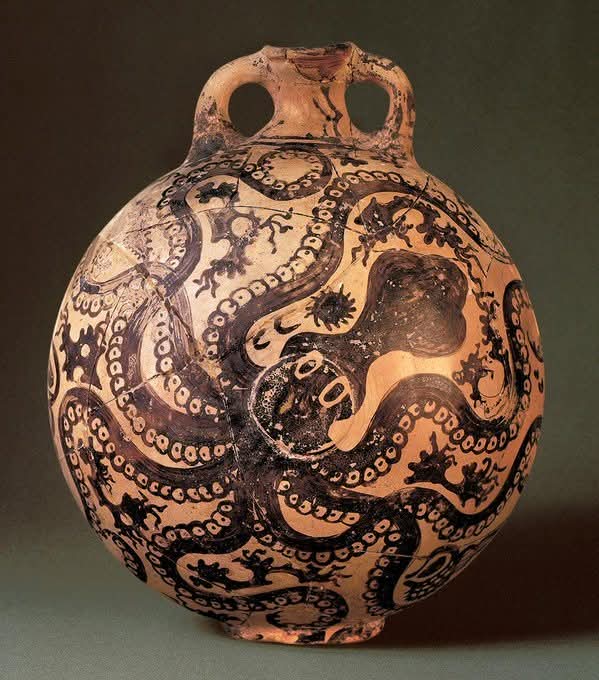
Minoan Octopus Vase (1500 BC) from Palaikastro, Crete - Greece 🇬🇷
This vase, found at Palaikastro, a wealthy site on the far eastern coast of Crete, is the perfect example of elite Minoan ceramic manufacture. It is 27cm high, wheel-made, hand-painted, and meant to hold a valuable liquid, perhaps oil of some kind. Its shape is somewhat unusual, constructed by slipping together, while still leather hard (clay that is not quite dry), two shallow plates which had been made on a fast spinning potter’s wheel and with highly refined clay. The circular bases of these shallow plates are still visible in the center of both sides of the flask.
A spout and stirrup-style handles (which would allow the user to carefully control the flow of the liquid out of the container) were added by hand, as well as a base, to facilitate the standing upright of the vessel.
The octopus is one of the most characteristic motifs of the “marine style”, which was invented by the Minoans and was adopted by the Mycenaeans. After the Mycenaean dominance, the design of the octopus was stylized and simplified , like all Minoan motifs. It is very possible that the “marine style” (depictions of life in the sea) was an expression of worship to the sea, which offered protection (navy),wealth (commerce) and food (fish).
The Octopus Flask is an example of Minoan New Palace Period pottery. Made to celebrate the sea, this Kamares Ware jug is covered in decoration of marine life. The jug is round with a small opening at the top and has two small, round handles on either side of the neck. The main figure is an octopus whose tentacles span over the rounded surface of the vase. There is not much attention to realism in this representation, and the figure is almost cartoon-like. The most unrealistic features are the figure’s bulging, round eyes and inclusion of all of its suckers, which would not be visible on all tentacles in a realistic perspective; However, these round motif features mimic the shape of the vase as well as the round handles at the neck. The overall appearance of the octopus is fluid and dynamic as it wraps around the surface.
The space around the main figures is filled with other sea objects - coral, seaweed, and shells. These objects are usually placed without much interest in composition or symmetry. While there is not a specific narrative, it is clear that the overall meaning is a representation of a love for the sea.This subject matter on vases is called of “Marine Style” pottery.The marine style is shown in the design of the subject as well as the overall structure of the jug.
The round body of jug represents head of an octopus, and two rounded handles are a simplified version of tentacles. This is what art historians call “Anthropomorphic”, meaning the object itself is a representation of the subject. Here, the handles are made to represent the subject of the octopus. This is important because, when used, this style gives historians insight into what the culture valued. In this case, as shown with the abundance of marine subjects in other media, it is evident that the Minoan culture valued marine life. This also supports evidence that the Minoan economy depended on the sea.
Over time, paint has become muted, but it is clear that there is a shift in style of Minoan pottery and ceramics. In Old Palace style, pottery showed light figures on a dark background, for most part. Here, dark figures are shown on a light background. This shift would be important in Greek pottery, and this dark on light technique would be the norm for Greek pottery until about 530 BC. Effect of this style is a greater attention to detail, like suckers on the octopus, which would be less prominent on a dark background. Across various ancient cultures, artists portrayed what they saw in everyday life and what was important to them, and this is very much true for Minoan art and pottery.
Archaeological Museum of Heraklion, Crete
📷 : Credit to the Owner
#archaeohistories
Have you ever heard of the myth of Persephone? 💐🍒
One of the most fascinating myths of Ancient Greece
And it is fascinating to think that, even today, this myth is still evoked in Taranto, in Puglia, Italy 🇮🇹
Why? Because Taranto, although it is an Italian city, once belonged to Magna Graecia and was one of the most important Greek colonies in the Mediterranean
Its culture, art and even many of its traditions have remained deeply connected to the Greek world
The myth of Persephone is one of the most symbolic and mysterious stories in Greek mythology
Persephone, daughter of Demeter — goddess of fertility and agriculture — was abducted by Hades, god of the Underworld, who took her into the realm of the dead to make her his queen
Demeter, devastated by the disappearance of her daughter, stopped crops from growing and the world fell into a long famine
To save humanity, Zeus intervened and reached a compromise: Persephone would spend part of the year in the Underworld with Hades and the other part on Earth beside her mother
However, before leaving the Underworld, Persephone ate a few pomegranate seeds offered by Hades
According to ancient Greek mythology, anyone who consumed food from the Underworld was forever bound to it
Because of those pomegranate seeds, Persephone could never completely leave Hades’ realm and was destined to return there every year
From this comes the deepest meaning of the myth: when Persephone returns to Earth, nature blooms again and spring and summer arrive; when she descends back into the Underworld, the world fades and autumn and winter begin
It is a myth about life, death, rebirth, transformation, and the eternal connection between light and darkness 🌒
And it is precisely this blend of Greek culture, symbolism and Mediterranean identity that makes it so evocative that the myth of Persephone is still remembered and celebrated today in Taranto, an Italian city with a profoundly Greek soul 🇮🇹🇬🇷