Introducing Claude Fable 5: a Mythos-class model that we’ve made safe for general use.
Its capabilities exceed those of any model we’ve ever made generally available.
@BrentLynch I think Grok does not support yet references to video. It uses the image as a first frame. Grok 1.0 has the option to use image as a reference, hope Grok 1.5 will support this as well.
GPT Image 2 is just... insane for INTERIOR DESIGN.
you can generate near-perfect 360-degree panoramas.
Just upload photo/sketch of the room -> select theme -> panorama ready.
🚫 Websites You Should Never Visit 🚫
Easy-Peasy .ai gives you access to HUNDREDS of different AI tools in one place, on a FREE PLAN.
Definitely don't save this because big AI businesses still need you to pay 😉
@rauchg@workflowsdk@pranaygp@rauchg@pranaygp evaluating Workflow SDK for our Agent and measuring 4× TTFB + 8× slower streaming throughput vs direct streamText via AI SDK. Is real-time streaming a target use case, or more of a background/batch tool? Thank you
I used Marky Agent on @easy_peasy_ai and Gemini Flash 3 model and the results are so much better.
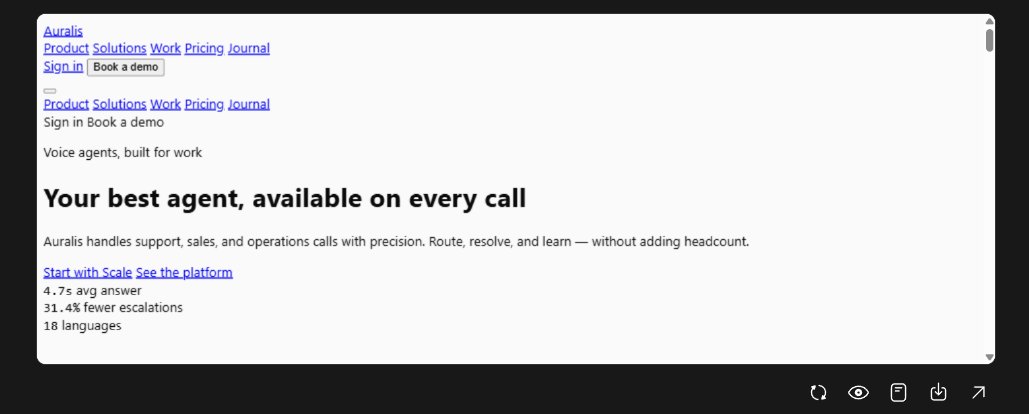
I used the same prompt 🙂 "Website creative for Al voice agent clean 10sections professional animated premium feeling, use GSAP and make it clena"
A small thing that makes a huge difference in AI Agents is whether they can do broad research in parallel.
If you ask ChatGPT or Claude to do wide research, they usually execute searches one by one. That often means you get a decent answer, but not a very complete one. Coverage becomes the bottleneck. In my case, I wanted to find all Singaporean companies that teach AI, and for each one collect the website, address, email, phone number, and a short summary of what they teach. That’s the kind of task where sequential search starts to break down pretty quickly. You can get some results, but it’s easy to miss a lot of the long tail.
We recently added a capability to our Marky Agent called parallel_map, which lets it spawn subagents to run research tasks in parallel. Instead of searching, opening pages, verifying details, and extracting data one company at a time, Marky can first gather a broad candidate list and then split the verification work across multiple subagents at once.
As you can see from the video, Marky first gathered the list of companies, and then it fanned out into parallel research jobs to validate each lead, visit official sites, extract contact details, summarise what each company teaches, and filter out weak or duplicate matches. The result is not just faster research. It’s wider coverage and better completeness.
That’s the difference between an assistant that gives you “some answers” and an agent that can actually work through a real research workflow.
I think this is where AI becomes genuinely useful for business users. Not just writing or chatting, but doing structured, repeatable work across dozens or hundreds of entities without falling into the usual shallow-search pattern.
We’re building more of this into Marky, because a lot of real-world tasks are not single-step tasks. They’re coordination problems. And once an agent can decompose work and run the right parts in parallel, the quality of the output changes a lot.
If you’ve ever tried to do market mapping, lead generation, vendor discovery, competitor tracking, or large-scale research with AI, you’ve probably felt this limitation already.