ಬೆಂಗಳೂರಿನಲ್ಲಿ 15 ಲಕ್ಷ ಸ್ಥಳೀಯ ಸಸಿಗಳನ್ನು ನೆಡುವ ಅಭಿಯಾನದಲ್ಲಿ ಭಾಗವಹಿಸಲು, ಆರ್ಟ್ ಆಫ್ ಲಿವಿಂಗ್ ಪ್ರತಿಷ್ಠಾನದ ಸಂಸ್ಥಾಪಕರು, ಗುರುದೇವ ಶ್ರೀ ಶ್ರೀ ರವಿಶಂಕರ್ ಗುರೂಜಿಯವರ ಶುಭಸಂದೇಶ.
ಸುಸ್ಥಿರ ಭವಿಷ್ಯಕ್ಕಾಗಿ ಈ ವಿಶ್ವದಾಖಲೆಯ ಅಭಿಯಾನದಲ್ಲಿ ಕೈಜೋಡಿಸಿ.
@Captain_Mani72@Gurudev@ArtofLiving#Gurudev#ArtofLiving #GreenBengaluruByBDA #HasiruBengaluru #GardenCity #BengaluruVoices #PlantForFuture #15LakhSaplings #GuinnessWorldRecord
How awesome to receive Sri Sri in Norway 🇳🇴!
I had a most amazing day yesterday going to the Norwegian parliament with Gurudev Sri Sri Ravi Shankar .
Sri Sri shared his thoughts on loneliness and mental stress for a generation facing new challenges from social media and more.
Even at the the day of Norways great victory in football World Cup, so many turned out to welcome Sri Sri and to listen to him.
At a packed meeting in Gamle Logen he and I discussed peacemaking and the role of India in a new world order. We agreed that wars are irrational, they hardly ever achieve the stated purpose. Just look to the US - Iran war.
The need of our time is to look for compromises at all levels - in the family and the local community, in national affairs and between nations. A comprise is not something boring or weak, it’s the glue which keeps societies together. Compromise is the act of the strong and the wise!
Kannada has almost no business podcast culture. No one was telling entrepreneur stories in our own language.
So we built it anyway with @mundhebanni
10 months. 25 episodes. 28 guests.
3M+ views. 450K+ hours watched. 50K+ subscribers.
All in Kannada - an earnest effort of purposeful storytelling.
25 trailers below - one for every guest who said yes.
Which guest's story hit you the hardest? Reply below 👇
Nowadays, we associate the stereotype of Indians excelling in math to Silicon Valley businesses/competitive exams. Centuries earlier, rural India had a highly advanced, beautifully poetic system of mental math that enabled ordinary village children, even those w/o paper/pens, to calculate complex arithmetic instantaneously.
The system got its name from Subhankar Das, a legendary mathematician from 14th-century Bankura, Bengal. He came to understand a basic fact about human nature: our brains are awful at remembering dull abstract eqns, but we are fabulous at remembering rhythms, rhymes & riddles.
He translated intricate math eqns into Bengali rhythmic verses.
The Subhankari system taught kids using folk riddles instead of teaching them x, y variables. Children in rural traditional schools, known as pathsalas, would sing their way in solving heavy arithmetic, land surveying, currency conversion etc, all in their heads (Manash-anka/mental math).
A pond has bloomed with lotus flowers and bees are humming in. If every lotus has a pair of bees, 1 lotus will be empty. If 1 bee sits on each lotus, 1 bee is left w/o a flower. Tell me, how many bees & how many lotuses? A child learning western math today would have to write down simultaneous algebraic equns:
y = 2(x−1)
y =x+1
A village kid trained in Subhankari would visualize the pattern through the rhythm of the verse & shout out the answer instantly: 4 bees & 3 lotuses.
The system was designed not just for puzzles; it was quite useful. It had special rhyming algos to measure the area of irregular agricultural fields, convert weights & find interest rates w/o touching pen & paper.
When British East India Company took over, they did not find an uneducated, illiterate mass. In the 1830’s, William Adam, a British official was assigned to survey education in Bengal. To his astonishment, almost every village had a Pathsala & to his surprise, ordinary peasants were highly literate & numerate.
So, how did they end this system? They did not just ban it; they systematically choked it out using 3 strategies.
1. Thomas Babington Macaulay asserted that Indian knowledge was worthless. Britain needed to create a class of persons, Indian in blood & colour, but English in taste, in opinions, in morals & in intellect. This was the essence of the 1835 Education Act.
The British colonial govt withdrew all state support, land grants & patronage from the traditional Pathsalas. If a school wanted funding or recognition, it had to teach the British curriculum which meant ditching oral Bengali math rhymes & adopting standard British textbooks, slates, and pens.
2. The British Empire was wary of polymaths/local geniuses who could independently compute things using their vernacular imagination. Thus, they militarized clerical maths. In order to run the incredible bureaucracy of the East India Company, they needed an enormous army of obedient clerks & bookkeepers.
Western mathematics stressed a structured, rigid, sequential, written process (showing your work on paper). Even if a Subhankari-trained student gives the correct answer instantly using mental maths, the British system gives zero for it because it does not match the layout in the western textbook. To land a government job/get admittance into a university, you had to forego Shubhankari.
3. Subhankari was intimately tied to local Indian systems of measurement: units like the hath (cubit) for length, bigha for land & monetary conversion involving cowries (shells), aana & rupees. Thus, dismantling subhankari & other such systems de -linked local units of the metric system.
The British centralized economy & standardized measures in law to western imperial measurement (inch, foot, yard & pound). Due to Subhankari's hardwired formulas being used to calculate local Indian units, these became functionally redundant in colonial marketplaces. The last traces of Subhankari almost vanished from mainstream schools when India was adopted the decimal/metric system post-independence.
By replacing an oral, rhyming system with expensive paper, pens & foreign textbooks, the British effectively took math which used to be a community-wide oral art form accessible to the poorest village child & turned it into an elitist, anxiety-inducing subject that required formal institutional schooling.
He is one of the richest people in India — Anand Deshpande. He recently entered the list of billionaires with billion-dollar wealth. He is the founder of Persistent, a multinational software company. The company, which has 53 offices across 18 countries, recently did a ‘Griha Pravesh’ / housewarming at yet another new location.
When you hear “software company”, what comes to mind is usually ‘Western culture’. But Persistent is an exception. See this photo. They entered the new place by performing a Satyanarayan Puja in the traditional Indian/Hindu way. In this company, holidays are given only for Indian festivals — meaning Hindu festivals, and specifically Marathi ones. So the New Year holiday isn’t on 1st January, but definitely on ‘Gudi Padwa’. No holiday for Christmas, but there _is_ a holiday on both days of Ganesh Murti Sthapana and Visarjan.
In Hinjewadi, Pune, the office has 4 towers named after Rigveda, Samaveda, Yajurveda, and Atharvaveda. The 2 towers of the office near Nal Stop are named after ancient Indian scientists Pingala and Aryabhata. The office building on Senapati Bapat Road is named Bhagirath. And inside the buildings, references from the Vedas are displayed on the walls at various places.
Just saying “Hindu culture is great” doesn’t achieve anything. To uphold its greatness, you have to send that message through action — and this company has done that, time and again. I’ve experienced the work culture here closely (I worked there for 2.5 years). Let me tell you a small thing: even though it’s an IT company, the women members here celebrate traditional customs like ‘Haldi-Kumkum’ with great joy. Even Satyanarayan Puja is performed properly. And despite all this, Persistent stands at a completely different peak in the IT sector. Last quarter, revenue was a whopping ₹1,491 crore.
The people working here aren’t called ‘employees’ but ‘members’ of the Persistent family. With over 15,000 members worldwide, this company’s turnover runs into hundreds of crores. We know Ratan Tata for “simple living, high thinking” — but Marathi Anand Deshpande Sir is an equally inspiring personality. (By Deviprasad, an ex- employee of Persistent)
For Durov to position himself as a neutral, benevolent observer protecting "150 million ordinary users" is deeply hypocritical. These platforms are corporate entities making billions off user data & engagement; they are not democratic institutions.
The govt’s time-bound, 1 week block on TG (ending June 22, 2026) is not actually because they think they can stop files from being sent. It is a targeted strike against a very specific, automated scam feature on TG: Retroactive Document Swapping.
A malicious group posts a completely random, innocuous PDF on TG before an exam (say, a 2022 practice paper). The moment the actual 2026 exam finishes, the admin uses TG’s edit feature to delete the old PDF & upload the real, leaked question paper into that exact same post. Because TG retains the original, pre-exam time stamp, it creates the terrifying optical illusion that the paper was leaked 24 hrs before the test.
This creates massive, manufactured panic, tells lakhs of students their hard work is worthless & sends angry youth into the streets to destabilize the present dispensation. By ordering TG to completely disable the message-editing feature until June 30, the govt effectively broke the mechanical spine of this psychological warfare.
If you want access to the world’s largest open internet market, you do not get to lecture the host nation on law & order; you comply with the local rules of the land.
The govt now has to execute 2 things flawlessly:
- The Internal Cleanup: Use the intelligence networks to ruthlessly hunt down the actual human insiders, institutional mafias & printing-press colluders leaking these papers. Technology cannot fix a corrupt human element.
- The External Defense: Keep drawing hard red lines for Silicon Valley & Dubai-based tech companies. India’s youth cannot be used as volatile algorithmic fuel to generate ad revenue/engineer political instability.
The connection b/w the South Indian Murukku (that crunchy, coiled, savory snack we all love) & the ancient medical treatise of the Sushruta Samhita is 1 of the most brilliant, hidden examples of how ancient Indian snack food was originally engineered as preventative medicine.
When people think of the Sushruta Samhita, they immediately think of plastic surgery, rhinoplasty & complex surgical tools. But Sushruta was a holistic genius. He knew that the ultimate goal of medicine was to ensure a patient never needed surgery in the 1st place.
Volume 1 (Sutra Sthana, Chapter 46) contains an entire, massive section dedicated to Ahara-tattva (the nutritional science of food). And this is where the fascinating origin story of the Murukku begins.
In the Sushruta Samhita, Sushruta categorizes deep-fried pastry items under the broad family of Bhakshyas (cooked, chewable foods). Among them, he singles out a distinct item called Śaṣkulī. Over centuries, as the Sanskrit word Śaṣkulī traveled across different regions of India, it underwent phonetic shifts: In the North & West, the word evolved through Prakrit into Chakli (retaining the circular, coiled meaning).
In the South cultures translated the physical action of making it, twisting the dough giving us the beautiful descriptive name Murukku (which literally means twisted in Tamil).
Sushruta was deeply concerned with the concept of Agni (metabolic digestive fire). He categorized foods based on whether they were Guru (heavy to digest)/Laghu (light to digest). He noted that deep-frying grain dough in ghee makes it highly caloric & strength-giving (Bala-vardhana), but it can be incredibly heavy for the stomach.
To fix this chemical problem, ancient Indian cooks did something brilliant that Sushruta documented: they introduced Masha (Black Gram/Urad Dal) into the rice flour matrix. By mixing rice flour with roasted, ground urad dal, they created a complete amino acid profile (rice is low in lysine but high in methionine, while dal is high in lysine but low in methionine).
A few might think why did Sushruta spend time documenting a fried, coiled snack in a medical text meant for surgeons? Because of shelf-life & thermodynamics.
In ancient India, monks, traders & soldiers traveling across vast empires needed food that met 3 strict scientific conditions:
- It could not contain moisture (water causes bacterial spoilage).
- It had to be compact & physically rigid so it would not crumble into dust in a horse carriage.
- It had to be nutrient-dense to sustain high physical exertion.
By taking the Śaṣkulī dough, piping it into tight, concentric, interlocking coils (which structurally reinforces the snack against breaking) & deep-frying it until 100% of the water content evaporated, ancient Indians invented the ultimate preservative-free, shelf-stable survival ration.
When you hear the crunch of a Murukku today, you are literally tasting a recipe that was vetted, chemically balanced & medically approved by the Father of Surgery himself, Acharya Sushruta, 1000s yrs ago.
So, the next time you serve Murukku/Chakli with tea, you can proudly tell your guests: You are not just eating a snack. You are consuming a highly engineered, ancient Ayurvedic military ration designed to preserve human tissue :))
The global audience viewing these exhibits has absolutely zero clue that the entire spiritual, philosophical & anatomical framework of this relaxed posture was systematically engineered in India.
Rājalīlāsana (The posture of Royal Ease) got rebranded to Zizai Zuò (The posture of Comfort/Freedom) & for West it is a unique innovation of Chinese Song Dynasty art.
Because India’s post-independence cultural ministries treated these exports as dead history rather than active civilizational assets, countries like China & Japan completely independent-ized the narrative. When a tourist stands in front of that statue in a New York museum, the plaque reads "Chinese, Song Dynasty." It never mentions that the sculptor was executing a precise aesthetic manual mapped out in ancient Indian texts like the Chitra Sutra of the Vishnudharmottara Purana.
Italy fiercely protects the provenance of the Renaissance & Greece claims ownership over every pillar of Western democratic aesthetics, India has historically been incredibly passive. We look at our own masterpieces in the Ajanta/Ellora/Badami caves as localized tourist spots rather than the fountainhead of a pan-Asian artistic superpower.
Because we do not aggressively fund global exhibitions/write the textbook chapters for Western universities/build a cohesive narrative linking Ajanta directly to the wooden sculptures of Kyoto & the stone carvings of Dunhuang, India remains invisible. We allowed our civilizational gold to be treated as raw material that only became refined art once it reached foreign shores.
Her name is Vijayalakshmi. She is playing 'Gayathiri Veena" which was made by her father and it has only one string. She recently won a Guinness World Record for playing the Gayathiri Veena for 24 hours continuously. She played 64 songs at a time.
Surprising factor - she is blind.
The systematic blocking of tourists from visiting the Shankaracharya temple and other prominent temples, is also rampant. The taxi drivers claim traffic jam or some other reason. Such a strong underground coordination is not good for the land or society #kashmir@HMOIndia
My friend visited Kashmir a few years back. His cab driver kept speaking against the Army.
Later, a tourist guide asked whether he was Hindu or Muslim. My friend replied, "Hindu. But why does it matter?" The guide just looked at the cab driver and smiled.
After getting back into the car, the driver again started talking about the Army & the govt. By the end of the trip, my friend was so fed up that he went to a nearby Army post & complained about him. The Army took him in.
The whole incident left a bad impression on our circle. We decided not to visit Kashmir, & when Pahalgam happened, we all remembered what our friend had faced years earlier..
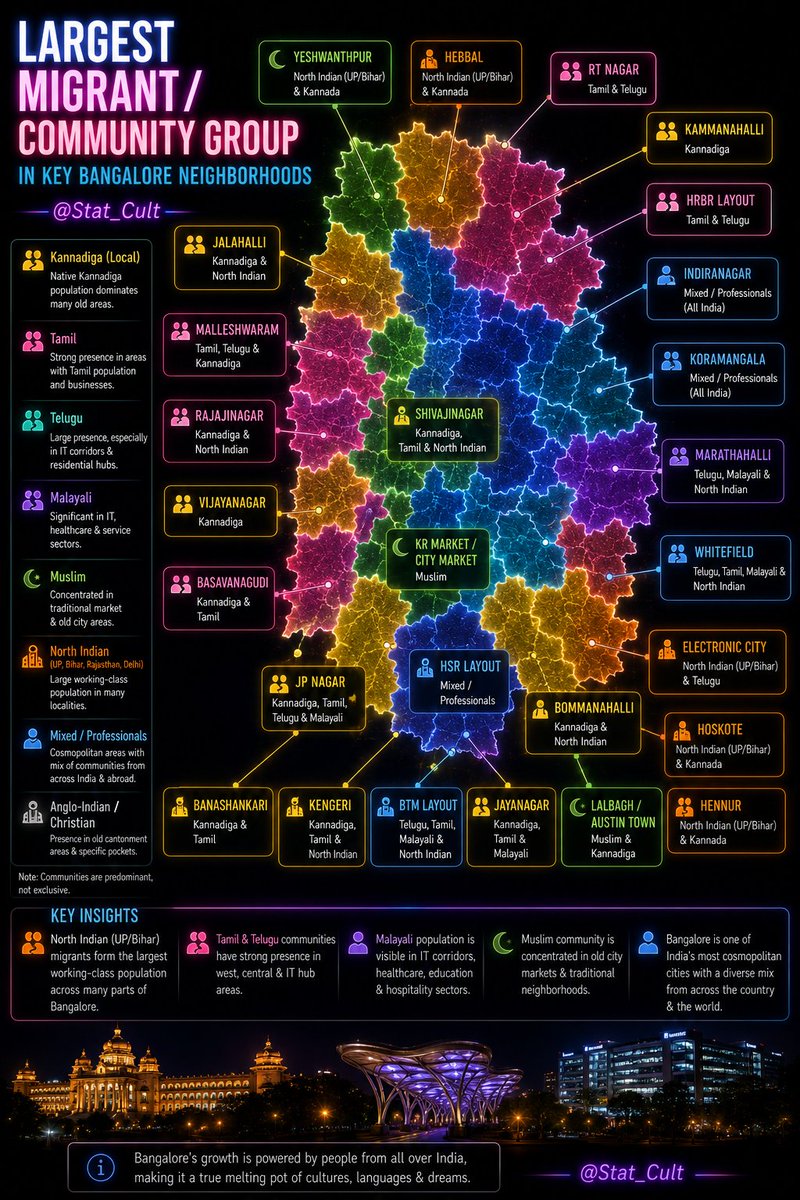
🇮🇳 Largest Migrant / Community Group in Key Bangalore Neighborhoods 🇮🇳
🇮🇳 Jayanagar – Kannadiga / Tamil
🇮🇳 Malleswaram – Kannadiga / Tamil Brahmin
🇮🇳 Basavanagudi – Kannadiga / Tamil
🇮🇳 Koramangala – Mixed IT Professionals / Malayali / North Indian
🇮🇳 Indiranagar – Malayali / Tamil / North Indian
🇮🇳 Whitefield – North Indian / Telugu / IT migrants
🇮🇳 Electronic City – North Indian (UP-Bihar) / Tamil
🇮🇳 Marathahalli – Telugu / North Indian
🇮🇳 HSR Layout – North Indian / Malayali
🇮🇳 Bellandur – North Indian / Telugu
🇮🇳 JP Nagar – Tamil / Kannadiga
🇮🇳 Rajajinagar – Kannadiga / Telugu
🇮🇳 Majestic / KR Market – Tamil / North Indian
🇮🇳 Shivajinagar – Muslim / North Indian
🇮🇳 Frazer Town – Anglo-Indian / Tamil
🇮🇳 Richmond Town – Tamil / Malayali
🇮🇳 MG Road / Brigade Road – Mixed Professionals
🇮🇳 Ulsoor – Tamil / Malayali
🇮🇳 Domlur – Tamil / Malayali
🇮🇳 BTM Layout – North Indian / Telugu
🇮🇳 Hennur / Thanisandra – North Indian (Bihar-UP)
🇮🇳 Hebbal – Kannadiga / North Indian
🇮🇳 Yelahanka – Kannadiga / Telugu
🇮🇳 Banashankari – Kannadiga / Tamil
🇮🇳 Vijayanagar – Kannadiga
🇮🇳 Yeshwantpur – Kannadiga / North Indian
🇮🇳 Kammanahalli – Malayali / Tamil / North Indian
🇮🇳 Kalyan Nagar – Malayali / North Indian
🇮🇳 Sarjapur Road – North Indian IT migrants
🇮🇳 Devanahalli / Airport Area – Mixed Migrants
Note: Bangalore (Bengaluru) has a strong Kannadiga native base, but is heavily shaped by internal migration. Major migrant groups include Tamils, Telugus, Malayalis, and large numbers of North Indians (especially in IT corridors). The city is one of India’s most cosmopolitan due to the IT boom.
1992. 2009. 2016. 2018. 2022. 2026.
Six years. Six frauds. One victim every time.
1992 : Harshad Mehta ( ₹4,000 crore )
Banks looted
2009 : Satyam ( ₹7,136 crore )
Shareholders wiped out
2016 : Vijay Mallya ( ₹9,000 crore )
Fled to London
2018 : Nirav Modi ( ₹14,356 crore )
Fled before FIR
2022 : ABG Shipyard ( ₹22,842 crore )
Biggest bank fraud ever
2026 : Rajesh Exports ( ₹15.15 LAKH crore fabricated revenue ) Stock down 90% ( under investigation )
LIC holds 10.80% stake.
1.94 lakh retail investors trapped.
Every decade. Same script. Different name.
The fraudster escapes. The auditor stays silent. The regulator wakes up after the damage.
And the common man pays. Every single time.
When will the punishment match the crime?
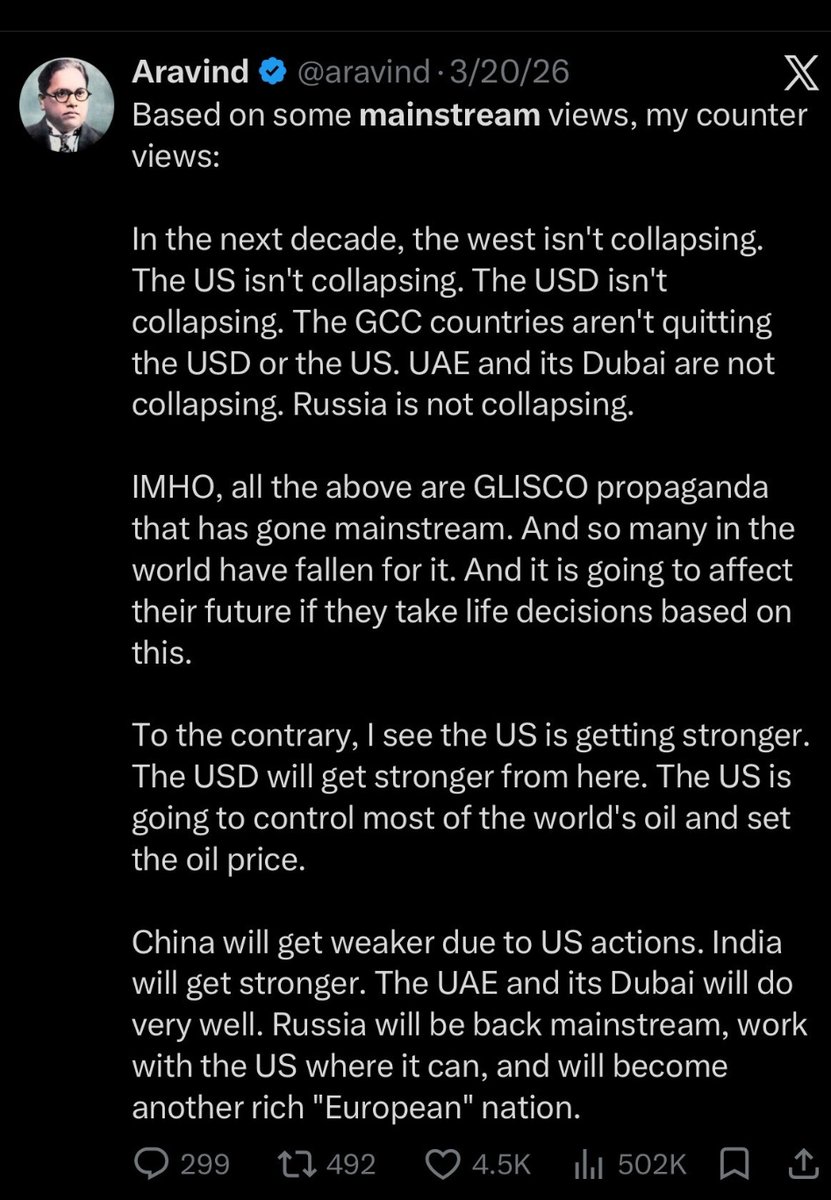
💥Before & After ft. @aravind
What is the difference between March and May?
US is getting stronger from here
To
It will crash and will look like US is dying.
According to him there is no Dedollarisation. So we need to wonder why will the US "look like" it is dying???
And what about his last year post asking everyone to settle in the US for the next 8 years?
Keep a close watch how he changes month by month...of course he will never give dollar to inr rates for the next 5 years. Gol gol jalebi is what you get.
This is an unbelievable piece of work by Sarthak and something that requires amplification.
Let me explain what he found, in simple terms.
Sarthak is a Class 12 student from the 2025-26 batch, one of the 17 lakh students whose answer sheets went through CBSE's new On-Screen Marking system.
He spent days reading through CBSE's evaluation tenders, scraped all 576 tenders CBSE has issued, and tracked how the rules changed across three versions of the same tender.
The core finding is that the company that won the contract to scan and grade 17 lakh students' answer sheets is Coempt Eduteck.
Coempt used to be called Globarena Technologies. Globarena was the company behind the 2019 Telangana intermediate exam disaster, where software failures led to 3.8 lakh students getting wrong or missing marks, and 23 students died by suicide.
A government committee found systemic failure and negligence. Six months later, Globarena rebranded to Coempt Eduteck.
So a company with that track record won a contract to handle 17 lakh CBSE students. Sarthak's investigation is about how the rules were rewritten to let that happen.
The tender was issued three times.
> First tender, February 2025. It existed, then disappeared from the public GeM portal. Sarthak scraped all 576 CBSE tenders and this one was missing from the archive entirely.
> Second tender, May 2025. Four companies applied including TCS and Coempt. All four failed the technical evaluation. Cancelled.
> Third tender, August 2025. Coempt won. Between the second and third tender, a series of rule changes happened, and every single one made it easier for Coempt to qualify.
Here is what changed, one by one.
01. The old rules disqualified any company with a history of abandoning work, failing to complete contracts, or financial weakness. The new rules deleted this clause entirely. Coempt's Telangana history stopped being a barrier.
02. The old rules disqualified any company that was "blacklisted earlier." The new rules changed this to "currently blacklisted." Because Globarena rebranded after Telangana, removing the word "earlier" effectively erased their past.
03. The rules required Rs 50 crore average turnover over three years. Coempt's exact average came to Rs 50.86 crore. They cleared the bar by less than 1%. Earlier, a smaller company had asked CBSE to lower the bar to Rs 30 crore for fairer competition. CBSE refused. So the bar was kept high enough to block small players, but sat exactly low enough for Coempt to scrape through.
04. Software maturity is measured on the CMMI scale, 1 to 5. The old rules required Level 5. The new rules dropped it to Level 3. Coempt is a Level 3 company.
05. The cooling-off period for engaging retired CBSE officials was cut from two years to one. This makes it easier to use recently retired insiders to influence the process.
06. The old rules required experience with large projects of at least 5 lakh students each. The new rules removed the student count and counted cumulative answer-book volume across small projects instead. Coempt has many small fragmented university contracts. This helped Coempt and hurt TCS.
07. The old rules required bidders to own their own data centre and disaster recovery centre on Indian soil. The new rules allowed third-party MeitY-empanelled cloud hosting. Coempt runs on AWS and Azure. This helped Coempt and hurt TCS, which owns its own data centres. It also means student data is no longer on sovereign, Indian infrastructure.
08. The old rules required the bidder to own or control the complete source code of its software. The new rules deleted this. Coempt's platform runs on Microsoft's proprietary IIS, which they don't own.
09. A last-minute corrigendum, issued right before bid submission, removed CBSE's own power to blacklist the firm if its software failed catastrophically. So even a Telangana-scale failure couldn't get Coempt banned from future government tenders.
10. The penalty structure shifted from punishing mistakes to punishing delays. The old rules fined the vendor for wrong scanning, merged pages, and unscanned books. The new rules dropped those and instead levied Rs 50,000 per day for delays. This incentivises rushed scanning over accurate scanning.
11. The old rules had a hard accuracy threshold, error rate not to exceed 0.5%. The new rules removed this number entirely.
12. The old rules specified proper book and robotics scanners. The new rules just say "sufficient scanners." The definition was vague enough that, as Sarthak notes, the scanning could be done with a phone on a stand.
13. On the security side, the contract required a VAPT (vulnerability and penetration test) certified by CERT-In before go-live, and a restricted beta phase before launch. The system clearly wasn't restricted, because the other researcher, Nisarga, was able to access it and find vulnerabilities four days before go-live. So the mandatory security audit appears to have been bypassed.
These are more than a dozen rule changes, all between the failed tender and the winning tender, all pushing in the same direction, all benefiting the one company with the worst track record in the field.
The security holes Nisarga found last week now have an explanation. The system was built by a vendor that was specifically allowed to skip the security certification, the source code ownership, the data sovereignty, and the quality thresholds the original rules demanded.
Following things need to happen immediately;
1. An immediate CAG audit of the tender process.
2. A parliamentary debate on the topic.
3. An independent investigation into
> Why the first tender vanished?
> Why the disqualification clauses were deleted?
> Why the turnover bar was held exactly where it was?
> Why the security level was dropped?
> Why the blacklisting power was removed at the last moment?
Sarthak, this is genuinely exceptional investigative work. Far better than most journalists with full resources ever manage. Take a bow. :)