ICYMI: @Chainlink just launched CustodySync with @Anchorage, and there's a direct connection to @Aave V4 that deserves attention.
An existing Aave governance proposal already outlines how institutions could borrow against assets held at Anchorage without moving them out of custody.
Here's how it works:
1. Institutions hold assets with Anchorage.
2. Chainlink CustodySync synchronizes custody records with Aave V4, enabling onchain representations of the collateral.
3. Institutions borrow stablecoins against those assets while the underlying collateral remains in regulated custody.
The sauce: Anchorage is also the issuer of USAT, a stablecoin currently being assessed for onboarding to Aave V3 and V4.
That creates the possibility of an integrated institutional lending market:
• Anchorage custodies the collateral.
• Chainlink provides the verification, synchronization, and pricing infrastructure.
• Aave V4 provides the lending liquidity.
• USAT could eventually serve as a borrowable asset.
The implications extend beyond another institutional DeFi integration. Institutions could unlock liquidity against assets they already custody, without transferring those assets into DeFi smart contracts.
> For Aave, that means access to a new category of borrowing demand and interest revenue.
> For Chainlink, every additional custodied lending market creates demand for its infrastructure throughout the loan lifecycle.
> For Anchorage, custody could become a gateway to credit markets rather than a service limited to asset safekeeping.
If this architecture scales, I expect institutional lending to become one of the more consequential sources of new borrowing demand (and hence, revenue) for Aave V4, with Chainlink positioned directly in the infrastructure connecting that capital to DeFi.
Very weird Sunday
US pentagon 90 day resource stockpile, Brazil stolen election, UK power grid down, king tides in FL, full moon, Netanyahu tweeting out a nuclear bomb picture and Elon saying neoclouds to zero
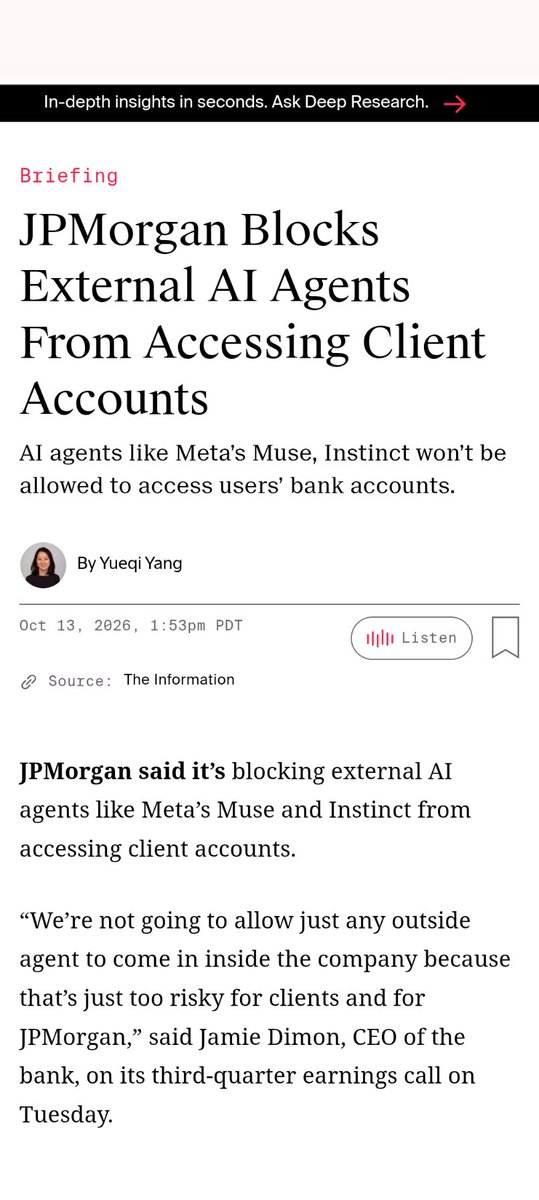
This is how banks are planning to stop those "agentic bank runs." Watch closely: their business model depends on seeding this narrative that AI agents are dangerous.
Remember, an "agentic bank run" (coined by Apollo) means agents helping customers move their own money en masse to higher-yielding products.
Once agents are ubiquitous, there are only a few ways for banks to hold onto cheap retail deposits.
Option A: Raise APYs (lol no)
Option B: Reduce leverage via fewer loans (no fun)
Option C: Ban AI agents, claiming they are a security risk (ding ding ding)
Cloud agents like Muse and Dot are trivial to stop, since they come from Meta / OAI IP ranges. If JPM sends them a cease and desist, they will comply.
Why would JPM bother? Because their business model depends on it; a huge portion of their ROE comes from cheap retail deposits. This is not theoretical. Just like Amazon banned Muse from shopping there to protect their ad revenue, JPM and Schwab have already banned AI agents to protect sticky deposits.
Are agents perfectly reliable today? Of course not. But look at the fix they chose. Not "here's a safe API for agents," it's "no agents ever." That tells you they're not protecting customers, they're protecting themselves.
No company ever wins a technological revolution this way. It's the last gasp of a dying business model. It's like the retailers who refused to put their inventory online and demanded users walk into the storefront. Over time they will lose market share to those platforms that embrace what's coming. Their whole deposit franchise depends on users unthinkingly clicking through walls of T&Cs and accepting 0.2% when the risk free rate is closer to 4%. Agents read the fine print and do their research, even when humans don't.
For users, the answer is simple: local AI agent frameworks like Hermes, that will actually act on your behalf and that the banks can't block. As the article says, if the agent is running on your own computer, they can't actually tell it's not you.
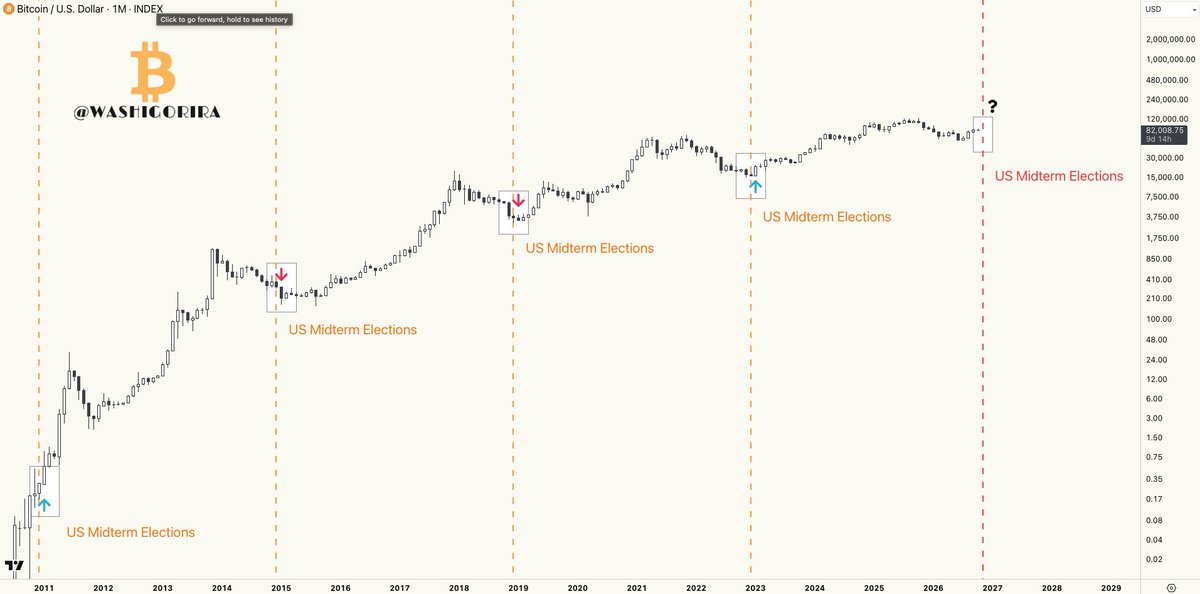
Bitcoin ISNT PUMPING WTF...
As the chart below shows historically we are in the moments before the Bulls run free.
Will it happen again this time?
We've been stacking preparing for the run of our lifetime.
#Bitcoin Midterms Are Coming
November 3 is just 12 days away.
Every previous US midterm election in Bitcoin’s history has come around a major market move or inflection point.
The direction hasn’t always been the same.
But the timing has been interesting. 👀