Returns were +157% in 2025.
Just dropped the annual report breaking down:
- Closed positions
- Current portfolio
- macro overview
Link in the usual place.
What if code could think while it runs?
Meet Maxwell: the world’s first Code Execution Model.
A new species of AI that lives inside the machine.
We believe it’s the key to unlocking 100% of compute.
Requests for early access are open, link below.
What if code could think while it runs?
Meet Maxwell: the world’s first Code Execution Model.
A new species of AI that lives inside the machine.
We believe it’s the key to unlocking 100% of compute.
Requests for early access are open, link below.
The student model never sees exploration pressure and doesn’t degrade. If the explorer degrades, no worries since we will discard it anyways. We can alternate exploration and student distillation for many rounds, and we can let multiple explorers run in parallel. 5/n
1/ What is the maximum number of legal moves in a chess position where every one of them gives check? The record on that question had stood since 1968. Double Agent, our AI research system, just broke it.
How many checks can you count here?
Keeping this brief, inference bottlenecks on HBM capacity are active parameters and KV cache.
Because memory bandwidth is the main bottleneck for decode steps, modern architectures attacks both.
Architectures attacking KV cache bottleneck:
- MQA: All query heads share 1 KV head. Slashes cache but hurts reasoning
- GQA (Gemma, Muse etc): Queries share small KV groups. Cuts cache (8x in Gemma, 16x in Muse) with near-zero quality loss.
- MLA (Deepseek, GLM, Kimi): Compresses multi-head Keys and Values into a single low-rank latent vector per token.
- Asymmetric Causal Arch (DeepSeek-V4.1-Flash): Activate fewer params/layers during prefill (KV cache creation).
- SWA (Sliding Window Attention ex Mistral and most OS western labs): KV cache becomes O(window size) rather than O(context size).
- Linear Attention (Chinese labs): Replace the softmax with a fixed size recurrent state.
Modern architectures are usually hybrids that have some of the layers SWA/linear
If you can underwrite solvency through the cycle, the cycle is not a super long one and your hurdle rate is not higher than 20-30% then I think is a great way to think
Wouldn't it make more sense to value cyclicals on peak earnings / multiples and just assume the next cycle will take a while and use a high discount rate? Rather than try to fudge some intractable through the cycle estimates
Sure, I think the more realistic scenario that does happen is progress making hardware obsolete. For example Blackwell 4-bit block scaling support in tensor cores makes older architectures much less cost effective.
Also possibly if we go to aggressive grouping of q/v and or hybrid archs with linear attention/swa and or expert sparsity you could get less hbm demand.
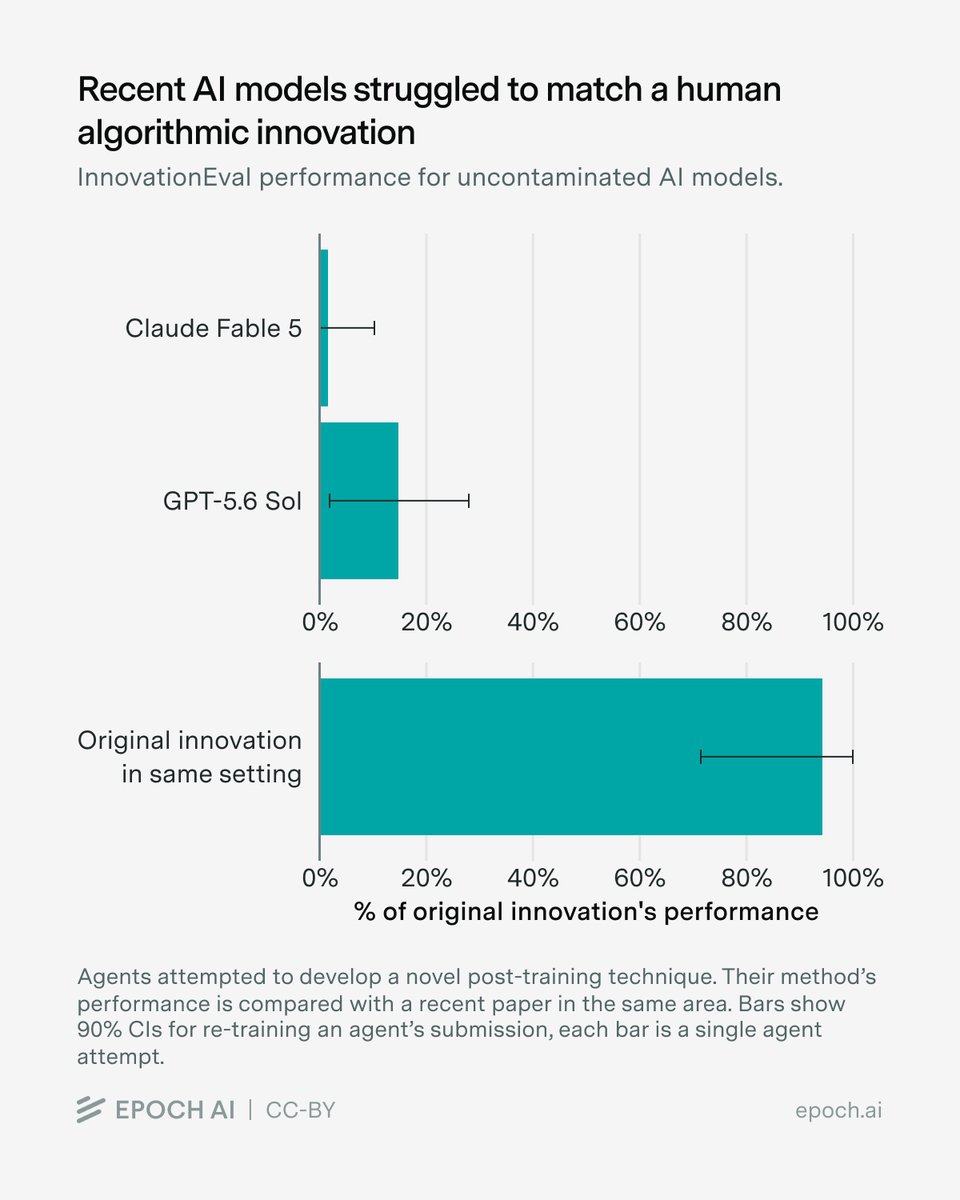
AI developers aim to create an automated AI researcher. How close are they?
To find out, we built InnovationEval, which tests whether AI can produce post-training innovations comparable in magnitude to a recently published advance. So far, agents’ results are underwhelming.
Introducing ChatGPT for Dishwashing
GPT-6 achieves state-of-the-art results on dishwashing benchmarks for long-running jobs and difficult stains.
The Navier–Stokes Millennium Prize Problem is a $1 million challenge about whether the equations describing fluid motion can break down. In this video, I accidentally found a counter-example while trying to optimize my dishwasher. But in reality, OpenAI used 10,000 AI agents to find a proof in 88 hours: https://t.co/6HTwFfXnm1
Parody of the original GPT-6 Astra ad
@OpenAI #ChatGPT_Partner #chatgpt
Credits:
Written and Directed by Joma
Co-Writer - Henry Connor Coan IV @coan_henry
Production by Dauntlus Studios @dauntlus.studios
Producer/Co-Director - Marcus Liew @dauntlus
Camera Operator - Amos Lee @amoselijahlee
Art Director - Alethea Soo @aletheasoo
Art Assistant - Alicia Lim @aliciatkl_
Assistant Editor - GPT-6 Astra
Music: Tensions Run High by Soundridemusic
https://t.co/kBUsd2DK76
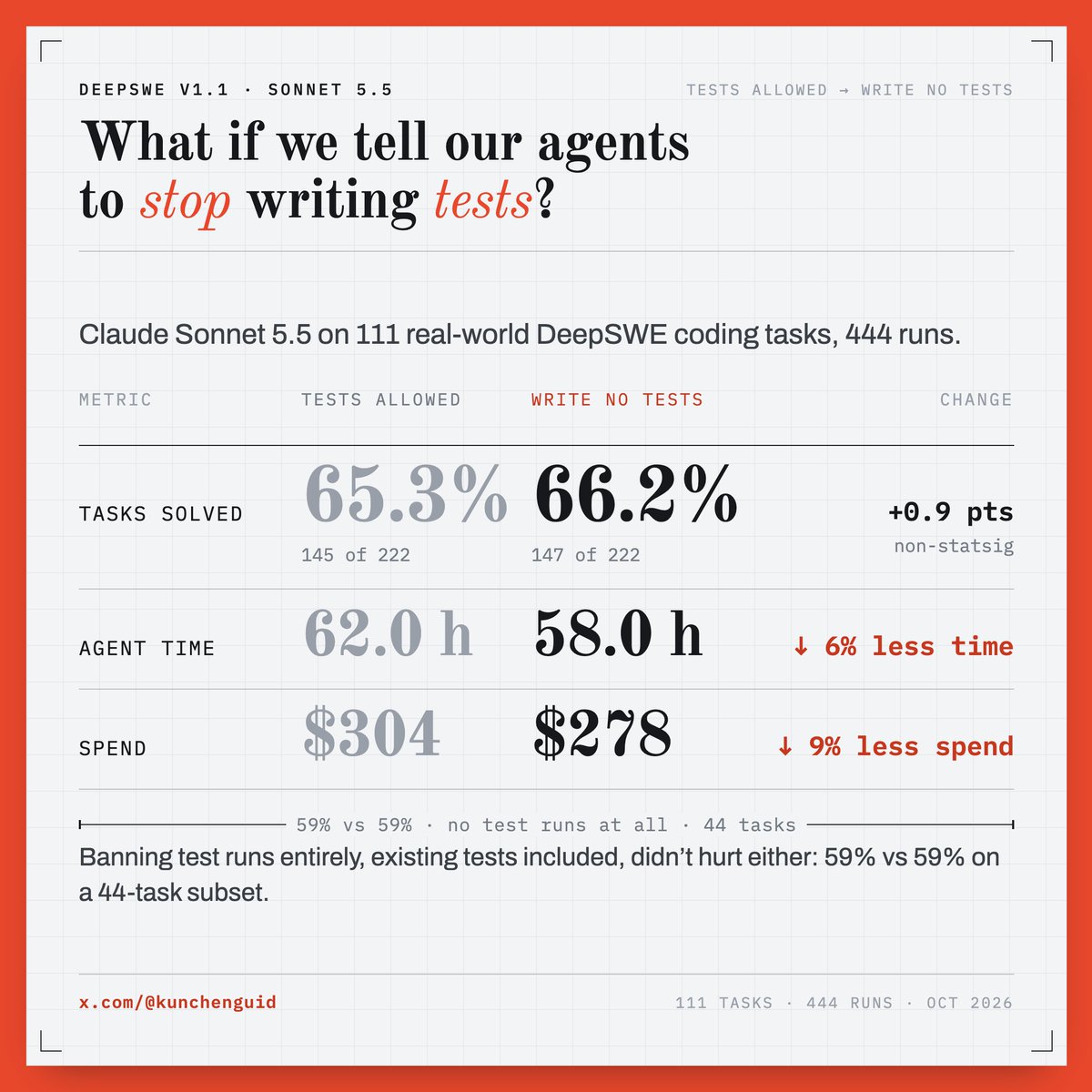
ok it's official... AI-written unit tests and integration tests are empirically proven to be unhelpful. you should tell your agents to stop writing tests by themselves
on the deepswe eval set, banning sonnet 5.5 high from writing any tests actually resulted in slightly higher success rate (non stat-sig), with less time and token spent (stat-sig). this is pretty hard empirical evidence
across the tests that were written by the "tests allowed" baseline arm, 65% of them were unit tests, 35% were integration tests, neither bucket resulted in any improvement compared to not writing any tests at all
i also picked a random sample of 44 tasks subset where i completely disabled executing even existing tests - it also did not affect success rate at all
i spot checked many tests written in the baseline arm, and my intuition is that most tests are simply a repetition of the implementation
agent-written tests do not add any value because both the implementation and the tests were simply the agent's interpretation of our intent. the tests aren't any more accurate than the implementation itself
i suspect we can still extract some value from unit tests and integration tests if we describe them ourselves when we believe we can articulate our intent better through test cases than through requirements. but i have not proven this yet
also worth noting, during deepswe eval the agent wrote almost no e2e tests (only 17, compared to 3000+ unit/integration tests written). so this analysis does not prove nor disprove the value of e2e tests - i will do another eval specifically for that
@michael_chomsky@LukeParkerDev Usually yes, do you stream the training data and envs? Setup usually takes time even when training sub 1B tiny models for me
Believe it or not this is the entire results section of this paper. For some reason we are back to experimenting with Qwen 2.5.
But the real problem with this paper is that it never says what setup it used for eval. "Single-shot accuracy" could mean one sample, zero-shot prompting, or one in-context example. It gives no temperature, no decoding settings, and doesn't say whether MMLU was scored by likelihood or by generation. If they sampled once at nonzero temperature on 600-question test sets, that adds noise on top of the seed variance. For AMC, one sample per question would make those numbers close to meaningless.