$IREN could 4x by next year for these reasons:
1. Sweetwater 1 (1.4GW) was energized on time.
2. The company doubled its power capacity (2.9GW to 5.8GW; now the largest neocloud in the world surpassing $CRWV and $NBIS)
3. Announced building Oklahoma (1.6GW) data center.
4. Announced its first data center in Australia (800MW).
5. Raised its ARR from $3.4B to $4.4B.
6. Acquired Mirantis, a strategic partner of $NVDA.
7. Announced its expansion in Europe.
8. Announced its strategic partnership with $NVDA to accelerate deployment of up to 5GW of AI Infrastructure.
9. Signed a $3.4B deal with $NVDA.
10. $NVDA to invest up to $2.1B in $IREN (still an option conditional upon deployment of 600K GPUs.)
11. Sweetwater (2GW) selected as a flagship deployment for $NVDA DSX AI factory architecture.
12. Disclosed having a global pipeline.
$4 trillion of IPOs in the next 12 months.
SpaceX: up to $2T (about 100x revenue)
OpenAI: $1T
Anthropic: $1T (tripled from $380B in 3 months)
Apple went public at 15x revenue. Google at 13x. Amazon at 2x.
These numbers should scare you more than they excite you.
Elon Musk’s business empire extends far beyond publicly traded $TSLA and the upcoming IPO $SPCX, with his companies representing more than $4.26T in combined value.
SpaceX $1.8T
Tesla $1.6T
Starlink $500B
xAI $250B
Terafab $55B
X $33B
Neuralink $10B
The Boring Company $6B
SolarCity $3B
His stake of each:
SpaceX 82.4% ownership
Tesla 20.3% ownership
The most expensive words in trading are "give it a little more time."
Sometimes the chart already told you to leave.
Here's exactly what that warning looks like ↓
If anyone wonders why your portfolio feels like it's moving around a lot lately:
$VIX is sitting at 22.
A quick way to estimate the market's expected daily move is to take the VIX and divide it by 16 (the square root of 252 trading days).
22 ÷ 16 = 1.375%
That means the market is pricing in roughly 1.375% daily moves in $SPY. With $SPY around $732, that's approximately $10.07 swings per day.
For context, when the VIX was around 14 earlier this year, implied daily moves were only about 0.875%.
In other words, we're experiencing nearly double the day-to-day volatility compared to just a few weeks ago.
So if your portfolio feels more volatile lately, it's not necessarily because you're doing something wrong.
It's the environment.
Debt and equity are the two fuels of every business
One gives you leverage. The other gives you ownership
Here’s a simple breakdown of Debt vs Equity every investor must understand
I quit 50 times in early years.
Looking back- It was my lack of patience.
I would be doing wrong things at the right time.
Sizing up when market is volatile because I had to make back a loss.
Forcing trades because I thought its now or never.
My message to everyone listening is this- If you have YTD gains you can risk, you can afford to take few trades. BUT if you dont- then cash is your friend, dont do too much because the easy money is made and we're in Summer chop and rangebound. Summers will make you financially and mentally weak
We are going to see a April to June type run again where you will think you're the greatest trader of all times. You have to make sure you have capital left when that time comes ( Real capital and Mental capital ). Dont make your brain and portfolio do donuts right now. I went from 80% of ideas working to 20% of ideas working. Same process, but now I am having to use wider SLs to make less money. My top ideas like $GLW $COHR $TER $SEDG $LITE failed. And like everyone - I am pissed, but I am taking that feedback. I dont get paid extra for trading in tough environment.
Everyone is going thru the wild swings in June together and I know people would appreciate some thoughts from myself.
$CRDO $UNH $APH $ALAB $OSCR $CVS $FTNT $FROG $FPS $MDB $DOCN $AMAT $HNGE $AMKR $VIAV $ACMR $SNOW $DDOG $NBIS $MRVL $VSH
Some of the best relative strength names in the market. This is where your focus should be!
New traders should learn these things immediately:
You're never going to sell at the exact top
You will never bottom tick the market or stock. You sell when you're happy and you start scaling into a position when technicals tell you to.
Growth stocks that ran with the market will drop harder than the market. It's just math. If your stock went up 40% while $QQQ went up 10%, the drawdown will also be larger.
Technical analysis will save you when Fundamental analysis fail.
Your stop losses are better left alone. I lost enough money and hair to tell you this - all my 20k losses started as 2k losses when I moved the SL.
The market gives you 3 opportunities every year to press gas. The rest of the time you just glide based on your good decisions. Big corrections. Small mini corrections. We're in a mini one right now. If we dip a bit more, it's an attractive entry.
The VIX rule:
→ VIX above 20 = volatile moves. Take fewer trades or use wider stops.
→ VIX at 20 = S&P could move 1.25% in a day
→ VIX at 30 = S&P could move 1.87% in a day
If you can nail this- 60% of your trading is solved immediately.
No one made more money in the markets than Jim Simons.
Not Buffett. Not Soros. Not Dalio.
A mathematician with zero Wall Street experience.
$100 in his fund in 1988 became around $400 million.
And he did it without predicting a single thing.
Here's what he understood that most traders never will ↓
SpaceX AI Satellites are HUGE.
They have a wingspan of 70 meters (229 ft) when deployed.
To put that in perspective, a Boeing 747-8 has a wingspan of 68.4 meters (224.5 ft).
3 days ago, Elon Musk sat in front of JP Morgan’s 3,500 wealthiest investors and explained why the AI economy is moving to space:
1. Starship is the first rocket in history designed to be fully reusable. Every other mode of transport... planes, cars, ships... you take reusability for granted. Rockets have always been thrown away after one use. That ends with Starship. Once you achieve full reusability, the only cost is fuel. Starship runs on liquid oxygen and methane. Both are cheaper than jet fuel.
2. Sending cargo to orbit will soon cost less than international air freight. This is not a distant projection. It is the direct mathematical outcome of reusable rockets plus cheap propellant. The economics of space change entirely.
3. Starlink V3 is 10 to 20 times more capable than what's currently in orbit. The satellite is so large it can only launch on Starship. It cannot fit on any other rocket on Earth. 100 times more bandwidth. Half the latency. It may become the highest bandwidth, lowest latency communication system that exists.
4. AI and robots will consume bandwidth at a scale humans cannot picture. Peak human bandwidth is a few hundred bits per second. A computer runs at a trillion. The appetite of AI for data infrastructure will be unlike anything built for human use. Starlink V3 is being built for that world... not this one.
5. Data centers are moving to space. Not as an experiment. As the primary way to scale AI compute going forward. It is increasingly hard to build power plants on the ground. Nobody wants one near their home. Space removes that constraint entirely.
6. From the moon, you can scale to 1,000 terawatts of compute per year. From Earth... maybe 1. The moon has no atmosphere and one-sixth Earth's gravity. You can manufacture solar panels from moon materials and launch data centers with a railgun. No rockets needed. The math on this is not close.
7. Current human civilization uses less than one trillionth of the sun's energy output. You could scale to a million times Earth's entire economy and still be using less than one millionth of what the sun produces. The ceiling on what's possible is so far above us it barely registers as a ceiling.
8. There is not a single high-volume computer memory fab in America right now. Zero. The chips needed to build the AI future do not exist in sufficient quantity anywhere in the Western world. That is why SpaceX is building one. Not to compete. Because there is no other option.
9. SpaceX has been cash flow positive since around 2014. The IPO is not a distress move. Past funding rounds were not even fundraising... they were liquidity events for employees. The company bought back its own stock. The IPO is happening now because the next phase requires capital private markets cannot absorb.
10. The senior team has barely changed in over a decade. The CFO has been there 15 years. Musk joined as the seventh employee in 2002. He says people who believe in the mission don't leave. And above technical skill, he now looks for one thing... whether someone is genuinely a good person.
The 30m pivot might single handedly be the best reversal strategy I've ever seen in the markets
Combine this with a high probability level like a key moving averages or gap support
& you have an incredibly high probability low risk approach to buying pullbacks..
got long $RKLB today off the 50 EMA + 30m pivot
bought some $MSCHP off the 50 EMA + 15m pivot
& added some $TE off the 8 week EMA + 30m pivot
If you are looking to buy relative strength on weakness this is about as good as it gets.
There is one concept I don't think I've ever seen properly explained in books or on FinX:
The low of a Power Earnings Gap (PEG) often acts as a major support level.
Why?
Because a PEG isn't just a technical event. It's a fundamental re-rating.
Institutions realize the company is worth much more than they previously thought. They rush to build positions, creating a large imbalance between buyers and sellers.
The result? That earnings gap becomes an area where institutions often defend their positions.
When price revisits the low of the PEG candle on lighter volume, it can offer one of the best low-risk, high-reward entries:
Your risk is clearly defined below the PEG low.
The reward can be substantial if the stock resumes leadership.
You're buying where big money previously stepped in.
Of course, it doesn't work every time. But in true market leaders, the PEG low often tells you where institutional conviction lives.
$SNOW $AKAM are good examples of that concept playing out right now.
Past example $JBHT $KEYS
While a chart like this may support 'buy and hold,' the more important point to raise is your age and where you are in terms of retirement, as well as risk-adjusted returns.
The chart hides the many 30-50% drawdowns the S&P500 incurred over that 36-year span.
2000-2010 was a decade of no returns. Someone without cash flow must think about risk completely differently from someone else just starting their career in their 20s.
Your moving average isn't lying to you.
You're reading it backwards.
The same line tells two completely different stories, and which one you see depends on one thing most traders never check.
Here's how the pros read the chart you're already looking at 👇
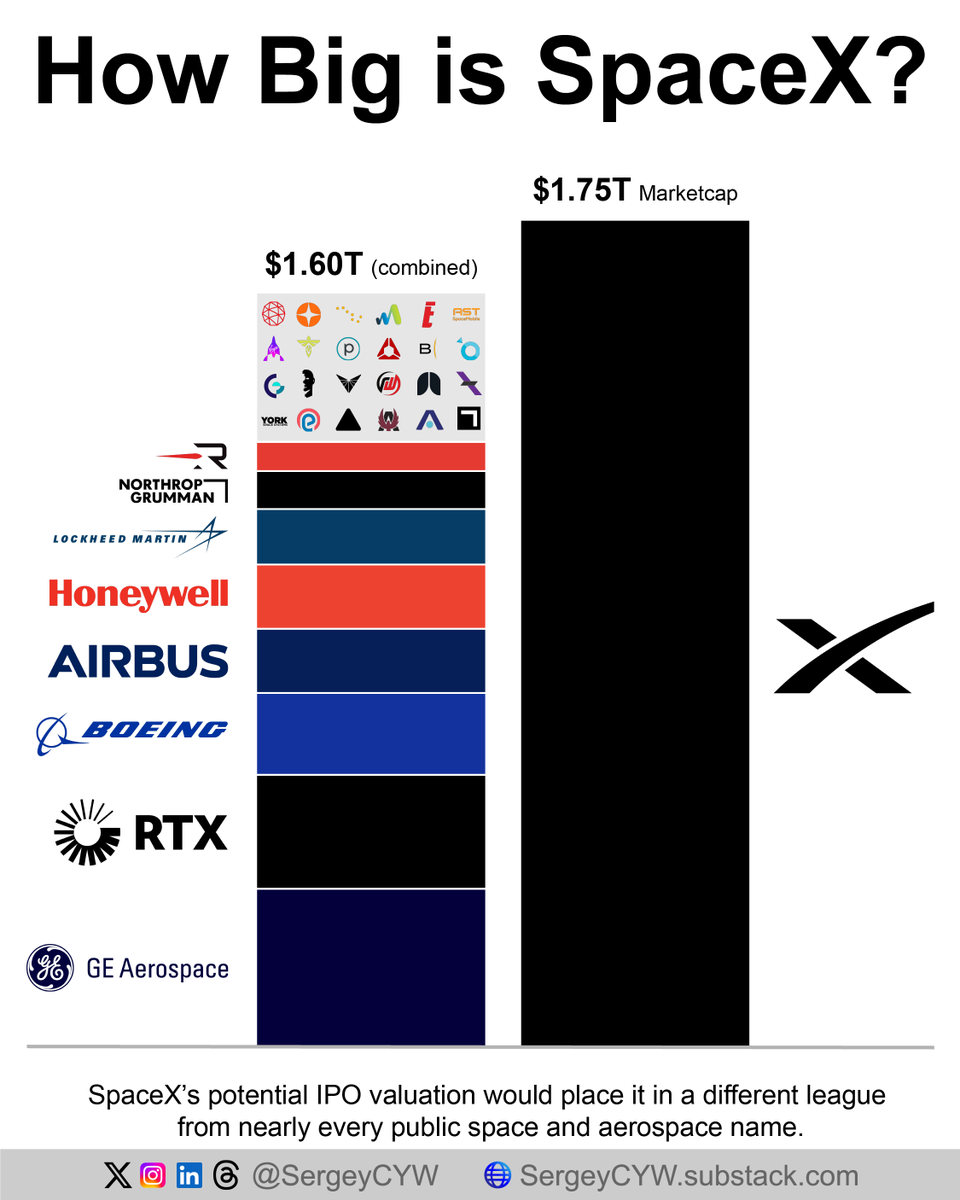
SpaceX could become larger than the public space market combined
$SPCX SpaceX’s planned IPO valuation is reportedly targeting around $1.75T, based on an estimated IPO price of $135 per share.
To put that into perspective, most public pure-play space companies — including $RKLB Rocket Lab, $PL Planet, $BKSY BlackSky, $ASTS AST SpaceMobile, and $RDW Redwire — trade at market caps in the low-single-digit billions or below.
Even larger satellite and communication names such as $IRDM Iridium, $VSAT Viasat, and $GSAT Globalstar generally sit from the mid-single-digit billions to low tens of billions.
The comparison becomes even more striking against aerospace and defense primes. $LMT Lockheed Martin, $RTX RTX, $NOC Northrop Grumman, $AIR Airbus, $BA Boeing, and $GE GE Aerospace trade around the $100B–$200B range.
At $1.75T, SpaceX would be several times larger than any major aerospace-defense company and above the approximate $1.6T combined market cap of major public space-related names.
WATCH: Elon Musk's full technical update on how SpaceX plans to build AI data centers in space.
Posted by SpaceX ahead of the IPO. About 31 minutes, with Ian Dahl from the Starlink team.
Notes on this upload:
~ Audio boosted
~ Subtitle added
~ Timestamps added for easy navigation
Timestamps
~ 0:00 Intro
~ 0:42 The Kardashev scale
~ 2:19 How big the sun is
~ 3:25 Energy we use vs the sun
~ 4:38 Why we go to space
~ 6:49 Solar power in orbit
~ 8:06 Three limits to scaling
~ 8:46 Starship and reusability
~ 11:41 Starship by the numbers
~ 12:39 Mass to orbit
~ 13:42 Data center in space
~ 15:13 Simpler than Starlink
~ 16:05 AI satellite design
~ 18:30 A rack of compute in orbit
~ 20:26 Million satellite constellation
~ 21:39 The Bastrop factory
~ 23:22 The chips
~ 24:16 The TeraFab
~ 25:46 Gigawatts to a terawatt
~ 27:04 The Moon mass driver
The plan behind every orbital compute headline this month, straight from @elonmusk