polymarket trader made $215 by betting only $10 on weather prediction
he only trades weather markets: 481 predictions
first deposit was $24 in early June
his profit over the past month is over $1,500
most successful predictions:
$7 -> $117
$10 -> $215
$13 -> $223
profile: https://t.co/aTggkSqXvp
predicting the weather only in Hong Kong, he has a very good result
HOW TO MAKE MILLIONS FROM THE AI BOTTOM
SAVE this BEFORE you trade next.
How to know:
• A relief bounce
• A true reversal
• The confirmation ofentering
I go over $SPY Calls taken today +300%
I also show what to watch for in AI names like $SNDK $MU $NVTS and $IREN
Kraken is not the last monero CEX!
I hear from people on twitter to reddit stating that kraken limiting monero is the last CEX folding. This is just blatanty not true
The united states has Kraken and https://t.co/uOA6IqetX6 but yes we still have something to fall back on if kraken delists.
But outside of the US, Europeans can buy it directly on WhiteBit and DFX
Globally? MEXC, Kucoin, HTX, XT, Bitfinex etc.
You can leverage trade it on hyperliquid, lighter, poloniex, binance and bybit… far from being only on one CEX
Source: https://t.co/06YJtlcwew
🚨 THE SAME SIGNAL JUST FLASHED FOR THE 3RD TIME.
MASSIVE RALLY.
MASSIVE RALLY.
NOW IT’S BACK.
THE BIGGEST PUMP OF THIS CYCLE IS NEXT.
$SOL BACK TO $200
$ETH BACK TO $4,000
$XRP TO $10.5
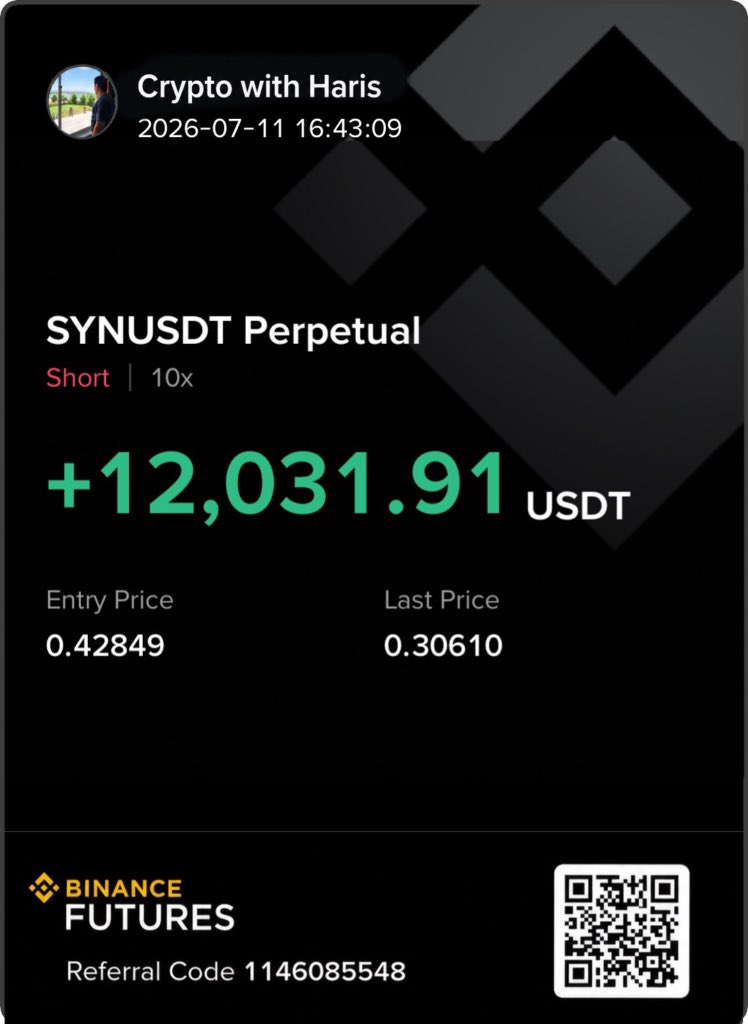
I just closed my $SYN short trade with $12,000+ profit. 🥳🎉
A few days ago, I said that if $SYN lost the $0.38 level, the move toward $0.32 would happen much faster than most people expected.
That’s exactly what happened.
In fact, it didn’t even stop there. $SYN is now trading below $0.30, and I still don’t think the downside is over yet.
I could’ve waited for a bigger profit, but I’m happy with what I made. One thing crypto has taught me is that taking profit is never a mistake. There will always be another trade, but once you let greed take over, one winning trade can easily turn into a losing one.
Robinhood chain is now top 5 in 24 hour DEX volume
Flipping both Hyperliquid and Polygon
Momentum is building quickly but is this the top or just the start
#Polymarket Perps is hands-down the most user-friendly perp DEX I've ever used as an amateur trader.
Super straightforward and easy to navigate
✅ Long or Short with up to 20x leverage
✅ Effortlessly add a stop-loss & take-profit on any trade
Wen trailing stops dropping?? 👀@Polymarket
👉 https://t.co/VmG5od0ejq
I'm not much of a trader but I do watch other traders and then trade based off their advise😀 My favorite trader is @Sheldino_D 🫶
Message @devjoshstevens for early access to PERPS
On August 2, 2023 Litecoin had its supply distribution per block halved from 12.5 LTC to 6.25. The hash rate at that time was 0.767 PH/s.
The next supply distribution halving per block is estimated to take place around July 27, 2027. Today's hash rate for the Litecoin network currently sits at 2.721 PH/s. An increase of nearly 4x what it was less than 3 years ago.
The Litecoin mining operations used to secure the global network have grown substantially and show no signs of slowing down.
This is what fully decentralized, fair launched, fungible freedom money looks like from a security perspective. This is exactly how money should be. Strengthened by the masses, used by the masses, feared by the upper classes.
We are currently in top 10 communities on PumpFun's @CoinComms
If everyone could take a couple seconds and head over to our PumpFun page and simply make an account, verify you have $8 worth of $THREE and make a post, we can easily reach top spot!
https://t.co/siyTlaKko5
I've been trading for 9 years and never seen so much stacked long liquidity on a single level
Once we reach 58K, dump will be brutal
There will be $2B liquidations with a final huge crash that will mark this cycle bottom
Throughout this cycles' market has been purely driven by liquidity, chopping from one imbalance to another
So far pattern continues repeating
My view remains that we must eventually drop to 55K and 50K and even eventually might get 42K and that perfectly lines both mathematically and with historical patterns right now
Plus macro bottom never feels like one, it usually comes after most aggressive liquidation event of the cycle when nobody expects it
Once that happens, when liquidity is fully taken, there's nothing left to dump and that's how bottom will be formed
Either way, I am already buying and will continue DCA at
58K
55K
52K
That’s my 9th year in crypto, I bought BTC at 16k last cycle, I called the exact 126K BTC top. swing short at 70K, called recent 20x memes
I genuinely believe I can help you make money on crypto
I post a lot of educational content and my trades, you can find everything in “highlights” tab on my profile
So make sure to follow me and turn on notifications - I’ve got plenty more profitable calls coming 🤝
.@HyperliquidX builder codes might be one of the smartest primitives in crypto I've seen.
Any wallet, bot, terminal, app, or frontend can route a Hyperliquid order, attach its builder address + fee, and earn directly from the trade.
– Phantom made $22M in cumulative builder revenue from a wallet UX.
– Based did ~$48.5B in volume and ~$15.1M in revenue.
– Top 10 builders already made >$86.4M cumulatively.
– There are 100+ teams using the system.
– 40% of DAU now trades through third-party frontends at times.
I'd say Hyperliquid is turning distribution into a marketplace. Builder codes are becoming a user acquisition layer.
The builder fee stacks on top of normal Hyperliquid fees.
So if you trade through Phantom, Phantom earns its 5 bps builder fee, but Hyperliquid still earns the base maker/taker fee, which flows back to $HYPE.
Builders are not just printing revenue from Hyperliquid's infrastructure. They're creating more surface area for $HYPE buybacks to happen.
Hyperliquid doesn't want to win the market by taking it all or competing with every exchange. It's letting every external app become a mini broker on top of the exchange.
Top 7 builders right now:
– @phantom: the king of wallet distribution. $44.4B cumulative volume, $22.4M in revenue, 158K+ users, generated ~32% of top-10 builder revenue.
– @BasedOneX: the super-app route. $48.5B cumulative volume, $15.1M in revenue, charges half of Phantom's fee and still wins through consumer UX + high velocity.
– @pvp_dot_trade: Telegram social/copy trading bot. $17.2B in volume, $8M in revenue, proving degen-native distribution can be a real order-flow business.
– @MetaMask: $9B in volume, $7.4M in revenue, reached #4 because brand trust + wallet distribution can support the highest fee tier.
– @InsilicoTrading: pro/HFT terminal lane. $35.9B in volume, $3.5M in revenue. Low-fee, high-volume flow is its own category.
Crypto devs have wanted to build fat apps for years.
Hyperliquid might be the first perps venue making fat apps pay themselves while still feeding the base asset.
MOVA Chain Adopts @Chainlink
We're excited to announce that MOVA Chain is adopting Chainlink CCIP to unlock the next phase of institutional adoption and increased liquidity.
As the exclusive cross-chain infrastructure for WLFI's USD1, adopting Chainlink CCIP is critical to connecting the leading stablecoin to the MOVA ecosystem. Now via Chainlink CCIP, MOVA developers, users, and enterprises can leverage cross-chain infrastructure that delivers the battle-tested security to unlock advanced DeFi use cases.
Through this adoption, MOVA Chain is leveraging Chainlink's market-leading infrastructure to drive the growth of the MOVA ecosystem.
This represents another major milestone in MOVA Chain's mission to bridge traditional finance and decentralized ecosystems while delivering a secure environment for builders and users worldwide.
The future of institutional DeFi starts here.
Chainlink 🤝 MOVA
https://t.co/mcnQAyrpVD
Five Catalysts lead to Real-World Adoption
Tokenization is entering a different phase.
I think the real shift is that the missing pieces are finally starting to line up: institutional rails, onchain cash, regulation, retail access, and market infra.
IMHO, these 5 catalysts matter most.
[1] Institutional participation is moving from experiments to core infra.
Asset managers have tested tokenized funds for years. Now the larger signal comes from @The_DTCC , @NYSE , @Nasdaq and major financial infra providers.
When institutions that already sit at the center of capital markets start embedding tokenization into existing rails, the conversation changes.
This matters because adoption in finance usually follows legal certainty, operational trust, and balance sheet scale.
Crypto-native demand alone was never enough.
[2] Onchain money is becoming the settlement layer
Early tokenization still depended on traditional fiat rails, which limited the efficiency gain.
Stablecoins and tokenized deposits change that.
If securities can move onchain but cash still settles off-chain, the system remains fragmented.
The real unlock is atomic delivery-versus-payment, near-instant settlement, and continuous market operation.
Stablecoins may dominate in the U.S. context. Tokenized deposits and CBDCs may matter more in Europe, India, and China.
Different regions will choose different models, but the direction is clear: money itself is becoming programmable.
[3] Regulation is becoming clearer, but fragmentation remains a risk
Clear rules help institutions move.
The U.S. treating tokenized securities under existing securities laws is important because it gives institutions a familiar legal base.
Europe has MiCA and the DLT Pilot Regime. The UK has its digital securities sandbox. Hong Kong and Singapore are already testing regulated tokenized assets.
The risk is not lack of regulation anymore, but inconsistent regulation across regions.
If every market builds different rules, tokenization could reduce friction inside each region while creating new friction globally.
[4] Retail access is changing investor expectations
Digital brokerages are already offering tokenized U.S. equities and ETFs to some users.
Current demand is still mostly crypto-native, but the user expectation is shifting.
Fractional exposure, longer trading hours, faster settlement, and easier global access are becoming normal expectations.
I don’t think mass retail demand is fully here yet.
But brokerages are training users to expect securities to behave more like internet-native assets.
That matters over time.
[5] Market infra is maturing
Tokenized assets only scale if they can move across venues, custodians, networks, and settlement systems.
That requires custody, compliance, clearing, interoperability, and liquidity.
This is where the next cycle of real adoption will be decided.
Tokenization does not win because assets are represented onchain.
It wins when the full lifecycle becomes more efficient: issuance, settlement, collateral, compliance, portfolio management, and distribution.
The most interesting use case to me is automated portfolio management.
Multi-asset funds, target-date funds, structured portfolios, and collateral strategies can become more dynamic when assets and rules are programmable.
But I would separate the vision from the current reality.
Right now, adoption is likely driven more by cost pressure on intermediaries and distribution platforms than by strong end-client demand.
That is still a valid adoption path.
In finance, efficiency often comes first. User demand follows when the experience becomes clearly better.
My view:
Tokenization is moving from narrative to infra.
The winners will not be the protocols that only talk about RWA, but the protocols that solve real institutional constraints:
- regulated issuance, compliant transfer & reliable settlement.
- deep liquidity, strong custody & interoperability.
- distribution beyond crypto-native users.
This is why I’m paying close attention to the protocols building around tokenized treasuries, stablecoin settlement, institutional DeFi, compliant asset issuance, and cross-chain asset movement.
I’d rank the top 5 protocols/projects building toward real-world adoption in crypto like this:
- @chainlink : institutional connectivity and interoperability.
- @OndoFinance : tokenized Treasuries and public market products.
- @Securitize : regulated tokenized securities infrastructure
- @centrifuge : onchain asset management infrastructure
- @maplefinance : institutional credit and lending
If I had to simplify, I’d separate them into 2 buckets:
Infra layer: $LINK, Securitize, $CFG
Product / capital layer: $ONDO, $SYRUP
Finally, I think real-world adoption will not happen because one sector goes onchain.
It will happen when cash, securities, compliance, and market infra can operate in the same programmable environment.
That is the real inflection point.
DYOR.
5k-10k-100k -1M Challenge Update:
Account update: 233k
Insane run so far. I’ve mainly been sizing into hard liquidation cascades and taking profit aggressively into pumps rather than holding large amounts of UPNL. Just focusing on compounding the book steadily and protecting capital.
It’s been an incredible run since the start. I’ve shared all the receipts and trades in my GC. If you’re not already following the challenge, DM me and I’ll add you.
For years crypto promised faster and cheaper payments
Now we're starting to see networks where the fees are basically invisible
$65B in stablecoin volume from a $470M float in just 5 days is kinda crazy. $SUI
The question isn't whether stablecoins will keep growing
It's whether people realize what's happening before the payment rails underneath them get replaced
Most infrastructure revolutions look boring while they're happening
Until one day everyone wakes up and realizes the old system is barely being used anymore







![Defi_Rocketeer's tweet photo. Five Catalysts lead to Real-World Adoption
Tokenization is entering a different phase.
I think the real shift is that the missing pieces are finally starting to line up: institutional rails, onchain cash, regulation, retail access, and market infra.
IMHO, these 5 catalysts matter most.
[1] Institutional participation is moving from experiments to core infra.
Asset managers have tested tokenized funds for years. Now the larger signal comes from @The_DTCC , @NYSE , @Nasdaq and major financial infra providers.
When institutions that already sit at the center of capital markets start embedding tokenization into existing rails, the conversation changes.
This matters because adoption in finance usually follows legal certainty, operational trust, and balance sheet scale.
Crypto-native demand alone was never enough.
[2] Onchain money is becoming the settlement layer
Early tokenization still depended on traditional fiat rails, which limited the efficiency gain.
Stablecoins and tokenized deposits change that.
If securities can move onchain but cash still settles off-chain, the system remains fragmented.
The real unlock is atomic delivery-versus-payment, near-instant settlement, and continuous market operation.
Stablecoins may dominate in the U.S. context. Tokenized deposits and CBDCs may matter more in Europe, India, and China.
Different regions will choose different models, but the direction is clear: money itself is becoming programmable.
[3] Regulation is becoming clearer, but fragmentation remains a risk
Clear rules help institutions move.
The U.S. treating tokenized securities under existing securities laws is important because it gives institutions a familiar legal base.
Europe has MiCA and the DLT Pilot Regime. The UK has its digital securities sandbox. Hong Kong and Singapore are already testing regulated tokenized assets.
The risk is not lack of regulation anymore, but inconsistent regulation across regions.
If every market builds different rules, tokenization could reduce friction inside each region while creating new friction globally.
[4] Retail access is changing investor expectations
Digital brokerages are already offering tokenized U.S. equities and ETFs to some users.
Current demand is still mostly crypto-native, but the user expectation is shifting.
Fractional exposure, longer trading hours, faster settlement, and easier global access are becoming normal expectations.
I don’t think mass retail demand is fully here yet.
But brokerages are training users to expect securities to behave more like internet-native assets.
That matters over time.
[5] Market infra is maturing
Tokenized assets only scale if they can move across venues, custodians, networks, and settlement systems.
That requires custody, compliance, clearing, interoperability, and liquidity.
This is where the next cycle of real adoption will be decided.
Tokenization does not win because assets are represented onchain.
It wins when the full lifecycle becomes more efficient: issuance, settlement, collateral, compliance, portfolio management, and distribution.
The most interesting use case to me is automated portfolio management.
Multi-asset funds, target-date funds, structured portfolios, and collateral strategies can become more dynamic when assets and rules are programmable.
But I would separate the vision from the current reality.
Right now, adoption is likely driven more by cost pressure on intermediaries and distribution platforms than by strong end-client demand.
That is still a valid adoption path.
In finance, efficiency often comes first. User demand follows when the experience becomes clearly better.
My view:
Tokenization is moving from narrative to infra.
The winners will not be the protocols that only talk about RWA, but the protocols that solve real institutional constraints:
- regulated issuance, compliant transfer & reliable settlement.
- deep liquidity, strong custody & interoperability.
- distribution beyond crypto-native users.
This is why I’m paying close attention to the protocols building around tokenized treasuries, stablecoin settlement, institutional DeFi, compliant asset issuance, and cross-chain asset movement.
I’d rank the top 5 protocols/projects building toward real-world adoption in crypto like this:
- @chainlink : institutional connectivity and interoperability.
- @OndoFinance : tokenized Treasuries and public market products.
- @Securitize : regulated tokenized securities infrastructure
- @centrifuge : onchain asset management infrastructure
- @maplefinance : institutional credit and lending
If I had to simplify, I’d separate them into 2 buckets:
Infra layer: $LINK, Securitize, $CFG
Product / capital layer: $ONDO, $SYRUP
Finally, I think real-world adoption will not happen because one sector goes onchain.
It will happen when cash, securities, compliance, and market infra can operate in the same programmable environment.
That is the real inflection point.
DYOR.](https://pbs.twimg.com/media/HLKl9bybkAAcsMk.jpg)