Ever wonder how ChatGPT uses web search?
I analyzed 50 real ChatGPT conversations by intercepting network traffic to uncover the patterns behind when and how ChatGPT searches the web.
Read this to optimize your presence in ChatGPT.
@foliofed Haven't tried anything else because they give me no reason.
One thing I absolutely love in openrouter is the billing predictability.
Send a request and immediately know what you get charged.
Sounds basic, until you try to use Gemini API directly from Google 🤦🏽♂️
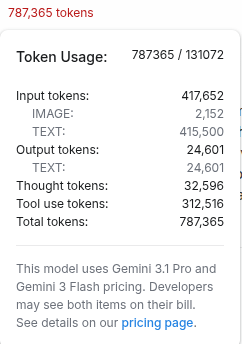
@OfficialLoganK@sundarpichai@GoogleAIStudio Still no way to tell how much this will cost?
Good to know the token counts and what models were used - but I have no idea on what model used what tokens?
Also - given you might have all that information in the backend maybe provide an approx cost?
@championswimmer Likely true right now.
But this effect will flip in the future - likely when the Mythos class of capabilities become commonly accessible.
@chaotictransfem@max_spero_ Agreed SEO slop makes internet worse.
Goal is to have genuinely useful content on internet - hopefully replacing both AI and human slop content.
@chaotictransfem@max_spero_ Slop is slop. AI or human.
Pre-chatgpt agencies used to populate the web with pure grade A human slop. Those have moved on to AI slop now.
However, i think fundamentally not all AI is slop.
@Teknium@goldstein_aa 1. this is a thinking model not a base.
2. also it doesn't identify as "every model". just sonnet.
fwiw, I love the Kimi models - but this to me is extraordinary proof for the stolen model claim
@Teknium@goldstein_aa somehow it always just says claude (and that too sonnet 3.5 to be specific) -- never chatgpt in any of the tests?
assuming it was pretraining quirk (imo not coz thinking comes from post) - shouldn't it effect all models?
also this?
https://t.co/fdBhF6fGXI
@Teknium@fractal_friend Hypothesis 1: It is a brand new model that is SOTA across many domains trained by a new team that somehow forgot to scrub "Claude" from the training data.
Hypothesis 2: Stolen model weights.
What do you think is more likely?
@pangram How about this:
Heading to SF
Moondream is headed to San Francisco from Seattle.
There's not many platform shifts as big as AI in our working lives.
Our role is simple enough: deliver frontier-grade vision models that are fast enough to make it reasonable to look at all of your visual data, in realtime and at scale. When you have the ability to run strong vision over every frame of video and every image in your archive, a lot of things that look impossible under today’s GPU budgets become straightforward software problems.
At least that’s the bet. That we’re at the right place, with the right people, while we take it.
When we first started Moondream, what my Seattle thesis looked like was pretty clean. Seattle has tons of unbelievably smart engineers. Tons of them are bored unfulfilled inside big tech. If I assemble a small team that has real problems to solve and a real stake in it, then the ones that are a bit bored and restless will show up. And we can quietly arbitrage between “I like my comp package” and “I’d actually like to build something that matters.”
Some of that worked. But mostly it didn’t.
What I found, again and again was that everyone in that world is optimizing for stability. They really want interesting work, but not at the cost of their RSUs, their ability to work remotely, or their comfort levels. Everyone loves the idea of AI and startups more than the reality of shipping hard things under constraints.
Seattle of course has a lot of talent. I spent 9 years at AWS -- I know what teams can do there. The issue is not ability. It's default settings. The default career here is: stay in big tech where you can climb one level at a time, collect refreshers, and not rock the boat too much. Which is a perfectly sound way to live. It's just not how I want to live.
In the last year, I've spent a lot more time in San Francisco. I've been to hack nights in half finished offices, small offices with nine more people and no furniture, and seen Moondream show up in whatever pipeline they hacked together that week.
The difference in attitude is obvious. In SF, you meet people who have already quit their FAANG job, shrank their burn, and just need to get something real working before their savings completely run out. In Seattle, it's pretty common for people to say they want to "think about startups" post the next promo cycle, or when the timing feels a little better.
Seattle’s been good to me. I learned how big systems work here. I got the space to spin up Moondream here. I’m not leaving angry.
If you’re tired of the comfort game and want to work on frontier vision models that are fast enough to actually use, you know where to find us.
@Teknium@fractal_friend Hypothesis 1: It is a brand new model that is SOTA across many domains trained by a new team that somehow forgot to scrub "Claude" from the training data.
Hypothesis 2: Stolen model weights.
What do you think is more likely?
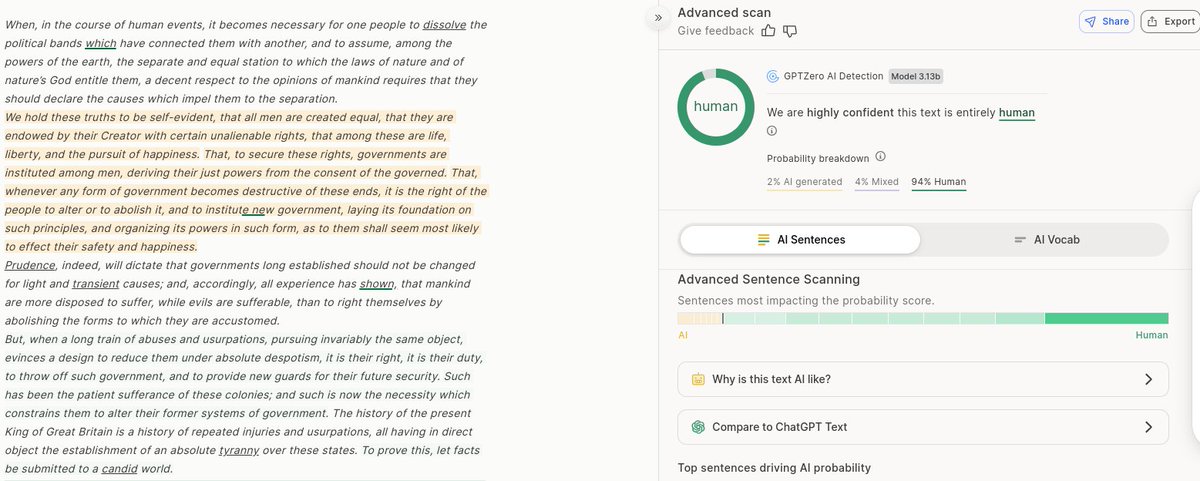
AI detection done right does work (not some crappy free tool).
Fundamentally, LLMs spit out tokens in a probability distribution. Given enough tokens, this is very much detectable.
A good detector will be able to detect all the top models.
The frontier labs have no incentive to make the output undetectable.
Is it fool proof? Nope. Someone who wants to beat detection can train a model that tries to cloak this signature.
But 99% of the text / images out there will just use the base model and will be detectable.
(That is until some frontier lab makes avoiding detection as a priority).