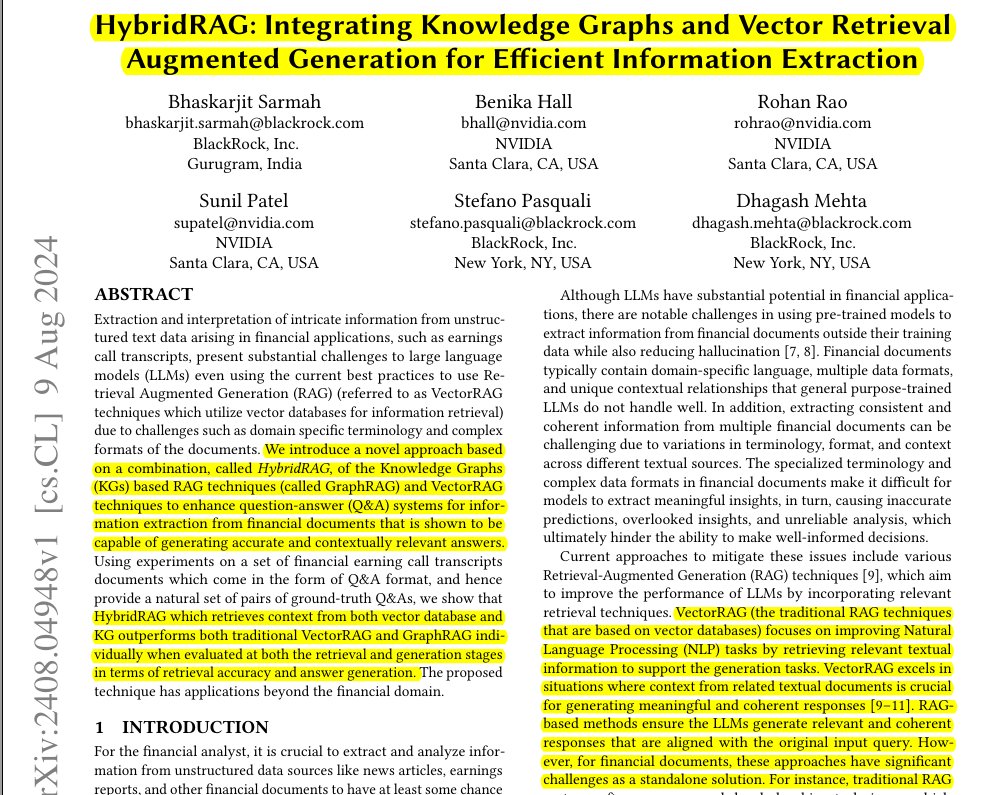
GraphRAG + VectorRAG i.e. HybridRAG outperforms both individually 💡
HybridRAG retrieves context from both vector database and Knowledge Graph (KG) is significantly better than traditional VectorRAG and GraphRAG individually.
**Problem** 🔍:
Extracting complex information from financial documents using LLMs faces challenges due to domain-specific terminology and intricate formats. Traditional Retrieval Augmented Generation (RAG) techniques struggle with inconsistent context retrieval from heterogeneous corpora, leading to inaccurate and incomplete analyses.
**Solution in this Paper** 💡:
Introduces HybridRAG, combining Knowledge Graph and vector-based RAG techniques. Constructs KG from earnings call transcripts using prompt-based entity and relationship extraction. Implements two-tiered LLM chain for content refinement and information extraction. Integrates VectorRAG (using Pinecone vector database and OpenAI's text-embedding-ada-002 model) and GraphRAG (using NetworkxEntityGraph) contexts for comprehensive information retrieval. Employs depth-first search strategy with depth one for KG traversal.
**Results** 📊:
HybridRAG demonstrates superior performance in extracting information from financial documents, balancing high-quality answers with comprehensive context retrieval.
• Faithfulness: 0.96 (tied with GraphRAG, vs 0.94 for VectorRAG)
• Answer Relevancy: 0.96 (vs 0.91 for VectorRAG, 0.89 for GraphRAG)
• Context Recall: 1.0 (tied with VectorRAG, vs 0.85 for GraphRAG)
• Context Precision: 0.79 (vs 0.84 for VectorRAG, 0.96 for GraphRAG)
• Excels in both extractive and abstractive questions
• Effectively handles questions without explicit entity mentions
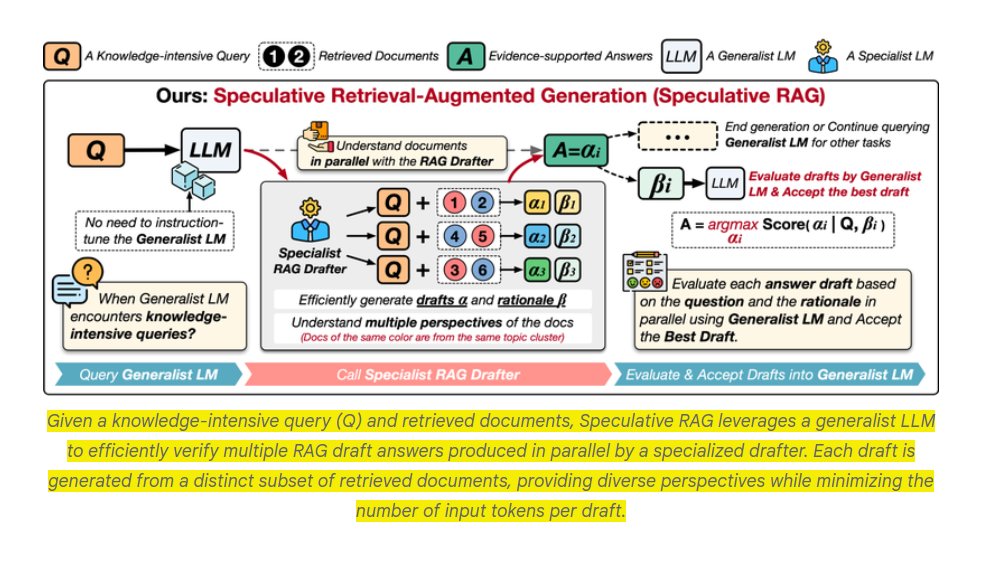
Newly published @GoogleAI Research on RAG - Two-step RAG Outperforms standard RAG 🤯
👉 Smaller specialist LM to generate draft texts that are then fed to a larger generalist LM to verify.
Original Problem 🔍:
LLMs struggle with factual inaccuracies and hallucinations in knowledge-intensive tasks. RAG improves accuracy but introduces latency with longer documents. Balancing efficiency and effectiveness in RAG remains challenging.
Key Insights 💡:
• Offloading computational burden to a smaller specialist model improves RAG efficiency
• Parallel generation of multiple drafts from diverse document subsets enhances answer quality
• Separating drafting and verification steps optimizes RAG performance
Solution in this Paper 🛠️:
• Introduces Speculative RAG framework:
- Specialist RAG drafter: Small LM fine-tuned for RAG tasks
- Generalist RAG verifier: Larger LM for draft validation
• Process:
1. Retrieve related documents from knowledge base
2. Generate multiple answer drafts with rationales in parallel using specialist drafter
3. Generalist verifier calculates conditional generation probability of drafts
4. Select draft with highest confidence score as final answer
Results 📊:
• Outperforms standard RAG systems across all benchmarks
• PubHealth dataset: 12.97% accuracy improvement over best baseline (Mixtral-Instruct-8x7B)
• Latency reduction: 51% compared to standard RAG systems
• Consistent lowest latency across all datasets due to parallel draft generation
Anthropic just released new interactive prompt engineering courses.
9-course links & academic papers.
Here's the link + a summary of each:
#1 → basic prompt structure
Vcc: Scaling Transformers to 128K Tokens or More by Prioritizing Important Tokens
Compared with competitive baselines, the proposed algorithm not only is efficient (achieving more than 3× efficiency improvement compared to baselines on 4K and 16K lengths), but also achieves competitive or better performance on a large number of tasks. Further, show that algorithm can be scaled to 128K tokens (or more) while consistently offering accuracy improvement
abs: https://t.co/8RkEInolal
paper page: https://t.co/holnL1caVJ
Language models can explain neurons in language models
use GPT-4 to automatically write explanations for the behavior of neurons in large language models and to score those explanations. Release a dataset of these (imperfect) explanations and scores for every neuron in GPT-2
blog: https://t.co/PsoIX6zwFX
blog: https://t.co/KyrVMBCiRV
github: https://t.co/VPfQLMnyTj
PyTorch 2.0 is announced!
Main new feature:
cmodel = torch.compile(model)
Faster training with no code modification.
Available in nightly build.
Stable release scheduled for early March
Sentence embeddings (e.g., SBERT) are powerful -- but we just don't know what is crammed into a %&!$# vector 😵💫.
💥So in our new paper, we use Abstract Meaning Representation (AMR) to make sentence embeddings more explainable! #AACL2022#nlproc#MachineLearning (1/3)
CelebV-HQ is a large-scale video facial attributes dataset with annotations.
GitHub repository: https://t.co/r3Jqcr7a7L
#paperswithcode#AI#dataset
https://t.co/VS17jTaMw9