My conversation with Michael Moritz, one of the great venture investors of the last 40 years.
Michael joined Sequoia in 1986 and co-led the firm with Doug Leone (@dougleone) from 1995 to 2012. His investments include Google, Yahoo, PayPal, and Stripe.
His new book, Ausländer, traces his parents' escape from Nazi Germany and helps explain his lifelong interest in what shapes exceptional people.
We discuss:
- The infamous Steve Jobs profile
- Why Don Valentine hired him
- The question he finds most revealing when interviewing people
- Monomania and the cost of greatness
- Why he has never felt good at anything
- Writing, journalism and AI
- What he learned about himself writing Ausländer
I'd recommend watching this one if you can. Michael was incredibly thoughtful and reflective throughout, particularly when talking about his parents, childhood, and the more difficult parts of his personal story.
Enjoy!
TIMESTAMPS
0:00 Intro
0:53 Family History & Identity
7:03 Survival & Outsider Instinct
18:53 Studying Exceptional People
33:50 Self-Doubt & Success
41:17 Steve Jobs & Obsession
52:50 Joining Sequoia
1:03:22 Leadership & Alex Ferguson
1:08:25 Elon Musk & AI
1:17:12 Becoming Who You Are
Doug Leone has three questions he asks himself before investing in any company:
1. Would I put my kids' money into this?
2. If I only make 20 investments in my life, is this one of the 20?
3. Can I return the whole fund with this investment?
“If I don't pass those three, I'm not going to make the investment.”
“There's probably 200 investments that you can make in your lifetime, and a lot of them are going to return 2x your money, 3x your money. I only want the ones where you can return 100x your money. That's all I'm interested in. I want the outliers.”
Doug Leone on the mistake every VC makes: Selling their winners too early.
“We owned 20% of Nvidia and sold.”
“We were the first investor in Apple and sold.”
“We owned 10% of Google and sold.”
“If we hadn’t sold Google that would be half a trillion dollars.”
“We owned a quarter of Cisco and sold.” ($433 billion market cap)
“Those are big ownership in very big companies.”
“The great companies compounded 20+ years after the IPO. If you had a little sniffer that this thing has essentially an unbounded market for many years, you should never sell a share.”
“You can make way more money holding those. If you're compounding a $5 billion gain that can turn into a $50 billion gain.”
“But we all made that mistake.”
“I’ve never said this publicly before. When I was made a partner at Sequoia
I was homeless. I had zero money. I slept in my car. I showered at 3000 Sand Hill Road.”
@dougleone on being the only homeless partner that Sequoia's ever had:
Does anyone care about Kimi K3, really?
Had a great time chatting with Xing Meng of @5YCapital for a deep dive into China’s AI ecosystem and what Silicon Valley may be getting wrong about it.
We talked Moonshot, DeepSeek, ByteDance, open-source models, distillation, AI video, data, and more. Hear more about the people behind China's AI race on @Valley101en:
https://t.co/DIxT2MbhqD
Gavin on why the hyperscalers are under-earning:
" I literally spoke to a company this morning who rented a cluster of several thousand Blackwells at somewhere in the mid $2 per GPU hour, and this is one of the sexiest startups that people want to be in business with.
They're renting the exact same cluster, and they're hoping 7 months later to pay just under $4.
That's pretty crazy because a really gentle decline in prices would be bullish. Instead, we're up, depending on the starting point, 50 to 60% in six or seven months.
And there have been so many anecdotes like that. One of the inference clouds, I think it was Baseten, they went on a podcast and essentially said, "We are planning to pay 100% more for Blackwells when our contract expires.
And that just means that essentially all the hyperscalers are under-earning.
My main mission out here this week is: tell me something negative."
📢Meet Qwen3.8-Max — our most capable model to date.
Next week, the open weights of Qwen3.8-Max will be released, and Qwen3.8-27B is also going open-weights to meet you all!🎉
Qwen3.8-Max, a new bar for coding and cowork at 2.4T parameters:
- Autonomous coding: 10+ days of self-evolving development, from empty folder to production without hand-holding, complete project trace in the GitHub:https://t.co/iVHZWQoeSo
- Real work, real results: Production-quality deliverables across hundreds of professions.
- Long-horizon mastery: System-level autonomous planning with closed-loop adaptive learning, driving 500+ turns of chip design optimization and 365 days of e-commerce strategy.
- Native multimodal intelligence: Vision isn't just input — it's a continuous feedback loop for planning, execution, and self-correction.
💰Pricing:
Input: $2.0 / M tokens
Output: $6.0 / M tokens
Implicit Caching: $0.25 / M tokens
Start building with Qwen3.8-Max! 🚀
📖 Blog: https://t.co/iwjmQxLBof
✅ Qwen Studio: https://t.co/4V2pFvDovG
⚡ API: https://t.co/gAGqaLQGbN
Everyone in the Valley has a take on whether China is winning AI, robotics, and biotech. Almost nobody understands how the capital works
Notes from meeting China's tier-1 investors and founders on how their venture ecosystem actually works. https://t.co/Dii6Oeqn1A
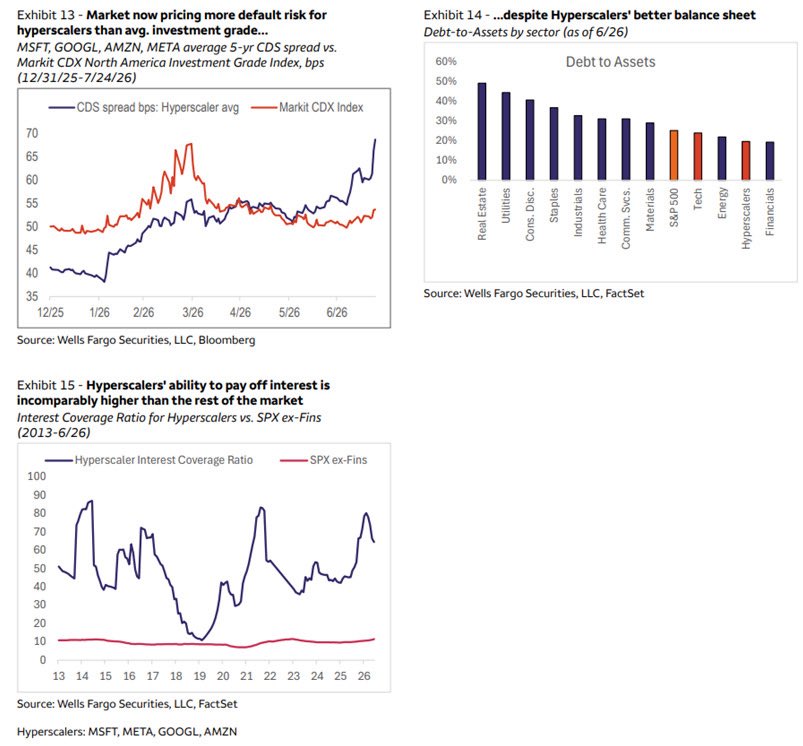
Market is overreacting to hyperscale credit spreads widening from my perspective. TL;DR Spot pricing for renting GPU compute materially above contracted rates implies hyperscalers are underearning while operating cash flow acceleration is an underestimated source of funds for AI capex.
The fact that spot prices for GPU rentals are at least 2x higher than contracted rates is the missing piece from the discussion about hyperscaler credit, which is the only fundamental factor behind this selloff. Multiple private companies are planning on spending at least 2x more per GPU for compute as contracts roll-off and some have spoken about this publicly.
As contracts roll-off, hyperscale growth rates are going to continue to accelerate as their installed bases of compute reprice higher. Hyperscale operating cash flow growth using a mix of estimates and actuals is modeled to accelerate from 31% in the first quarter of 2026 to 50% in the second quarter. This acceleration should continue for the rest of the year and this is not in estimates which incorrectly model a deceleration in the third quarter from my perspective.
Some math. Consensus estimates are probably for 25-35 gigawatts added by hyperscale and neoclouds in CY28 (using a range as standing up datacenters is hard and a lot of the neos plus labs are still private). At 60b per gigawatt, that is 1.5 to 2.2 trillion in capex. Consensus estimates for hyperscale/neo operating cash flow is 1.3 to 1.4 trillion. I think this gets revised up materially as contracts reprice and growth accelerates so the 100b to 700b that would hypothetically need to be plugged by debt goes away. And their credit profiles materially improve. Not to mention the said 100b to 700b would be less than 1 turn of incremental leverage on consensus EBITDA estimates. And obviously the Nvidia and Broadcom “credit wrappers” help improve creditworthiness as well given their FCF profiles.
OpenAI, Cursor/Grok and the various Open Source inference clouds have accelerated materially over the last two months per public data and Anthropic continues to grow insanely fast while likely generating FCF. This - along with the fact that spot prices for GPU rentals are so far ahead of contract - are the missing pieces from the BofA chart on hyperscale FCF vs. semiconductor FCF.
Hyperscalers are underearning and anyone who signed a contract for GPU compute in 2024 and 2025 is overearning. Operating cash flow will be enough to fund capex but as contracts reprice and cloud growth continues to accelerate then spreads likely come in as well.
Would also note that CDS markets are easy to manipulate - was a huge feature of the GFC - short the stock and then buy the CDS. So I would not put attach much signal to CDS.
Net, net I’m not that concerned about the widening spreads in hyperscale credit. The real risk is that bringing power online and energizing all these GPUs is really hard but we are getting better at this every day.
The best founders have clear founder-problem fit. Havi of Abby Care lived the problem firsthand when she helped file Medicaid benefits for her family as a child and experienced the complexities of the healthcare system. That and her later experience in tech led her to realize that technology could help family members become paid caregivers for their loved ones, when most were already dropping out of the workforce anyway. There are an estimated 59M family caregivers of adults in the US, mostly unpaid and working almost 50 billion hours - nearly $1T in wages. Abby Care is still early (they're only in 8 states out of the 37 that currently allow it), but the impact on families' lives is indisputable and we're excited to be their partner.
For my first post, I’m sharing a letter @NVIDIA signed on why open models matter.
AI will transform every industry, power every company, and be built by every country.
Open models strengthen safety and cybersecurity, accelerate innovation and diffusion, and enable sovereignty.
The world needs both frontier closed models and frontier open models.
https://t.co/AUKzoQ5Ikb
Robert Scoble interviews me outside YC after the summer 2010 Demo Day. By that point we'd funded what seemed the enormous number of 208 startups, including 36 in that batch.
https://t.co/y9KG6bKPFX