@veorq aws-lc-rs has an ML-KEM implementation that rustls uses by default. It also has an “unstable�� implementation of ML-DSA, presumably waiting for FIPS stuff.
@brandur On the other hand: once someone has a novel idea, the LLMs will be a great help in getting the 80% boring stuff needed to support it off the ground?
🚀 On https://t.co/lPU0G3BwGq 🎙 Ep.7 we spoke with @djco — maintainer of #Rustls, #Quinn & #HickoryDNS.
From TLS for QUIC ➝ DNS over QUIC ➝ sustaining OSS.
Protocols, safety trade-offs & Rust at internet scale.
🎧 https://t.co/oUWhKlWZVh
#Rust#Networking#TLS#QUIC
@jedisct1 9110: “ A client SHOULD NOT generate content in a GET request unless it is made directly to an origin server that has previously indicated, in or out of band, that such a request has a purpose and will be adequately supported.”
The people behind Rustls https://t.co/9X7Y0TJewd, an up-and-coming TLS library written in—you guessed it—Rust, published their follow-up performance benchmark, showing excellent results under high concurrency. https://t.co/KPltrolgJy
@WillyTarreau We would like to hear what symbols rustls-openssl-compat is missing. We could probably spend some effort on this…
https://t.co/9nLdmuBvRZ
A few months late, but I'm back with another report on my open source activity in October of 2024! This installment contains news from rustls, Hickory DNS, KumoMTA, Quinn, tracing-opentelemetry, bb8, instant-epp, instant-xml, instant-acme, gcp_auth and chrono.
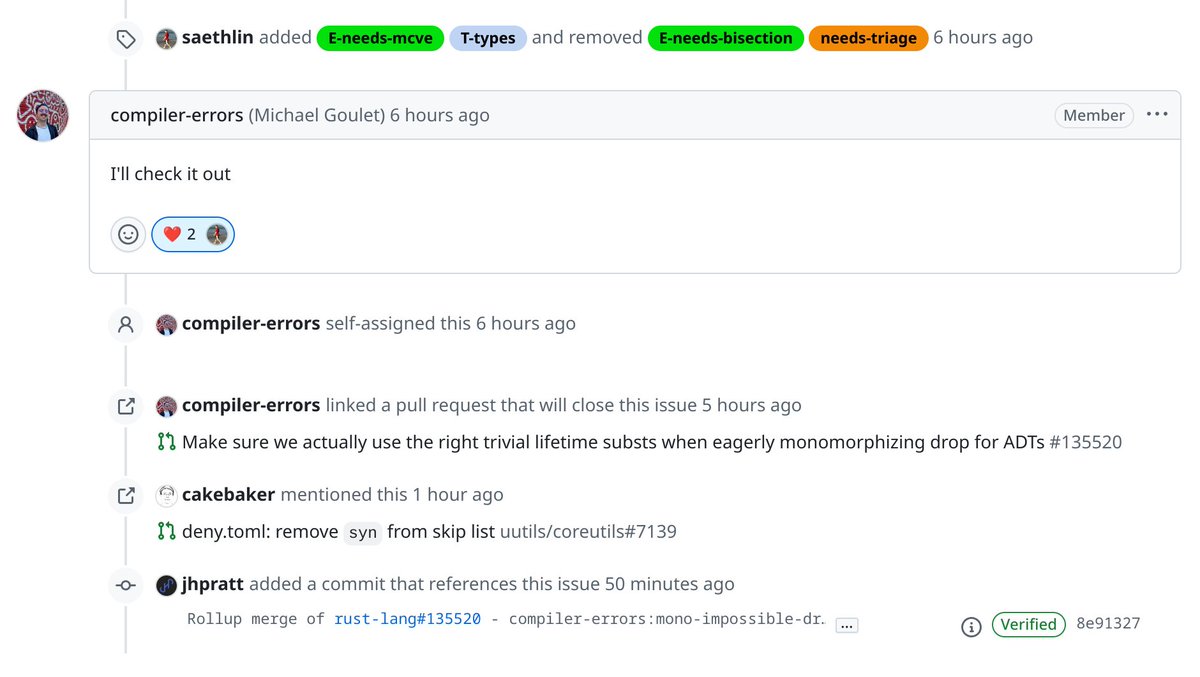
The #rust community is crazyyyyyy! Or at least @compiler_errors is.
- I created an ICE report.
- less than an hour later, Ben Kimock arrived and completed it with a minimal repro.
- two minutes later, @compiler_errors assigned himself and fixed it within half an hour.
👏👏👏