A Polity question that even serious UPSC aspirants get confused about:
If your legal right is violated, can you directly approach the Supreme Court under Article 32?
Not necessarily.
Article 32 → Enforcement of Fundamental Rights.
Article 226 → Enforcement of Fundamental Rights AND other legal rights.
That's why the High Court's writ jurisdiction is wider than the Supreme Court's under Article 32.
One more thing: Article 32 is itself a Fundamental Right.
Sounds basic? These distinctions can cost you marks in Prelims.
How many of you knew this?
This is reminder for UPSC Aspirants:
- Brainstorm on 2GS + 2 Optional answers daily
- Write at least 10 questions in single seating once every week
- Read daily newspaper. Just read. It's okay if you don't make details notes.
- Keep revising limited resources multiple times
- Don't ignore CSAT (if you are not comfortable with it). Practice solving 5 CSAT questions daily from now itself.
- Take care of your physical and mental health.
Answer writing tips: GS1 Paper!!
When asked to evaluate the significance of a topic like Rock Cut Architecture, do not just claim it is an important source of ancient history and walk away.
You must prove exactly how it acts as a source by breaking your answer down into specific historical dimensions. Detail how the Ellora caves prove religious tolerance, how the Tandava dance sculpture shows an astronomical understanding of the universe, and how the strategic location of Viharas reveals economic interactions between monks and traders.
Then, use these diverse points to build your core arguments. This proves to the examiner that you are thinking multidimensionally, rather than just reciting generic facts.
▶️ Key Drivers of Edible Oil Inflation
- The Food-to-Fuel Diversion (Biofuel Mandates): A massive share of vegetable oils is diverted to produce biodiesel (Fatty Acid Methyl Esters or FAME) instead of food. Roughly 29% of soyabean oil, 28% of palm oil, and 29% of rapeseed oil go toward feedstock for biofuels.
- Aggressive Government Mandates: Major producing countries have escalated blending mandates to reduce their reliance on imported fossil fuels. Indonesia raised its palm oil blending mandate to B50 (a three-month transition period), Malaysia rolled out B15, and the US expects over 54% of its soyabean oil to go toward biofuels.
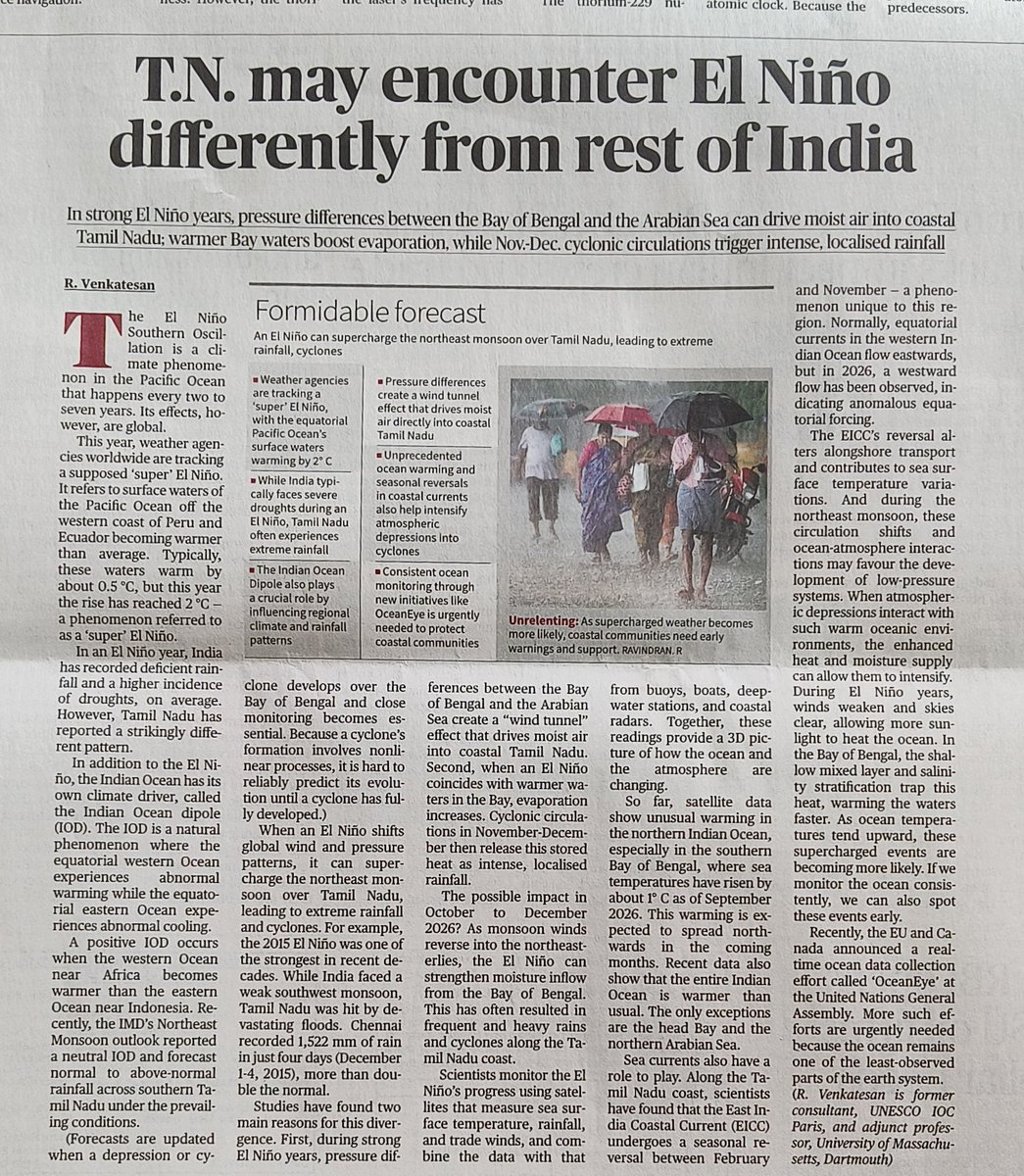
- El Niño and Geopolitical Disruptions: Weather phenomena like El Niño are expected to peak and negatively impact palm oil production yields. Simultaneously, the Russia-Ukraine war has created severe logistical bottlenecks, suspending navigation through the Sea of Azov and overloading alternative Black Sea and Baltic ports.
- Crashing Export Volumes: Indonesia's push toward higher biodiesel blending (moving from B40 to B50) will absorb an estimated 4.7 million tonnes of its palm oil locally, leaving significantly less available for international export markets.
▶️Impact on Importing Nations (Like India)
- Record Import Demands: With domestic production facing climate and policy headwinds, India's edible oil imports are projected to hit a new record high of 17.2 million tonnes (comprising palm, soyabean, and sunflower oils).
- Surging Landed Prices: High international crude oil prices (staying above $100 per barrel due to geopolitical conflicts) continue to incentivize the diversion of edible oils to energy, keeping landed prices for crude palm, soyabean, and sunflower oils sharply elevated compared to previous years.
Answer writing tips: Ethics Paper!!
When a question presents two opposing viewpoints, do not just jump straight into your personal opinion.
You must introduce the answer by acknowledging both sides immediately. Use a dual concept introduction, like mentioning Gandhi's idea of Ramrajya to show the peace aspect, and briefly noting the Divine Command Theory to show how strict adherence leads to conflict.
Then, explicitly state your perception in the conclusion.
This perfectly addresses the core demand of the question and shows balanced analytical thinking.
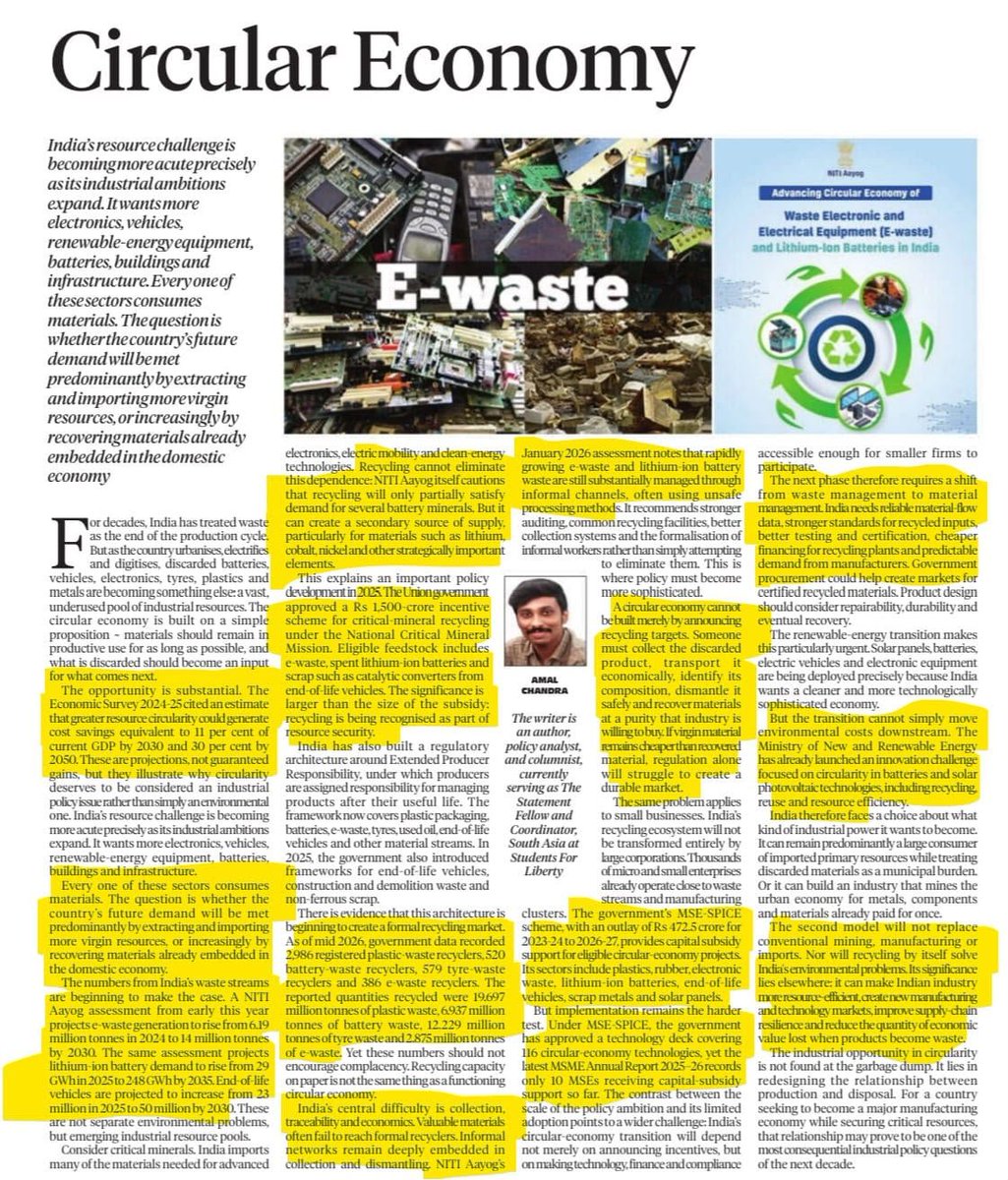
India is moving away from linear extraction towards a circular economy to unlock massive Gross Domestic Product (GDP) savings.
With e-waste and lithium-ion demand surging
Here are the hurdles and solutions:
𝗖𝗼𝗿𝗲 𝗦𝗵𝗶𝗳𝘁
Transitioning from linear extraction and imports to a circular economy targeting 11 percent Gross Domestic Product (GDP) cost savings by 2030.
𝗞𝗲𝘆 𝗗𝗮𝘁𝗮
E-waste is projected at 14 million tonnes by 2030 with lithium-ion demand scaling to 248 Gigawatt hours (GWh) by 2035.
𝗕𝗼𝘁𝘁𝗹𝗲𝗻𝗲𝗰𝗸𝘀
Heavy dependence on unsafe informal networks and virgin materials remaining cheaper than recycled alternatives stifle growth, with weak support for Micro Small and Medium Enterprises (MSMEs).
𝗜𝗻𝘁𝗲𝗿𝘃𝗲𝗻𝘁𝗶𝗼𝗻𝘀
Policy pushes include Extended Producer Responsibility (EPR) frameworks and a Rs 1500 crore critical minerals recycling incentive scheme.
𝗪𝗮𝘆 𝗙𝗼𝗿𝘄𝗮𝗿𝗱
Shift focus from pure waste management to ecodesign, boost demand via public procurement of recycled goods, and formalize informal recycling networks.
Sources of UPSC Prelims 2026 questions..!!
Look at Question 50 on "India's Deep Ocean Mission" asked in UPSC CSE Prelims 2026. Question source is PIB Article.
UPSC CSE Prelims 2026 Question Paper: https://t.co/hhVnyr843E
PIB Article: https://t.co/fz2o4WRfuL
🔴 To get all important PIB Articles, for UPSC CSE, on daily & monthly basis, join paid group.
Join from here: https://t.co/mTF2Mz368u
#UPSC #PIB #UPSCPrelims
You don't need to solve 500 random questions.
You need to understand why UPSC keeps asking certain things in different forms.
We’ll work through 10 years of Mains PYQs and identify:
→ Repeated themes
→ Directives
→ Hidden dimensions
→ Static-current linkages
→ Possible frameworks
MAINS is about reproducing what you already have read
You cannot waste time after Prelims consolidating notes
instead, you must work hard next 3 months and finish notes for mains
IR Concepts You Should Know. 🫰🏼🤌🏼
Notes covering high value IR concepts you need for UPSC:
• Thucydides Trap
• Malacca Dilemma
• Kindleberger Trap
• Security Dilemma
• Madman Theory
• Escalation Ladder
• Dead Hand Doctrine
• Securitisation Theory
• Prisoner’s Dilemma
• Responsibility to Protect (R2P)
• Tragedy of the Commons
📚 Thinkers, core ideas & UPSC applications - all in one place.
PDF link in the next tweet. ⬇️
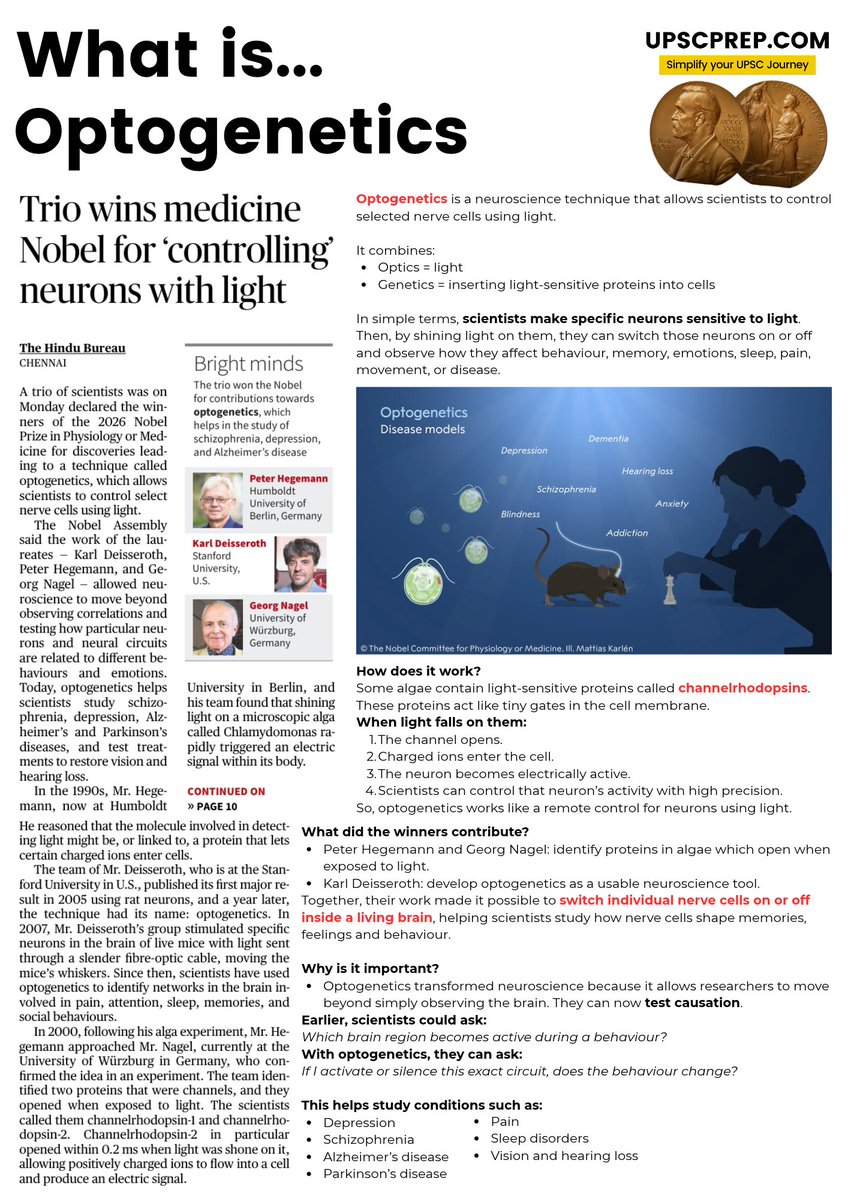
What is Optogenetics? | 🔖 #UPSC
In simple terms, scientists make specific neurons sensitive to light. Then, by shining light on them, they can switch those neurons on or off and observe how they affect behaviour, memory, emotions, sleep, pain, movement, or disease.
T-1359: Across the 4 UPSC Mains that I wrote, I found answer writing to be the easiest part of preparation. Once you develop answer writing skill i.e. break a question into subparts, identify main demand & know subject specific nuances, all you need is content revision as answer writing will take care of itself because you know what to write and how to write.
Major mistake that Aspirants make is that they keep writing answers after answers without even trying to get the skill of "how to write" right.
Think for yourself, once you are confident that you will be able to break any given 10 marker question into 3 subparts and a 15 marker question into 5 subparts, all you need is revision of content so that you are able to write 3-4 points per subpart.
More the genuine subparts you identify for a question, lesser the number of points to write per part and lesser the time taken to brainstorm number of points.
This is the skill that I worked on rather than merely filing mock answer booklets for sake of it. And, this isn't rocket science either. This is what I did in CBSE Boards as well.
Essentially, UPSC Mains Answer writing is no different than boards exam. At least, I looked at it this way. This helped me in scoring 11th highest in my 2nd Mains i.e. 144 marks more than the Mains cut-off & 5th highest in GS in my 3rd Mains.
Don't be under FOMO. Answer writing is easy once identifying subparts, demand and paper-specific nuances are sorted.
More at https://t.co/1K3rOmQsOq
#UPSC #UPSCExam #UPSCAspirants #UPSCPreparation #UPSCMains #AnswerWriting
Answer writing tips- Ethics Paper!!
When substantiating your arguments in GS4, do not write long, four line explanations for a single example.
You must practice the Economy of Words. If you want to show that religion promotes charity, simply write: "Promotes charity and humility. Example: Zakat in Islam or Langar in Sikhism."
Then, move straight to your next argument. Cramming 6 to 7 diverse, concise examples into a two page answer will fetch far more marks than writing two heavily explained examples.