XYXX's new ad (agency: PinkSauce Studios) is a brilliant exercise in gender-role reversal used as a comic device. But beneath the humor, it is a smart strategy to solve a unique marketing problem: how to differentiate the selling of an unsexy, utilitarian, and deeply unglamorous garment that has traditionally been sold only in one way in India - the 'macho' way?
The 'macho' way of selling baniyans has always been about roping in a famous male movie star (one of the Khans, Varun Dhawan, etc.) and selling an imaginary world where men miraculously inherit a movie star's magnetism just by putting on a specific brand of baniyan.
This ad takes a completely different route and forces men to think about fit and aesthetics of a garment they rarely talk about. How? By lavishing as much attention on a baniyan as women (and the world) do on a bra! By comparing it to the intense public scrutiny, "staring", judgment, and hyper-awareness surrounding women's bras, the ad forces men to look at their innerwear through a social lens.
And by having a man say, 'My eyes are here' to a group of women in a public bus, the ad mines humor through subversion!
Of course, I thought there was a false equivalence of scrutiny too - for women, the public policing and hyper-sexualization of bra lines or straps isn't just about "looking messy". It is tied to deeply rooted issues of modesty/moral-policing, objectification, and personal safety. For men? A visible baniyan line or a peek of fabric at the collar is just a style slip-up or a sign of being slightly old-fashioned.
By equating a woman’s genuine discomfort with a man’s minor fashion embarrassment, is the ad trivializing a heavy social issue to sell an innerwear? In other words, is it suggesting that the gaze is symmetrical, when in reality, the power dynamic behind that gaze is completely different?
But then, I don't think the ad is equating the danger or the systemic oppression. It is onlt using a universally understood cultural pain-point to create a surreal and absurd taboo-flip. If it makes men uncomfortable, that’s perhaps the point, because that discomfort may drive both social awareness and product consideration.
This comment from a follower only made me aware of this initiative. Edited comment:
I reported a bribe I paid through Makkal Saatchi https://t.co/7f45Pwyvia yesterday (06.06.2026).
Today, the Deputy Commissioner personally called me, took full details, and assured me of appropriate action. Two police officers also visited my home - one from the DC office and another from Intelligence and enquired in detail.
This level of response within 24 hours is impressive.
I strongly urge everyone affected by corruption to use this platform and report bribes. Change is possible when we speak up.
Yet another #GSTHorror story.
A highly reputed business family running one of the most popular shops in a town for generations. Monthly turnover must be in crores. They get a notice for a tax demand for petty amount. A few thousands. They respond to the notice disputing the claim. The tax officer sends orders to the banks to freeze the businesses' bank account. The bank manager immediately calls up the family to inform them and helplessly tells they have no choice but to comply. The family is shell-shocked. The reputation they had built up over decades would be in tatters when their cheques don't get honoured. All for a few thousand rupees when they pay millions as GST every month. Shaken, they settle the demand.
Dear @nsitharaman@narendramodi this is the kind of tax terror that goes on in the name of GST - the 10th year of the Good and Simple Tax.
Few things to note:
- neither the bank manager nor the bizman knows whether the tax officer has the powers to do this.
- but that doesn't matter. It's the asymmetry in power and outcomes. Look at what the bizman gets to lose (and it is immediate) vs what the tax officer would lose (after a long drawn out process) if he is shown to have broken rules.
High time we curtail the discretionary powers of this parasitic, bloodsucking babudom. When is Modi going to get this?
This is a request to my friends in the media and to the many journalists who have reached out to me.
Please understand that my schedule is currently quite packed, and I am unfortunately not available for interviews or video calls today or tomorrow.
I genuinely appreciate the interest this issue has received, and I would love to continue helping media organizations bring attention to it. That has been my goal from the beginning.
However, it is becoming difficult for me to accommodate the volume of interview requests and calls I am receiving. I would greatly appreciate it if you could refrain from calling multiple times in a day. If you'd like to get in touch, please send me a text message instead. It becomes quite exhausting to manage hundreds of phone calls while also trying to keep up with my regular responsibilities.
For anyone looking to understand the issue in detail, I encourage you to read the blog linked below. I have documented the matter as comprehensively as possible, including all relevant sources and references at the end. Most questions I receive are already addressed there.
https://t.co/ZdlvecXe9C
I am always happy to help journalists over text whenever possible, and many journalists who have interacted with me can attest to that. If there are specific questions that remain unanswered after reading the blog, feel free to reach out.
(however, tomorrow text might also be difficult)
Thank you for your understanding and for your interest in covering this issue responsibly.
@aajtak@IndiaToday@BBC@TV9Bharatvarsh
Shrey spelling 32 words in 90 seconds to win the Spelling Bee is the new greatest athletic accomplishment of 2026. I don’t even know how he said the letters that fast. Got a “Holy Mackerel” out of
@minakimes
As a country, we've never dealt with corruption seriously.
When you realise how difficult it is to build a wealth of Rs.6 crores in a developed nation, we come across news items where even low level government officials are caught with unaccounted wealth ranging from tens of crore to hundreds of crore rupees.
I mentioned how Singapore and China brought death sentences for what are routine in India like selling adulterated food and spurious drugs.
Not that we should give death to corrupt. The numbers may be huge in our country. Long jail terms coupled with confiscation of entire wealth is the way to go. That would send a strong message to rest of the people to give up corrupt practices.
NEET छात्रों से मुलाक़ात में एक बात बिल्कुल साफ़ हो गई - भारत का युवा नरेंद्र मोदी पर भरोसा नहीं करता।
उन्होंने मुझे बताया - पेपर WhatsApp और Telegram पर खुलेआम बिक रहे हैं। किस कीमत पर बिक रहे हैं, कौन ख़रीद रहा है, माफ़िया कैसे काम कर रहे हैं - यह सब इन बच्चों को पता है।
उनका एक ही सवाल था - जो हमें पता है, वो सरकार और संस्थाओं को क्यों नहीं? सच यह है ये बच्चे सरकार से बेहतर जानते हैं कि इस सड़ी हुई व्यवस्था को कैसे ठीक किया जा सकता है।
और दूसरी ओर कितनी शर्मनाक बात है कि जिस सेना का काम दुश्मनों से देश की रक्षा करना है, आज उसे मोदी सरकार के अपने भ्रष्टाचार से बच्चों के पेपर बचाने भेजा जा रहा है।
टुकड़ों के सुधार से अब काम नहीं चलेगा। छात्रों, शिक्षकों और Experts के साथ मिलकर पूरी परीक्षा व्यवस्था नए सिरे से बनानी होगी।
हम और बच्चे नहीं खो सकते। और एक भी पीढ़ी का भविष्य इस भ्रष्ट तंत्र के हवाले नहीं कर सकते।
Good to see the Leader of Opposition give clear visibility to a young student who has exposed what many in the media could not even think of in their imaginations.
What a shame for Narendra Modi Regime.
Dharmendra Pradhan should be kicked out and the Secretary of his Ministry should be immediately suspended.
A young kid, has to focus his productive energies on unearthing Modi Regime’s Corrupt practices rather than on Research and Education.
The GenZ won’t give in to their Communal Jumlas anymore. They know their future is at stake.
Hats off to Sarthak @sidhant_sarthak for exposing the lid off the corruption nexus.
Every single thing that is prohibited by the Central Vigilance Commission’s Guidelines, to ensure competitive bidding, was not followed by CBSE. Heads have to roll.
Sarthak is many times braver than all the supine, immoral Principals who came online to provide cover fire to Modi Regime.
Not just the education minister but the entire bureaucracy behind it should be fired and rogue cos should be banned for life. and their directors DIN should be debarred from life.
Unless we as a country set examples it won't fix.
Be it NEET exam paper leak or CBSE OSM fiasco, lot of parents and their kids are getting genuinely upset with such severe flaws in our education system.
It is time for education minister to go. Someone who is very competent and of unquestionable ethics need to be brought as an education minister.
With employment opportunities already being dwindling for freshers and things are becoming more and more competitive, the least we can do is to have a proper examination and evaluation system. These are hygiene factors and are expected as matter of routine.
Saw a news item that government is planning to use airforce to carry NEET papers. If we've to depend on defence forces for routine civilian functions, it shows the institutional collapse.
Education ministry not only need new set of people, foolproof systems need to be deviced to prevent any future paper leaks and fiasco happened recently in CBSE evaluations.
17-year-old Sarthak Sidhant has exposed how CBSE manipulated its own selection process to benefit COEMPT, using CBSE’s own documents.
The details in his blog reveal how CBSE changed the RFP to unduly benefit COEMPT, at the cost of TCS.
He has revealed the hollowness of Dharmendra Pradhan ji’s denials. The PM remains silent, as usual. The question is simple: who are they protecting, and why?
An independent judicial inquiry is now essential to uncover the full extent of this scam.
Sarthak’s work shows that India’s Gen Z is brilliant and fearless. And sooner or later, they will find out the full truth.
India spent a decade learning why retrospective tax is poison. We're about to throw the lesson away.
Picture this: your team wins a cricket match, clean, by the rules of the game that day. A year later, the umpire changes a rule and applies it backward — and declares you lost the match you already won.
That's retrospective tax. You broke nothing. They moved the line, then pointed it at your past.
We did exactly this to Vodafone in 2012, chasing them over a 2007 deal. Cairn Energy got hit too. Both went to international arbitration. Both won. India refunded over $1.2 billion and spent years as the cautionary tale that every global investor cited as the reason they hesitated on us.
In 2021, we finally repealed it and called retro taxation a thing of the past. Capital started trusting us again.
This week, the courts upheld retrospective GST on online gaming. Dream11 and an entire industry now owe tax on years of operations under rules that didn't exist at the time.
Retrospective tax doesn't punish what you did. It punishes you for not predicting what the government would later wish you'd done.
As a country, we should not set such a precedent.
#Noretrospectivetax
The national high school exam of India, CBSE, has been Pwned!
This incompetent organization continues to deny the allegations against them. And a teenager has taken over their prod servers hosting the exam booklet scans of 2M test takers. They have just taken it down.
All they had to say is "can you help us fix the problem?" but their ego is too big to admit they were wrong.
Incompetence is one thing. The complete lack of accountability to the nation while your servers get catastrophically owned is another. Internet-scale embarrassment.
Read this story. Carefully.
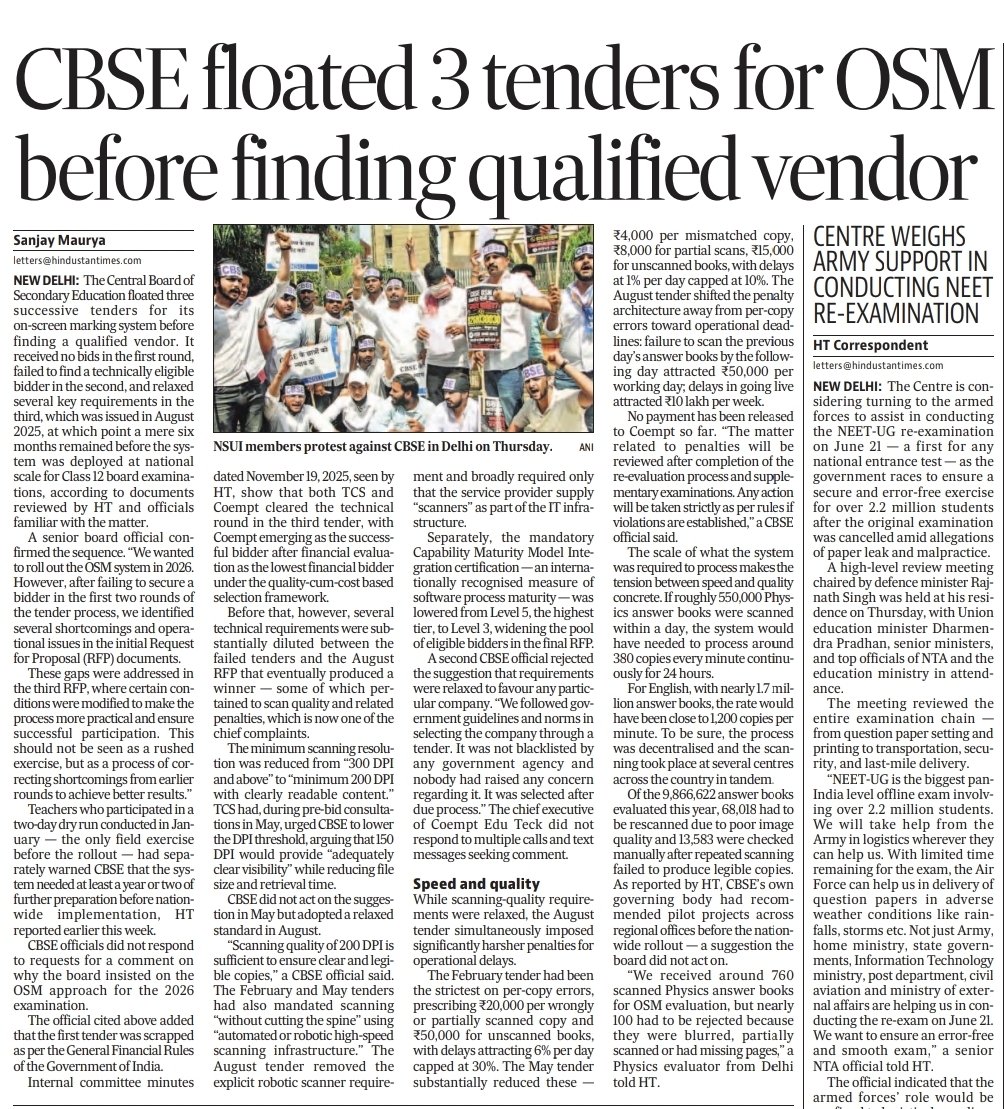
CBSE called for OSM tenders thrice. Zero bids the first time. No qualified bidder the second time. And finally, the technical bar was lowered until COEMPT could clear it.
Scanning resolution cut. Robotic scanner requirement dropped. CMMI certification lowered from Level 5 to Level 3. Penalties for errors in answer sheets removed.
TCS, India’s biggest IT services company, qualified in the third round too. TCS lost. COEMPT - a company with a spectacular track record of failure - won.
And what are CBSE students complaining about today? Badly scanned answer sheets. Missing pages. A broken evaluation portal.
Teachers had warned CBSE that the OSM system needed at least a year or two for further preparation before nationwide implementation, yet it was rushed through.
So I ask again - who wanted COEMPT to win? Who lowered the bar, step by step, until this company could clear it?
Pradhan ji and CBSE say “due process was followed.” That is not an answer, that is not accountability. The question is whether the contract was honestly awarded to the best company which could do the job correctly.
The futures of 18.5 lakh children were handed to a company that could only qualify after the rules were bent for it.
To the BJP Ministers attacking me for asking questions - I have, from day one, demanded an independent judicial probe. Expand it from CBSE to every contract awarded to COEMPT. Our youth deserve the truth.
And Modi ji, your silence on the CBSE debacle and inaction against the Education Minister tells the country what you actually care about - not the futures of lakhs of students, only the survival of your own government.
This is an unbelievable piece of work by Sarthak and something that requires amplification.
Let me explain what he found, in simple terms.
Sarthak is a Class 12 student from the 2025-26 batch, one of the 17 lakh students whose answer sheets went through CBSE's new On-Screen Marking system.
He spent days reading through CBSE's evaluation tenders, scraped all 576 tenders CBSE has issued, and tracked how the rules changed across three versions of the same tender.
The core finding is that the company that won the contract to scan and grade 17 lakh students' answer sheets is Coempt Eduteck.
Coempt used to be called Globarena Technologies. Globarena was the company behind the 2019 Telangana intermediate exam disaster, where software failures led to 3.8 lakh students getting wrong or missing marks, and 23 students died by suicide.
A government committee found systemic failure and negligence. Six months later, Globarena rebranded to Coempt Eduteck.
So a company with that track record won a contract to handle 17 lakh CBSE students. Sarthak's investigation is about how the rules were rewritten to let that happen.
The tender was issued three times.
> First tender, February 2025. It existed, then disappeared from the public GeM portal. Sarthak scraped all 576 CBSE tenders and this one was missing from the archive entirely.
> Second tender, May 2025. Four companies applied including TCS and Coempt. All four failed the technical evaluation. Cancelled.
> Third tender, August 2025. Coempt won. Between the second and third tender, a series of rule changes happened, and every single one made it easier for Coempt to qualify.
Here is what changed, one by one.
01. The old rules disqualified any company with a history of abandoning work, failing to complete contracts, or financial weakness. The new rules deleted this clause entirely. Coempt's Telangana history stopped being a barrier.
02. The old rules disqualified any company that was "blacklisted earlier." The new rules changed this to "currently blacklisted." Because Globarena rebranded after Telangana, removing the word "earlier" effectively erased their past.
03. The rules required Rs 50 crore average turnover over three years. Coempt's exact average came to Rs 50.86 crore. They cleared the bar by less than 1%. Earlier, a smaller company had asked CBSE to lower the bar to Rs 30 crore for fairer competition. CBSE refused. So the bar was kept high enough to block small players, but sat exactly low enough for Coempt to scrape through.
04. Software maturity is measured on the CMMI scale, 1 to 5. The old rules required Level 5. The new rules dropped it to Level 3. Coempt is a Level 3 company.
05. The cooling-off period for engaging retired CBSE officials was cut from two years to one. This makes it easier to use recently retired insiders to influence the process.
06. The old rules required experience with large projects of at least 5 lakh students each. The new rules removed the student count and counted cumulative answer-book volume across small projects instead. Coempt has many small fragmented university contracts. This helped Coempt and hurt TCS.
07. The old rules required bidders to own their own data centre and disaster recovery centre on Indian soil. The new rules allowed third-party MeitY-empanelled cloud hosting. Coempt runs on AWS and Azure. This helped Coempt and hurt TCS, which owns its own data centres. It also means student data is no longer on sovereign, Indian infrastructure.
08. The old rules required the bidder to own or control the complete source code of its software. The new rules deleted this. Coempt's platform runs on Microsoft's proprietary IIS, which they don't own.
09. A last-minute corrigendum, issued right before bid submission, removed CBSE's own power to blacklist the firm if its software failed catastrophically. So even a Telangana-scale failure couldn't get Coempt banned from future government tenders.
10. The penalty structure shifted from punishing mistakes to punishing delays. The old rules fined the vendor for wrong scanning, merged pages, and unscanned books. The new rules dropped those and instead levied Rs 50,000 per day for delays. This incentivises rushed scanning over accurate scanning.
11. The old rules had a hard accuracy threshold, error rate not to exceed 0.5%. The new rules removed this number entirely.
12. The old rules specified proper book and robotics scanners. The new rules just say "sufficient scanners." The definition was vague enough that, as Sarthak notes, the scanning could be done with a phone on a stand.
13. On the security side, the contract required a VAPT (vulnerability and penetration test) certified by CERT-In before go-live, and a restricted beta phase before launch. The system clearly wasn't restricted, because the other researcher, Nisarga, was able to access it and find vulnerabilities four days before go-live. So the mandatory security audit appears to have been bypassed.
These are more than a dozen rule changes, all between the failed tender and the winning tender, all pushing in the same direction, all benefiting the one company with the worst track record in the field.
The security holes Nisarga found last week now have an explanation. The system was built by a vendor that was specifically allowed to skip the security certification, the source code ownership, the data sovereignty, and the quality thresholds the original rules demanded.
Following things need to happen immediately;
1. An immediate CAG audit of the tender process.
2. A parliamentary debate on the topic.
3. An independent investigation into
> Why the first tender vanished?
> Why the disqualification clauses were deleted?
> Why the turnover bar was held exactly where it was?
> Why the security level was dropped?
> Why the blacklisting power was removed at the last moment?
Sarthak, this is genuinely exceptional investigative work. Far better than most journalists with full resources ever manage. Take a bow. :)
@tejeshwi_sharma Yet most consumer cos are down by 40%-70% and their earnings growth in single digit
What is the highest market cap a casual/fine dining has the answer may shock you