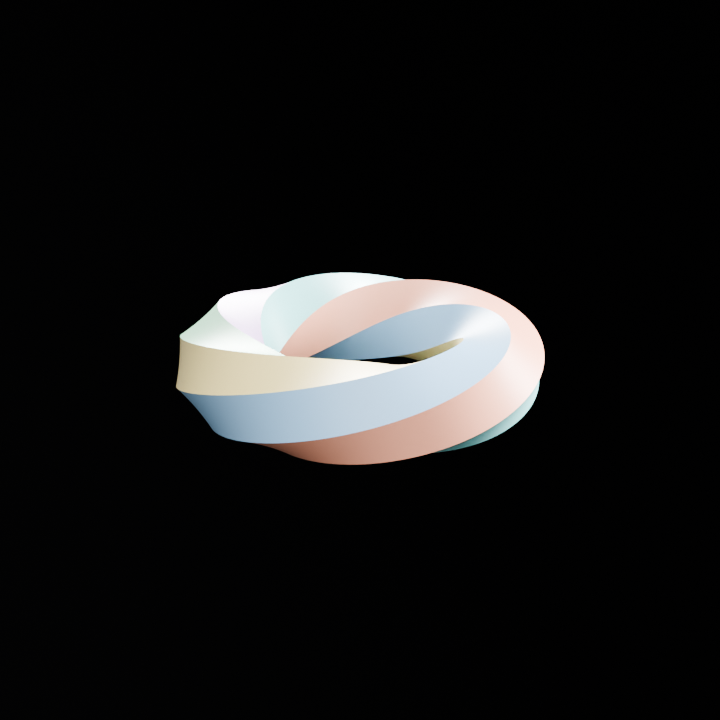
@RBehiel@JasonHise64 One idea I had was to use a shape-memory alloy. Four wires go along the ribbon, two pairs are "trained" to bend in opposite directions. By applying heat to them at different points and modulating it over time you can induce it to bend and rotate like Dirac's "belt".
@RBehiel@JasonHise64 I recently created an interactive version of this and had the same thought. https://t.co/26fbrEq8Pt
The code for this and a number of other mathematical objects accessible through a Blender extension may be found at
https://t.co/0hSjg5oCrg
@QuantaMagazine For those interested, Claude and I created an interactive site to explore the new 3D monotile: https://t.co/QOVUlQDgvd All errors are Claude's.
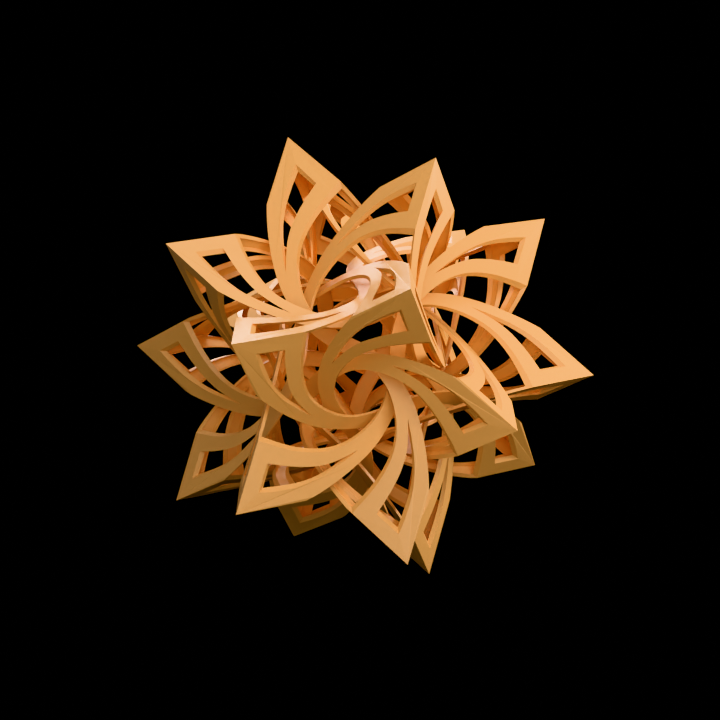
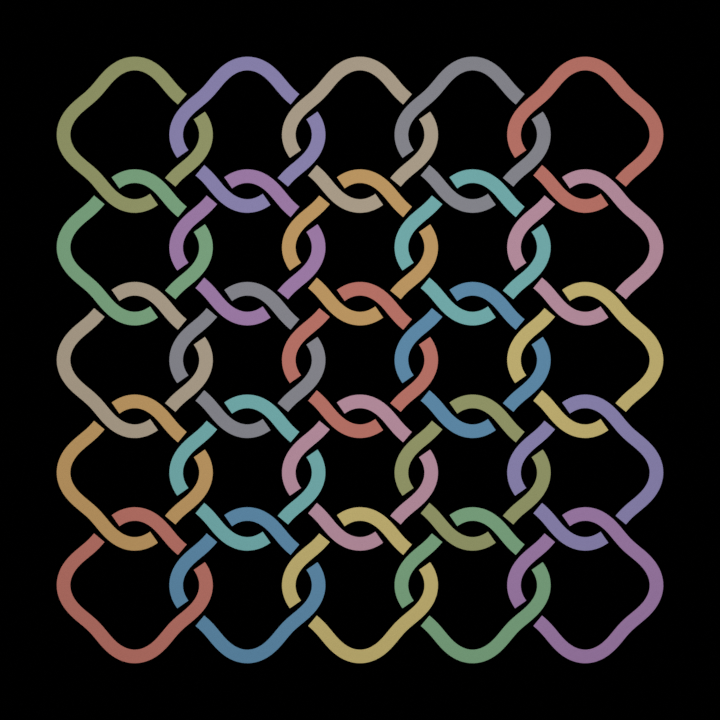
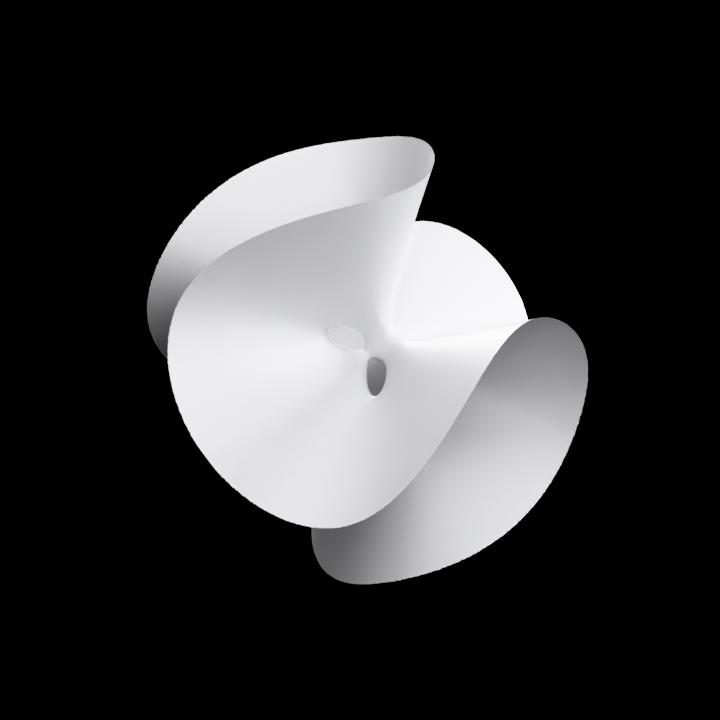
I just released a new version of Math Art, a Blender extension bundling 150+ mathematical-sculpture generators. #math#generativeart#mathart https://t.co/eEQBS1NxQh
This new release includes significant new functionality including coverage of nearly all polyhedra, minimal, algebraic and periodic surfaces. It has generators for fractals, knots, tangles, tilings and weaves.
I just released Math Art, a Blender 4.2+ extension bundling 50+ mathematical-sculpture generators — from minimal surfaces to Archimedean solids, torus knots, Menger sponges and woven polyhedra. Free & open source. #math#generativeart#mathart
https://t.co/GYUEoKGes0
@txyyss I'm really excited to see your work. I have spent a lot of time exploring Quintrino and her other sculptures using a manual process in Blender. I'm looking forward to understanding better how you model it mathematically.