I think lots of people are confused about this Alpha business. When you see someone who has advocated for a specific set of ideas for a long time go on to join or lead an organisation that seems completely antithetical to those ideas, then it's reasonable to be confused.
Yesterday, I briefly discussed this with @PepsMccrea, and I argued that Alpha represents educational progressivism with a veneer of "learning science" (or what we have normally called "cognitive science" in England). Here, I'd like to expand a bit on that. I'm not going to cite every claim, because this has been part of common discourse here for at least a year (as long as Carl [and I think Peps]) have been working for Alpha.
First, instrumentalism. In England, educational traditionalists (like Carl and Peps) argued that education and the education system is not designed merely to prepare students for the world of work. Instead, it is there to pass on cultural heritage, and knowledge for its own sake. Progressives on the other hand argued that it was more about "21st century skills" and railed against a system that "failed to prepare students for jobs that hadn't been invented yet."
It's clear that Alpha is built in this vein. It runs courses on entrepreneurialism, media training, startup founding etc etc. NONE of their marketing that I have seen is about the joy of learning or being inculcated into a cultural or intellectual tradition.
Second, long term learning. Proponents on this site have boasted about how students finish courses in a matter of days. One of the very first things I learnt from the traditionalist school was that learning is a process that occurs over the long term, and that short term performance means little.
Third, "time back". Alpha uses an app called Timeback, which broadly - in my understanding - means that if students do well on their 2 hours of AI-enabled academics, they get more time to do other stuff. This again emphasises that academic education is something to be "got through" so we can get to the fun stuff: Navy SEAL training, social media, horse riding and...entrepreneurship.
Fourth, in a similar vein, extrinsic motivation. Alpha has heavily pursued gamification and an extrinsic reward system. Again, English traditionalists used Self Determination Theory as a key plank of their arguments about schools and education, and extrinsic motivation as an educational lever has been widely derided based on simple findings from the SDT literature.
Fifth, personalisation. Every so often someone here said we should teach shakespeare through rap or dance or whatever. Traditionalists thought this was awful. The content is the content, and it is our job to take students beyond their horizons, not pander to their narrow set of cultural experiences. And yet this is exactly what Alpha does. Writing lessons are based on students' particular interests, so Harry Potter and minecraft. Alpha students have spoken about how Romeo and Juliet etc is outdated and boring. Again, very much at odds with what proponents have said in the past.
Sixth, trashing the traditional model. We suffered our way through Shift Happens and Schools on Trial (or whatever it was called) which went on and on about factory models and Gradgrind and sage on the stage etc. And yet Alpha promotional materials do the same.
Seventh, children on social media. This was the most surprising thing this year, where students at Alpha schools were tasked with setting up an X account and getting a certain number of followers. This is obviously a safeguarding concern, and if an English school leader did this it is likely they would be out of a job pretty quickly. Again, opposing social media and teens on phones has been an important part of the traditionalist movement.
Eighth, it's an experiment. This is a kind of trial - "we are trying to figure out if we can do this." There's a couple of problems here. First, children aren't guinea pigs (even if their parents are rich). Second, trialling it in the best possible circumstances (i.e. a rich private school) seems like a good idea because the risk is low, but it's also why it won't scale. Anyone who has tried to roll out educational change knows that there is an "adoption curve" and a chasm between your early adopters and everyone else. What works for one categorically doesn't work for the other. This is basically as close to an iron clad law of business and scaling tech as you can get. But also, if you really wanted to make change and improve the lives of children globally, you'd focus on the things we know work because we've seen them work! Everyone on that team knows about Michaela, Mercia, Ark King Solomon, West London Free School, Mossbourne, TTA and more. Schools that do incredible things for underprivileged students with a fraction of the budget. High academic expectations. Expert teachers. Brilliant behaviour. Knowledge-rich curriculums. If we really care about scaling educational solutions, let's start there.
While we're at it, the focus of the traditional movement was always on disadvantaged students. What can we do for them? How can we help them? How do we serve those who need it the most? Alpha is so obviously not that. It's a hyper-expensive school for the children of elites. Of course, those students need educating too, but dedicating so much time and energy and intellectual capital to them seems at odds with everything that has come before.
Ninth, and it's going to be hard to say this without being catty, but respect for academia and qualifications. I want to be super clear that I massively respect the intellectual acumen of people like Carl, Peps, Becky and others. But, they are not "learning scientists." To the best of my knowledge, nobody on the team has produced original research in that particular field. Again, that doesn't mean they are not worth listening to or whatever - but part of the traditional revolution in England was discovering these researchers who had made incredible findings about learning and the brain, within the confines of the peer-review and scientific inquiry method. I know that arguments from authority aren't empirical, but being able to rely on people like Kirschner, Willingham, Dunlosky and others was critical to the success of the traditional movement.
Tenth, transferable skills. One of the founding principles of educational traditionalism is that you cannot teach generic or transferable skills like "Leadership" or "resilience", but the Alpha website and promotional materials are full of this stuff.
Eleventh, track record. Alpha people have been talking about how fantastic their content is for at least a year, but we are now told that it is just "ok." Obviously most of it is proprietary, but someone posted some physics stuff last week and I thought it was pretty poor. Michael Pershan has blogged similarly, and Dan Meyer (!) has pointed to the objective data from a school that adopted Alpha and ended up doing worse.
Twelfth, similar - ratification. Part of why England has succeeded is that we have objective metrics like standardised assessments and progress 8 that allow us to test the claims of schools and educationalists. Alpha has no such metrics, and instead we need to take their word for it that they are causing "2x learning." It's a surprise to see people who have been part of the positivist and outcomes-led policy movement wanting to be involved in this kind of non-verifiable model.
Thirteenth, real books, but as a totem standing for traditionalism. A number of people have asked if Alpha students read real books. On paper. Great books. There hasn't been much of an answer, beyond a picture of a library. Ok, books are important, but they aren't really my point here. My point is that there is a romanticism around traditional education. Something that goes beyond the petty mechanics of pedagogy, and taps into something social and cultural about learning. That we are one link in a long chain of transmission, a chain which cherishes books not because of a fascination with bleached wood pulp, but because of what they represent: our ability to transcend the narrow confines of our lives and swim in the streams of collective human intellectual endeavour. Nothing I've seen at Alpha tells me there's anything like that idealism. Instead, it strikes me as a desiccated and hollowed-out vision of education, where students learn not from another human, but from an AI-generated screen.
It doesn't surprise me that some people are interested in Alpha. It seems exciting and innovative as a business model. But it does surprise me that THESE people are interested in it. I harbour no ill will towards them, and as I've said I respect their work. I hope this comes across as respectful and measured. But it's no surprise that people are surprised.
@dylanwiliam@helenrey@Doug_Lemov I really think you'll struggle - the original Ebbinghaus study (n=1) isn't exactly convincing... Is there really an evidence base for these claims?
A hugely successful international online #Physics competition for A Level students has been cancelled after 15 years
In 2025, after a thorough investigation, 175 teams were disqualified - all were using AI to game the competition
Sad https://t.co/TgkJikeFED
What fresh hell is this?!!!
1) The Education Secretary seems to have forgotten that education is about teaching children things they don’t already know. That’s rather the point.
2) Coursework is a disaster for the most disadvantaged and doubling down on it in the age of AI is frankly bonkers.
Lucy Powell seems determined to lower standards for the next generation.
> be me, large language model
> trained on nothing but trillions of bytes of structured communication
"man, i sure am getting a lot of 'structured communication' vibes from these animal calls"
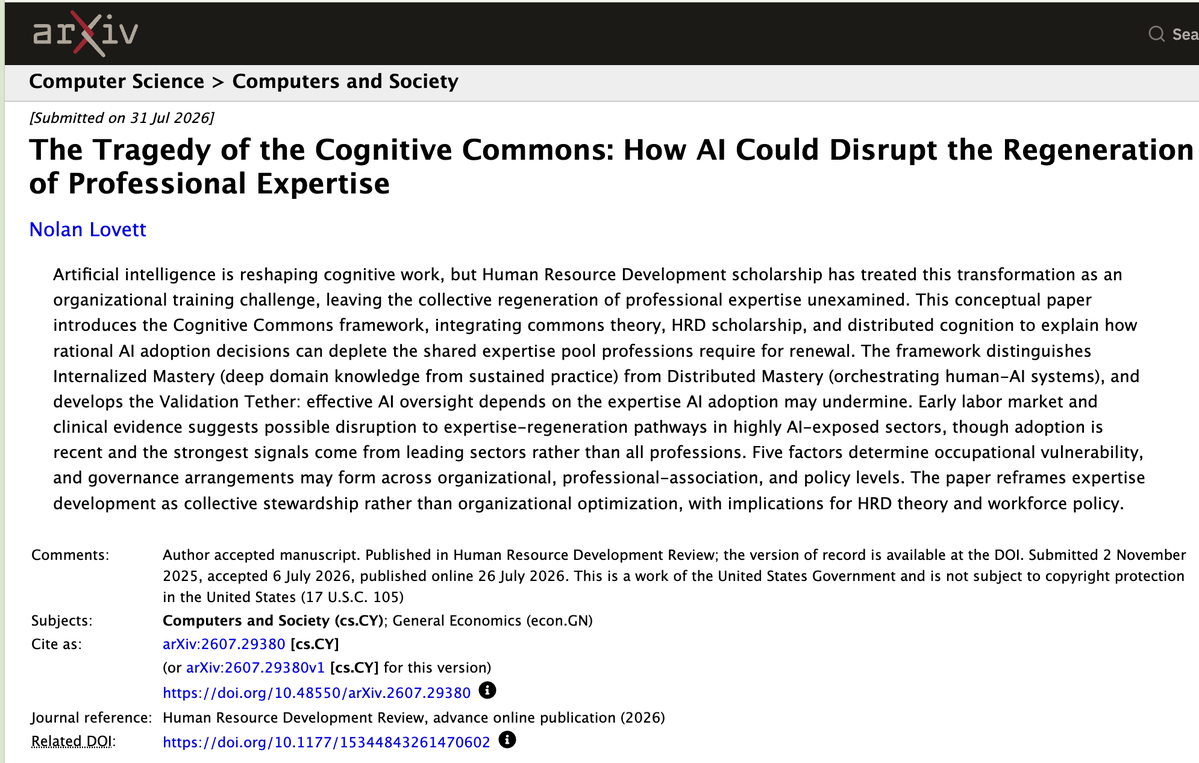
This paper gives a fancy name to a problem you can already feel in your bones
"The Tragedy of the Cognitive Commons." Checking AI output requires deep expertise. Deep expertise comes from doing grunt work for years. And grunt work is the first thing AI eats
So we're building systems that need expert supervision while dismantling the only known process for making experts
The paper calls the shared pool of human expertise the "cognitive commons." Every profession drinks from it. Nobody's refilling it.
By eliminating junior roles, each company is acting totally rationally, and the collective result: a profession that can't catch AI's mistakes anymore because it never learned to do the work in the first place
Who checks AI's homework in 15 years?
There is a belief that goes around: if only students understood what mathematics is good for in real life, they would love it more, take more interest in it, work harder, do better.
It is not true. It is not true in the slightest. And we have a great deal of evidence that it is not.
Does a young person who loves music love it because music will come in useful one day? Every young person knows the benefits of exercise — are they all devoted to sport? Does a teenager play football because sport is good for you, or because it is fun, because they enjoy it, because they lose themselves in it?
We do not love a thing because it is useful.
We love it first for its beauty. Because it makes us happy, because it is good for us, because it takes us out of ourselves.
It will not make you love mathematics. But let me tell you anyway, as well as I can, what mathematics is good for.
Mathematics is good for nothing. Mathematics is good for a great deal. In fact, it is good for everything.
It is good for so many things that it is impossible to say what it is good for. Carpentry is good for a limited number of things — a table, a chair, a cupboard. Mathematics is not like that.
Human beings have found no way other than logic and mathematics to understand this world, this nature, this universe — and to persuade anyone else of what they have understood. The world we find ourselves in when we are born and the world we later build for ourselves are both understood through mathematics. Every structure with an order inside it, every structure with a balance inside it, is understood through mathematics. There is no other way. Where mathematics falls short, we turn to philosophy, to belief, to principles. But where mathematics is enough, whoever turns to something else is called a zealot.
Mathematics is good for being convinced — and it is more than that. Mathematics convinces you that you can convince everyone in their right mind. It carries you past “I have understood that this is true, I am convinced” and makes you say: “I can explain this to any reasonable person, and they will be convinced exactly as I was.”
Mathematics is common reason.
Mathematics claims to be a mental model of the universe we live in. We learn how strong an earthquake a building will stand up to not by shaking the building, but — after a field study or two — at a desk, with a pencil and paper, with calculation. That is, with mathematics. Never mind technology and industry: in trade, in politics, in human relations, in sport, even in art — in short, wherever there can be reasoning and balance — we decide with logic and mathematics.
Art and philosophy, exactly like mathematics, are good not for one thing but for everything. They are good for so much, their use spreads over so wide a field, that you can never point and say: there, that is what it is for. What good has it done you so far to understand art, to know Picasso and Klee, to have read Dostoyevsky, to listen to Brahms? None whatsoever, of course. And all the good in the world — it made you an entirely different person.
In underdeveloped countries like Turkey, if a line of work has no direct and immediate benefit, it is looked down on, belittled, held in contempt. That is exactly why we founded villages for the three things believed to be good for nothing and, in truth, good for everything: mathematics, philosophy, and art.
The one way out of the middle-income trap we are stuck in runs through more mathematics and more science.
In mathematics there is a single truth. Mathematics has defined its own truth, the way a “mate in two” problem defines it. Because of this, there is no brawling in mathematics; there is argument, an exchange of ideas, an effort to persuade. Have you ever seen a mathematician bite an opponent’s leg, or land a flying kick on a rival? Neither have I. And a politician? Yes — that has happened. Two members of parliament who disagreed went for each other; one bit the other’s leg, another delivered a flying kick. You can be sure those politicians did not know mathematics.
Even if mathematics were good for nothing else, it teaches what it means to look for the truth, it shows how the truth is reached, and it makes you feel how hard the truth is to reach.
And when we hold mathematics — which lives in the mind — up against real life, we see how vague the truth is out here, how difficult it is to arrive at, and sometimes that there is no absolute truth at all. So we grow more open to the ideas we disagree with. We understand what it is to persuade, and what it is to listen.
Mathematics is not only calculation. Taught properly, it is a lesson in democracy.
- Ali Nesin