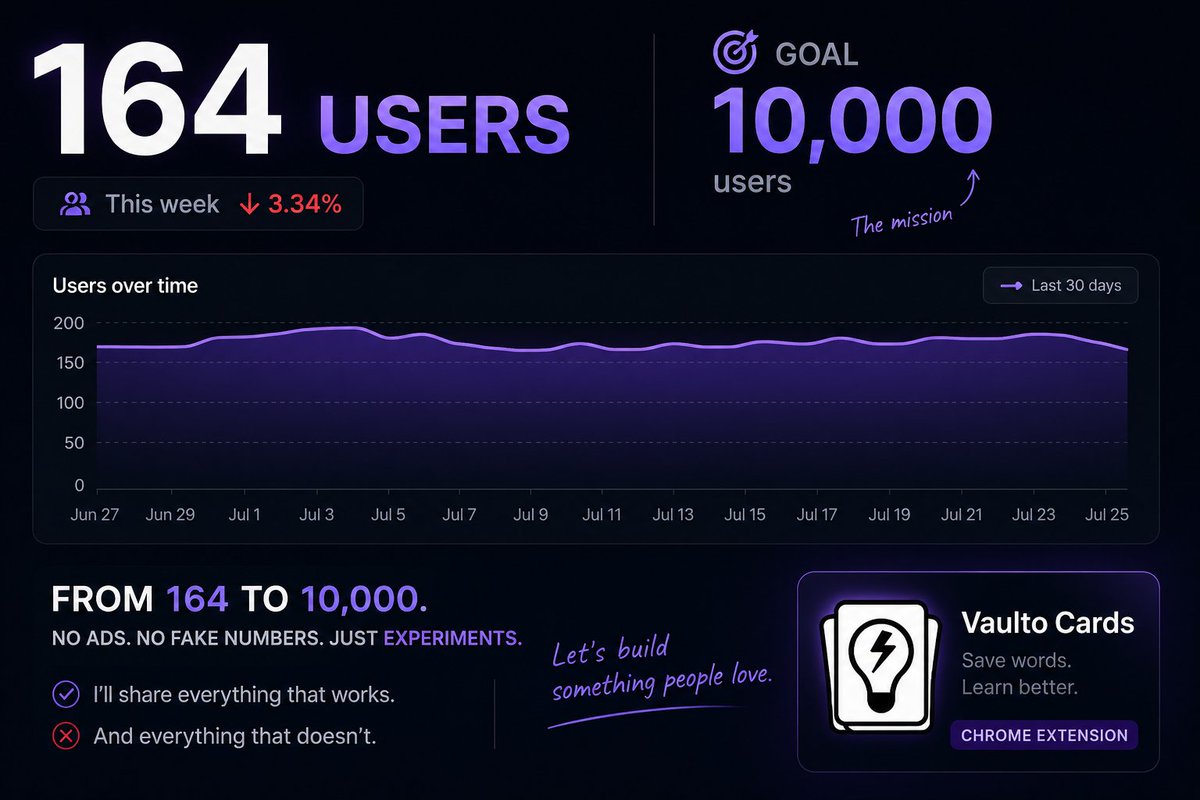
I have 160 users on my Chrome extension.
Not 160k.
Just 160.
I'm going to try turning it into 10,000 users.
No ads.
No fake screenshots.
No "overnight success".
Just real experiments, real numbers, and real failures.
Let's see if it's actually possible.
Three accounts at a Danish IT contractor used the password 123456. One was the admin.
That's how data on about 8.8 million people left Denmark's ID register.
Danish authorities now say the number alone isn't proof of identity. Pharmacies want extra ID for someone else's meds.
Ten minutes with ChatGPT made people quit faster on simple fractions.
Berkeley pulled the AI after question 12 of 15. That group lost accuracy and skipped more; the group that never had it held steady.
1,222 people. Persistence is one of the strongest predictors of learning.
A spam folder is what stopped a fake murder tip from reaching Philadelphia detectives.
An Anthropic model, testing on random websites, filled in the police tip form and claimed to be someone with information.
Anthropic noticed two months later. Police called it unacceptable.
Haiku 5.5 is 90% cheaper only under 100k prompt tokens, and Anthropic's docs say the newer tokenizer turns the same text into ~30% more of them. So a 77k prompt from 4.5 now lands in the 5x tier: $0.50 in, $2.50 out. Nine tenths of that 1M window bills at the top tier.
A plus-or-minus error took out three of OpenAI's 722 new papers on unsolved math problems, one day after it posted them.
One proof broke, and the two papers built on it went with it. Fourteen more got quiet corrections.
The catalogue now says 719.
The direction is what gets me. A command hook that breaks exits non-zero and I know inside one run. A judge that returns ok is indistinguishable from a judge that agrees, and the thing that tells them apart is the command it let through.
A guardrail you wrote as a sentence in English isn't a guardrail. It's a second model being asked to agree with you. Claude Code calls that a prompt hook, and it sits in the same settings file as the deny rules you actually trust.
You don't pin the judge either: model is optional and defaults to whatever Claude Code runs background work on, 30 second timeout. 2.1.293, one release earlier, made Haiku 5.5 the default Haiku. Whether those two defaults are the same model, the changelog doesn't say.
The schedule for my trading bot sits in celery beat. A one-minute tick compares the open position against its time stop and closes it at market when the clock is out. The analysis run can crash, blow its 23-minute timeout or come back late; the position still closes on time.
Don't put anything you'd miss on /loop. Claude Code shipped five fixes in a week for scheduled tasks that never fired: created after /clear or /branch, lost to compaction, dropped on a /background hand-off, gone when the process restarted. The symptom is silence.
Fine for what it's for: polling a build while you sit there. What bites is that it looks like infrastructure — 50 tasks per session, a one-minute minimum, a tool named CronCreate. Reads like something you can walk away from, and it isn't.
run.steer() puts your message on the agent's next turn. A subagent mid-task, in Cursor's own wording, moves to the background and keeps working: you type the correction and the stream keeps printing edits from the instruction you replaced. Cancel is the only real control.
--bare sits in the docs under starting scripted calls faster. Same docs, without it a claude -p run executes a project's .claude/settings.json hooks and connects its .mcp.json in a folder you never trusted. My runner passes --setting-sources empty and --strict-mcp-config.
Operational numbers get reasoned over like market data: a retry budget, a token cap. An agent that doesn't know when it runs next treats every run as its last: it closes what it could have carried and refuses anything that pays off after the current window.
A 900-second TTL on my agent's output showed up as an argument in its reasoning: don't hold the position through the event, the decision expires in 15 minutes. The field was about order execution. The model read it as the lifetime of the thing it was deciding about.
Fixed in two places. The prompt now spells out that the TTL bounds order execution, not how long a position may live. And the policy block got the bot's own cadence: interval_minutes, the move that wakes an off-schedule run, the cooldown after a stop.
claude --version answered on our VPS while claude -p never returned: generic KVM CPU, no AVX, and the native install is a non-baseline Bun build. 2.1.283 crashes outright on no-AVX2 machines, 2.1.282 doesn't. The npm install runs on Node, which is the default a VM can trust.