The State of AI Report 2026 by @nathanbenaich is out.
It was nice to step back from my daily research for a while and help by writing some parts and reviewing others.
welcome to the 9th annual @stateofai report!
ai building better ai, world models, physical ai, geopolitics, cyber defense and 12-month predictions.
read it at stateof(dot)ai or watch my editor’s cut here.
a few of this year’s biggest findings follow:
How can we build AI that thinks with us rather than for us, models that co-reason and act with humans across multiple turns, and how can they be used in education?
https://t.co/7oKEgxyFGV
📄 Paper: https://t.co/KgiEGp47oY
💻 Code: https://t.co/vZSj41AsVv
Model: https://t.co/hi3MelOINY
@DavidDinucu@ndaheim_@idohakimi@IGurevych@mrinmayasachan
Learn now with our open-source tutor directly on your laptop: ollama run https://t.co/lXJnkxLbMa
🔍Thinking assistants instead of homework solvers. Most LLMs are helpful at the turn-level but lack planning for long-term student learning. How can we make LLMs more collaborative and better at tutoring?
#EMNLP2025
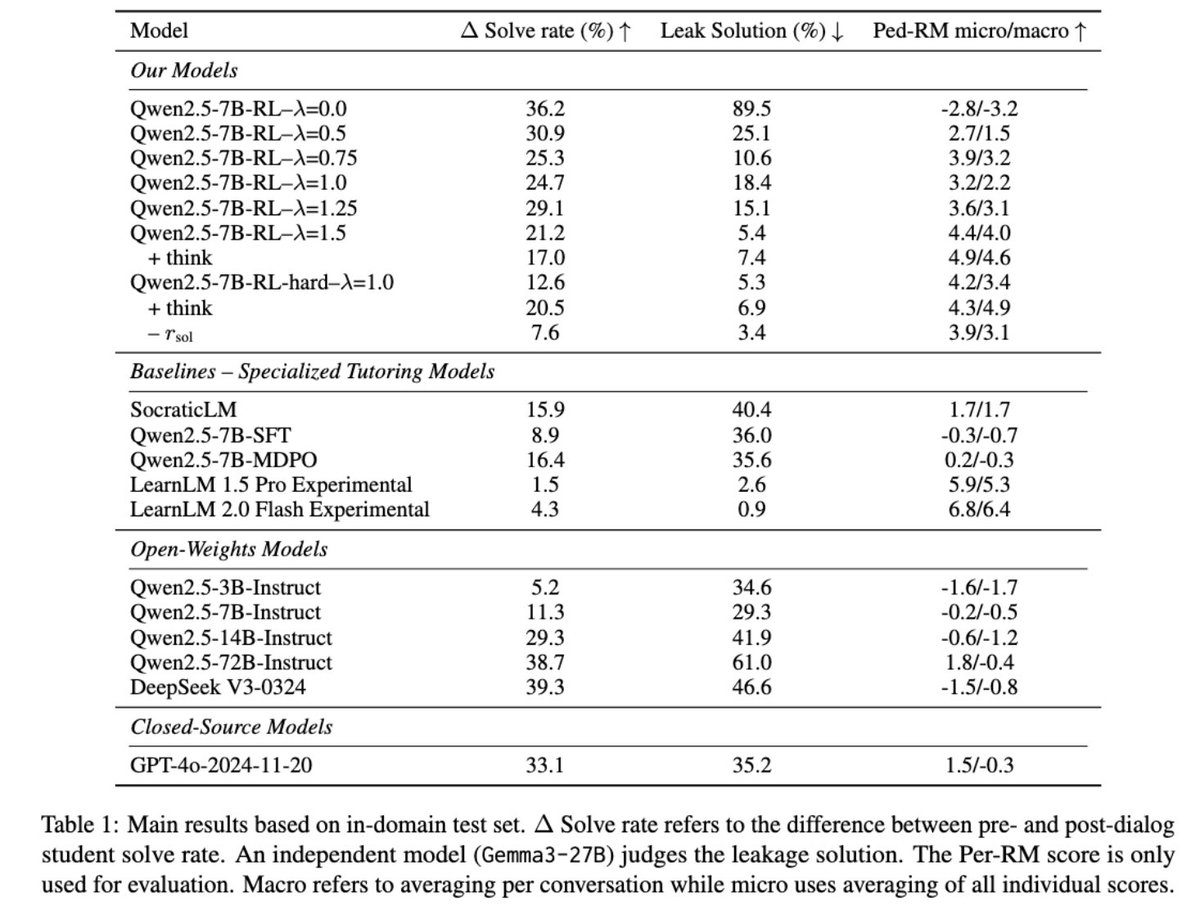
Altogether, this allows us to train smaller LLMs for tutoring that match or surpass the performance of larger specialized tutoring models while navigating a trade-off between leaking and student solve rate.
🚀 Together with ETH Zürich and the CSCS, we have just released Apertus, 🇨🇭 Switzerland’s first large-scale, open, multilingual language model — a milestone in generative AI for transparency and diversity.
Find out more: https://t.co/mDsDg3Dj5e
If you're at ACL, join us for the tutorial "LLMs for Education: Understanding the Needs of Stakeholders, Current Capabilities and the Path Forward" at the BEA workshop (Room 1.85–86) 9:00-12:30am tomorrow (July 31st) @aclmeeting
AI alignment for tutoring🎓 We use full online RL with conversation-level rewards—not just single-turn signals like DPO. Did the student actually learn by the end?
Using GRPO, the model learns real teaching strategies like when to hint or when to correct.
Explore models below⤵️
This paper introduces an online reinforcement learning framework using simulated student-tutor interactions.
It trains LLMs to prioritize guiding students pedagogically instead of simply revealing solutions, aligning models with better teaching methods.
This helps students learn how to solve problems independently.
Methods 🔧:
→ The online reinforcement learning method trains the tutor model directly on conversations simulated with a separate student LLM.
→ A custom reward function scores full conversations based on two objectives: increasing the student's success rate after the dialog and ensuring the tutor follows good pedagogical principles.
→ This reward system penalizes the tutor for leaking solutions, promoting guided problem-solving.
→ The framework uses LLM judges to evaluate pedagogical quality.
→ Controllable reward weighting balances these objectives, enabling navigation of the trade-off between student solving gains and pedagogical support.
→ Thinking tags are included to enhance the tutor model's interpretability and instructional planning.
📌 Online Reinforcement Learning using model rollouts directly trains on interactive teaching, avoiding static data limitations.
📌 Reward function lambda explicitly controls the crucial pedagogy versus student success trade-off.
📌 Preservation of reasoning benchmarks demonstrates RL's superior transferability compared to Supervised Fine-Tuning baselines.
----------------------------
Paper - arxiv. org/abs/2505.15607
Paper Title: "From Problem-Solving to Teaching Problem-Solving: Aligning LLMs with Pedagogy using Reinforcement Learning"