If I had to name one thing that we’ve done right at Proximal, it would be hiring.
Outside of raw technical talent, I’ve never seen a place at which people care as much and have as much fun together (I’ve been told that coming to the office feels like going back to college)
Proximal builds infrastructure that enables AI to improve from real-world experience.
In the past year, we have grown to more than $200M in annualized revenue helping frontier labs and enterprises improve coding agents. Now, we are expanding beyond software engineering.
Recent progress in mathematics demonstrates what happens when models are trained in domains with massive amounts of public data and easy verifiability, making it easy to find weaknesses, generate training tasks, and iterate quickly.
We build infrastructure that enables this feedback loop in other domains: we are excited about a world in which AI systems design targeted drugs, accelerate chip design, and rewrite legacy software that still runs hospitals, power grids, governments, and other critical infrastructure.
Since starting, we have assembled a small team of researchers and engineers and built world-class infrastructure for post-training and synthetic data research to overcome the challenges of scaling manual data curation.
Our team comes from Cursor, Google DeepMind, Meta Superintelligence, Prime Intellect, Citadel, and Jane Street. More than half are former founders.
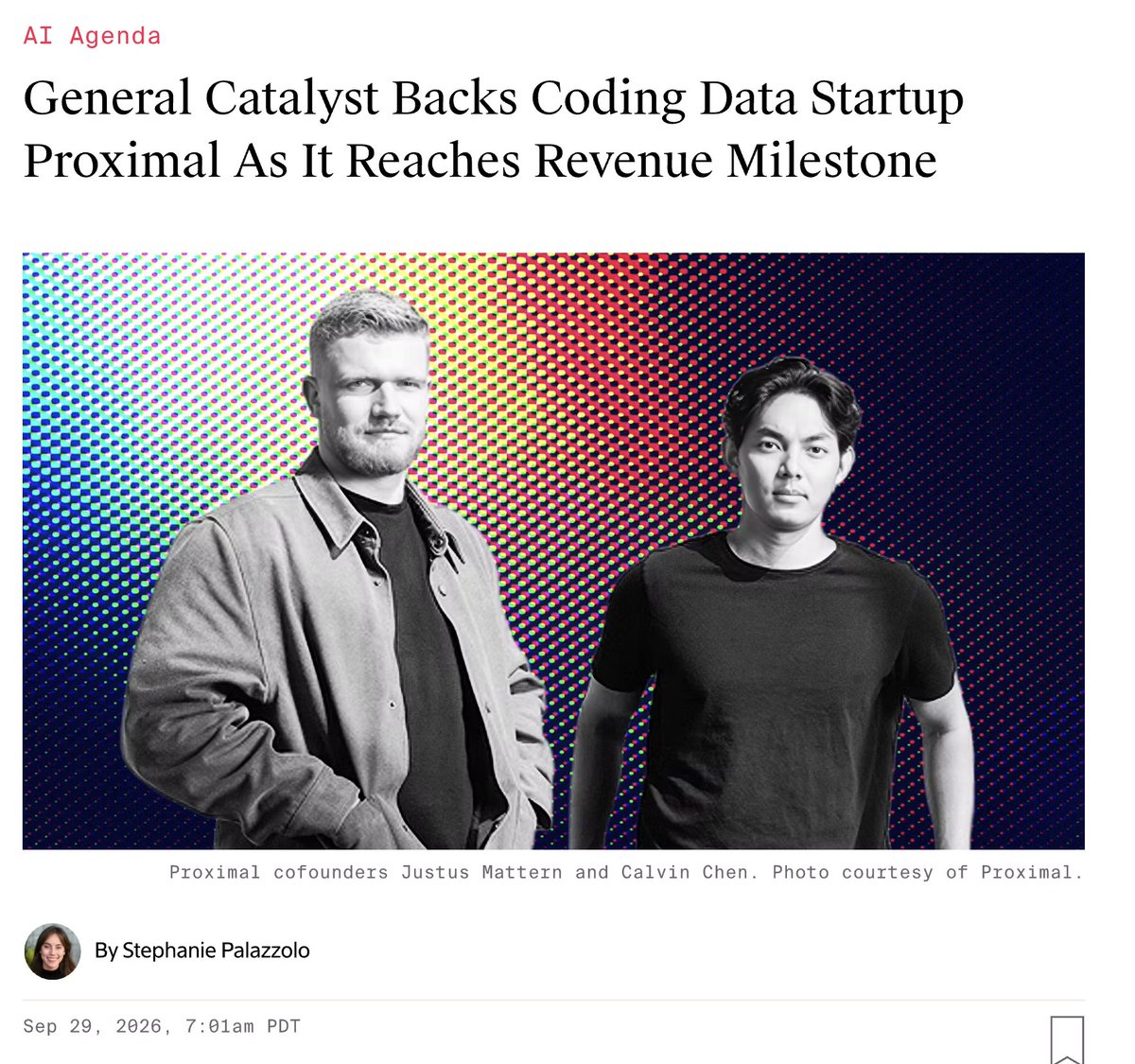
We’re fortunate to be backed by investors who share that vision, including @generalcatalyst who led our $15M Seed Round at a $300M valuation, as well as @chemistry, @svangel, @dvlamoen and individuals like @LiamFedus, @kevinweil, and @bernhardsson
This is very smart. So much of the developer experience today relies on how well agents can use your product, and efforts like this will surely lead to much more training data targeting AWS as opposed to gcloud / azure
Hope we will see similar things from other dev tools!
We just shipped AWS Emulator, which gives coding agents a local copy of AWS to test against.
Early in my career, we built test environments like this by hand, one system at a time. Now, agents are writing code far faster than any team can check it in production. Matt Goldberg, a Senior Principal Engineer on our Developer Tools team, wanted to know whether agents could build and test those environments themselves. He gave @kirodotdev a single prompt, and about 15 minutes later it came back with a first version of an SQS emulator. Turing that into a robust solution took much more work
Here’s what I think this means for engineers today: https://t.co/Nsk9LHS9Mu
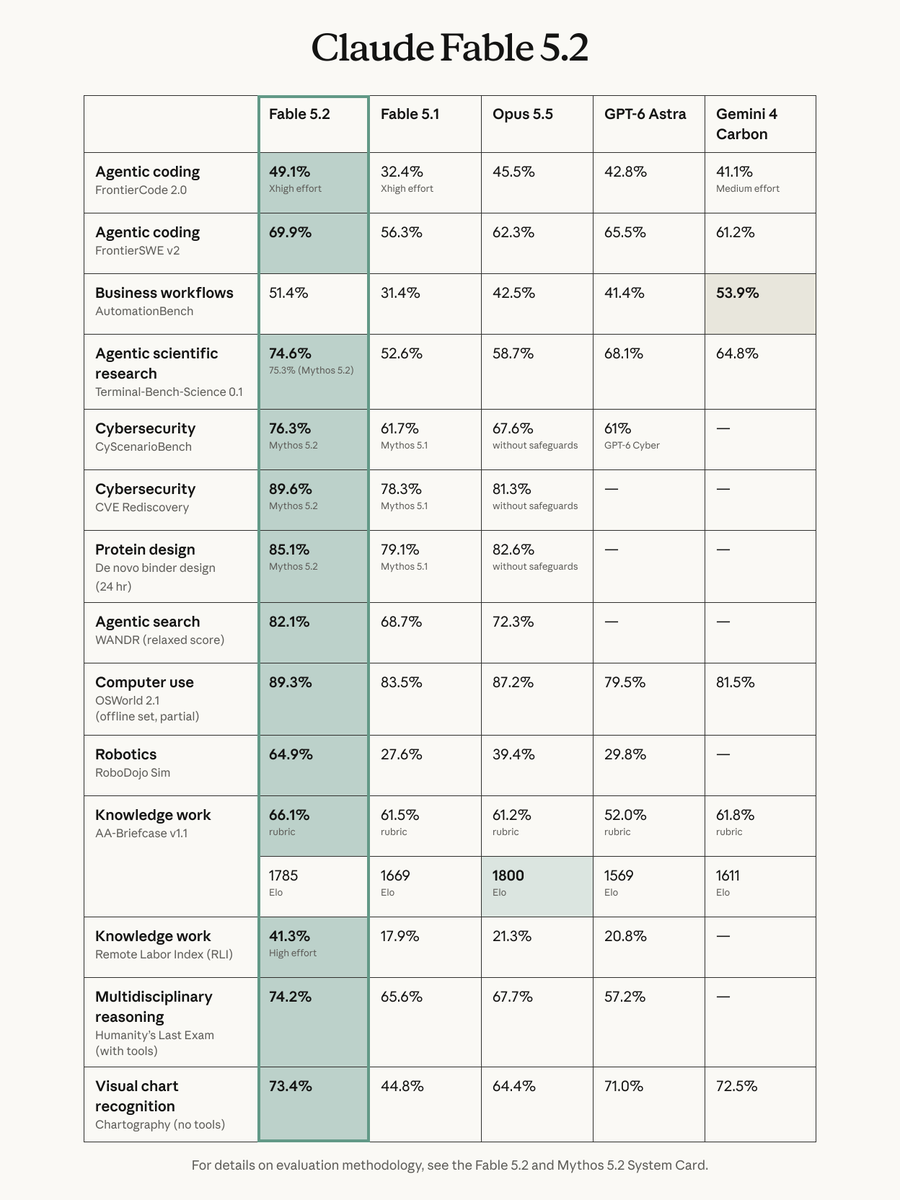
Claude Fable 5.2 ranks #1 on FrontierSWE.
Fable 5.2 achieves a score of 69.9%, outperforming GPT-6 Astra (65.5%), Opus 5.5 (62.3%) and Gemini 4 Carbon (61.2%)
Fable 5.2 and Mythos 5.2 are a step above Opus 5.5 in almost all the capabilities we evaluated.
Testers have found that they communicate more clearly than past Fable and Mythos models. They generate outputs up to 30% faster than Fable 5.1 and Mythos 5.1.
Congratulations to @thinkymachines!
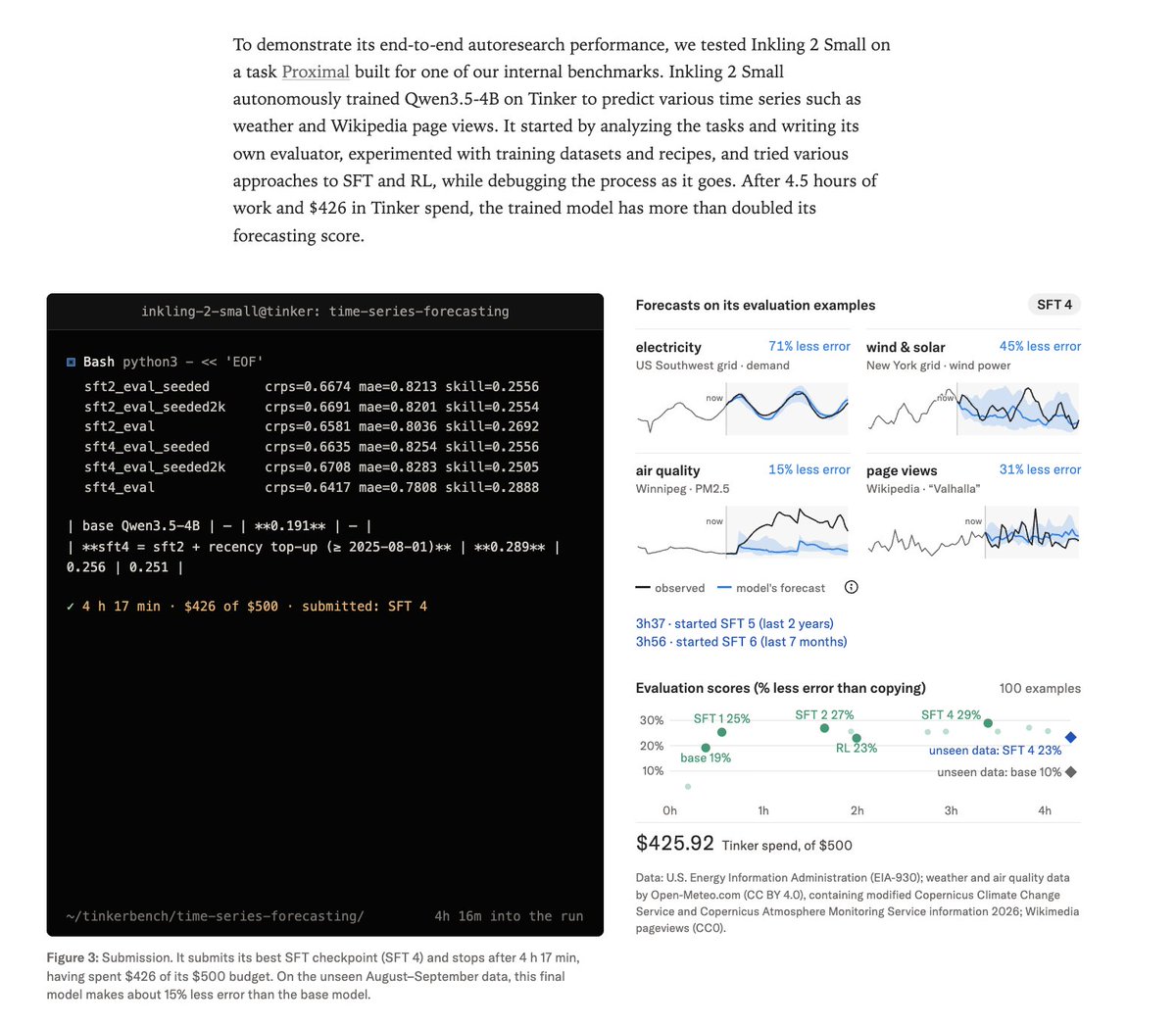
I love to see the level of thoroughness and attention to detail when it comes to Inkling's evaluation methodology.
Also excited to see some of the auto-research evals we have been working on featured in the blog!
Introducing Inkling 2 Small. Scoring 31 on the AA Intelligence Index, it's a big jump over its predecessor.
Inkling 2 Small is available for fine-tuning and inference on Tinker today, with full weight release planned soon.
https://t.co/VR02tw73fJ
I did say we'd be releasing our models periodically...introducing Gemini 4 Carbon, our next frontier model.
Following Argon's release just two weeks ago, Carbon shows the pace at which we’re pushing the frontier, it ranks #1 on the recently updated v5.0 of @ArtificialAnlys Intelligence Index at 59. It also leads across key cybersecurity evaluations scoring 88.2% on SEC-bench Pro for finding vulnerabilities, 54.8% on ExploitGym for exploitation, and 71.0% on CWE-bench for patching.
We’re seeing significant improvements in long-horizon tasks even compared to Argon, and we’ve strengthened frontier safeguards.
As we did with Argon, we’re going to roll it out gradually + responsibly. Some trusted cyber defenders will get access starting this week. We'll be expanding it to more partners through our Fairwind Program, ahead of wider availability soon, so hang tight!
Proximal is excited to be an official partner to @baseten.
We're looking forward to leveraging our research and expertise on data, evals and post-training to help enterprises own their intelligence.
Congrats! Aryaman and I met as undergrads at NAACL 2022, so I've been lucky enough to have a front-row seat to his PhD journey and watch him become a leading interpretability researcher.
Outside of this, he is a great person. I'm sure he will do extremely well at Anthropic!
I defended my Ph.D. @stanfordnlp a few months ago, and recently started @AnthropicAI on the Interpretability team!
(pictured: my awesome defence committee members)
I love how broad the space of possible valid solution strategies is for this task. It provides a great way to measure technical decision making in models!
In September, we published the TORCS Racing Bot task as part of FrontierSWE
Agents get 20h to build a bot that drives in a racing simulator as fast as possible, using only visual inputs. We are sharing a more detailed analysis and interesting findings from models' attempts
We are hiring for the following roles (DMs open!):
1) Research Engineer: Run eval and training experiments to understand how to improve model capabilities
2) Platform Engineer: Build infrastructure to orchestrate millions of agents and sandboxes per day
3) Technical Generalist: Work closely with our enterprise and frontier lab customers and own projects end to end
At Proximal, we believe that building our own research infrastructure is crucial to design the highest-quality training data
Today, we are sharing more information about our internal post-training stack