This is the most important post you'll ever see.
The biggest question I get is what happens if you bought the top of individual stocks that may never recover.
Here's how to recover, the professional way:
1. Tax Loss Harvesting (do this first)
This is the single most valuable move you can make right now. The IRS lets you use investment losses to offset gains and reduce your tax bill.
How it works:
- Sell your losing positions to realize the loss on paper
- Use those losses to offset any capital gains you had this year (from other trades, crypto, real estate, etc.)
- If your losses exceed your gains, you can deduct up to $3,000 per year against ordinary income
- Any remaining losses carry forward indefinitely to future tax years
The swap trick:
- For example, sell $NBIS at a 70% loss, book the loss
- Immediately buy a similar but not "substantially identical" stock (this avoids the wash sale rule)
- Example: sell one AI infrastructure name, buy another. Sell $SMCI, buy $DELL. Sell $NBIS, buy an AI ETF. You stay exposed to the same theme but you banked the tax loss.
- The wash sale rule says you cannot buy the same or substantially identical security within 30 days before or after the sale. Different companies in the same sector are fine.
The math:
- You put $50K into AI stocks, now worth $15K. That is a $35K realized loss if you sell.
- If you had $20K in gains elsewhere this year, that $35K loss wipes out the $20K in gains (saving you roughly $3,000 to $7,000 in taxes depending on your bracket)
- The remaining $15K loss carries forward. $3K offsets income this year, $3K next year, $3K the year after, and so on.
- You are literally getting paid by the government to reposition your portfolio.
Deadline: You must sell BEFORE December 31 to claim the loss for this tax year. Do not wait.
2. The Quality Audit
Pull up every position and sort them into three buckets:
Bucket A: Leaders with real earnings - $NVDA, $MSFT, $GOOGL, $META, $AMZN, $ORCL, $TSM
- These are down 30 to 50% but they print cash, have massive moats, and will recover
- Action: hold, or add slowly if you have capital
Bucket B: Promising but speculative- companies with real revenue growing fast but no sustained profitability yet
- Action: trim to a size where you can sleep at night. If it goes to zero tomorrow, it should not change your life.
Bucket C: Hopes and dreams - pre-revenue, story stocks, SPACs, names down 70%+ with no clear path to profitability
- Action: tax loss harvest these immediately. Sell, book the loss, move on. These are the ones that may never come back. Down 70% can easily become down 95%.
3. The Rebalancing Framework
You said you put "all your money" in AI stocks. That is the real problem, not the drawdown. Concentration killed you, not the thesis.
Target allocation going forward:
- 55% core holdings (strongest fundamental leaders or blue chip leaders)
- 30% high conviction sector bets (AI infrastructure, semis, cloud)
- 15% growth and speculative (the ones you believe in long term)
How to get there from here:
- Use the tax loss harvest proceeds to buy broad index exposure
- You are not "giving up" on AI. You are building a base that lets you survive the volatility without panicking.
4. The Dollar Cost Average Recovery
If you believe in AI long term (and you should, the capex cycle is real), set up a systematic plan:
- Take whatever new capital you can invest each month
- Split it: 60% into stronger fundamental names, 40% into your highest conviction AI name
- Do this every single month regardless of what the market does
- In 12 to 24 months, your average cost basis will be dramatically lower than your original buy
This is how you turn a bad entry into a good position over time. You are not "averaging down" emotionally. You are executing a plan.
5. The Covered Call Income Strategy
If you hold 100+ shares of any position, you can sell covered calls against them to generate income while you wait for recovery.
How it works:
- You own 100 shares of $NVDA at $140 (bought at $200)
- Sell a call option at $170 strike, 30 to 45 days out, collect $400 to $800 in premium
- If NVDA stays below $170, you keep the premium and your shares. Repeat monthly.
- If NVDA goes above $170, your shares get called away at $170 (you still made $30/share from your current price plus the premium)
The math over a year:
- Collecting $500/month in premium on a $14,000 position is roughly 40% annualized income
- This dramatically accelerates your breakeven timeline even if the stock goes sideways
6. The Roth Conversion Play
If your portfolio is down 70%, this is actually the best time to do a Roth conversion.
- Convert your beaten down AI stocks from a Traditional IRA to a Roth IRA
- You pay taxes on the current (low) value, not the original value
- When those stocks recover (and if they are quality names, they will), all the gains are tax free forever
- You are essentially converting $15K worth of stock that you originally paid $50K for. You pay tax on $15K now instead of $50K+ later.
7. The Mental Framework
Stop thinking about your entry price. It is irrelevant. The market does not know or care what you paid.
The only question that matters every single day: "If I had cash instead of this position right now, would I buy it
today at this price?"
- If yes, hold.
- If no, sell and redeploy into something you would buy.
- If maybe, trim to a smaller size.
Your portfolio should only contain positions you would actively choose to own today. Anything you are holding just because you are "waiting to get back to even" is a position you should probably exit.
The Action Plan (this week)
1. Today: List every position, current value, and loss amount
2. This week: Sort into Bucket A, B, and C
3. Before Dec 31: Tax loss harvest all Bucket C names. Swap into similar exposure or broad index.
4. January: Set up the monthly DCA plan. Start the covered call strategy on your largest positions.
5. Ongoing: Stop checking daily. Set a calendar reminder to review quarterly.
The people who built generational wealth in markets all have one thing in common: they survived their worst trade and kept going.
This is that moment. I got you.
US equity futures down on reports that President Trump is set to impose new tariffs on China, the EU and 14 other countries.
Never a dull moment with this administration.
I think every investor should read this letter from Jeff Bezos when Amazon's stock fell -80% back in 2000.
It will teach you a lot about emotional discipline & irrational markets:
This is all you need to do to make millions in the stock market. Save this. Screenshot it. You will need it.
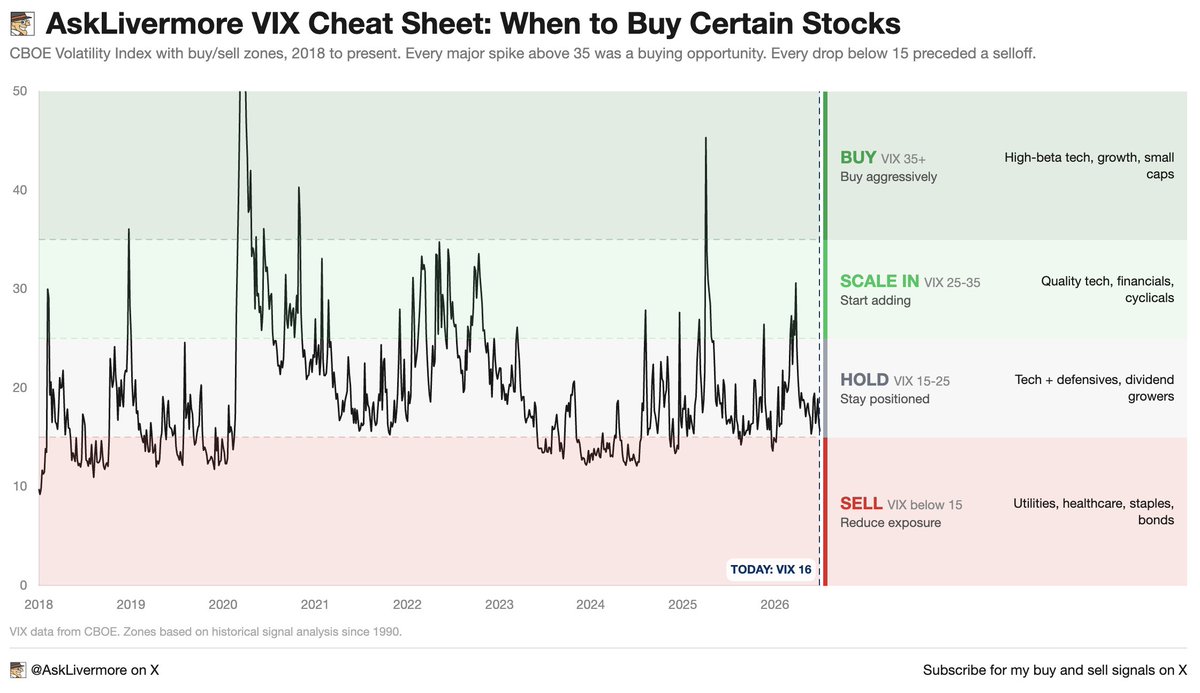
1. VIX above 35: buy aggressively
- High-beta tech, growth, small caps
- Every single time the VIX spiked above 35 since 2018 was a generational buying opportunity. COVID bottom. Oct 2022 bottom. Tariff crash. If you bought when everyone else was panicking, you made a fortune.
2. VIX 25 to 35: start scaling in
- Quality tech, financials, industrials, cyclicals
- This is where smart money starts building positions. Not all at once. Gradually. The fear is real but the opportunity is bigger.
3. VIX 15 to 25: hold
- Balanced: tech + defensives, dividend growers
- This is normal. Stay positioned. Don't chase, don't panic. Let your winners run.
4. VIX below 15: reduce exposure
- Rotate to: utilities, healthcare, staples, bonds
- This is when everyone is comfortable. Nobody is hedging. Nobody is worried. That's exactly when you should be.
- Every major crash in market history was preceded by the VIX sitting below 15 for weeks.
Right now the VIX is at 16. We're in the hold zone. Stay positioned but stay alert.
Bookmark this. The next time the VIX spikes above 35, don't freeze. Buy.
Over the past couple weeks we've met with management teams across memory, optics, neoclouds, semis, semi cap equipment and substrates.
Everyone is frustrated and confused about their stock prices but everyone is still very, very bullish.
Everyone expects 2027 capex to be significantly higher than 2026 and they expect 2028 capex to be moderately to significantly higher than 2027.
Everyone knows the YoY capex growth rates will decelerate but the total dollars spent will continue to get bigger... at least for the next few years. Everyone says we're still in the early innings of ai adoption.
Every company in the ai ecosystem is 50-100% sold out for 2027 and 40-80% sold out for 2028.
Everyone is sitting on LTAs from the hyperscalers... some of those LTAs are getting signed and they last anywhere from 3 years to 6+ years... and they're getting done at record prices and record margins. Customers can't take the chance of not having enough supply to meet their needs over the next 3-5 years... locking up supply at record prices is better than not having enough supply when it's needed the most.
Some of these LTAs could consume more than 50% of their supply over the next 2-3 years and at least one company has an LTA that would consume 75% of their capacity over the next 2-3 years.
Neoclouds continue to see demand that is 5-10x higher than capacity. Many of them are saying the financing concerns are overblown. They're seeing 3-5 year deals get signed at 10-20% higher prices that the first half of 2026 and they think deals signed in the first half of 2027 will have 10-20% higher prices than deals signed in the second half of 2026. Power is still a big bottleneck and many sites are dealing with small construction delays but nothing is getting canceled. Customers are desperate for compute. Many of the neoclouds are trying to reserve 10-15% of capacity for shorter term deals and spot market because rates are 2-3x higher than the 3-5 year deals.
Memory companies say demand will outstrip supply until 2029 at the earliest. They are very confident LTAs won't get cancelled because even at record prices for memory, the customers have enough margin to make it work.
I know there's lots of fear and uncertainty in the market right now but it's not showing up in the demand... it remains stronger than ever... many backlogs are growing faster than current revenues.
In 20+ years of investing, I've honestly never seen this much dislocation between fundamentals and valuations. This is truly a historic time to be an investor and not in a good way. It's very hard to be patient and lean into your conviction/thesis during times like this but that's probably the right strategy for most long-term investors.
Hopefully the lows are near. Make sure you are getting sleep, sunlight and exercise. Protect your mental health if possible.
The US equity market is experiencing a historic losing streak:
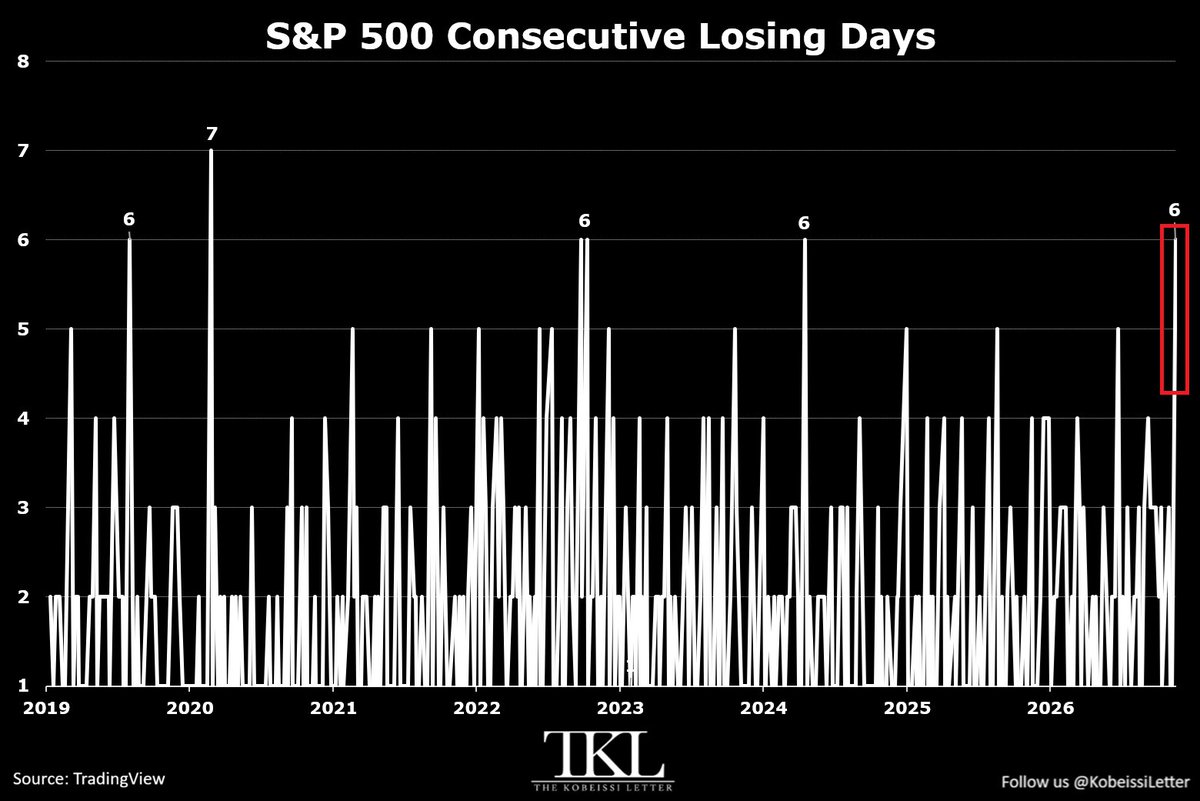
The S&P 500 has declined for 6 consecutive trading sessions, its longest streak since the 2020 pandemic sell-off.
Over this period, the S&P 500 has declined -5.8%, to its lowest level since April.
Today, the S&P 500 is on track for its first 7-day losing streak since the 2020 pandemic.
The S&P 500 is now also on track for its 5th weekly loss over the last 6 weeks.
On Thursday alone, just 38 stocks in the index finished higher, the lowest reading since December 31st, 2025
Meanwhile, the Nasdaq 100 index has declined in 5 of the last 6 trading sessions, down -6.6% over this period, to its lowest level since April.
US equities are under historic selling pressure.
THESE NUMBERS ARE RIDICULOUS.
The top AI stocks are down 53% on average from their peak.
In the dot-com crash, the top stocks fell -89%. In 2008, they fell -87%.
But it took 2.5 years for the dot-com crash to play out, and about 1.5 years in 2008.
AI stocks have lost 53% in just 5 months.
Already, 22 of the 39 biggest AI stocks have lost more than half their value and Yet the S&P 500 is down only 8.5%.
In 2000, the Nasdaq fell 78%, and in 2008, the S&P 500 fell 57%.
This time, giants like Apple, Microsoft and Amazon are keeping the index up, so most people don't see how bad it is.
The biggest AI companies haven't fallen much yet either.
The index may not crash like 2000 or 2008, because today's biggest companies are making huge profits and paying for AI mostly with their own cash.
In 2000, the leaders traded at over 100 times earnings, and in 2008, the banks were drowning in debt.
The unwind everyone's waiting for..
back in October someone paid about $173 million for year-end SPX puts
at Thursday's close they were worth about $650 million
that's nearly $480 million of profit.. and as far as we can see they haven't sold a single one
so what happens to vol when they do?
(thread)
It's clear now more than ever:
Ultimately, this bear market in tech stocks will be remembered as the best buying opportunity of the last decade.
Unless your view is that the AI is worthless and the AI Revolution is over, many key parts of this market are extremely cheap.
Democrats will be more friendly to AI than expected, Nvidia will survive its leadership crisis, and concerns around CapEx and free cash flow will prove to be overblown.
To top it off, current sentiment is as if the market has just gone through another 2008, all while the S&P 500 is posting +32% earnings growth.
The comments on this post will show you just how polarized sentiment has become in the direction "bubble" callers.
Fear creates an investor's biggest opportunity.
Bookmark this post.
Lots of posts on X that this is 2000, 2008 or 2022.
At this stage, its not conclusive that we are in a lengthy bear-market. Even those bear-markets had face ripping multi-week rallies and in terms of positioning and sentiment we are very washed out now.
The TMT bust (2000-2002) was triggered by tight monetary which inverted the yield curve and caused a recession. Back then, the NASDAQ also traded at an absurd valuation. Today, the yield curve is not inverted and the NASDAQ's forward PE is at the same level as the COVID-crash low!
The 2008 bust was triggered by the housing bubble and the collapse of various banks; which is not the case today.
The 2022 bear market was triggered by the Federal Reserve which abruptly ended massive QE and embarked on a severe rate hiking cycle. This is also not similar with the current situation.
This time around, the market is worrying about a slowdown in AI capex for 2028 and beyond; and uncertainty surrounding Nvidia's leadership and circular financing arrangements. In spring the market was also very worried about AI killing cybersecurity and infrastructure software companies and that turned out to be dead wrong.
The jury is still out on how the Dems sweep will impact the AI capex cycle and how Nvidia's next CEO will manage the business. During times like these when most are super bearish and sentiment is super negative, best to remain calm and focus on the facts.