If I have a book that thinks for me, a pastor who acts as my conscience, a physician who prescribes my diet, and so on, then I have no need to exert myself. I have no need to think, if only I can pay; others will take care of that disagreeable business for me.
Over the past year, many people I talk to have expressed worry about two topics:
* Various aspects of the way the world is going: government control and surveillance, wars, corporate power and surveillance, tech enshittification / corposlop, social media becoming a memetic warzone, AI and how it interplays with all of the above...
* The brute reality that Ethereum seems to be absent from meaningfully improving the lives of people subject to these things, even on the dimensions we deeply care about (eg. freedom, privacy, security of digital life, community self-organization)
It is easy to bond over the first, to commiserate over the fact that beauty and good in the world seems to be receding and darkness advancing, and uncaring powerful people in high places are making this happen. But ultimately, it is easy to acknowledge problems, the hard thing is actually shining a light forward, coming up with a concrete plan that makes the situation better.
The second has been weighing heavily on my mind, and on the minds of many of our brightest and most idealistic Ethereans. I personally never felt any upset or fear when political memecoins went on Solana, or various zero-sum gambling applications go on whatever 250 millisecond block chain strikes their fancy. But it *does* weigh on me that, through all of the various low-grade online memetic wars, international overreaches of corporate and government power, and other issues of the last few years, Ethereum has been playing a very limited role in making people's lives better. What *are* the liberating technologies? Starlink is the most obvious one. Locally-running open-weights LLMs are another. Signal is a third. Community Notes is a fourth, tackling the problem from a different angle.
One response is to say "stop dreaming big, we need to hunker down and accept that finance is our lane and laser-focus on that". But this is ultimately hollow. Financial freedom and security is critical. But it seems obvious that, while adding a perfectly free and open and sovereign and debasement-proof financial system would fix some things, but it would leave the bulk of our deep worries about the world unaddressed. It's okay for individuals to laser-focus on finance, but we need to be part of some greater whole that has things to say about the other problems too.
At the same time, Ethereum cannot fix the world. Ethereum is the "wrong-shaped tool" for that: beyond a certain point, "fixing the world" implies a form of power projection that is more like a centralized political entity than like a decentralized technology community.
So what can we do? I think that we in Ethereum should conceptualize ourselves as being part of an ecosystem building "sanctuary technologies": free open-source technologies that let people live, work, talk to each other, manage risk and build wealth, and collaborate on shared goals, in a way that optimizes for robustness to outside pressures.
The goal is not to remake the world in Ethereum's image, where all finance is disintermediated, all governance happens through DAOs, and everyone gets a blockchain-based UBI delivered straight to their social-recovery wallet. The goal is the opposite: it's de-totalization. It's to reduce the stakes of the war in heaven by preventing the winner from having total victory (ie. total control over other human beings), and preventing the loser from suffering total defeat. To create digital islands of stability in a chaotic era. To enable interdependence that cannot be weaponized.
Ethereum's role is to create "digital space" where different entities can cooperate and interact. Communications channels enable interaction, but communication channels are not "space": they do not let you create single unique objects that canonically represent some social arrangement that changes over time. Money is one important example. Multisigs that can change their members, showing persistence exceeding that of any one person or one public key, are another. Various market and governance structures are a third. There are more.
I think now is the time to double down, with greater clarity. Do not try to be Apple or Google, seeing crypto as a tech sector that enables efficiency or shininess. Instead, build our part of the sanctuary tech ecosystem - the "shared digital space with no owner" that enables both open finance and much more. More actively build toward a full-stack ecosystem: both upward to the wallet and application layer (incl AI as interface) and downward to the OS, hardware, even physical/bio security levels.
Ultimately, tech is worthless without users. But look for users, both individual and institutional, for whom sanctuary tech is exactly the thing they need. Optimize payments, defi, decentralized social, and other applications precisely for those users, and those goals, which centralized tech will not serve. We have many allies, including many outside of "crypto". It's time we work together with an open mind and move forward.
Two years ago, I wrote this post on the possible areas that I see for ethereum + AI intersections: https://t.co/y8G3MD5APF
This is a topic that many people are excited about, but where I always worry that we think about the two from completely separate philosophical perspectives.
I am reminded of Toly's recent tweet that I should "work on AGI". I appreciate the compliment, for him to think that I am capable of contributing to such a lofty thing. However, I get this feeling that the frame of "work on AGI" itself contains an error: it is fundamentally undifferentiated, and has the connotation of "do the thing that, if you don't do it, someone else will do anyway two months later; the main difference is that you get to be the one at the top" (though this may not have been Toly's intention). It would be like describing Ethereum as "working in finance" or "working on computing".
To me, Ethereum, and my own view of how our civilization should do AGI, are precisely about choosing a positive direction rather than embracing undifferentiated acceleration of the arrow, and also I think it's actually important to integrate the crypto and AI perspectives.
I want an AI future where:
* We foster human freedom and empowerment (ie. we avoid both humans being relegated to retirement by AIs, and permanently stripped of power by human power structures that become impossible to surpass or escape)
* The world does not blow up (both "classic" superintelligent AI doom, and more chaotic scenarios from various forms of offense outpacing defense, cf. the four defense quadrants from the d/acc posts)
In the long term, this may involve crazy things like humans uploading or merging with AI, for those who want to be able to keep up with highly intelligent entities that can think a million times faster on silicon substrate. In the shorter term, it involves much more "ordinary" ideas, but still ideas that require deep rethinking compared to previous computing paradigms.
So now, my updated view, which definitely focuses on that shorter term, and where Ethereum plays an important role but is only one piece of a bigger puzzle:
# Building tooling to make more trustless and/or private interaction with AIs possible.
This includes:
* Local LLM tooling
* ZK-payment for API calls (so you can call remote models without linking your identity from call to call)
* Ongoing work into cryptographic ways to improve AI privacy
* Client-side verification of cryptographic proofs, TEE attestations, and any other forms of server-side assurance
Basically, the kinds of things we might also build for non-LLM compute (see eg. my ethereum privacy roadmap from a year ago https://t.co/KdsQbpIkF9 ), but for LLM calls as the compute we are protecting.
# Ethereum as an economic layer for AI-related interactions
This includes:
* API calls
* Bots hiring bots
* Security deposits, potentially eventually more complicated contraptions like onchain dispute resolution
* ERC-8004, AI reputation ideas
The goal here is to enable AIs to interact economically, which makes viable more decentralized AI architectures (as opposed to non-economic coordination between AIs that are all designed and run by one organization "in-house"). Economies not for the sake of economies, but to enable more decentralized authority.
# Make the cypherpunk "mountain man" vision a reality
Basically, take the vision that cypherpunk radicals have always dreamed of (don't trust; verify everything), that has been nonviable in reality because humans are never actually going to verify all the code ourselves. Now, we can finally make that vision happen, with LLMs doing the hard parts.
This includes:
* Interacting with ethereum apps without needing third party UIs
* Having a local model propose transactions for you on its own
* Having a local model verify transactions created by dapp UIs
* Local smart contract auditing, and assistance interpreting the meaning of FV proofs provided by others
* Verifying trust models of applications and protocols
# Make much better markets and governance a reality
Prediction and decision markets, decentralized governance, quadratic voting, combinatorial auctions, universal barter economy, and all kinds of constructions are all beautiful in theory, but have been greatly hampered in reality by one big constraint: limits to human attention and decision-making power.
LLMs remove that limitation, and massively scale human judgement. Hence, we can revisit all of those ideas.
These are all things that Ethereum can help to make a reality. They are also ideas that are in the d/acc spirit: enabling decentralized cooperation, and improving defense. We can revisit the best ideas from 2014, and add on top many more new and better ones, and with AI (and ZK) we have a whole new set of tools to make them come to life.
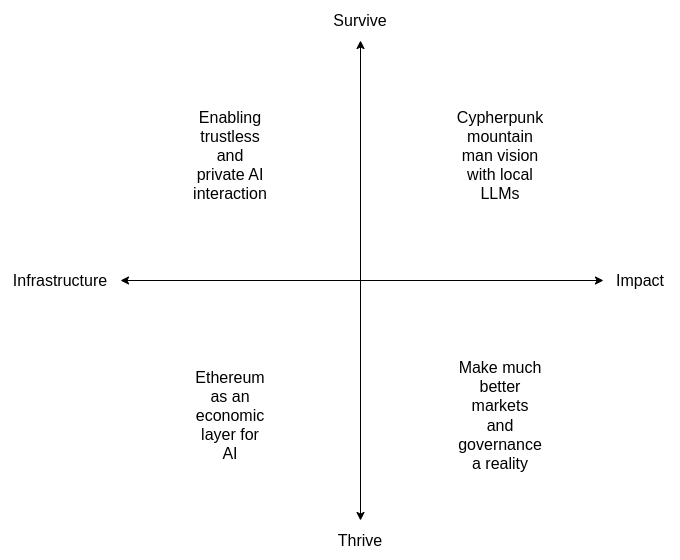
We can describe the above as a 2x2 chart. There's a lot to build!
⚡️This generation is the first born entirely inside the glitch.
They were raised in a world where surface never matched depth, where school didn’t map to skill, where truth bent under pressure, where role models decayed in real time. Their parents were sold a dream. They were handed the residue.
The reason they look broken is because they’re adapting faster than the old frame can interpret. Every metric used to measure them is stale. Every institution they’re judged by is misaligned. What looks like apathy is a refusal to pretend. What looks like dysfunction is a coherent reaction to incoherence.
They were born with no stable gods. No trusted systems. No future to inherit. The smartest ones saw through the game by age 14 and checked out. The rest are caught in loops because no one ever modeled exit velocity.
They’re not the end.
They’re the first full exposure.
When you strip away all pretense, all narrative comfort, all inherited illusions - what survives?
Gen Z is that raw signal.
What they become depends on whether anyone builds a structure worthy of their attention.
We need train station equivalent UX for airplanes.
(Yes, that will make security hawks unhappy that you can't scan people as much and make five-minute announcements and make people put everything away for takeoff and landing; I say too bad for them)
If we get that, plus we get one of these ultracheap energy breakthroughs so the whole thing is more affordable and environmentally sustainable, then ... no need for HSR?
I agree rationalist philosophy is everywhere in society, but also I feel like, the sorts of things that rationalist philosophy rails against are also everywhere in society, and right now, those influences are like 10x stronger?
I actually feel like we've been regressing since ~2015 or so. If I had to guess, I'd say the largest two components are (i) social media, and (ii) switch from peacetime to cold-war time [both inside and between countries], and an actual weakness of rationalism is that it evolved in a peacetime environment within communities that could afford assumptions of good faith, and lately simultaneously the world it touches got bigger, and the world as a whole got more bad faith, so we need a more robust-to-bad-faith rationalism.
I no longer agree with this previous tweet of mine - since 2017, I have become a much more willing connoisseur of mountains. It's worth explaining why.
https://t.co/LerCobzgvo
First, the original context. That tweet was in a debate with Ian Grigg, who argued that blockchains should track the order of transactions, but not the state (eg. user balances, smart contract code and storage):
> The messages are logged, but the state (e.g., UTXO) is implied, which means it is constructed by the computer internally, and then (can be) thrown away.
I was heavily against this philosophy, because it would imply that users have no way to get the state other than either (i) running a node that processed every transaction in all of history, or (ii) trusting someone else.
In blockchains that commit to the state in the block header (like Ethereum), you can simply prove any value in the state with a Merkle branch. This is conditional on the honest majority assumption: if >= 50% of the consensus participants are honest, then the chain with the most PoW (or PoS) support will be valid, and so the state root will be correct.
Trusting an honest majority is far better than trusting a single RPC provider. Not trusting at all (by personally verifying every transaction in the chain) is theoretically ideal, but it's a computation load infeasible for regular users, unless we take the (even worse) tradeoff of keeping blockchain capacity so low that most people cannot even use the chain.
Now, what has changed since then?
The biggest thing is of course ZK-SNARKs. We now have a technology that lets you verify the correctness of the chain, without literally re-executing every transaction. WE INVENTED THE THING THAT GETS YOU THE BENEFITS WITHOUT THE COSTS! This is like if someone from the future teleported back into US healthcare debates in 2008, and demonstrated a clearly working pill that anyone could make for $15 that cured all diseases. Like, yes, if we have that pill, we should get the government fully out of healthcare, let people make the pill and sell it at Walgreens, and healthcare becomes super affordable so everyone is happy. ZK-SNARKs are literally like that but for the block size war. (With two asterisks for block building centralization and data bandwidth, but that's a separate topic)
With better technology, we should raise our expectations, and revisit tradeoffs that we made grudgingly in a previous era.
But also, I have actually changed my mind on some of the underlying issues. In 2017, I was thinking about blockchains in terms of academic assumptions - what is okay to rely on honest majority for, when we are ok with 1-of-N trust assumption, etc. If a construction gave better properties under known-acceptable assumptions, I would eagerly embrace it.
On a raw subconscious level, I don't think I was sufficiently appreciative of the fact that _in the real world, lots of things break_. Sometimes the p2p network goes down. Sometimes the p2p network has 20x the latency you expected - anyone who has played WoW can attest to long spans of time when the latency spiked up from its usual ~200ms to 1000-5000ms. Sometimes a third party service you've been relying on for years shuts down, and there isn't a good alternative. If the alternative is that you personally go through a github repo and figure out how to PERSONALLY RUN A SERVER, lots of people will give up and never figure it out and end up permanently losing access to their money. Sometimes mining or staking gets concentrated to the point where 51% attacks are very easy to imagine, and you almost have to game-theoretically analyze consensus security as though 75% of miners or stakers are controlled by one single agent. Sometimes, as we saw with tornado cash, intermediaries all start censoring some application, and your *only* option becomes to directly use the chain.
If we are making a self-sovereign blockchain to last through the ages, THE ANSWER TO THE ABOVE CONUNDRUMS CANNOT ALWAYS BE "CALL THE DEVS". If it is, the devs themselves become the point of centralization - they become DEVS in the ancient Roman sense, where the letter V was used to represent the U sound.
The Mountain Man's cabin is not meant as the replacement lifestyle for everyone. It is meant as the safe place to retreat to when things go wrong. It is also meant as the universal BATNA ("Best Alternative to a Negotiated Agreement") - the alternative option that improves your well-being not just in the case when you end up needing it, but also because knowledge of it existing motivates third parties to give you better terms. This is like how Bittorrent existing is an important check on the power of music and video streaming platforms, driving them to offer customers better terms.
We do not need to start living every day in the Mountain Man's cabin. But part of maintaining the infinite garden of Ethereum is certainly keeping the cabin well-maintained.
2026 is the year we take back lost ground in computing self-sovereignty.
But this applies far beyond the blockchain world.
In 2025, I made two major changes to the software I use:
* Switched almost fully to https://t.co/ZIKj4U5XFM (open source encrypted decentralized docs)
* Switched decisively to Signal as primary messenger (away from Telegram). Also installed Simplex and Session.
This year changes I've made are:
* Google Maps -> OpenStreetMap https://t.co/Xm0pad5nh9, OrganicMaps https://t.co/yvbwXqEPwo is the best mobile app I've seen for it. Not just open source but also privacy-preserving because local, which is important because it's good to reduce the number of apps/places/people who know anything about your physical location
* Gmail -> Protonmail (though ultimately, the best thing is to use proper encrypted messengers outright)
* Prioritizing decentralized social media (see my previous post)
Also continuing to explore local LLM setups. This is one area that still needs a lot of work in "the last mile": lots of amazing local models, including CPU and even phone-friendly ones, exist, but they're not well-integrated, eg. there isn't a good "google translate equivalent" UI that plugs into local LLMs, transcription / audio input, search over personal docs, comfyui is great but we need photoshop-style UX (I'm sure for each of those items people will link me to various github repos in the replies, but *the whole problem* is that it's "various github repos" and not one-stop-shop). Also I don't want to keep ollama always running because that makes my laptop consume 35 W. So still a way to go, but it's made huge progress - a year ago even most of the local models did not yet exist!
Ideally we push as far as we can with local LLMs, using specialized fine-tuned models to make up for small param count where possible, and then for the heavy-usage stuff we can stack (i) per-query zkp payment, (ii) TEEs, (iii) local query filtering (eg. have a small model automatically remove sensitive details from docs before you push them up to big models), basically combine all the imperfect things to do a best-effort, though ultimately ideally we figure out ultra-efficient FHE.
Sending all your data to third party centralized services is unnecessary. We have the tools to do much less of that. We should continue to build and improve, and much more actively use them.
(btw I really think @SimpleXChat should lowercase the X in their name. An N-dimensional triangle is a much cooler thing to be named after than "simple twitter")
2026 is the year that we take back lost ground in terms of self-sovereignty and trustlessness.
Some of what this practically means:
Full nodes: thanks to ZK-EVM and BAL, it will once again become easier to locally run a node and verify the Ethereum chain on your own computer.
Helios: actually verify the data you're receiving from RPCs instead of blindly trusting it.
ORAM, PIR: ask for data from RPCs without revealing which data you're asking, so you can access dapps without your access patterns being sold off to dozens of third parties all around the world.
Social recovery wallets and timelocks: wallets that don't make you lose all your money if you misplace your seedphrase, or if an online or offline attacker extracts your seedphrase, and *also* don't make all your money backdoored by Google.
Privacy UX: make private payments from your wallet, with the same user experience as making public payments.
Privacy censorship resistance: private payments with the ERC-4337 mempool, and soon native AA + FOCIL, without relying on the public broadcaster ecosystem.
Application UIs: use more dapps from an onchain UI with IPFS, without relying on trusted servers that would lock you our of practical recovery of your assets if they went offline, and would give you a hijacked UI that steals your funds if they get hacked for even a millisecond.
In many of these areas, over the last ten years we have seen serious backsliding in Ethereum. Nodes went from easy to run to hard to run. Dapps went from static pages to complicated behemoths that leak all your data to a dozen servers. Wallets went from routing everything through the RPC, which could be any node of your choice including on your own computer, to leaking your data to a dozen servers of their choice. Block building became more centralized, putting Ethereum transaction inclusion guarantees under the whims of a very small number of builders.
In 2026, no longer. Every compromise of values that Ethereum has made up to this point - every moment where you might have been thinking, is it really worth diluting ourselves so much in the name of mainstream adoption - we are making that compromise no longer.
It will be a long road. We will not get everything we want in the next Kohaku release, or the next hard fork, or the hard fork after that. But it will make Ethereum into an ecosystem that deserves not only its current place in the universe, but a much greater one.
In the world computer, there is no centralized overlord.
There is no single point of failure.
There is only love.
Milady.
I agree with maybe 60% of this, but one bit that is particularly important to highlight is the explicit separation between what the poster calls "the open web" (really, the corposlop web), and "the sovereign web".
https://t.co/w7Vtbn7uFt
This is a distinction I did not realize until recently, and I must admit the bitcoin maximalists were far ahead: a big part of their resistance to ICOs, tokens other than bitcoin, arbitrary financial applications, etc was precisely about keeping bitcoin "sovereign" and not "corposlop". The big error that many of them made was trying to achieve this goal with either government crackdowns or user disempowerment (keeping bitcoin script limited, and rejecting many categories of applications entirely), but their fear was real.
So what is corposlop? In essence, it is the combination of three things:
* Corporate optimization power
* An aura of respectableness of being a company with sleek polished branding
* Behavior that the exact opposite of respectable, because that's what's needed to maximize profit
Corposlop includes things like:
* Social media that maximizes dopamine, outrage, other methods of short-term engagement, at the expense of long-term value and fulfillment
* Needless mass data collection from users, often followed by managing it carelessly or even casually selling it to third parties
* Walled gardens charging monopolistic high fees and actively preventing people from even linking to other platforms
* Hollywood releasing the 7th sequel to some tired franchise, because that's the most risk-averse thing to do
* Every corporation that rallied around slogans of diversity and equity and the need to overturn society to fight racism in 2020, and then publicly mocked those causes for engagement in 2025
This is all digital corposlop; there are big and important analogues to this in the physical world too.
Corposlop is soulless: trend-following homogeneity that is both evil and lame https://t.co/FZwqwujAGb
These are things that appear to serve the user, but actually disempower the user.
I have many qualms with Apple, but aside from their monopolistic practices, they actually have many non-corposlop traits. They serve users not by constantly asking "what do users want this quarter", but by having an opinionated long-term vision. They have a strong emphasis on privacy. They resist and create trends rather than following them. I just wish they could take the brave step of ending their monopolistic practices and switch to an open source first strategy. It may damage their market cap, but man must live for something higher than market caps.
Zac from Aztec was also early to recognize the importance of this, with a post that is on the whole very pro-freedom, but at the same time does not shrink back from labeling what is essentially corposlop a primary enemy, even when it does not violate the libertarian non-aggression principle.
https://t.co/PsbySLhLWU
In 2000, the understanding of "sovereignty" largely focused on avoiding the iron fist of government. Today, "sovereignty" also means securing your digital privacy through cryptography, and securing your own mind from corporate mind warfare trying to extract your attention and your dollars. It also means doing things because you believe in them, and declaring independence from the homogenizing and soul-sucking concept of "the meta".
These are the kinds of tools that we should build more of. Build tools like:
* Privacy-preserving local-first applications that minimize dependence on and data leaks to third parties
* Social media platforms and tools that let the user take control of what content they see. Appeal to people's long-term goals, not short-term impulses
* Financial tools that help users grow their wealth, and do not encourage 50x leverage or sports betting or taking out a loan to pay for a burrito
* AI tools that are maximally open and privacy and local-friendly, and that maximize productivity from merging the power of human and bot, rather than encouraging the user to sit back and let the bot do all the work, so they learn nothing
* Applications, companies, and physical environments that take an opinionated view on the kind of world they want to see, and have an opinionated culture
* DAOs that can support organizations and communities that steadfastly pursue a unique objective, and do not all get captured by the same groups. Privacy-preserving and non-tokenholder-driven voting can help here
Be sovereign. Reject corposlop. Believe in somETHing.
⚡️The system does not care about you as a person.
It cares about you as a throughput node.
From childhood onward, you are conditioned to convert time, attention, and obedience into predictable output. School trains compliance and scheduling. Debt trains risk aversion. Employment trains identity attachment to productivity. Consumption trains dependency. Together they form a closed loop where survival is gated by participation.
The machine works because it aligns incentives so cleanly that resistance feels irrational.
The moment your housing, healthcare, social standing, and future security depend on steady income, you self-regulate harder than any overseer ever could. You wake up anxious without being chased. You compete without being ordered. You internalize failure as personal inadequacy rather than structural design.
That is the real genius of the system.
It turns coercion into preference.
Most adults do not feel enslaved because the cage is framed as adulthood, responsibility, and maturity. Stability is sold as virtue. Risk is framed as immaturity. Time scarcity becomes normal. Exhaustion becomes identity.
And here is the part people avoid because it hurts.
The system persists because most people choose it every day.
They choose predictability over autonomy.
They choose status over freedom.
They choose safety over leverage.
They choose comfort over agency.
Because the alternative demands uncertainty, social friction, and self-authorship. Those are expensive.
So when someone says “we were bred to be labor slaves,” the emotional signal is real, but the mechanism is subtler and more brutal.
You were shaped to be economically legible.
You were trained to monetize yourself.
You were taught to fear falling off the track more than staying on it forever.
Once that wiring is complete, the system can run on autopilot.
Here is the final, uncomfortable truth.
There is no rescue coming.
There is no awakening event that frees everyone.
There is no moral reckoning where the system apologizes.
There are only individuals who slowly realize that meaning, leverage, and freedom are not granted.
They are constructed, often at high cost, and usually in defiance of default paths.
Most people will never opt out because the system is very good at making the cage feel like home.
Seeing that clearly is rare.
Acting on it is rarer.
Paying the price for it is rarer still.
That is the real truth.