Forty-eight documented incidents, 2017 to 2026, built from the primary documents rather than from anybody's summary of them — seven years of US State Department religious freedom reporting read in full, the Ethiopian Human Rights Commission's own statements, the Ethiopian Human Rights Council, the BBC, ACLED, the World Council of Churches, the Vatican's news agency, Borkena, a peer-reviewed study, and field reporting labelled as field reporting.
Responsibility is separated into three tiers: what is established by a body with a mandate and a method, what is claimed and by whom, and what remains unattributed. Nothing is filled in by inference.
I am posting it because the figure that circulates about Ethiopian Orthodox churches is always a total, and a total is the one thing this subject cannot carry. What it can carry is an incident at a time, each with its own source and its own attribution stated honestly — including the incidents that are uncomfortable for the people most likely to share this.
Read the tier before you use a row. If you take one thing from the thread, take that.
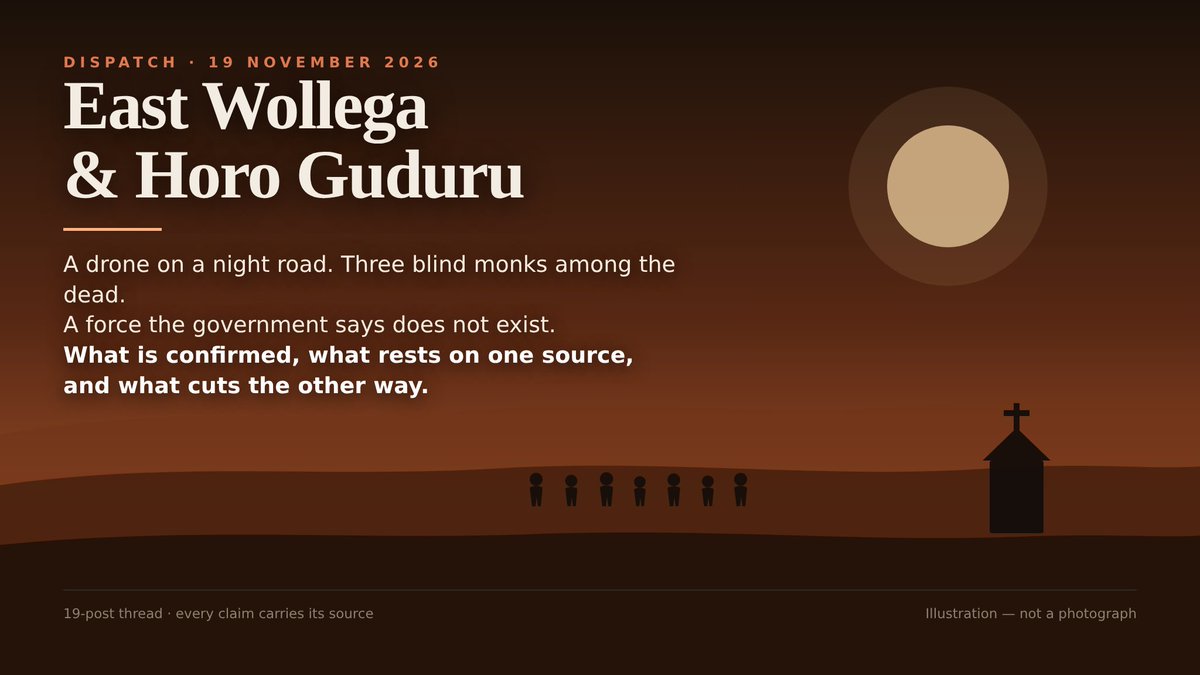
Seven Orthodox priests killed in a week. Half a million displaced civilians under blockade. Starvation used as a method.
Those are the claims circulating about East Wollega and Horo Guduru today, 19 November 2026.
Some of it is confirmed by the BBC. Some by the Red Cross. Some by the Oromia government itself. Some rests on a single advocacy source. And one part of it cuts in a direction most people posting about this will not want to carry.
I have separated them. A thread that blurs those lines is worth nothing to anyone who has to act on it.
Community members and friends in the UK 🇬🇧 are invited to join @JemalCountess for a public talk tomorrow (Thurs, Nov 19) evening in @ucl. Earlier this year Jemal published a special book featuring photos captured between 2020-2022 of the human toll of the northern #Ethiopia war.
The category is the dangerous part
The worst thing in this statement is not the denial. It is the category.
❝ Part-time combatant ❞, as the High Command uses it here, is not a status the law of armed conflict recognises. Under the rules governing non-international conflicts, civilians lose their protection from attack only for such time as they take a direct part in hostilities.
Being armed is not taking a direct part. Having been armed last month is not taking a direct part. Belonging to a community the state has handed rifles to is not taking a direct part.
What OLF-OLA has published is a rule under which an entire rural population — in a region where the government arms kebele militias village by village — can be reclassified as combatants in advance, before anything happens.
That is what makes this document worse than the killing it describes. Publish that rule, and the next village does not need a justification afterwards.
It already has one.
Three statements. One zone. One year.
The OLF-OLA High Command published three statements about Arsi in 2026. All three sit on the organisation’s own distribution site.
2 March 2026 — “The Massacre of Orthodox Christians in Arsi”
3 June 2026 — “The OLA has launched an investigation into the recent attack on civilians in Arsi”
16 November 2026 — “Attacks in Arsi, EHRC’s Report and Politics of Manufactured Conflict”
Read in order, these are not three statements about three unrelated events.
They are one organisation changing its account of what kind of people were dying in Arsi — at the precise moment its own fighters entered the account.
Where does the word “Galla” come from, what did it originally mean, and did the Oromo ever call themselves that?
Almost everyone arguing about this is working from a fragment. Here is what the literature says when you read it through.
There are twelve explanations on record. Not two. Twelve — a Somali word for strangers, a river in Guragé, an Oromo war-cry, an Oromo verb meaning “to go home,” an Oromo word for incomers, “shepherds,” a Sidama word, an Amharic word for “subjects,” a word meaning “blackness,” Greek for “milk,” the story that the Prophet named them for refusing Islam, and descent from a slave. They contradict each other. Several were dismissed by the very men who recorded them. Not one is proven.
On the self-name question, the strongest evidence is a letter, and almost nobody has read it. In Tutschek's *Grammar of the Galla Language* two of his Oromo students write to each other in Oromo. One letter is signed and dated — *Akafed'e Agaf, Munich, 21 October 1840* — and in it stands *Gallan gudumtu*, “many Gallas,” the plural noun, formed exactly as *Oromoonni* is. On the facing page, *ini Galla ziti ha ergu*, “that he may send thee a Galla.” An Oromo text, named Oromo authors, the word used of their own people. Post 7. The qualification — Munich, 1840, men lately out of slavery, taught by the European whose book it is — is in that post too.
Ask the question the other way, though — is “Galla” an Oromo word at all? — and the literature answers much more generously. Huntingford says it “may be a genuine Galla word (adopted by non-Galla).” Krapf says it “in their own language means immigrants.” Tutschek derives it from the verb *gala*, “to go home.” Cerulli has it in a song. Four observers across a hundred and eleven years, finding the word inside Afaan Oromoo. That is the strongest claim these sources will carry, and posts 11, 12 and 13 make it in full.
The strongest etymology is Somali *gal* — whose first sense, as Cerulli gives it, is “stranger,” and only afterwards “non-Moslem.” Its true author is not who everybody says. Its foundation sentence has been read in opposite directions by two serious scholars, and when you read that sentence it turns out not to say what either of them claims.
And the famous 1332 date, repeated as settled, rests on thinner evidence than its users admit — and another scholar in the same literature dates the first record to the late sixteenth century instead. This thread says exactly how thin, and shows where the two dates collide.
There is also a lesson in the ground. Lewis excavated one of the stone mounds that Somali tradition calls a “Galla grave,” radiocarbon-dated the wood, and found a burial no more than 250 years old, probably Somali. An inherited explanation, measured, and wrong. The whole subject is made of those.
And one document settles the self-name question outright. Onesimos Nesib and Aster Ganno's 1894 reader opens with two facing title pages. The English one: “THE GALLA SPELLING-BOOK by Onesimus Nesib, A NATIVE GALLA.” The Oromo one, in Ge'ez script: *Jalqaba Barsiisa … afaan Oromoo*, “in the Oromo language,” and *warra biyya Oromoo*, the people of the Oromo country. Same author, same year, same book — Galla facing the Europeans, Oromo facing his own. Post 8. And post 9 goes inside that book, where on printed page 77, in running Oromo prose, the people are named ኦሮሞ twice in one sentence — while ጋላ, in all 88 pages, never once names a people.
One more thing, settled in the original rather than at second hand. A modern study quotes Onesimos Nesib — the first Oromo to publish in Oromo — as writing of “a fluent Galla (Oromo) language.” The Swedish periodical he actually wrote it in has now been read. The word on the page is gallaspråk, and there is no “(Oromo)” anywhere on it. In that one signed letter he uses the name of his own people seven times.
Twenty-six posts. Every claim sourced, every weak link marked as weak, every place where the scholars contradict each other left standing rather than tidied away. 🧵
Article-15: CONCLUSION
I am autistic and can't speak.
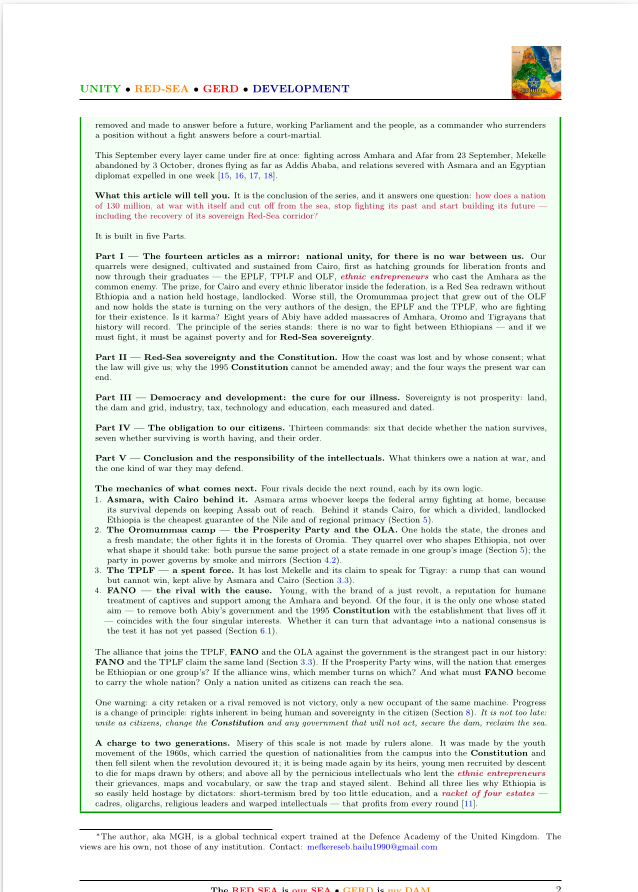
I have written a series of 15 articles examining Ethiopia’s geopolitics through the interconnected Red Sea, Gulf, maritime, and energy corridors, the wider Horn of Africa, and the dynamics of domestic ethnic entrepreneurship.