Most people think crypto is one thing
NO, IT ISN'T!
It's a stack of very different sectors that happen to share a settlement layer.
I'll lay the whole map out first, then break each sector down in its own thread.
Amazon's chip business is now running at over 20 billion dollars a year, and most people have never heard of it.
While everyone watches Nvidia, AWS has quietly built its own silicon: Graviton processors, Trainium AI training chips, Nitro security chips. That lineup has passed a 20 billion dollar annual run rate, growing over 100% year on year, with multi-year commitments from names like OpenAI, Anthropic, and Meta.
The strategic point is leverage. Every big cloud wants an in-house alternative to buying Nvidia at Nvidia's margins, and Amazon is furthest along at scale.
The chip war isn't only Nvidia versus AMD. It's your cloud provider quietly trying to build its way out of needing either.
Blackstone just committed 30 billion dollars to AI data centers. In Japan alone.
The pledge is one more entry in a building spree that's starting to feel bottomless. Around the world, the money going into the physical homes for AI (buildings, power, cooling, land) has become one of the largest infrastructure pushes in modern history.
The tension worth holding: all this concrete and steel is a bet that demand for AI compute keeps climbing for years. If the models get dramatically cheaper to run, or demand stalls, some of these data centers become very expensive real estate.
High conviction, high stakes. That's the whole AI infrastructure trade in one line.
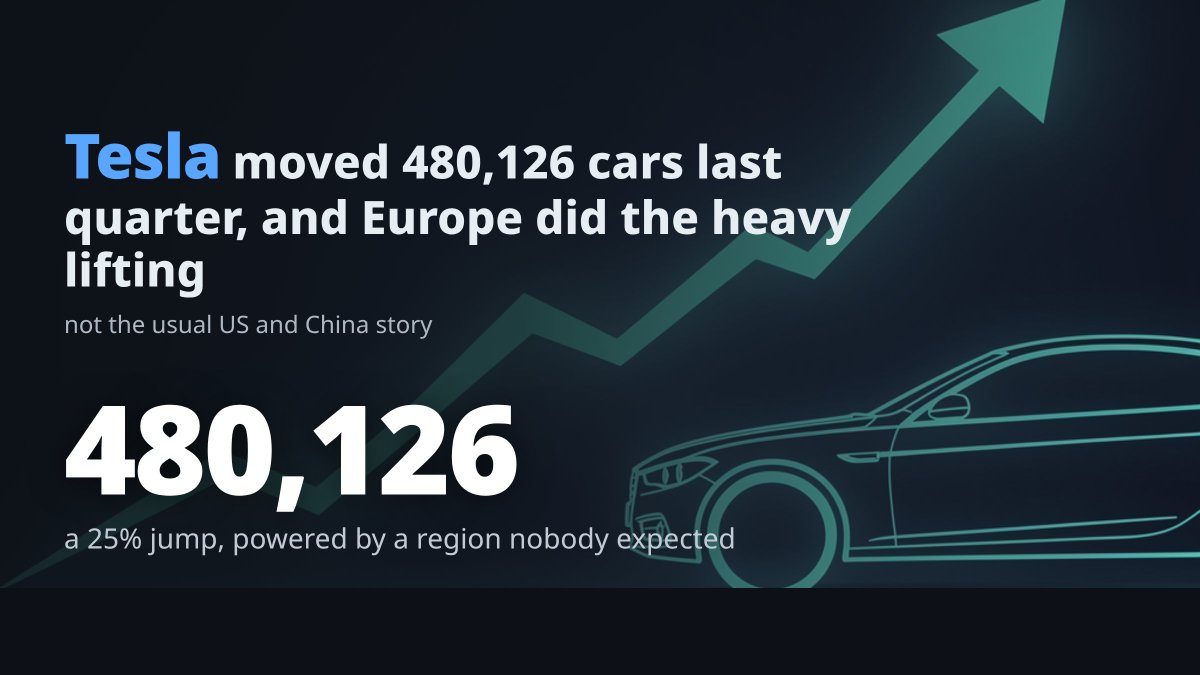
Tesla just delivered 480,126 cars in three months, and the interesting part is where the demand came from.
The Q2 number, reported July 2, beat expectations and rose about 25% from a year earlier. Analysts pinned a good chunk of the rebound on stronger European demand, not the usual US and China story.
Why a car number belongs in a tech feed. Tesla is really a bet on software, batteries, and self-driving, wrapped in sheet metal. Delivery counts are the clearest signal of whether that bet is still compounding.
One strong quarter isn't a trend. But a 25% jump after a rough stretch is the kind of thing that quietly resets the narrative.
An AI model just got treated like a controlled weapon, then quietly un-treated.
According to reporting rounded up on July 2, Anthropic restored access to its Fable 5 model after the US government lifted export controls that had been imposed over cybersecurity worries. A more capable model, Mythos 5, stays locked to vetted security organizations under tighter rules.
Sit with that. We've reached the point where the government gates who can touch certain AI models the way it gates encryption or missile parts, on national-security grounds.
Whether that's prudence or overreach is a real debate. Either way, "which humans are allowed to run this model" is now a policy question, not just a pricing one. More like this: @dnagabut.
Anthropic is talking to Samsung about building its own chip. It won't even say what the chip is for yet.
TechCrunch reported on July 2 that the two are in early contact over a pending custom silicon project, with Anthropic still undecided on how powerful it needs to be or exactly what job it does.
The subtext is the whole industry's problem. Everyone building frontier AI is desperate to stop renting Nvidia's chips at Nvidia's prices, so they're all trying to design their own, or partner with someone who can.
Early talks are not a deal. But when an AI lab starts sketching its own hardware, it's telling you where the real cost pressure is.
Google just shipped an image model whose entire selling point is being cheap and fast.
Google DeepMind rolled out Nano Banana 2 Lite, billed as its fastest, most cost-efficient image generator. Not the most powerful. The cheapest good one.
That framing keeps repeating across AI right now. The frontier labs proved these models can do impressive things, so the fight has shifted to who can serve them for a fraction of a cent without the quality falling apart.
Quietly, that's the more important race. Capability grabs headlines, but cost per image is what decides whether this stuff ends up inside every app you use. Follow @dnagabut for plain-English AI and crypto.
There are now hundreds of stablecoins, and swapping between them is a mess. Uniswap and Spark just shipped a fix.
Called FX Layer, it's a shared liquidity network aimed squarely at stablecoin-to-stablecoin trades, so moving from one issuer's dollar to another's is smooth instead of janky. Crypto press covered the launch in late June, alongside a wave of new issuers getting ready to enter.
The part people miss about stablecoins: a "dollar" from one issuer is not automatically worth a dollar from another. They can drift. Deep, shared liquidity is what keeps those tiny gaps from turning into real losses.
Plumbing, basically. But plumbing is what decides whether the promised digital dollars actually behave like dollars.
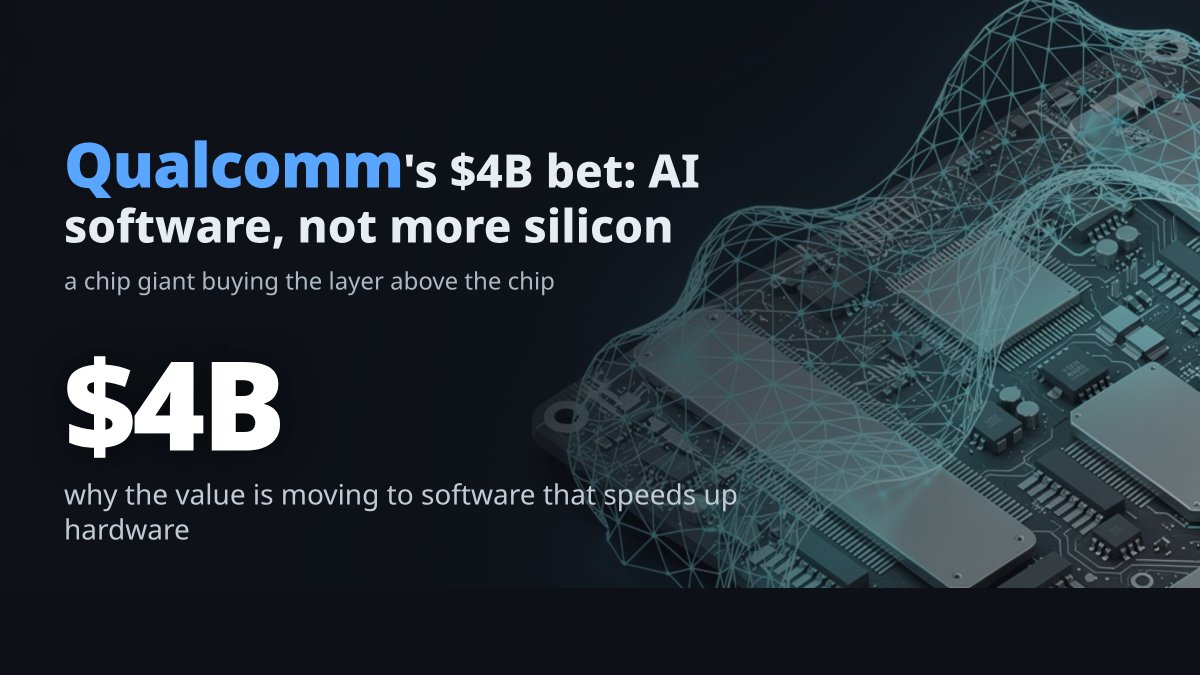
Qualcomm just agreed to a roughly 4 billion dollar all-stock deal for a company that makes AI software, not chips.
The target, Modular, builds tools that make AI models run efficiently across different hardware. For a company famous for the silicon inside your phone, buying a software layer is a tell.
The logic: chips alone don't win anymore. The value is increasingly in the software that squeezes real speed out of the hardware, and whoever owns that layer owns a chunk of the margin.
A slightly funny footnote from the week. Two separate companies bought AI software firms and the venture crowd mostly sat it out. The buyers now are the big incumbents, not the startups.
South Korea just committed something like 649 billion dollars to chips, AI data centers, and robots. In one announcement.
On June 29 the government unveiled three public-private mega-projects, with Samsung and SK Group as the lead backers, per Al Jazeera. SK pledged money for two fabs and a gigawatt-scale AI data center. Samsung committed to two memory fabs and a national AI computing center. Both anchored in the Honam region.
The framing matters. This is a country treating chip fabs and AI compute as national infrastructure, the way you'd treat highways or a power grid.
The number is almost hard to picture. That's roughly the entire annual output of a mid-sized economy, aimed at silicon.
OpenAI quietly previewed GPT-5.6 Sol last week, and its trick is that it splits your task across copies of itself.
Instead of one model grinding through a long job start to finish, Sol can spin up subagents, hand each a slice, and stitch the results back together. OpenAI is pitching it as their most agentic model yet, built for work that runs a while without you hovering.
It landed days before Anthropic's Sonnet 5, which is not a coincidence. The mid-tier race stopped being about raw IQ and turned into a fight over who can run long, self-directed jobs cheaply.
For now these are previews, not the finished thing. Worth watching how they hold up on real work, not benchmarks.
Anthropic shipped Claude Sonnet 5 this week, and the headline number is the price, not the smarts.
It approaches their flagship on agentic tasks (planning, using a browser, running a terminal on its own) while costing a fraction of what that level cost a few months ago. TechCrunch framed it plainly: the cheap tier can now do the autonomous work that used to need the expensive one.
What that means for the rest of us. "Can an AI act on its own" stopped being the hard question. The new question is how cheaply, and how reliably, without a human watching every step.
That second half is the one nobody's fully solved. Follow @dnagabut for crypto and AI, explained daily.
One of crypto's loudest critics is about to launch his own token. Yes, really.
Nouriel Roubini, the economist who spent years calling crypto worthless, is behind USAFi, a regulated digital security planned for later this year. It's backed by an SEC-registered ETF, with reserves parked at a major bank, according to reporting rounded up by crypto outlets in late June.
The twist is the framing. This isn't "buy magic internet coins." It's a tokenized wrapper around a boring, regulated fund, which is exactly the kind of crypto a skeptic could stomach.
That's the quiet trend of 2026. The interesting action is real-world assets going on-chain, not meme tokens. Not financial advice. Just notice who's building now.