@misamajic Naravno,izvinjavam se, znam da veliki ljudi (naucnici,profesori,pravnici itd., bilo koje profesije) ne pate od titule, meni je to nekad profesionalna deformacija :-D Molim Vas ako saznate,objavite, stvarno nas jako zanima da procitamo. Ne znam kad cemo kuci a bas nas zanima.
I’m running for the health of every kid in Canada, and my goal is to raise $500. The Million Reasons Run is a fundraising event in support of our local children’s hospital foundations. Will you support me with a donation today? https://t.co/QtFEd63Hkg
@catherine_tays Thanks! I love the map too! We wanted exponential phase, late or early, that would be the balanced growth period. However , I think that metabolites are varying between growth phases . PHB for sure
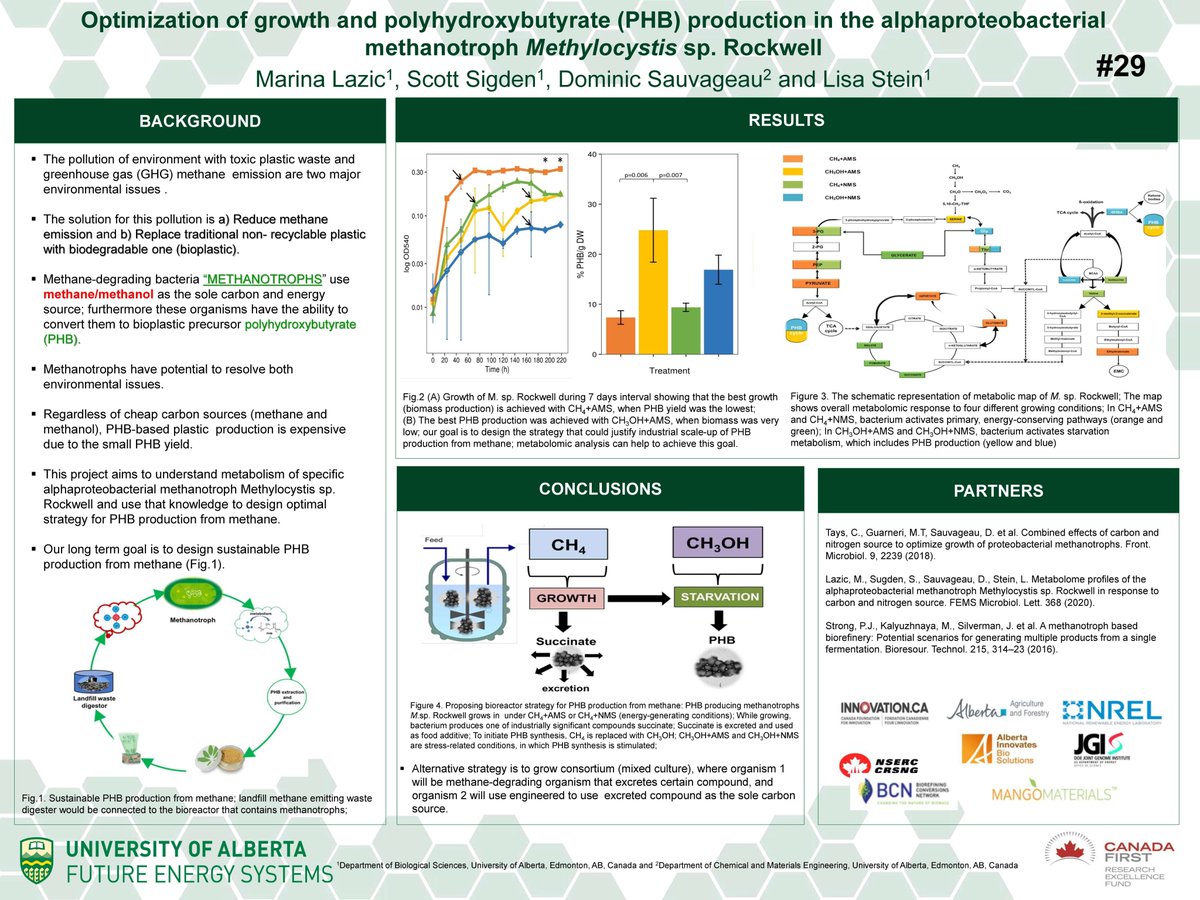
Have you ever heard about climate change and global warming? What about plastic waste? Check this out, microbes named methanotrophs offer solutions for both problems!#FESResearchShowcase
@simranghoman We believe that this methodology will also give similar results, but that is future work to do for sure. The methodology will definitely be faster, and without any toxic solvents
Bacteria known as methanotrophs are able to help us to reduce methane emission and plastic waste. However, experiments include toxic solvents that are again harmful. the solution for this is again in the bacterial world! #UAlbertaInnovationShowcase
@simranghoman Great questions! We did a comparison with standard GC-FID, but not with this exact approach, we did it with the approach that was a basis for developing this one. Basically, we stained cells with different dye (NBA), and that approach matched values with GC.
@catherine_tays Yes, I love this methodology a lot! Just Rockwell engineering is still not on the table, Alphaproteobacterial methanotrophs have not been engineered yet, and I want to try it definitely after I complete this project and GEM. So unfortunately not in next 2 years
Bacteria known as methanotrophs are able to help us to reduce methane emission and plastic waste. However, experiments include toxic solvents that are again harmful. the solution for this is again in the bacterial world! #UAlbertaInnovationShowcaseFES
@Valerie89Miller It is fairly new, there are some similar methodologies , one of the developed by our collaborators, but not this synthetic biology approach, this is new.
@ua_futureenergy@ualbertaScience In addition, we are facing with a problem of plastic waste, and these bacteria can help in solving that problem. Plus, bioplastic precursors are only one possible product made by these bacteria, they can make biofuel precursors as well. And many more.
@ua_futureenergy@ualbertaScience Excellent question! Bacteria consume methane and can produce molecule precursor for production of bioplastic. In this way bacteria can help in reducing methane emission, and methane is 30 x more potent than CO2(and highly contributes to climate changes).
@KTam_Iceberg Exactly! Just we are still working on improving and optimizing the production of bioplastic precursors such as PHB. However, we realized that we might should think about methodology we use as well. If we are advocating for green planet, we should observe it from all aspects
@alexander_gzyl Great question! Yes, there is a way to separate it and detect it, and yes there are other value added compounds in addition to PHB that can be made by this organism. Succinate is only one of them.
Have you ever heard about climate changes and global warming? What about toxic plastic waste? Check this out, microbes named methanotrophs offer solutions for both problems!
#FESResearchShowcase
@catherine_tays Very interesting! We have some evidences that it is can be redox stress, and we see that through perturbed GSH-GSSG metabolism, but that has to be investigated in details. And exists in both, gamma and alpha organisms. Physiologically is really interesting!
@dbandita Very good question! PET is still cheaper definitely, but the cost of damage is much higher. And with improvements that are coming from our and other labs, PHB will hopefully replace and PET and other toxic polymers.
@catherine_tays Very good question! I think the reason behind this is methanol-caused stress response. The metabolic basis for PHB synthesis is acetyl-CoA. Under the methanol stress acetyl-CoA is shunt to PHB instead TCA cycle. That doesn’t happen so intensely in methane-growing conditions.