@shanaka86 This is the most stupid analysis I have read in weeks. The energy crisis drives up price of oil, Russia sells oil. The more money they get the longer they can continue the war in Ukraine. Vance is there to support Orban in hope to destabilize Europe pleasing both Putin and Trump.
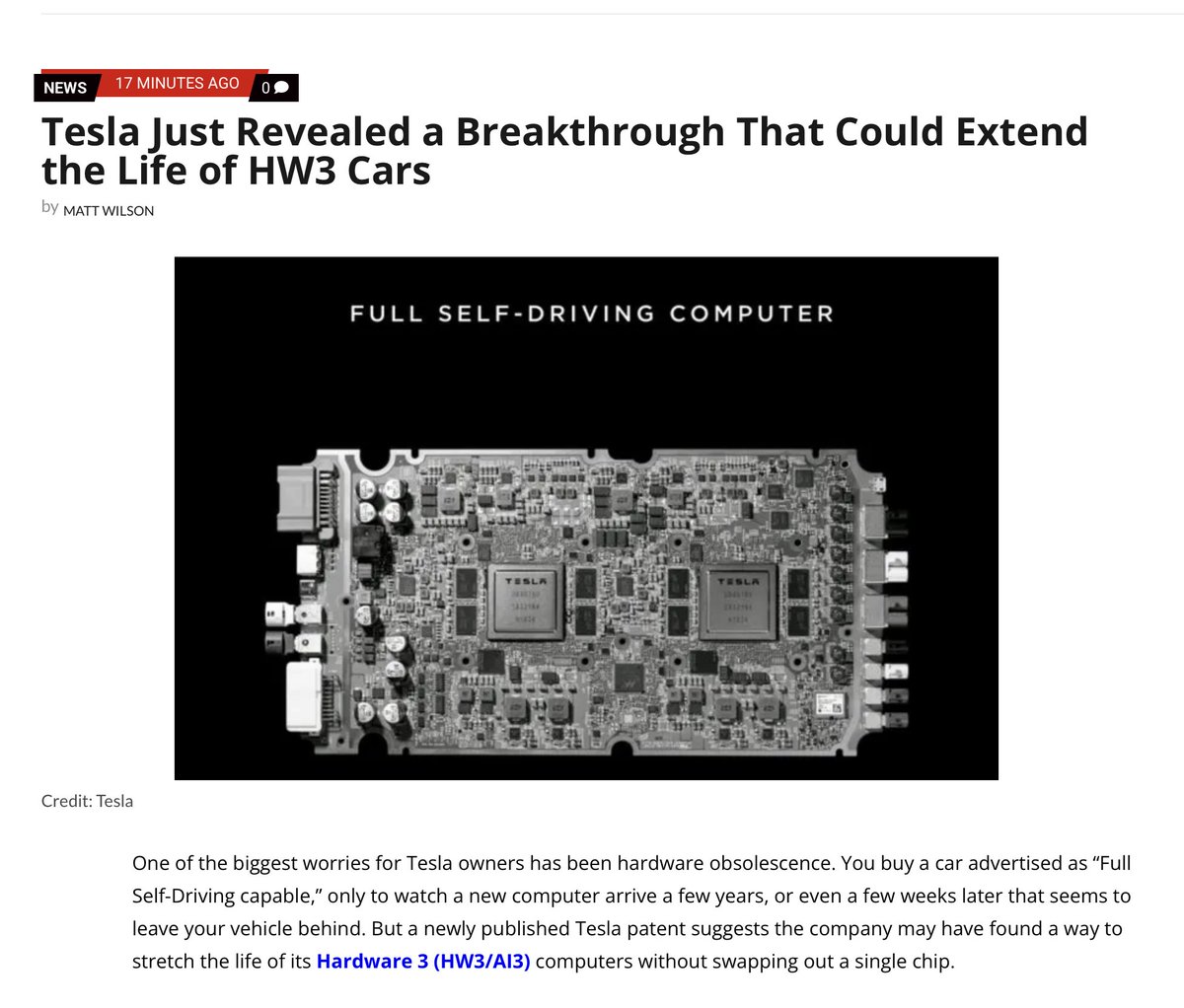
NEWS: Tesla reveals breakthrough that could extend the life of HW3 cars.
A new patent shows what Tesla wants to do: let modern, high-precision AI models run on older, lower-precision hardware using clever math and software, instead of requiring brand-new silicon.
Instead of forcing high-precision data into low-precision hardware, Tesla splits the data into smaller chunks that AI3 can handle.
Source: https://t.co/Rv58u7kMvV
CEO's question: What will be the hourly cost of work of a humanoid robot?
Several projections have been published, e.g. by @CernBasher, @adam_dorr and @GoingBallistic5. Here's my take.
I've produced a long-form video on this question (see link in comments).
Here is the essence - based on very conservative assumptions (see attached image).
- Production cost: $30,000. A humanoid is ~5% the mass of a passenger car. The costly parts are actuators and gearboxes; the rest is electronics, sensors, a few kWh of batteries, and plastics—components that are highly scalable in volume manufacturing.
- Operating cost: $30,000 per year, of which $18,000 is human oversight and coordination. This is likely way too high.
- Operating time: 6,600 hours per year (330 days × 20 hours/day). That equals the yearly working time of more than three people.
- Work speed vs. humans: 100% initially. As with industrial robots, later generations will likely reach 200%+.
- Business model: Most manufacturers will offer Robot-as-a-Service (RaaS) rather than selling units, because it drives far higher revenue and margin. Expect an initial one-time fee roughly equal to manufacturing cost plus a usage fee per year, month, day, or hour.
- Service life (incl. repairs): 8 years.
- Market dynamics: Because humanoids will be highly profitable to use (see below), demand will ramp quickly. But many suppliers will enter, so sustained overly high monopoly pricing is unlikely.
Result: Based on these assumptions, a humanoid work hour will cost at most $14.
That’s the highest realistic value. With learning effects and scale, the hourly cost will drop below $10 and likely below $5. @rethink_x even projects that by 2035 a humanoid hour could cost less than $1.
By comparison, a skilled worker’s fully loaded hour is $42.53.
Strategic consequence: In competitive markets, companies will have no real choice: first to replace labor shortages, and soon to replace existing roles. Even at $14/hour, the financial advantage vs. human labor is close to $200,000 per robot per year.
I’ve published a three-part video series on the societal implications of this inevitable shift (see comments).
Urgent advice: If you make or move anything physical, start rethinking your business around humanoids—as a supplier, service provider, or user. It is quiet now, but the ramp-up will be fast.
How about you? Which tasks would you deploy humanoids for first?
Chinese automaker BYD’s U9 Xtreme EV just hit a verified top speed of 496 km/h (308 mph) at Germany’s ATP proving grounds, making it the new fastest production car in the world, beating the Bugatti Chiron's 304.77 mph.
• 2,978 hp
• 80 kWh LFP battery
• 1,200v platform
• New track-grade LFP Blade Battery with dual-layer cooling, capable of 30C discharge rates for improved thermal management. Density of each cell is increased by 170% compared with the lower trim U9 800V system.
• Up to 500 kW charging speed
• Each of its four motors spin at a max of 30,000 RPM and is made of super thin 0.1mm silicon steel, a first in mass production
@TadekSolarz Eerst werd Europa de les gelezen dat het vrije woord in gevaar was en nu 180 graden draai dat spot en satire niet mogen. Of wellicht gewoon een andere mening. Bubble of niet ik ben het met die Kimmel eens. Maar blijkbaar zijn er goede en slechte bubbles en is het een machtsspel
@RnaudBertrand Defence and LNG we need anyway. Unless we want to sponsor Russia. Tariffs will push up the consumer price in the US. (together with de devaluation of the dollar). Since when are investment in a country a bad decision.?
Ultimately this will strengthen Europe and weaken the US.
Ice read about the value of aer and design: I adored a piece of art that cost $280,000. So I decided to forge it. https://t.co/rnaxMOeiVE via @businessinsider
It’s funny, because to me, the trade is just so simple and clear eyed.
Neither party can stop spending money. Neither party wants to raise taxes.
Our most significant effort to cut government spending looks like it’s going to yield $50B in annual savings on a $7.5T budget. We couldn’t even cut 0.75% of spending.
We have to borrow 10% of our GDP every single year (and it’s only getting worse).
On top of all of it, we are a waning hegemon that is using our decreasing power to try and strong arm others to behave the way we want. Largely via weaponizing the Dollar system.
The long term trade is just so simple to me.
Short the Dollar. And Long Gold and Bitcoin.