As someone who grew up as an NRI in the Middle East, I’ve always found the debate around India’s history curriculum deeply personal rather than merely political.
I studied Islamic Social Studies and Arabic throughout my early schooling. I then spent a year in a convent where mornings began by reading from a hymn book. I eventually completed my education through the Cambridge GCSE and A-Level system. Looking back, what strikes me isn’t that I learnt about other cultures and faiths. That was never the problem. The problem was how little I learnt about my own.
If you had asked me to explain India’s historical chronology back then, my understanding was embarrassingly simplistic. In my mind, the British had simply taken India from the Mughals. Thousands of years of civilisation before that barely existed in the education I received.
It was only much later that I learnt the British did not establish dominion over India by merely replacing a powerful Mughal Empire. By the late eighteenth century, Mughal authority had largely collapsed beyond Delhi. Before the East India Company could become the dominant power on the subcontinent, it had to fight and ultimately prevail in three hard-fought Anglo-Maratha Wars between 1775 and 1818 against the Maratha Confederacy, which had become the foremost indigenous power across much of India. Yet, in the curriculum I grew up with, this immense struggle for the subcontinent often felt like little more than a footnote compared to the space devoted to the Mughals and the Raj.
Everything I knew about the Mahabharata, the Ramayana, the Mauryas, the Guptas, Shivaji Maharaj, Chanakya and countless other chapters of our civilisation came not from school, but from the stacks of Amar Chitra Katha comics my mother would buy for me every time we returned to India during our vacations.
No child should have to discover the story of their own civilisation by accident.
Teaching Indian history with greater depth and continuity doesn’t require diminishing anyone else’s history. It simply means ensuring that Indian children, wherever they grow up, leave school knowing that our story did not begin with the Delhi Sultanate, the Mughals or the British. Those were important chapters, but they were chapters in a civilisation whose history stretches back millennia.
True.
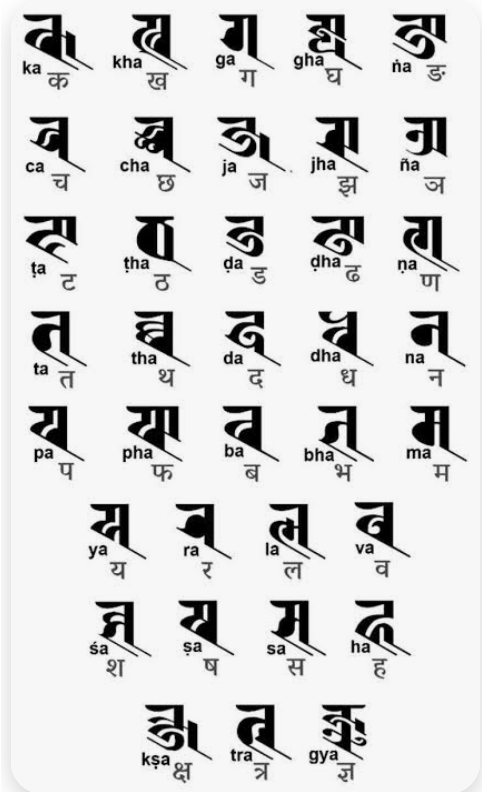
"Certain high-ranking ceremonial helmets from the Qing Dynasty (Manchu era, particularly the 18th century under Emperor Qianlong) feature the mantra "Om mani padme hum" embossed or applied in Ranjana/Lantsa script (Ranjana lipi)."
Ranjana lipi îs a decorative version of Devanagari, as shown below.
Why isn't this widely known in Bharat?
Today, the multi-billion dollar fintech startups of India brag about "Buy Now, Pay Later" as if they invented fire. But 7 decades ago, a penniless orphan who spent his nights sleeping on empty gunny bags used a revolutionary currency to build India's retail empire: raw trust.
In the 1940s, a 12 yr old boy named Veraputhra Gnanadraviam Rajadas Panneerdas (often known as V.G. Panneerdas) fled his drought-stricken village in Tirunelveli, Tamil Nadu, with nothing but ₹25 in his pocket. He arrived in Madras starving, homeless & desperate. He took the 1st job he could find, cleaning dishes & sweeping floors at a local ration shop in Saidapet. He worked like a machine by day & slept on jute bags on the floor by night.
By 1954, through sheer grit & skipping meals, he saved enough to set up a tiny tea stall, alongside vending newspapers door to door with his brother. A yr later, he opened a tiny, cramped shop selling alarm clocks, wall clocks & wristwatches.
But Paneerdas quickly hit a massive wall.
In 1950s India, luxury items like a simple watch/a bicycle/a radio were strictly for the elite. The working class Indian: the handcart pullers, the tea sellers, the low-wage clerks could only stare at the shop windows with longing. They could never afford to buy them upfront.
Paneerdas did not see customers w/o money; he saw humans with dignity. He made a move that his competitors called commercial suicide.
He walked out to a roadside cart puller, handed him a shiny new wristwatch & said: "Take it home today. Pay me just 1 rupee every week."
The concept was "Hire Purchase"... the grandfather of the modern Equated Monthly Installment (EMI). There were no credit scores, no digital bank verification & no collaterals. There was only a signature/a thumbprint in a small ledger notebook. People told Paneerdas he would be robbed blind & end up back on the streets.
Instead, a miracle happened. The poor of Madras proved to be the most honest paymasters in history. Defying all traditional banking logic, the default rate was virtually zero. The working class valued their honor & their newly acquired lifestyle too much to break Paneerdas’s trust.
Word spread like wildfire. The lines outside his shop grew so long they blocked the streets. Paneerdas rapidly expanded from clocks to bicycles, then to sewing machines & eventually to heavy home appliances, building a massive 3 story mega showroom under the legendary banner: VGP.
He single-handedly democratized the Indian dream. Decades before banks began giving loans to the middle class, VGP made it possible for an ordinary clerk to bring home a refrigerator/an electric fan. Later, he took the exact same philosophy into real estate, buying up vast tracts of land & offering affordable housing plots to the common man under his signature tagline: "Take possession now, pay later."
He started his life with absolutely nothing to his name, but before he left the world, V. G. Paneerdas had given millions of ordinary, struggling Indians the wealth of dignity & the power to own their own future, 1 rupee at a time.
⚡️While I had earlier illustrated in 2020 how Āryabhata created Sine tables from Bow and Arrow, but something is striking me more :
•RCos(θ) is the piercing Power of Arrow while RSin(θ) deals with Elevation parameters .
•The use of Mathematics for Development of Dhanurveda Lost Arts and Military Grade Bows , just like Pentagon Maths for US military !
•Are you interested to know more . Should I put my time in it ?
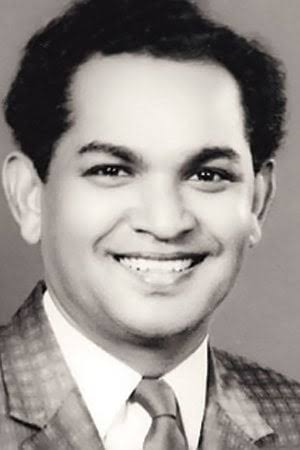
In Aug 1951, a sleek, twin-seat aircraft roared over the runways of Bangalore, executing flawless aerobatic loops in front of a stunned crowd of defense officials. It was the HT-2: the very 1st aircraft entirely designed, engineered & manufactured from scratch on Indian soil. When global aviation experts rushed to see the state of the art lab where it was conceptualized, they found no high-tech computing/imported foreign testing rigs. The plane had been calculated using basic slide rules & hand-drawn drafting boards by an Indian engineer who had once studied under the absolute pioneers of rocket science in Germany.
He gave India its wings, yet while modern space & rocket programs are celebrated across the country, the pioneer who laid the literal bedrock of Indian aeronautical engineering has become a ghost hidden in the jet wash of the machines he birthed.
Born in 1908 in a small village near Kolhapur, Maharashtra, Vishnu Madhav Ghatage was possessed by fluid dynamics. While ordinary students were content with textbook physics, Ghatage wanted to know how invisible air currents could lift tons of metal into the sky. His intellect was so undeniable that he traveled to Germany in the 1930s, entering the University of Göttingen, the undisputed world capital of fluid mechanics.
There, he completed his doctorate under none other than Ludwig Prandtl, the undisputed Father of Modern Aerodynamics. Ghatage sat in rooms with the absolute elite of global rocket & jet propulsion engineering. He was offered lucrative paths to stay in Europe/move to America to design the next gen of Western aircraft. He refused it all.
He packed up his complex aerodynamic eqns & flew back to a colonized India that did not even have a single factory capable of manufacturing a standard aircraft aluminum panel. When Ghatage joined HAL in Bangalore, he faced a wall of absolute skepticism. The prevailing colonial mindset was toxic: Indians are built to fly planes, not to design them.
The British establishment firmly believed that India would always be a customer, forever buying obsolete aircraft from European factories. Ghatage decided to shatter that narrative permanently. In 1948, he took a blank sheet of paper & began sketching the Hindustan Trainer-2 (HT-2). India desperately needed a primary trainer aircraft to teach its young pilots how to fly w/o relying on expensive, imported British Tiger Moths.
Working day & night in uncooled sheds, Ghatage & his small team of Indian technicians calculated every single rivet, wing spar & fuselage curve by hand. They had no automated simulation software; every stress test was done manually.
When the HT-2 took its maiden flight on 13th Aug, 1951, it was incredibly stable, highly responsive & boasted an innovative all-metal structure that made it vastly superior to contemporary Western trainers. For the next 2 decades, every single pilot who entered the Indian Air Force & the Indian Navy learned the art of flying by gripping the controls of a machine designed by Dr. Ghatage.
Ghatage was not a 1 hit wonder. He looked at India's vast agricultural fields & realized that the country needed a rugged, ultra-cheap flying jeep that could land on mud tracks, help farmers spray crops & connect remote villages. He went back to the drawing board & designed the HAL Pushpak: a light, high-wing cabin monoplane that became the darling of flying clubs across India.
He followed it up by designing the HAL Kiran, a jet trainer that would go on to power the iconic Surya Kiran aerobatic display team for decades. Ghatage was an absolute polymath of the skies. He designed gliders, pioneered the study of IC engines under tropical conditions & laid down the precise curriculum for the Aeronautical Engineering Department at the IISc.
During the late 1950s & 60s, the Indian govt became obsessed with supersonic speeds. Desperate to build a Mach 2 fighter jet, they bypassed Ghatage’s steady, incremental domestic pipeline & hired a German designer, Kurt Tank, to lead the HF-24 Marut project.
The glitz of the foreign superstar engineer & the massive geopolitical theater of jet-age politics completely pushed Dr. Ghatage out of the limelight. His quiet, systematic work of building an independent, native aviation ecosystem was sidelined in favor of high-profile, fast-tracked projects that ultimately stalled when foreign engine contracts fell through.
Ghatage retired quietly in 1970. He did not lobby the press, did not write scathing memoirs about the bureaucracy that choked his later designs & spent his final decades in Bangalore focusing on fluid dynamics research & music. He passed away quietly into the night on 6th Dec, 1991.
Every single time an Indian fighter pilot streaks across the sky/a commercial airliner lands safely on our tarmac, they are operating within an airspace mapped out by the calculations of a single man. Dr. Vishnu Madhav Ghatage taught a newly born nation how to break its gravity & touch the clouds, but we left the literal Father of Indian Aviation to remain a ghost standing silent on the very runways his genius built.
EVEN AFTER BEING HIT BY 11 BULLETS,
SHE DIDN’T STEP BACK.
Kamlesh Kumari, India’s first woman to receive the Ashoka Chakra, displayed extraordinary courage and dedication in the line of duty.
On 13 December 2001, during the terrorist attack on the Indian Parliament, she alerted security forces and helped prevent the attackers from gaining unhindered access to the Parliament complex. Despite being shot multiple times, she continued her duty until her last breath.
For her exceptional bravery and supreme sacrifice, she was posthumously awarded the Ashoka Chakra, India’s highest peacetime gallantry award.
Salute to a true hero, Kamlesh Kumari.
In ancient Indian texts, royal cooks and masters of the culinary arts were not called chefs; they were officially designated as Sūpakāras (literally, "the makers of Sūpa / broth").
Liquid nutrition was systematically cataloged in India millennia before the West formalized the concept of a multi-course meal starting with soup.
The great Sanskrit grammarian Panini explicitly lists Sūpa as a prominent pulse-based liquid dish prepared by stewing pulses & mixing them with spices:
सूपशाकं मिश्रे
sūpa-śākaṃ miśre
sūpa (soup/broth) & śāka (vegetables/greens) are mixed (miśre).
The Charaka Samhita & Sushruta Samhita contain entire chapters dedicated to dietetics (Ahara Kalpana), breaking soups down into precise technical categories based on how they were cooked:
Yūsha (यूष) - Clear Lentil Soup / Consommé
Sūpa (सूप) - Classic Velouté / Thick Split-Pea Soup
Māmsarasa (मांसरस) - Bone Broth / Stock
Furthermore, to make a soup, a civilization requires advanced pottery that can withstand direct, sustained fire to boil water & extract nutrients over hrs. The Indus Valley Civilization was a global pioneer in firing highly durable, sophisticated earthenware pots. They were boiling lentils, turmeric & wild grains into liquid stews while much of Europe was still roasting meats directly over open fires.
Also, Indian dishes like Rasam (derived from the Sanskrit Rasa, meaning juice/extract) are direct, unbroken descendants of ancient Yūsha. When the British colonized India, they fell in love with these spicy, digestive broths, modified them to suit Western palates & exported them globally as Mulligatawny Soup (from the Tamil Miḷagu-taṇṇīr, meaning "pepper water").
If we open almost any global culinary history book, we will find a common narrative: Ancient Europeans & Mesopotamians were the masters of baking bread, while ancient Indians only knew how to boil grains/fry them on a flat griddle. Baking, we are told, was introduced to India much later through Middle Eastern & Central Asian migrations.
This is a complete historical distortion.
Long before the 1st medieval wood-fired ovens of Europe were built, the chefs & engineers of the Indus Valley Civilization had already mastered the physics of thermal radiation, refractory clay engineering & controlled baking.
The ultimate weapon against the imported baking myth lies buried in the soil of Kalibangan (an ancient Indus Valley city in modern-day Rajasthan) & Harappa. During excavations, archaeologists unearthed several perfectly preserved, subterranean (underground) & overground cylindrical clay ovens dating back to 2500 BCE.
These ovens are structurally identical to the modern Indian tandoor. They feature thick, smooth clay walls designed to trap a massive amount of heat from a bed of charcoal/wood embers at the base.
We do not build a sophisticated, structurally reinforced vertical clay cylinder just to boil water/roast a piece of meat on a stick. The physical architecture of a vertical cylindrical oven serves exactly 1 scientific purpose: to trap hot air, creating a convection & radiant heat environment, which is the exact thermodynamic definition of baking.
Baking requires an incredibly high level of metallurgical & ceramic sophistication. If we take regular river clay, build an oven & subject it to intense, direct fire, the moisture inside the clay expands rapidly, causing the walls to crack/collapse/explode. The Harappans solved this through advanced material science:
They blended their clay with precise ratios of sand, quartz & organic binders like cattle dung/husk. This created what modern engineers call refractory ceramics, materials that can absorb immense thermal energy w/o structurally failing.
The interior walls were finished with a smooth, fine slips so that raw dough could be slapped directly onto the hot vertical surface, baking it via conduction on 1 side & intense radiant air heat on the other.
Now, to bake, we need a grain that can form a cohesive dough. While India later became synonymous with rice, the Indus Valley Civilization was heavily reliant on wheat & barley. Archaeologists have found massive public granaries packed with carbonized remains of Triticum aestivum (bread wheat) & barley.
They did not just boil these grains into porridge. The discovery of heavy stone saddle querns (grinding stones) & flat mullers at every residential unit proves that grains were systematically milled into fine flour. This flour was kneaded with water, shaped into flat/raised loaves & baked inside those ancient clay ovens.
When we look at the modern Indian kitchen today, whether it is a rustic village chulha/a tandoor in a dhaba/the traditional baked breads of North & Western India, we are not looking at borrowed traditions from the West/the Middle East. Our ancestors were masters of the oven when the Pyramids were still being built. They mapped out how clay interacts with fire, how dough behaves under radiant heat & built a baking legacy that has remained unbroken for 1000s yrs.
The next time someone claims baking is a Western/foreign concept, tell them about the ancient clay ovens of Kalibangan.
In the screaming, blood-slicked labor wards of colonial Calcutta, young mothers were dying by the 1000s in absolute, unmentioned agony. The heavy, crude steel instruments imported from Europe were designed exclusively for Western anatomy, turning a difficult childbirth into a literal death sentence for Indian women until a quiet Bengali daaktar stepped out of the ward, walked into a local forge & picked up a blacksmith’s hammer.
Long before he became the silent savior of the unborn, Kedarnath Das was just a quiet, intensely observant boy navigating the dusty lanes of mid 19th century Bengal. Born in 1867 into a modest middle-class family, Kedarnath did not possess a lineage of wealth, but he inherited a sharp, analytical mind. He watched a changing India, a nation adapting to Western education while its people quietly starved under colonial economic policies.
He fought his way into the prestigious Calcutta Medical College, graduating in 1892 with a brilliant academic record that forced the British faculty to take notice. While his peers chased lucrative private practices/drifted toward general medicine, Kedarnath chose the messy, chaotic & deeply tragic world of obstetrics. He did not just want to treat disease; he wanted to stand at the very threshold of human life.
By the turn of the century, Kedarnath was appointed as an obstetrician at the Eden Hospital in Calcutta. It was here that he walked into a silent, horrifying epidemic. When a baby was stuck in the birth canal, doctors had to rely on obstetric forceps: metal tongs used to gently guide the child into the world. But the British Empire supplied only British tools, specifically the massive, heavy Simpson & Barnes forceps.
These instruments were engineered for the larger pelvic structures of European women. When British doctors/trained mid-wives applied these brutal, oversized steel clamps to the smaller, deeply delicate & often malnourished frames of Indian mothers, the results were catastrophic. The heavy steel routinely crushed the fragile skulls of the infants or caused fatal, uncontrollable internal hemorrhaging in the mothers.
To the colonial medical establishment, these deaths were dismissed as a mere statistical byproduct of native frailty. But to Kedarnath, it was systemic, mechanical slaughter. He realized a truth that the entire British Empire was too arrogant to see: colonial medicine assumed that 1 imperial size fitted the entire human race.
Kedarnath executed an audacious, decade-long anthropological crusade. Working in absolute silence, away from the prying eyes of British supervisors, he manually measured the pelvic dimensions of 1000s of Indian women across different regions & backgrounds. He compiled a mountain of unprecedented, raw anatomical data.
Armed with his sketches & calculations, Kedarnath bypassed the elite British medical supply chains. He walked into a local Calcutta forge. Amidst the roaring fire, the flying sparks & the rhythmic clang of iron, he instructed the local blacksmith to shape a completely new weapon of survival.
He threw out the heavy, overbearing British design. He forged a pair of forceps that were significantly shorter, lighter & featured a precision-engineered, gentler curve that perfectly cradled the smaller, delicate anatomy of native mothers. Symmetrical, elegant & minimalist, it became known to a handful of stunned specialists as the "Bengal Forceps/the Das Forceps."
When he introduced his handmade prototype into the labor wards of Calcutta, the mortality rates plummeted overnight. Lives that would have vanished into the cold statistics of colonial neglect were suddenly walking out of the hospital doors, healthy & breathing.
The Western world was stunned. British manufacturers in London, who had initially dismissed Indian medical minds, were suddenly forced to mass-produce Kedarnath’s precise design in their factories, exporting the "Das Forceps" across the British Empire & the Americas to save women of similar petite statures worldwide. In 1928, he published Obstetric Forceps: Its History & Evolution, a monumental, 900 page masterpiece that became the definitive global textbook on the subject for half a century. He was knighted for his genius, yet he remained fiercely dedicated to his soil, eventually helping found the indigenous Carmichael Medical College to train Indian doctors on their own terms.
As the 20th century roared forward, bringing partition, independence & the high-tech digital revolution, the memory of Sir Kedarnath Das was quietly, systematically erased. The textbook he authored vanished from modern curriculums. The local forges that once pounded out his life-saving steel were replaced by modern pharmaceutical corporations.
Today, his name does not line our textbooks, nor are there massive national monuments erected in his honor. He has become a complete phantom, a ghost of Indian scientific brilliance. Yet, if you walk into the dusty archive rooms of old medical colleges/look through the vintage surgical kits of vintage rural clinics, you will find a pair of short, elegantly curved, unmarked steel forceps resting in the dark.
Empires have crumbled into the dust of textbooks, & the names of the kings who ruled us have faded from the wind, yet every single time an Indian child is born healthy into a world that once tried to gatekeep its survival, the silent hammer of Kedarnath Das still echoes in the room proving that the ultimate act of freedom is not taking a life, but having the courage to forge the tools that save it.
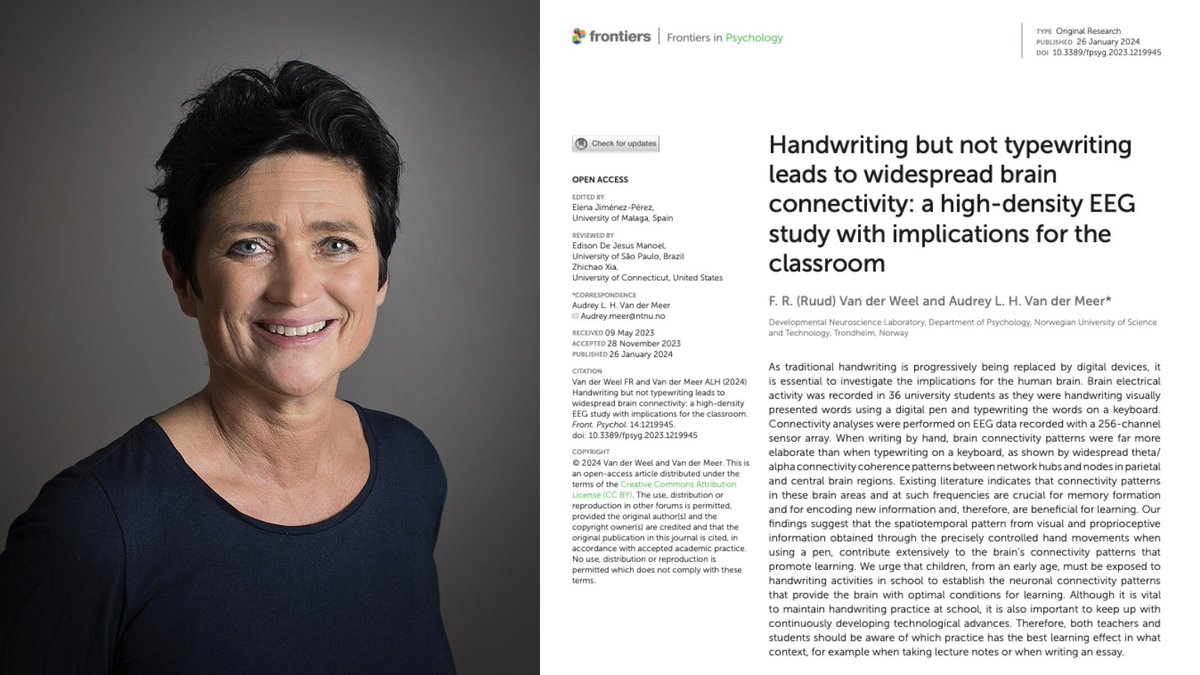
A Norwegian neuroscientist spent 20 years proving that the act of writing by hand changes the human brain in ways typing physically cannot, and almost nobody outside her field has read the paper.
Her name is Audrey van der Meer.
She runs a brain research lab in Trondheim, and the paper that closed the argument was published in 2024 in a journal called Frontiers in Psychology. The finding is brutal enough that it should have changed every classroom on Earth.
The experiment was simple. She recruited 36 university students and put each one in a cap with 256 sensors pressed against their scalp to record brain activity. Words flashed on a screen one at a time.
Sometimes the students wrote the word by hand on a touchscreen using a digital pen, and sometimes they typed the same word on a keyboard. Every neural response was recorded for the full five seconds the word stayed on screen.
Then her team looked at the part of the data most researchers had ignored for years, which is how different parts of the brain were communicating with each other during the task.
When the students wrote by hand, the brain lit up everywhere at once.
The regions responsible for memory, sensory integration, and the encoding of new information were all firing together in a coordinated pattern that spread across the entire cortex. The whole network was awake and connected.
When the same students typed the same word, that pattern collapsed almost completely.
Most of the brain went quiet, and the connections between regions that had been alive seconds earlier were nowhere to be found on the EEG.
Same word, same brain, same person, and two completely different neurological events.
The reason turned out to be something nobody had really paid attention to before her work. Writing by hand is not one motion but a sequence of thousands of tiny micro-movements coordinated with your eyes in real time, where each letter is a different shape that requires the brain to solve a slightly different spatial problem.
Your fingers, wrist, vision, and the parts of your brain that track position in space are all working together to produce one letter, then the next, then the next.
Typing throws all of that away. Every key on a keyboard requires the exact same finger motion regardless of which letter you are pressing, which means the brain has almost nothing to integrate and almost no problem to solve.
Van der Meer said it plainly in her interviews.
Pressing the same key with the same finger over and over does not stimulate the brain in any meaningful way, and she pointed out something that should scare every parent who handed their kid an iPad.
Children who learn to read and write on tablets often cannot tell letters like b and d apart, because they have never physically felt with their bodies what it takes to actually produce those letters on a page.
A decade before her, two researchers at Princeton ran the same fight using a completely different method and ended up at the same answer. Pam Mueller and Daniel Oppenheimer tested 327 students across three experiments, where half took notes on laptops with the internet disabled and half took notes by hand, before testing everyone on what they actually understood from the lectures they had watched.
The handwriting group won by a wide margin on every question that required real understanding rather than surface recall.
The reason was hiding in the transcripts of what the two groups had actually written down.
The laptop students typed almost word for word, capturing more total content but processing almost none of it as they went, while the handwriting students physically could not write fast enough to transcribe a lecture in real time, which forced them to listen carefully, decide what actually mattered, and put it in their own words on the page.
That single act of choosing what to keep was the learning itself, and the keyboard had quietly skipped the choosing and skipped the learning along with it.
Two studies. Two countries. Same answer.
Handwriting makes the brain work. Typing lets it coast.
Every note you have ever typed instead of written went into your brain through a thinner pipe. Every meeting, every book highlight, every idea you captured on your phone instead of on paper was processed at half depth.
You did not forget those things because your memory is bad. You forgot them because typing never woke the part of the brain that would have made them stick.
The fix is the thing your grandmother already knew.
Pick up a pen. Write the thing down. The slower road is the faster one.
A man sits in his office quietly, meditating. His office hums with activity, working on oiled wheels.
Files reach him, information is shared with him and large folder bound files for the "PM only" are brought to him by certain designated people in sealed tamper evident envelopes or locked dispatch cases.
He reads into the files till late at night, cross checking and rechecking his information. Multiple divisions of the MEA, Indian embassies abroad, intelligence agencies, security units and the PMO are being briefed and given last minute instructions.
Late in the night, a call is put through to the FM, it is picked by the second ring. A brief conversation and the phone is cut off.
A flight leaves New Delhi in the morning and the India's PM lands in Abu Dhabi in the afternoon.
Day One May 15, 2026: He signs a LPG Petrol deal and an investment deal of $5 billion with a more stable energy supply with UAE & leaves for Netherlands.
Day Two May 15-17, 2026 : In the Netherlands he will sign an agreement for Green Energy, for trade, shipping, ports, and technology. Deals here usually help India with logistics, semiconductor related cooperation, and access to European business networks.
Day Three May 17-18, 2026 : On the third day, he will be seen in Sweden, for green technology, industrial cooperation, and support for sustainable manufacturing.
The fourth day, May 18-19, 2026, he will be in Norway where he will negotiate on India's fuel security especially gas, maritime work, shipping, and clean energy projects.
The fifth day, May 19-20, 2026 he will be negotiating Italy's co-operation in the fields of machinery, aerospace, defence equipment, and manufacturing.
He will return back the fifth day. Calm, quiet, and stoic. He will not complain that he worked relentlessly for 140 crore Indians while others enjoyed their Sunday. He will ignore the criticism and the mockery and immerse himself back into his work.
While a handful of Indians like Bhagwant Mann will abuse him, berate him, for increasing the price of fuel by Rs 3, he would have secured India's future for the next 100 years when fossil fuel will deplete and the whole world will rely on renewable energy sources.
That is why he is called the Vishwaguru.
A person unaffected by criticism or praise, focussed on his country's sustenance and development.
Today is the beginning of Adhik Maas.
Ancient Indian astronomers realized that the lunar year is ~11 days shorter than the solar year. Without correction, festivals and seasons would slowly drift apart.
Their solution was Adhik Maas, an extra month added roughly every 32.5 months to create a self-correcting calendar system based on actual celestial motion.
One of the world’s oldest living examples of scientific timekeeping integrated with civilizational life.
The river's name is Iravati. Literally it means that she surrounds the earth because of her meandering nature.
River Iravati meets Asikhni who literally means one who is brown colored. This brown color is due to sediment rich water . This is incorrectly called Chenab.
Other river Vipasha who is incorrectly called as Beas joins them. Vipasha is called so because Vipasha means unrestrained. This is because she is fastest river among five rivers that feed Puncha Aap. Literally Five Waters in Sanskrit.
Another river Shatudri is called so because she has 100 tributaries. She is incorrectly called as Sutlej by invaders who do not know Sanskrit.
Then up north we have river Vitasta also incorrectly called Jhelum. Vitasta is called so because she is one Vitasta wide at the source.
These names are meaningful and allow us to reconnect with mother nature.
Please use native names for Bharat's rivers.
I have written about this earlier.
Thanks.
In 1929, an Indian family bought a German machine & forgot to name their company. They started a Candy War against the British, turning a simple Kiss into a national toffee & engineering a rainbow that would not melt in the heat. From saving a starving nation in 1947 with Army Biscuits to creating a Ghost Girl who lives on every grocery shelf, discover the secret history of the brand that taught India how to treat itself.
In 1929, a man named Mohanlal Dayal Chauhan bought an old, rusted factory in the suburbs of Bombay (Vile Parle). He went to Germany to learn how to make sweets. When he returned, he brought back a massive, sophisticated candy-making machine.
The family was so busy trying to figure out how to run the machine that they forgot to name the company. When people asked where the sweets came from, they just said the factory in Parle. That is how Parle was born, by accident.
Before the 1960s, the Indian candy market was dominated by British brands like Morton & Mackintosh. They sold Hard-Boiled sweets (lozenges) that were expensive & catered to the elite. Parle decided to create a Peoples' Candy. They realized that the Indian palate did not just want sugar; it wanted Elaichi (Cardamom) & Caramel.
They engineered a toffee that was a Hybrid. It had the chewiness of English toffee but the soul of an Indian dessert. They called it Kismi. The name was not just a cute word for a Kiss. It was a clever play on Kiss-Me, designed to sound Western & cool to the youth, while the flavor was purely 100% Swadeshi. It was the 1st Romantic candy of India.
Also in the 1960s, Parle launched Poppins. To the older generation, this was Rainbow in a Roll. In the Indian heat, multi-colored candies would melt & bleed into each other, turning into a brown sticky mess. Parle’s engineers developed a unique Dry-Glaze coating that allowed 10 different flavors (Guava, Blackcurrant, Orange, etc.) to sit side by side in a single roll w/o ever touching.
They turned a candy roll into a Chemical Marvel that could survive an Indian summer w/o a wrapper for hrs.
During the chaos of Partition in 1947, a severe wheat shortage gripped the newborn nation. With vast fertile fields now across the border, Parle faced a crisis. The Chauhan family temporarily halted production of their hugely popular Parle Gluco biscuits & switched their machines to barley-based alternatives to keep the factory running.
Even in those dark days, they refused to abandon the masses. They kept prices rock-bottom so that even the poorest refugees could afford a packet. What began as a humble glucose biscuit in 1939, already a favourite of the British Indian Army during World War II now became a symbol of resilience & Swadeshi spirit. Parle urged Indians to make do with barley till wheat returns, turning scarcity into a quiet act of service. This choice to put nation & people before profit is why Parle-G (originally Parle Gluco) rose to become the world’s largest-selling biscuit, a legacy built not just on taste, but on character.
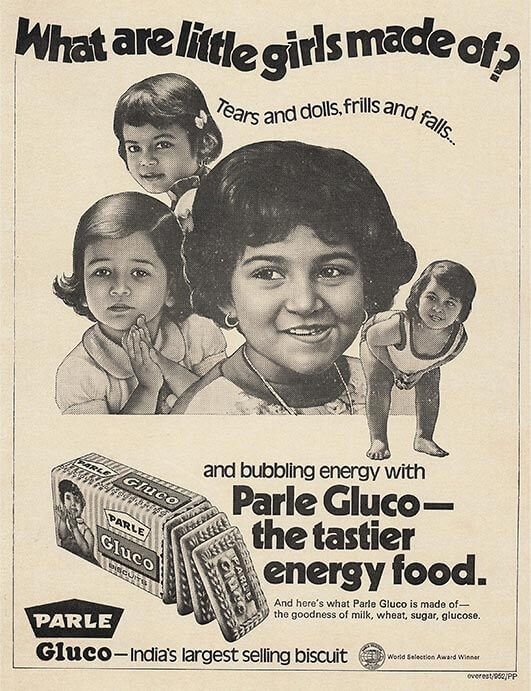
For decades, Indians have debated who the little girl on the wrapper is. Is it Neeru Deshpande? Is it Sudha Murthy? The truth is that she is not a real person. She was an illustration created by an artist named Maganlal Dahiya in the 1960s. She is a Composite Ghost, a symbol of every Indian child’s innocence, designed so perfectly that millions of people recognize her as someone they know.
The Parle toffee empire was not built in a boardroom; it was built in a kitchen that refused to use British recipes. They took the Fancy English toffee & gave it a Desi spine.
We remember the taste of the red & white Kismi wrapper/the rainbow Poppins, but we forget that these were Industrial Weapons. They were the 1st candies that told the West: "We do not need your sugar; we have our own sweetness."
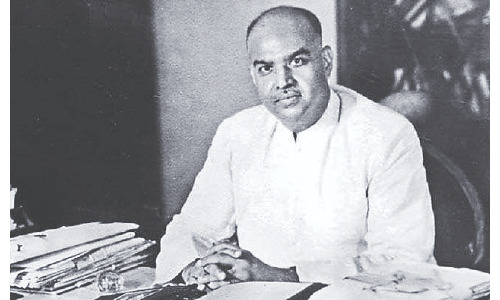
This is the Corporate Mookerjee that history books & even his own party rarely discuss. To understand his work as India’s 1st Minister for Industry & Supply, we have to look at how a Bhadralok scholar became as a COO of a bankrupt startup called "Independent India."
In 1947, India’s railways were a mess of British-made parts. We had the tracks, but we did not have the Heart... the engines. The British believed India would be a repair shop forever. Syama Prasad Mookerjee did not just want to buy trains; he wanted to build them in the very heart of the Bengal-Bihar coal belt. He chose a sleepy village named Mihijam & transformed it.
He named the factory after Deshbandhu Chittaranjan Das, his mentor. On January 26, 1950 (Republic Day), production activity/construction work commenced at the factory. This was a symbolic start on the day India became a Republic. While the British doubted that Indian engineers could master the complex science of high-pressure steam boilers & locomotive design, Mookerjee turned to the best technical talent the country had to offer.
Drawing from the engineering & physics graduates of premier institutions like Calcutta University & other centres of learning, he built a core team of Indian professionals who would prove the skeptics wrong. He was showing the world that India’s universities were not just academic halls, they were the womb of a new industrial nation.
Post-Partition, India was on the verge of mass starvation. The Green Revolution had not happened yet. Mookerjee realized that if India did not produce its own nitrogenous fertilizers, we would be begging the West for bread. He pushed through the Sindri Fertilizer Factory in Bihar. It was not just a factory; it was the largest of its kind in Asia.
This is where Mookerjee’s leadership shone. He did not just build a plant; he built a Miniature City. He insisted on a self-contained township with a hospital, schools, & a distinct Industrial Culture. He believed that an Indian worker should not just be a laborer but a citizen-producer. Sindri became the blueprint for every PSU that followed from Bhilai to Bokaro. He invented the PSU Life before the term even existed.
While Mookerjee was building heavy industry, he did something very unusual for a Modernist. He created the All India Handicrafts Board & the Handloom Board. He realized that heavy industry would take 20 yrs to employ everyone, but Bengal’s weavers & artisans were dying now.
He was the 1st to bridge the gap b/w the Small-Scale & the Large-Scale. He argued that India needed the Locomotive for its muscles, but the Handloom for its soul. He protected the Small Brands of rural India by giving them a seat at the cabinet table.
Long before global IP laws, Mookerjee was obsessed with Standardization. He was the driving force behind the Indian Standards Institution (now Bureau of Indian Standards - BIS). He knew that "Made in India" would only be a global brand if it had a Hallmark. He wanted an Indian Standard that was as rigid as the British BSI. Every time we see an ISI mark today, we are seeing a residue of Mookerjee’s obsession with quality.
Next time we see an Indian train/a sack of fertilizer, remember: the man who founded the 'Right Wing' was actually the 1 who laid the 'Industrial Foundation' of the Indian State. He was a Technocrat in a Saffron Cloak.
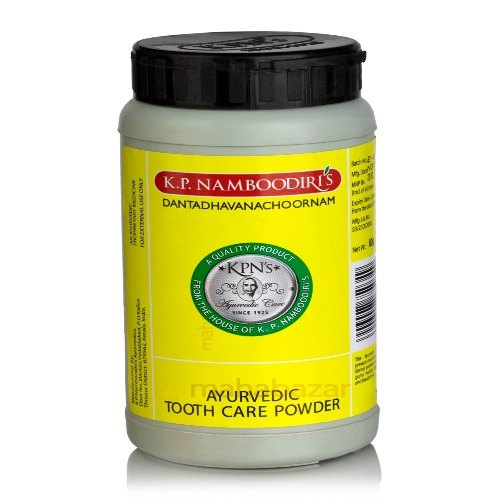
Today, global dental giants are sprinting to launch Activated Charcoal lines, charging a premium for the charcoal revolution. But in 1925, a physician in a small Kerala village was already selling it in paper pouches. The British mocked it as primitive ash, while secretly, their own officers used it to scrub away the stubborn stains that Imperial White paste could not touch. An indian invented Biological Magnetism 100 yrs before the West could put a marketing name on it.
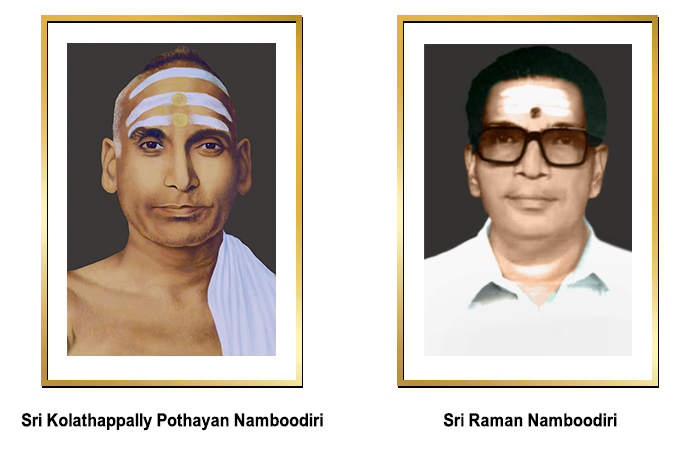
K.P. Namboodiri, an Ayurvedic physician, realized that the British were fundamentally wrong about the science. When paddy husk is charred at a specific temperature, it creates a micro-porous structure almost identical to what we now call Activated Carbon.
Namboodiri infused the ash with Pepper, Clove, & Ginger. The black carbon acted as a magnet (adsorption) to pull toxins & stains out of the gums, while the spices provided the thermal healing. He was practicing Molecular Chemistry in a small Kerala village decades before Western brands understood that carbon is the most efficient way to detoxify the mouth.
The British tried to market their white powders as a symbol of The New India... the educated, clean, Westernized Indian. Namboodiri flipped the script. He made his Black Ash a symbol of Vedic Purity. In the 1920s & 30s, the most orthodox Brahmins & the most radical revolutionaries in the South both used the Black Powder.
It became a silent way to identify who had rejected the British lifestyle. If your gums were slightly tinted with the dark residue of charred husk in the morning, it was a badge of honor. It said: "My mouth is cleaned by the soil of my ancestors, not the chalk of the King."
British dental companies tried to run smear campaigns against Black Powders, claiming they were abrasive. Namboodiri’s powder was so fine that it actually had a lower RDA (Relative Dentin Abrasivity) than the British chalk-based powders. It was physically impossible for the British to prove it was harmful.
The Black Powder was so effective at removing the stubborn stains of Betel Leaf (Paan) & Tobacco that even British officers in the South reportedly bought it in secret. They could not get their Imperial White pastes to remove the deep stains of Indian life, so they relied on Namboodiri’s Ash behind closed doors.
For 90 yrs, global giants like Colgate & Pepsodent spent millions on advertising to tell Indians that Black is Bad & White is Bright. In the late 2010s, those same companies launched Charcoal toothpastes at a luxury price point. They are now using the exact same tech K.P. Namboodiri was selling for a few annas in 1925.
If we look at a modern, high-end Activated Charcoal tube today, we are looking at a 100 yr old apology to K.P. Namboodiri. He was not backward; he was a century ahead of the global dental industry. The British used Chalk (a sedimentary rock) because it was cheap & looked clean. Namboodiri used Paddy Husk (a life-giving grain) because it was biological & functional.
K.P. Namboodiri’s legacy is the story of a man who looked at the waste of a rice field & saw a diamond. He took the blackest substance he could find & used it to give India its brightest smile.
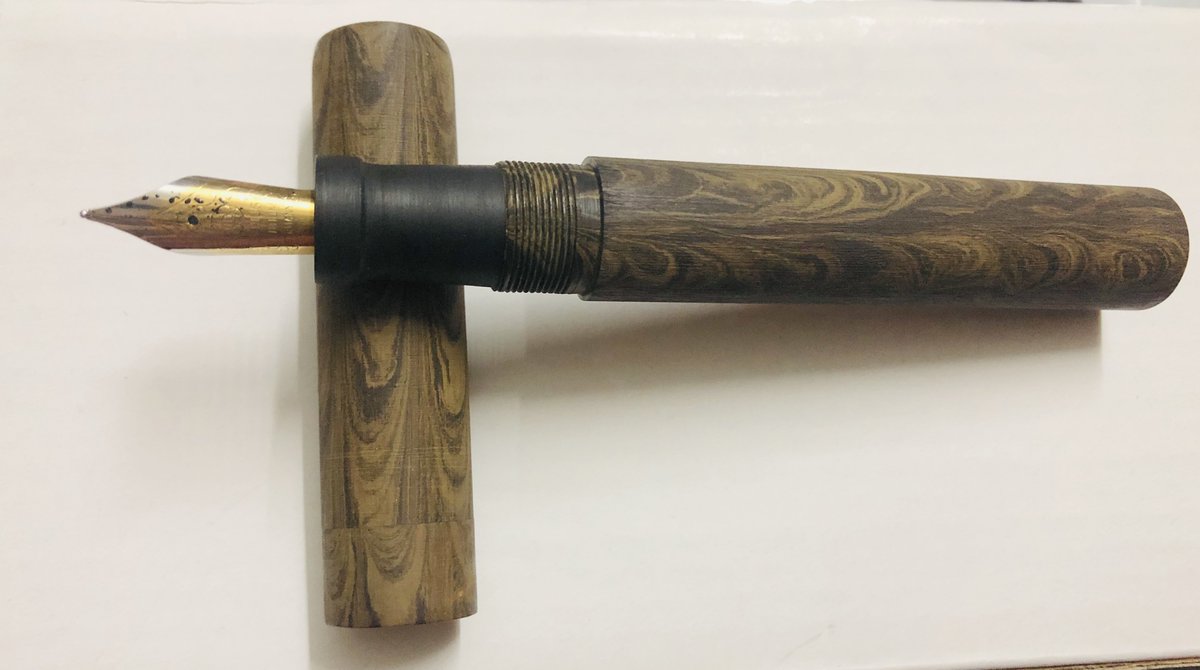
In 1921, Mahatma Gandhi asked K.V. Ratnam to make a pen; he issued a challenge that was practically an industrial death sentence. He told Ratnam to build a fountain pen made entirely of Indian materials, or not to bother at all. For 13 yrs, Ratnam operated like a medieval alchemist in the shadows of Andhra Pradesh, trying to solve a puzzle that the British claimed was impossible for an Indian mind.
The story started with a failure. Ratnam's 1st attempt was a hybrid pen using foreign nibs. When he showed it to Gandhi, the Mahatma famously rejected it. Gandhi’s logic was brutal: “If the nib is from Germany, the soul of the letter is foreign.”
Ratnam went into a 13 yr exile within his own workshop. He was not just making a product; he was fighting a war against Ebonite & Iridium. The British laughed because they believed the tipping of a pen (the tiny point on the nib) required specialized European machinery that no Indian could access/operate.
How did a man in Rajahmundry replicate 20th century German metallurgy w/o a factory?
Ratnam began experimenting with local materials. He sourced Ebonite (hardened rubber) &, most importantly, developed a secret method to tip the nibs using indigenous alloys. In 1934, Ratnam sent his 100% Swadeshi pen to Gandhi. The Mahatma wrote back a letter that changed history: "I have used it & it is a good substitute for the foreign pen." That single piece of paper turned a small-town workshop into the Official Armory of the Satyagrahi.
Before the Ratnam pen became famous, Ratnam was known as the only man who could fix the expensive British Parker & Sheaffer pens of the elite. While repairing the pens of British officers, Ratnam was essentially performing Industrial Autopsies. He was studying the internal mechanics of the Empire’s best tools to build something that would eventually destroy their market.
The British officers were paying Ratnam to fix their pens, unwittingly funding the R&D of the very brand that would soon make their imports obsolete in the Indian market.
When world leaders met, they often exchanged expensive Swiss watches/German pens. But the Indian leadership carried the Ratnam, a pen made of humble ebonite that did not leak at high altitudes (a common flaw in early pens), proving that Indian low-tech engineering had outsmarted European high-tech manufacturing.
If Saha’s pen (story link at the bottom) was a Scalpel (precise, scientific, cold), Ratnam’s pen was a Staff. It was rugged, made of the earth, & designed to write the destiny of a nation on a piece of handmade paper.
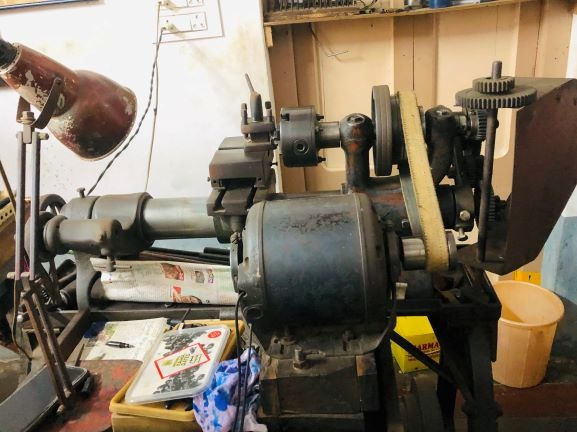
To this day, the Ratnam Sons workshop in Rajahmundry still uses some of the original lathes. When you hold a Ratnam pen, you are holding 13 yrs of stubborn refusal to accept that "Indian" meant "Inferior."
Saha Story Link - https://t.co/MWcvnhDQI1
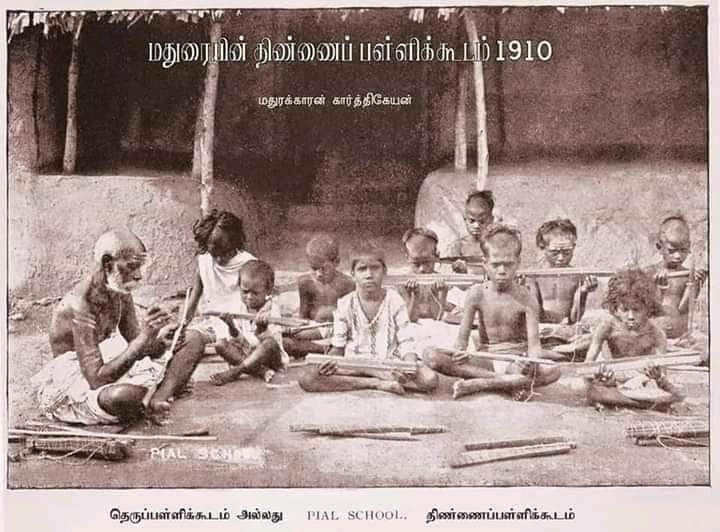
1910. Madurai.
Children. Different ages.
Different backgrounds.
One space. One पाठशाला.
Palm-leaf manuscripts in hand.
Learning together.
Not a modern classroom.
No degrees. No standardized boards.
Yet knowledge flows.
Now pause.
We are told education was restricted.
Access was limited.
Learning was locked behind rigid walls.
Then what are we looking at?
A classroom that doesn’t fit the narrative.
No, this doesn’t mean everything was equal.
But it does mean—
Reality was more complex than the story we inherited.
Because on the ground, systems existed.
Local. Functional. Adaptive.
And then came replacement.
From *community learning* → to *centralized schooling*.
From *oral + manuscript traditions* → to *textbook dependency*.
Today?
₹5–15 lakh for degrees.
Years in classrooms… still chasing skills. 🎓💰
So ask—
Did we expand education…
or standardize it at a cost?
And more importantly—
What did we lose when we replaced systems
we barely tried to understand?
📜👴💰
#IndianHistory #Education #Indology #Madurai
Next in who after the Ramanujan Series? Before Google was a company, he had already built an early intelligent system based on neural networks. Subhash Kak is the Ghost who bridged the gap b/w Narayana of the past & the Algos of the future. In a quiet lab in Oklahoma, he designed a Neural Network that learns in a fundamentally different way from conventional systems. He is the man who looked at 2000 yr old Sanskrit grammars & saw deep structural insights that could inspire the world's most advanced code. While Silicon Valley builds the future, Kak is 1 of the few who found ancient patterns that resonate with modern computing. He is the titan who proved that the computer is not just a machine, it is also a mirror of the ancient mind.
While the world was still using floppy disks, Kak was trying to solve the hardest problem in tech: How to make a machine understand Meaning, not just Math. In the early 90s, Kak developed an early AI-based search engine concept called LASSI (Language Analysis and Synthetic Search Inference). Unlike the early keyword-based search engines (like AltaVista), LASSI used Neural Networks & Associative Memory to go beyond simple word matching. It was an important early attempt at semantic search, a forerunner of the kind of contextual understanding we use today.
In fact, he redesigned key aspects of how computers could learn. He introduced the Kak Neural Network (a type of instantaneous learning network). While most AI today requires massive training (LLMs take months), Kak’s approach explored the idea of rapid, 1 shot learning... modeling how a human child can learn a word after hearing it just once.
He was 1 of the early researchers to propose ideas in Quantum Neural Computing, merging concepts from quantum physics with neural architectures.
Kak is a Ghost (for his AI contribution) because his work is too Eastern for the West & too Technical for the East. He realized that the Panini Grammar (from 2500 yrs ago) was a masterpiece of formal structure, 1 of the most sophisticated rule-based systems ever created. He spent decades at Oklahoma State University, working in a silo that sounds like science fiction, translating the ritual logic of the Vedas into the language of Machine Learning.
He solved important qs in the Chronology of Indian Science, using Archaeo-astronomy (tracking the position of stars mentioned in old texts) to push the timeline of ancient Indian mathematics & astronomy much earlier than previously thought.
He proves that the Ramanujan Gene, the ability to see deep patterns in the universe is part of a 1000s yrs old tradition. He is the man who showed that modern AI we are so proud of has surprising philosophical & structural connections to ancient Indian logic. Because he talks about both Quantum Physics & Ancient History, the siloed academic world often does not know where to put him. He remains a Ghost because he refuses to pick just 1 side.#WhoAfterRamanujan