Ashwani Gaur Foundation is organizing a food distribution event on Ashwani’s Birthday (21 July 2023)
If you're interested in helping out, we'd love to have you on board! The event is for a great cause and your support would be much appreciated🤍
पिछले ढाई सालो से युवाओं को अचानक मरते देख रही मोदी सरकार को हजारों बार वैक्सीन के साइड इफेक्ट के बारे में चेताया गया
सरकार तब जागी जब लाखों टैलेंटिड युवाओं के परिवारों के चिराग बुझ गए
मोदी के लिए कोई भी मौत इवेंट बन जाती है
हमारे लिए मौत जिंदगी भर का ज़हर बन गई
@RahulGandhi
|| How Rishi Kanand gave an atomic theory atleast 2,500 years ago? Works Of Rishi Kanad- one of the greatest minds in Ancient India ||
The Western world has propagated the notion that John Dalton discovered the atom around 1800. Some argue that the credit for the idea of the atom should be attributed to Democritus in 450 BCE. However, it is important to recognize that Indians had a much earlier and more detailed understanding of atoms.
Maharishi Kanad, also known by various names such as Kashyapa, Uluka, Kananda, and Kanabhuk, is believed to have lived between the 2nd and 6th centuries BCE, although the precise date of his birth remains uncertain. He was the one who made significant contributions to the field of philosophy, logic, and atomic theory. He is widely regarded as one of the earliest proponents of atomic thought and is considered the founder of Vaisheshika, one of the six philosophical schools of Hindu philosophy, where he expounded his ideas on atoms and the nature of the universe. He authored a book called "Vaisheshik Darshan" and earned the title "The Father of Atomic Theory."
Kanada's school of thought aimed to provide an explanation for the creation and existence of the universe by proposing an atomistic theory that employed logic and realism. According to Kanada, everything in the universe can be divided into smaller parts, but this process of subdivision cannot continue infinitely. Eventually, there will be a particle that is indivisible and cannot be further subdivided. Kanada referred to this indivisible particle of matter as "anu" or "parmanu," which is what we now recognize as the atom. Kanada further explained that this parmanu, or atom, cannot be detected or perceived through any of the human senses or organs.
A question must arise that how can Maharishi kanada was able to find, such small particles at that time. Well, we find the answers in his book itself---
तथा द्रव्यान्तरेषु प्रत्यक्षम् | 9.1.12
“It’s said in this Sutra that as Yogis can see the actual Atma in Yogic meditation by process of unification of Mind and soul. They can also see the Atoms (Sukshma Dravyas)”.
The difference is Yujjaana yogis can see them in Samadhi only and the Yukata do not need Samadhi. In the next sutra-
तत्समवायात् कर्मगुणेषु | 9.1.14
It states that advanced yogis, known as Yukta Yogis, have the ability to perceive not only the atoms themselves but also the Guna-Karmas (qualities and actions) associated with these entities.
This suggests that the Vaisheshika philosophy holds that through the practice of Yoga, nothing is impossible. Yukta Yogis possess the remarkable capability to see atoms even without engaging in meditation, thanks to their Yogic powers. These atoms can be perceived through Yogipratyaksha, which is a form of direct perception through the yogic abilities, and in some cases, even with their physical eyes.
Vaiseshikas further held that atom had the ability to combine with each other, resulting in the formation of dvyanuka (diatomic molecules) and tryanuka (triatomic molecules). Kanad also proposed the concept that atoms could undergo different combinations, leading to chemical changes when influenced by external factors like heat.
He has also propounded six categories of padarthas, which are sufficient to describe everything in the universe. These include:
1. Dravya (substance)
2. Guna (quality)
3. Karman (motion)
4. Samanya (universal)
5. Visesa (particular)
6. Samavaya (inherence).
Kanada’s conception of the atom was different from the ancient Greeks, because of the differences between the theories. For example, Kanada suggested that atoms as building blocks differ both qualitatively and quantitatively, while Greeks suggested that atoms differed only quantitatively but not qualitatively.
Other works of Rishi Kanad-
◆ Concept of Akasha: Rishi Kanad also introduced the concept of Akasha, often translated as "space" or "ether." He posited that Akasha is an eternal substance that provides the substratum for the existence of all other elements. This concept of Akasha plays a vital role in understanding the interplay of matter and consciousness in the Vaisheshika philosophy.
◆ Theory of Causation: Rishi Kanad developed a comprehensive theory of causation known as "Asatkaryavada." According to this theory, he proposed that the effect (karya) exists potentially in its cause (karan) before manifesting. He categorized causes into four types: material cause, instrumental cause, efficient cause, and inherent cause.
◆ In the field of gravity- Yes, Gravity was known to him. Not only that, he also shared his detailed knowledge on gravity ( I will write about it in details).
Not only history but, Science needs to be re-written with Indian context.
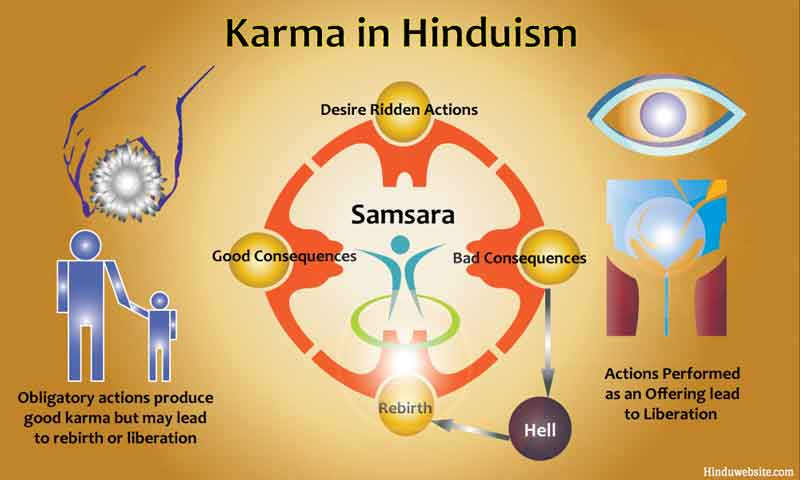
|| The Law of Karma, How Does It Work? Why is there suffering? Why Shree Ram Took Birth ||
Hinduism has a complex and diverse concept with various philosophical and spiritual concepts, and one of its 3rd fundamental concepts is the law of karma. (I have already written about the first two).
What is Karma?
The process of action and reaction on all levels — physical, mental, and spiritual - is karma. Karma is the most important and basic principle of Hinduism, yet a very complex thing to understand.
Karma, derived from the Sanskrit word meaning "action" or "deed," is the belief that every action a person takes has consequences that affect their present life and future lives.
What is its significance?
a) Everyone is bound to perform action, no one can escape it. BG, chapter 3.4-
न कर्मणामनारम्भान्नैष्कर्म्यं पुरुषोऽश्नुते |
न च संन्यसनादेव सिद्धिं समधिगच्छति।।
Meaning- One cannot achieve freedom from karmic reactions by merely abstaining from work, nor can one attain the perfection of knowledge by mere physical renunciation.
b) Many people think that karma is their actions but its only the half truth. karma is not only the actions you take but it is also what you think all the time. The quality of one's thoughts and the motivations behind their actions are believed to have a profound impact on the consequences they experience. Positive thoughts, such as love, compassion, and selflessness, are considered to generate positive karma, while negative thoughts, such as hatred, greed, and selfishness, are believed to produce negative karma.
BG 3.5-
न हि कश्चित्क्षणमपि जातु तिष्ठत्यकर्मकृत् |
कार्यते ह्यवश: कर्म सर्व: प्रकृतिजैर्गुणै: ||
Meaning- There is no one who can remain without action even for a moment. Indeed, all beings are compelled to act by their qualities born of material nature.
So whatever we think or do, every single thing is getting registered and we’ll be reincarnated accordingly.
c) Every karma has an equal resultant. All positive action and thoughts generate good karma and vice-versa.
d) Karma can only be earned in human life. In lower lives such as plants and animals, plants and animals are generally considered to have limited consciousness and are driven by instinctual behaviors. While they may experience the consequences of their past actions, their ability to consciously generate new karma is thought to be limited. Only their bad karmas get burned in the lower lives.
Types of karma-
Karma can be divided into four parts -
a. Sanchita Karma- The sum of all karmas of this life and past lives.
b. Prarabdha Karma- The portion of sanchita karma that is bearing fruit and shaping the events and conditions of the current life.
c. Kriyamana karma - The karma which is being created and added to sanchita in this life by one's thoughts.
d. Agama karma- the actions that we are planning for the future.
Why Shree Ram took birth?
Many thinks that he was born to-
1. Kill ravana
2. For dharmasthapna
3. to free sabri etc etc.
These all are true but let's reconsider the main purpose behind shree Rama's birth, which is often overlooked. His incarnation aimed to demonstrate that the law of karma applies even to gods and is unyielding. Bhagawan Vishnu, known for his strategic character, consistently had underlying motives behind each of his avatars. As the overseer of the human realm, he took on various avtars to impart wisdom and establish essential principles.
To support this perspective, consider the following points:
1. Vrinda, the wife of Jaladhar, cursed Bhagawan Vishnu, decreeing that he would endure separation from his own spouse.
2. Narada, a sage, cursed Bhagawan Vishnu, stating that he would face a situation similar to Narada's own unfulfilled love, causing suffering in his quest to be with his beloved.
3. The path followed by Rama is widely recognized as the most arduous route to attain spiritual liberation (moksha). Reading the Ramayana in its entirety reveals that it encompasses more than a simple tale of good triumphing over evil; it portrays a narrative of anguish, sacrifice, and the challenges one must endure to lead an exemplary life.
Being a god, Vishnu could have easily escaped the principles of Karma but no he didn't and that makes law of karma inevitable.
Why there is so much suffering?
Happiness or suffering is just the resultant of one's past life karmas. If there is pain and suffering in your life while your friend is having a cheerful life, you must understand that you had done something very bad in your past life while your friend must have done something excellent in his/her past life.
Karma and fate-
Karma has suffered a chronic association with the word fate. Fate is a Western idea, derived largely Abrahamic religions, Judaism, Christianity and Islam. It means, that one's life has been set by agencies outside oneself. However, Karma is exactly the opposite. Karma says that your life is completely based on what you think and do. Karma teaches that individuals have the power to shape their lives through their thoughts, intentions, and actions, emphasizing personal responsibility and agency. It highlights the interconnectedness of actions and their consequences, suggesting that individuals have the ability to influence their own destiny.
Congratulations to those youngsters who have cleared the Civil Services Exams. My best wishes for a fruitful and satisfying career ahead. This is a very exciting time to be serving the nation and bringing a positive difference in the lives of people.
I understand the disappointment of those who couldn’t clear the Civil Services Exams. Not only will there be more attempts to avail but also India offers several diverse opportunities to showcase your skills and strengths. Wishing you the very best.
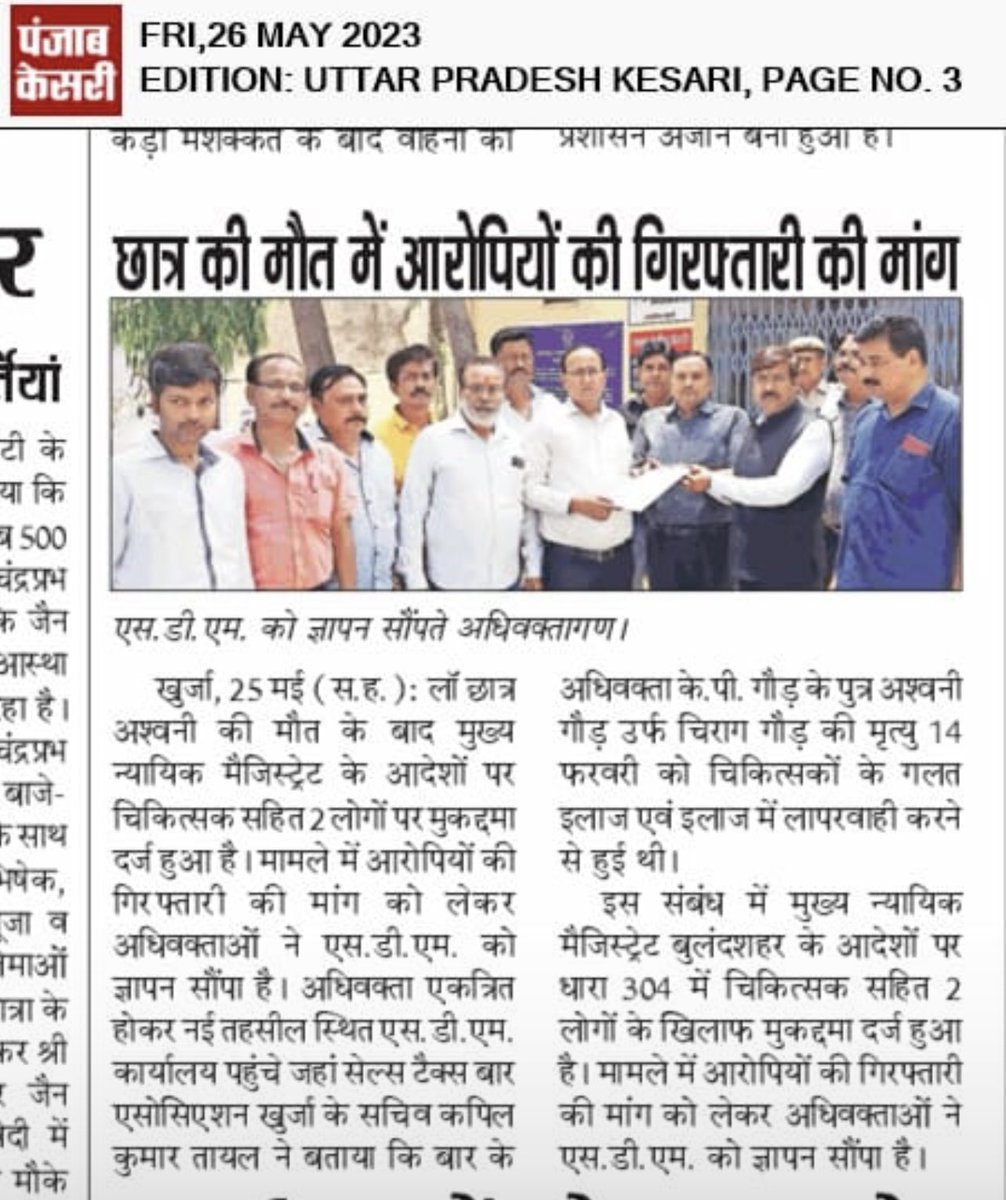
FIR has been lodged against
Dr. Neeraj kumar (MBBS,MD) and Prem Prakash Arora (Admin of Kailash Hospital, Khurja) u/s 304 of IPC by court’s order. They are accused of Ashwani Gaur - 19 y/o Young Law Student,whose life has been taken away on 14 Feb,2023.
https://t.co/DVH7PKvsyn
सभी माननीय अधिकारियों से नम्र निवेदन है कि अश्वनी को न्याय दिलाने में हमारी मदद करें। अगर आज ऐसे भ्रष्टाचारियों पर रोक नहीं लगाई ना जाने कितने घरों के चिराग ऐसे ही भूज जाएंगे।#JusticeForAshwani