कह रहे है कि #प���िसीमनबिल पास होने के बाद लोकसभा में माननीय सांसदों की संख्या 543 से बढकर करीब करीब 830 हो जायेगी!
यानी अभी जो सांसद बगैर हमारे (जनता) के पास आये .. आपसी मिलीभगत (और भाईचारे) से अपना वेतन, भत्ते और खर्चे आदि में लगभग हर साल बढोतरी कर लेते हैं .. जो कि हमारी आपकी टैक्स का पैसा है! अह ऐसे 270 और सांसदों की तनख्वाह का बोझ हम और आप पर आने वाला है!!
आम लोगों की तनख्वाहें बढ नहीं रहीं, नौकरियों के लाले हैं…
ऐसे में हम करीब 270 नये लोगों को काम पर रखने जा रहे हैं! क्या आप लोग इस अतिरिक्त भार के लिये तैयार हैं!
नोट - वैसे आपको बता दूं अमेरिका ने अपने देश में सांसदों की संख्या 435 पर फ��रीज कर रखी है.. वो भी करीब 100 सालों से… यानी अमेरिका की आबादी कितनी भी बढे सांसदों की संख्या नहीं बढेगी चाहे कुछ हो जाये!
अमेरिका से बहुत देखते और सीखते और चुराते रहे हैं हम लोग … क्या ये वाली बात भी भारत को कॉपी नहीं कर��ी चाहिये? क्या है आपकी राय अपने देश के लिये —
A piece of advice for everyone choosing a specialty or super-specialty.
I see so many people worrying about what will happen after they finish their training. Will there be enough opportunities? Will establishing a practice be difficult? Will I earn well?
Honestly, we overthink this far too much.
The more people you talk to, the more frustrated everyone seems with their own specialty. Everyone has a list of negatives and makes you feel that the grass is greener on the other side. Stay away from such conversations. Don’t let someone else’s dissatisfaction determine your career choices.
Of course, some specialties, particularly interventional and surgical branches, may have higher earning potential, but they also come with their own compromises in terms of workload and work-life balance. Every specialty has its opportunities and challenges. AI won’t eliminate the need for good radiologists, just as competition won’t eliminate the need for good clinicians.
My advice is simple:
Write down which specialty genuinely interests you.
Decide whether you want a particular institute for better training and exposure.
Make your choice and commit to it.
Don’t obsess over what you will do once you finish your training.
If you do genuinely good work for 3–5 years in a field you enjoy, build your skills, communicate well, treat patients ethically and develop a good reputation, you will find your own pathway. You will also build relationships, discover opportunities and encounter people who may completely change the direction of your career.
Sometimes, a little serendipity goes a long way. Your life may take a completely different trajectory because of one exposure, one mentor or one opportunity you never anticipated.
Choose what you like, work hard, stay open to opportunities and let things unfold.
Your good work will do the needful.
And trust me, if you become really good at what you do, you will probably have more money than time to spend it!
Just my two cents. Best wishes!
Today, we release LingSante-3.1-flash, an open-weight MoE model with 560B total parameters and 25B activations per token. It unifies diverse medical capabilities while retaining general capabilities, including complex medical reasoning, long-horizon workflow execution, and professional behavior alignment.
LingSante-3.1-flash moves beyond medical QA toward real-world healthcare problem. The model leads on HealthBench Professional (65.72), HLE (text-only, with tools: 72.22) and BrowseComp (with context: 94.10), outperforming GPT-6 Astra, Claude Opus 5.5 and Gemini 4 Argon on all three. LingSante-3.1-flash also performs well on professional long-horizon medical workflows, such as PhysicianBench (57) and EHR-Complex (74.40).
Together, these results establish LingSante-3.1-flash as the leading open-weight models for healthcare.
The weights are available. Explore LingSante and build with it.
More below ↓
Research on predicting who responds to GLP1.
In 483 adults with obesity, a subtype with fast gastric emptying, more hunger after meals and low GLP-1 was described.
On tirzepatide, this group lost 21.5% body weight at 6 months vs 11.7% in others.
Observational; prospective validation is needed.
https://t.co/kuSxTrtkm4
Your morning coffee might be doing more for your brain than you think. ☕
A big JAMA study of ~132,000 people followed for up to 43 years found that 2–3 cups of caffeinated coffee a day was linked to an 18% lower dementia risk and modestly better cognitive function. Tea showed a similar pattern. Decaf did not.
Sweet spot appears to be moderate intake — more wasn’t better. Association held across genetic risk levels, but this is observational (not proof of cause and effect).
If you already enjoy a couple of cups, the data look encouraging.
Not a substitute for sleep, exercise, and other brain-healthy habits.
Source: Zhang et al., JAMA 2026
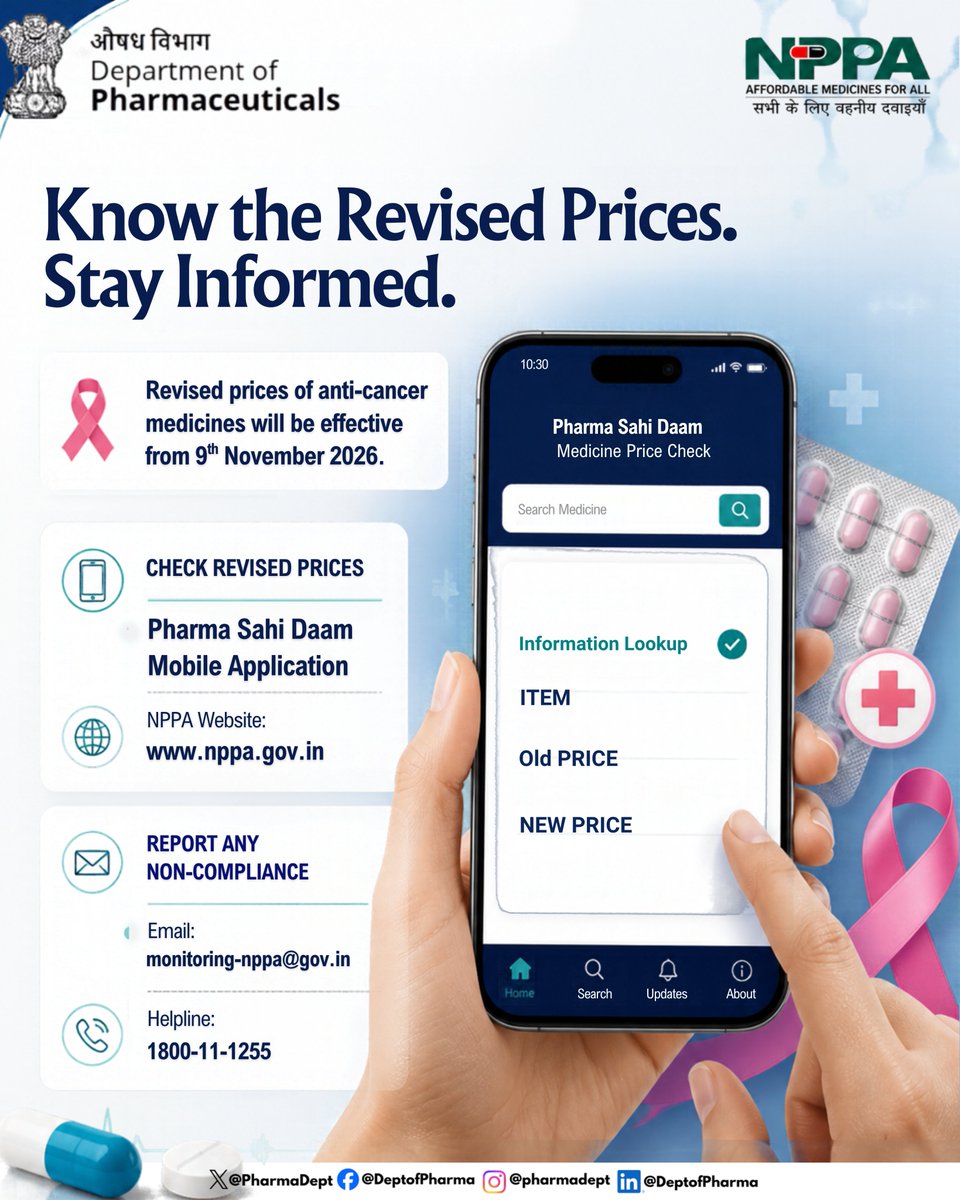
📢 Know the Revised Prices. Stay Informed.
💊 Revised prices of anti-cancer medicines will come into effect from 9th November 2026.
📱 Check applicable prices through the Pharma Sahi Daam mobile application or NPPA website: https://t.co/hoxsURgf4F
📩 Report any non-compliance or violation of revised prices:
💠Email: [email protected]
💠Helpline: 1800-11-1255
#TMR #ConsumerAwareness #AffordableCancerCare
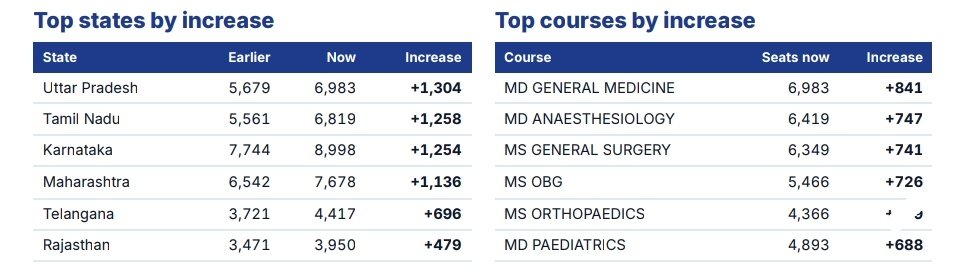
NEET PG 2026: State-wise and branch-wise seat increase!
The revised NMC seat matrix shows some significant additions across states and clinical specialities.
🇮🇳 TOP STATES BY SEAT INCREASE
🪳 Uttar Pradesh: +1,304 (5,679 → 6,983)
🪳 Tamil Nadu: +1,258 (5,561 → 6,819)
🪳 Karnataka: +1,254 (7,744 → 8,998)
🪳 Maharashtra: +1,136 (6,542 → 7,678)
🪳 Telangana: +696
🪳 Rajasthan: +479
TOP COURSES BY SEAT INCREASE
🪳 MD General Medicine: +841
🪳 MD Anaesthesiology: +747
🪳 MS General Surgery: +741
🪳 MS Obstetrics & Gynaecology: +726
🪳 MD Paediatrics: +688
🎯 Uttar Pradesh leads the state-wise increase, while General Medicine tops the speciality-wise additions.
A substantial expansion in PG seats this year. The big question now is how these additional seats will translate into AIQ and State Quota opportunities in Round 2.
#NEETPG
The National Medical Commission (NMC) has approved an additional 318 postgraduate (PG) medical seats in Odisha.
College-wise distribution: 👇
1. Dharanidhar Medical College, Keonjhar - 44
2. Govt. Medical College, Sundargarh - 22
3. SLN Medical College, Koraput - 28
4. PM Pradhan Medical College, Talcher - 32
5. Swami Laxmanananda Saraswati Medical College, Phulbani - 27
6. PRM Medical College, Baripada - 33
7. Bhima Bhoi Medical College, Balangir - 44
8. Fakir Mohan Medical College, Baleshwar - 46
9. PGIMER & Capital Hospital, Bhubaneswar - 11
10. SCB Medical College, Kataka - 17
11. Acharya Harihar Regional Cancer Centre, Kataka - 3
12. VIMSAR, Burla - 11
Five government medical colleges in Keonjhar, Sundargarh, Koraput, Talcher and Phulbani are introducing PG courses for the first time.
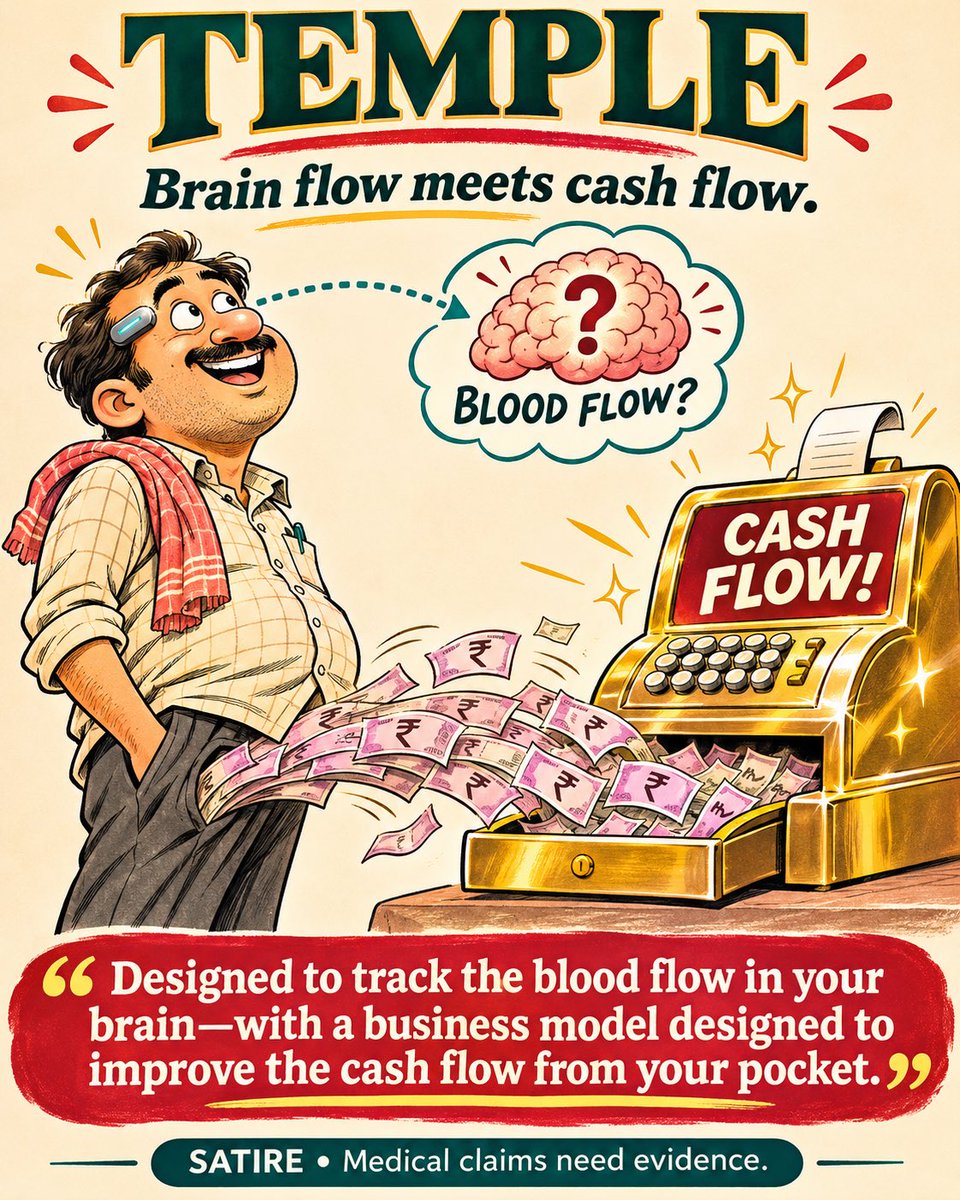
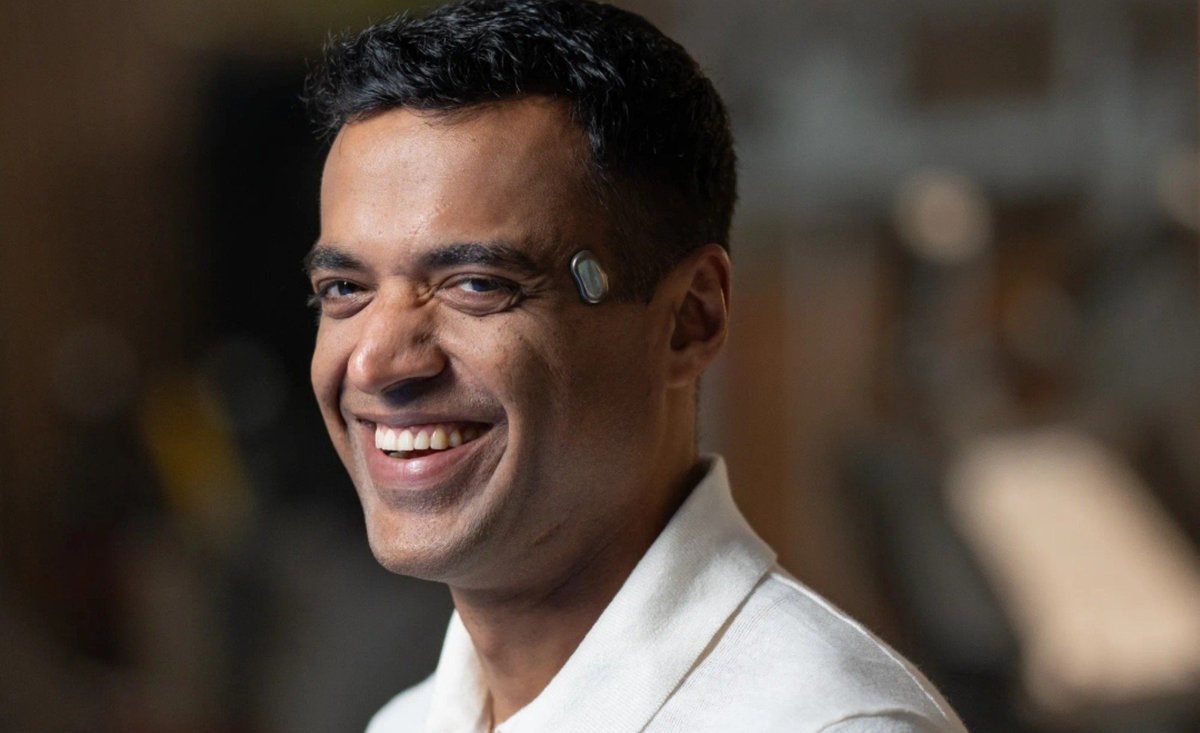
Can Temple track brain health? Why doctors are sceptical of Deepinder Goyal’s wearable device
As Zomato founder Deepinder Goyal launches a Rs 85,000 wearable, medical experts warn that relying on unverified brain-tracking tech for stroke risk could be ‘dangerous’
An informative article prepared by @ToufiqRashid published in @firstpost has my quotes.
https://t.co/HTVdDbcp4Q
“The main claim is that the device can act as a surrogate marker of blood flow to the brain. That is where the scientific questions arise,” says Dr Sudhir Kumar, consultant neurologist at Apollo Hospitals, Hyderabad.
"A surrogate marker is an indirect measurement used to provide information about a biological process that may be difficult to measure directly. Neurologists in India, however, are questioning whether changes detected in the artery near the temple reliably correspond to changes in blood circulation inside the brain."
Why are doctors questioning the brain blood-flow claims?
“The Temple device measures signals from the superficial temporal artery, which runs close to the skin and supplies blood to the scalp and surrounding tissues. It is a branch of the external carotid artery and is not one of the four major arteries supplying the brain. Therefore, we cannot assume that the readings from this artery accurately reflect blood flow through the arteries supplying the brain,” says Dr Kumar.
"He explains that someone could have normal blood flow through the superficial temporal artery while simultaneously having disease or narrowing in the carotid or vertebral arteries."
“Just as a person can have a blockage in one of the coronary arteries supplying the heart while the others remain normal, the same principle applies to the brain's blood vessels,” he says.
Can Temple predict a stroke or detect blocked arteries?
So what is a medical device versus a fitness device, and can consumers tell the difference? This is an important concern, say doctors, because consumers may interpret a device that claims to monitor brain blood flow as something that can provide information about a stroke risk or the health of their brain arteries.
Dr Kumar says this assumption would be dangerous. “What is the practical purpose of giving people this information? If someone is buying a device for around Rs 85,000, what exactly are they expected to do with the readings?” he asks.
"He cautions that normal readings from the superficial temporal artery cannot rule out a blockage or narrowing in the arteries supplying the brain. “In neurology, clinical symptoms are extremely important. If a person develops difficulty speaking, facial drooping, or weakness in an arm, these symptoms must be taken seriously, irrespective of what a wearable device reports," Dr Kumar cautions.
Stroke treatment is time-sensitive. Someone who experiences symptoms but gets a reassuring reading from a wearable could delay reaching a hospital, with potentially serious consequences.
"Doctors use the FAST acronym – Face drooping, Arm weakness, Speech difficulties, and Time – to seek emergency medical attention."
"Diagnosis requires urgent hospital assessment and investigations such as CT or MRI scans and, where indicated, vascular imaging. A consumer wearable cannot replace these investigations."
"That could have catastrophic consequences," Dr Kumar warns.
What scientific evidence is needed to establish that Temple works?
The fact that a device produces readings does not automatically mean those readings are accurate or clinically useful.
"Dr Kumar says three things must be clearly communicated whenever a new health-monitoring device is introduced: what it can do, what it cannot do, and what limitations consumers should understand."
“The research supporting a device also needs to be examined carefully. Studies uploaded to non-peer-reviewed platforms do not carry the same scientific weight as research that has undergone peer review and been published in established journals,” he emphasises.
"The neurologist believes the technology should undergo well-designed clinical trials, with its readings compared against established clinical assessments."
“Ultimately, the question is whether the device provides information that can be meaningfully used in clinical practice. If it cannot be applied to patient care, what is its practical value?” Dr Kumar asks.
When doctors clash with innovators
"Dr Kumar says the debate should not be reduced to a confrontation between doctors and entrepreneurs."
“This is not a question of doctors versus innovators or doctors versus businessmen. Doctors use medical devices every day. Hospitals invest crores of rupees in equipment because these technologies have demonstrated their usefulness and have been scientifically validated,” he says.
"He concludes that developers of new health technologies should clearly present evidence supporting their claims and explain their products’ limitations."
As Zomato founder Deepinder Goyal launches a Rs 85,000 wearable, medical experts warn that relying on unverified brain-tracking tech for stroke risk could be ‘dangerous’ writes Toufiq Rashid.
Temple's core pitch collapses under basic medical scrutiny. It is sold as an adhesive optical sensor placed over the temple of the head, that gives a measure of the blood flow of the brain. And a laughable gravity ageing hypothesis.
Blood flow to the brain is by the Internal Carotid & Vertebral Systems. To assess them, you need transcranial Doppler Ultrasound measuring Middle Cerebral Artery or phase contrast MRI. Optical signals placed over the temple skin, might possibly give data about the superficial temporal artery, that supplies the face & scalp. So this marketed device can possibly measure extra-cranial flow changes, but not reliably- blood flow to the brain.
The Gravity ageing hypothesis is flawed too. Ageing is multifactorial- Metabolic factors, genomic instability, mitochondrial dysfunction, chronic inflammation, senescence etc. Cerebral autoregulation keeps blood flow to the brain relatively stable across postures. Deepinder Goyal's hypothesis is reductionist.
Goyal framing it as NOT a medical device, does not make it a scientific device. It is what it is- Pseudoscience.
By 2029, Gen Z is projected to become India's largest voting bloc, with 380 mn voters. Political leaders need to understand their aspirations, address their concerns and speak their language. Let’s be clear, the politics of tomorrow will be shaped by the generation of today.
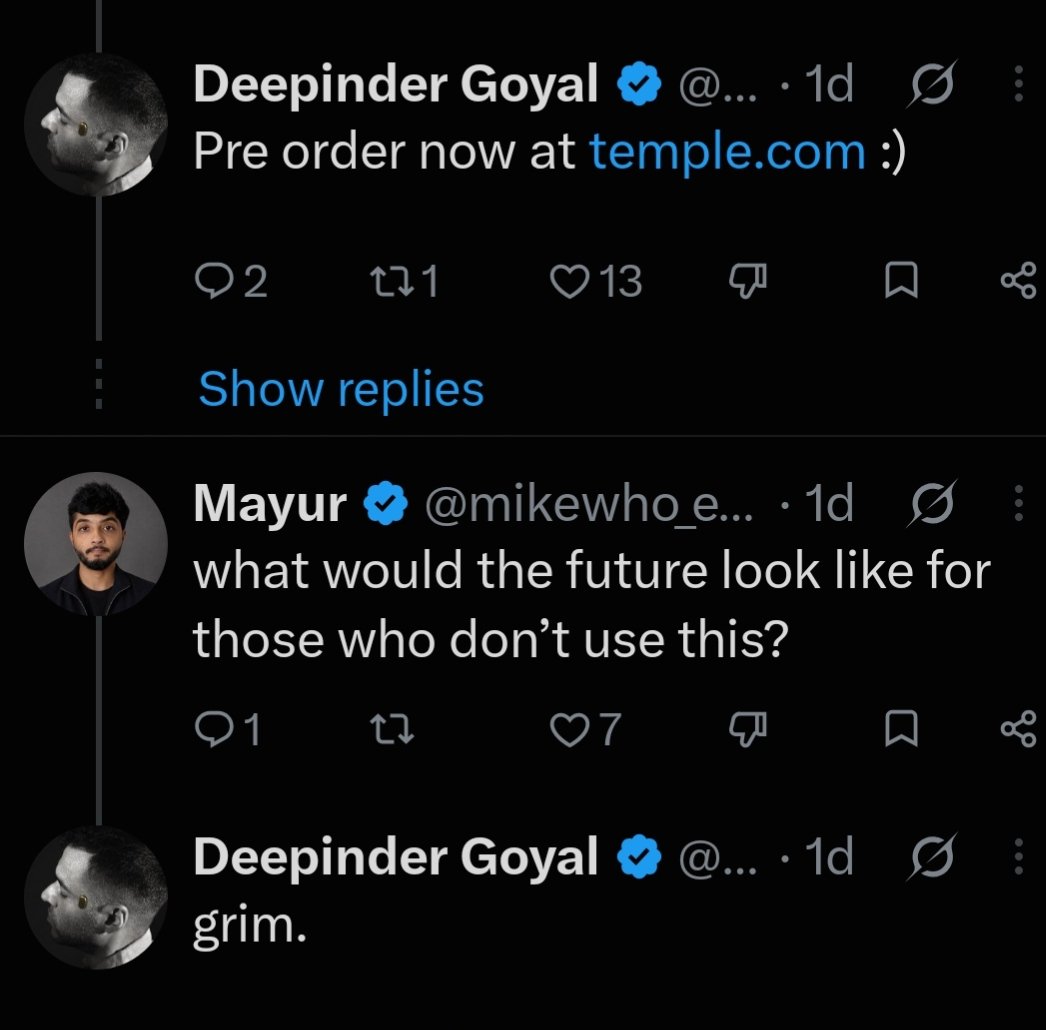
OK, he shifted the goalpost again, so it seems.
He hired this new brand manager who chose this "humanity's last personal device" on a woman model's temple.