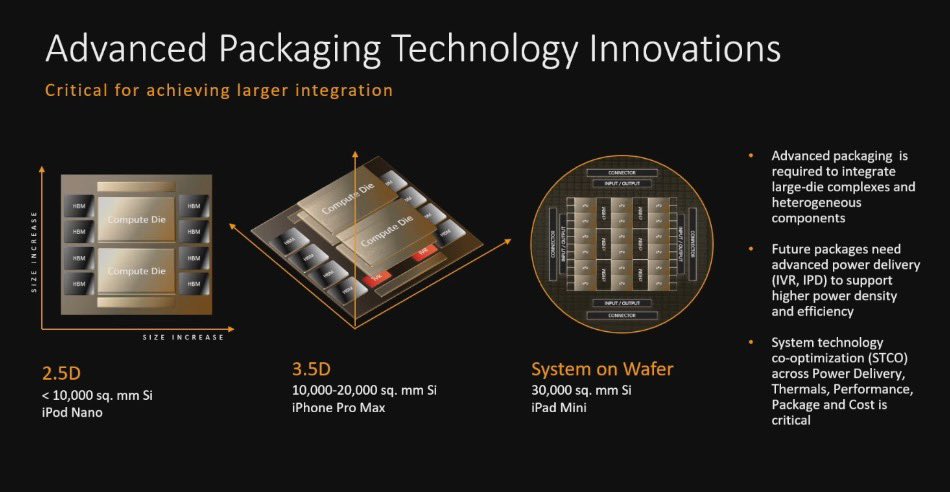
I am proud to announce our 2nd book on Advanced Packaging is finally available! Thank you @asegroup_global @Yole_Dev @Deca_Tech @Fraunhofer_IZM @UCLA@GeorgiaTech & more! https://t.co/JVHGamOftF
“Density is no longer measured in two dimensions. It’s measured by space. The vertical dimension also comes in when you talk about overall space.” Die stacking is certainly an innovative way to increase computation density, Zhang said. https://t.co/IbZUSjiVQK
SEMI Projects 67.2% CAGR for Glass Core Substrates from 2028 to 2040 as AI and HPC Accelerate Demand for Advanced Packaging Technologies https://t.co/RtufvCOADA
Douglas Yu Joins MediaTek: A Signal for Advanced Packaging
Market reports suggest that Douglas Yu, former TSMC R&D Vice President and a key architect behind CoWoS, has joined MediaTek after retiring from TSMC in 2025. MediaTek has not officially confirmed the news.
If true, this is more than a personnel move. Yu brings deep experience in advanced packaging architecture, process integration, and mass-production ramp-up. His expertise could help MediaTek reduce technical risk as it explores Intel’s EMIB-T and builds a dual-track packaging strategy with TSMC CoWoS.
The bigger message is clear: advanced packaging is no longer a backend process. It is becoming a core battleground for AI and HPC chip competitiveness.
https://t.co/2s5tH3HTrs
The U.S. fertility rate has just hit another historic low.
In 2025, the total fertility rate fell to 53.1- its lowest level on record.
Japan, South Korea, and Germany have been facing long-term population decline. Japan’s population has been shrinking for years, South Korea’s has begun to decline, and Germany would also contract without immigration.
Now the UK is joining them- starting in 2026, annual deaths are projected to exceed births.
Without people, economies cannot grow. Without young workers, pension systems cannot be sustained.
Without families having children, culture cannot continue.
This is the slowest-moving civilizational crisis in human history.
During CIOE, Chinese internet companies largely reached a consensus that CPO (Co-Packaged Optics) is not yet suitable for scaling up networks in China. The main reason is that domestic ASIC chips are still immature. As a result, Chinese internet companies currently prefer NPO (Near-Packaged Optics), which offers a more open ecosystem and lower costs.
At the event, Huawei, HG Genuine, and Accelink each introduced optical engines at 7.2T and 3.2T. Going forward, more optical module vendors are expected to release their own optical engines.
“There must be someone between scientific research and industry who transfers the knowledge and the technology, and that is where Fraunhofer comes into play,” he said. https://t.co/1sGgrIBFEp
The California Highway Patrol will conduct a 24-hour Maximum Enforcement Period Tuesday, focusing on speeding to help reduce serious and fatal crashes across the state. https://t.co/6tf0ThonPR