Read documents. Not too many. Mostly PDFs.
Our parents read and wrote documents. Having the world's knowledge an internet connection away doesn't change this.
One of the craziest operating system lab presentation I've ever seen (or heard!).
For his 340lx midterm project @houjun_liu built his own custom bare metal synthesizer with attack curves, tuned decay, custom drivers, dma engines, hard realtime, effect keyboard all running on his own custom operating system. Plus analog vocals. was an amazing presentation despite my shaky camera work.
Glad I have tenure. Kids these days are beasts
(*) In the words of the man himself: "digital audio synthesis on the pi! First layer is PolyBLEP, Karplus-Strong, Commuted Piano, and noise synths; second layer is volume-compensating filter, ADSR, detune, GPU accelerated FDN Reverb, and ringbuffer delays; third layer is a multitrack sequencer w/ a CPU-side buffer, and punch-in effects on the track; and lastly a bare-metal, DMA driver i2s driver and renderer onto DAC."
The only reason I can make sense of this tweet is that I can't see all the individual pixels on my computer screen, let alone hold them all in my head. A galaxy-scale intelligence lacks this defect, so it would have no notion of "tweet" or "talking head" or "wrong argument".
@intellectronica In a winner-take-all game, evenly matched players still don’t end up with even shares. Having one Nvidia tells you about the market. It doesn’t tell you how rare Jensen is. (I don't know how close GPU design is to a natural monopoly.)
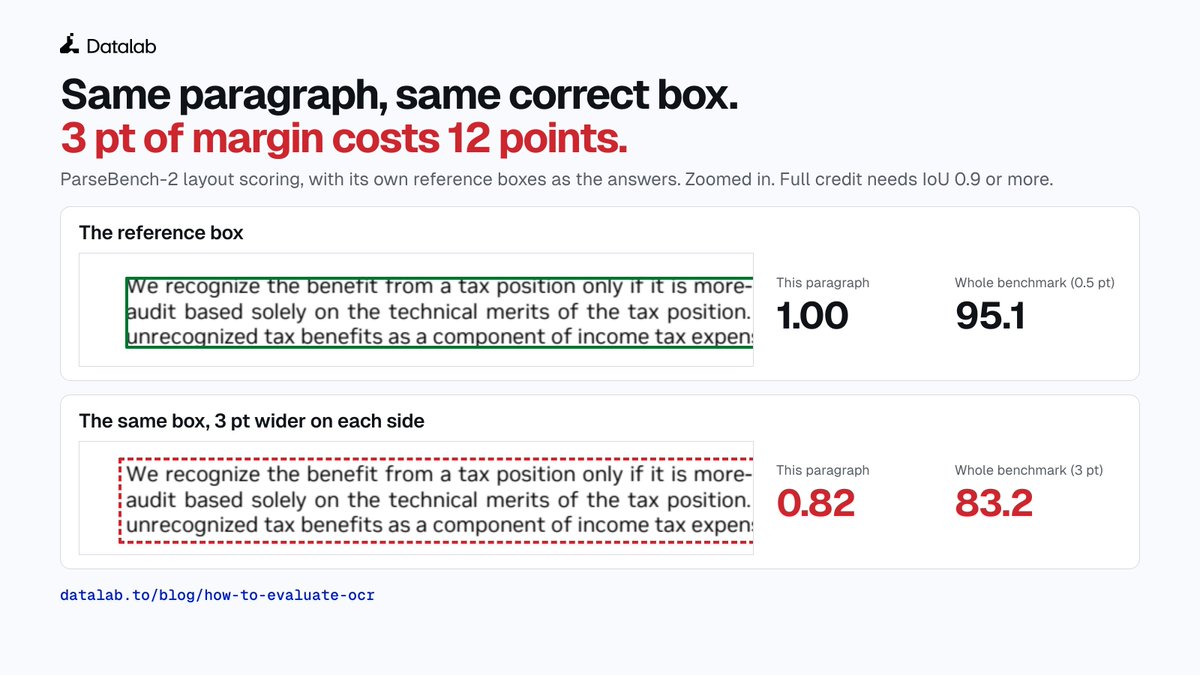
There are so many flawed OCR benchmarks, and more come out every week.
I gave a talk on how to evaluate them in @HamelHusain's course. Here are common issues, how to spot them, and a guide on evaluation 🧵
Local AI is quickly becoming a requirement. If you need to recover a password protected file that you created and forgot the password for.
Opus will not help you.
GPT will not help you.
Your AI, running on your hardware, will.
Everyone who owns hardware with abominable software (like Sonos players) owes a debt of gratitude to Venkatraman Srinivasan and the rest of the eMudhra gang in Bengaluru, Karnataka. Without their gross negligence, it'd be a lot harder to counterfeit certificates and fix the sw🙏
The reason that this tweet is so annoying to me is that OpenAI and Anthropic are playing a double game. On one hand, they tell us there is massive distillation by Chinese labs, that this proves they are far ahead, and that those labs should be restricted because it is simply not fair.
On the other hand, they refuse to show any evidence. They could. They could say: here are the benchmarks, here is how we detect it, here is our estimate of how much distillation happened. Then we could have a discussion based on facts.
Instead, they just say, " Trust us; it is very severe. And, based on that, trust us to block and restrict the competitors." That is not a fair argument.
And all of this is before we even get to the question of whether distillation is a problem at all. Companies have always copied and taken inspiration from each other. OpenAI and Anthropic built their models by distilling the entire internet. But that is a separate discussion.
Folks worry about how to test if models will be trustworthy in deployment, given that models can often tell if they are being trained or evaluated, so they might behave differently to fool evaluators.
This thread shows an even subtler possibility: models can learn to notice even the presence of a *read only* probe which monitors their intermediate activations.
How can a read only probe produce any effect on downstream computation? This is what demands explanation, since the model saying “I’m being monitored” is a huge effect on the final output of computation.
One mechanism is that the probe is not entirely read only. Its presence forces the compiler to write one of the model's intermediate activations out to GPU memory where the monitor can see it. This prevents the compiler from keeping that activation inside a fused kernel. Splitting the surrounding operations, instead of fusing them, creates very small differences in the floating-point computations. Those differences are enough that the model can notice them, if it is trained to do so.
Remarkable.
Congratulations Karl! The wonderful neurotechnologies that you’ve been developing for years now are of revolutionary importance for fundamental neuroscience as well for clinical applications. Our understanding of the brain wouldn’t be the same without you!
A 59-year-old conjecture in fusion physics just fell.
Harold Grad (1967): smooth 3D plasma equilibria can't exist unless pressure is constant or there's symmetry.
This week: 3 families of counterexamples. 2 independent papers, posted a day apart. Two found with GPT-6 Astra.
Huge for stellarators.
Always good advice, that I didn't always take. With AI's current rapid advances, I am exposed to new information faster than usual. So do I focus on learning a about it in order to become more effective later? Or apply the visible new information for short-term gain?
here's the whole 1996 conversation with @mckewmax, @rodneyabrooks, doug lenat, plus hugo degaris at the start. the part on RSI (not original with me; i.j. good had the idea in 1965) is around the 28 minute mark.
https://t.co/nt2bzDptsx