Yuan Zhang, @docvock, @MeganPatrickPhD & Thomas A. Murray propose a method to deal with the two types of misspecification concomitantly, builds interactive models into modified parametric Q-learning with Murphy’s regret function https://t.co/nNMDjkCM4Z
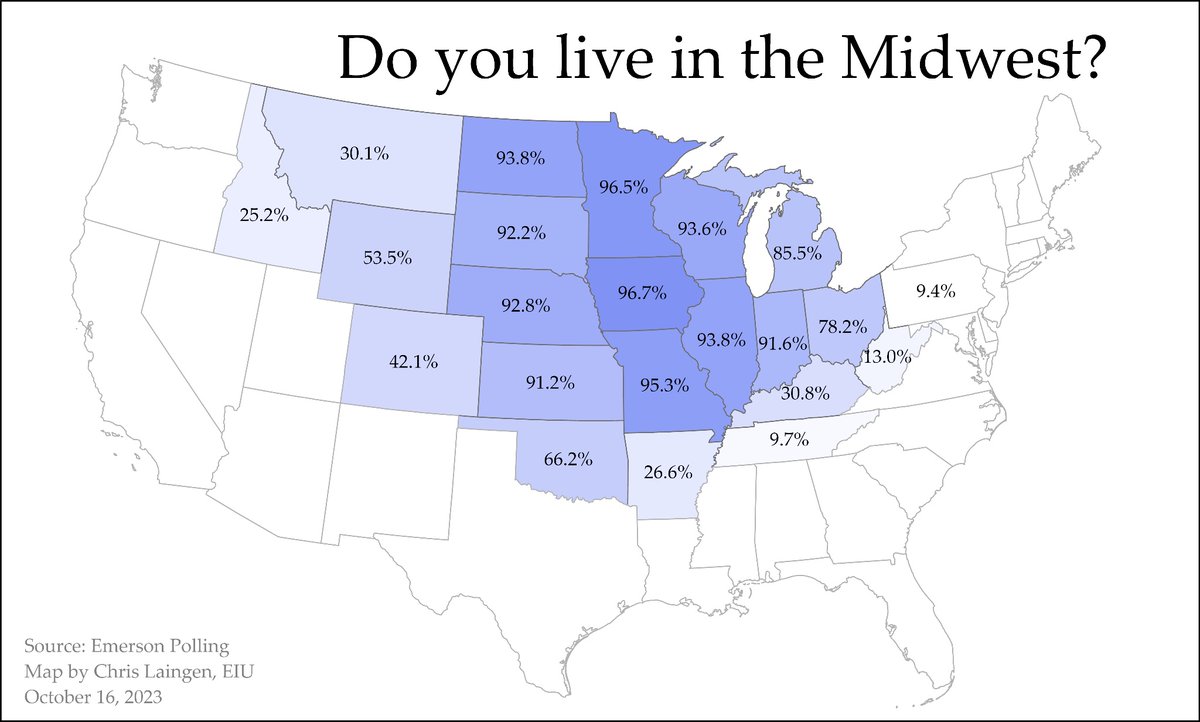
Results! In these states, this percentage of people believe they are in the Midwest. Chew on these results while we crunch the data down to the zip code level and get granular. What parts of these Midwestern states do you think will shade less Midwestern? All input welcome
Great and nuanced view 👇
A point I frequently make to students: when people criticize RCTs they (almost) never criticize the randomization part. Many of these challenges would be present in any prospective human health study even if the researchers did not control treatment
RCTs are the gold standard for good reason — they provide the only good chance to have an unbiased estimate of the causal effect of an intervention.
However, like all studies they have their own limitations.
They are not that large, often not representative of the target population, and are also frequently in idealized settings not indicative of real-world medical care in the community.
Thus, even after well run clinical trials, observational studies are needed in the real world settings to validate, supplement and complement the knowledge gained in the randomized trial.
With RCT and observational studies it is not a question of “or”, it is the necessity of “and”
There is nothing about an observational study that guarantees it is representative of the target pop. (Heath) Data are challenging to collect (e.g., require consent, integration of EMRs, etc.) and we often just collect the "easiest" data to acquire.
Moreover, observational studies has an advantage over RCTs in handling the problem of "external validity". Such studies are conducted on the target population, on large number of people, in their own natural habitat, instead of artificial experimental settings, marred by selection bias" #Bookofwhy
.@MeganPatrickPhD, Aparajita Sur, Brooke Arterberry, Sarah Peterson, Nicole Morrell & @docvock examined engagement effects in an adaptive preventive intervention for college student drinking https://t.co/zML6zWj7NG
Daniel Almirall & coauthors used a SMART to assess adding a prescription medication therapy management referral to a tobacco longitudinal care program for patients eligible for lung cancer screening who smoke & don't respond to early treatment https://t.co/WGAbmlTZdn @d3_center
RCT: A Tobacco Longitudinal Care (TLC) program with intensive counseling and combination nicotine replacement therapy is feasible, results in meaningful quit rates, and can be implemented without further modification in the Lung Cancer Screening setting. https://t.co/wL5HtO4iCZ
Seems like every junior faculty gets assigned to chair seminars (me included). The things that I might consider are (a) Diversity, (b) Timing, (c) Explicit instructions, (d) Inviting good speakers. A 🧵
Folks, I have been asked to chair the departmental seminar committee at @NCSUStatistics. I would greatly appreciate your input and perspectives on the following:
In my field, we have too many speakers give terrible talks -- slides that are poorly designed with an overload of equations. We should strive to invite people who are going to excite our students about the profession.
Great summary of some of the methods challenges. As someone who got fb ~2004, fb was WAY different than the current version. Early version of fb didn't have photo albums and was mostly a listing of favorite movies and tv shows. Didn't elicit nearly as many social comparisons
Does the rollout of Facebook across college campuses in 2004-5 provide clear evidence of negative effects of social media on mental health?
I wrote some comments on this now widely-cited study
https://t.co/lXUxbFfaje
🚨#JSM23 attendees, giveaway alert! We are giving away one copy of 'Telling Stories with Data', signed (!!) by @RohanAlexander To enter, retweet this, you must be able to pick up the book on Wed. morning at the booth.
If you haven't already transported yourself away from X, here's my latest paper on transportability:
https://t.co/16ZS5QU2EX
Featuring: adaptive treatment strategies, kidney-pancreas transplant, @docvock, @SRTRNews, and more!
What better way to cap off @umnbiostat and @PublicHealthUMN Jim Neaton's retirement reception than to have @Beyonce come give a little concert before her big show? Twitter make it happen!
This professor had to pay “the professor” Kyle Hendricks @Cubs a visit while I was in town for @ATCMeeting - visiting another faculty means I can expense this, right?