In Hong Kong for Bitcoin Conference & Bitmain Rosewood.
Currently exploring how #Bitcoin can mitigate #AI risks — especially at the physical execution layer.
This is insane.
This is INSANE.
This is a blatantly obvious sign of the impending doom of the U.S. Dollar and all fiat currencies.
Here's the situation:
The United States Treasury issues bonds and other investment securities.
They call these, “treasuries.”
The U.S. Treasury issues treasuries when the U.S. Federal Government spends past its budget, resulting in a “budgetary deficit.” The sale of treasuries makes up for the loss.
The treasuries are sold and tacked on as debt. This is the substance of the big $40 trillion debt number in the United States.
Key point: The U.S. Federal Government has been in a budgetary deficit in 51 of the last 55 years, with the last surplus year being in 2001.
Here's how it actually plays out:
A year passes. The government spends too much money, creating a budgetary deficit. The government finances that deficit by selling debt (in the form of treasuries). The government receives money to cover its spending, and tacks on the sold debt to its debt total.
Next year comes around. The government spends too much money again, creating another deficit. Same mechanism... government sells debt, receives money, and tacks on more debt. But there's an issue. Old debt is coming due. But the government doesn't have the money to pay for it - it has been spent. What does the government do? It issues new debt to pay off the old debt.
Round and round this goes, year after year. This is how the government operates.
Key point: The U.S. Treasury, which is part of the U.S. Federal Government, has to sell new debt to new investors to pay off the old debt from old investors. This is because of 1) the constant budgetary deficits and 2) the debt from years past coming due.
Key point: Given that the definition of a Ponzi scheme is, “An investment scheme where new investor money is used to pay off old investors.” …The U.S. Federal Government is running a Ponzi scheme. To the tune of $40 trillion, and counting.
Trillion is just a word. Let’s make sure we note the significance.
A *billion* seconds ago was 1994 (32 years ago).
A *trillion* seconds ago was 30,000 B.C.
Multiply that trillion by 40. That's 1.2 million B.C.
*Over a million years' worth of debt*
That’s the scale of the United States debt bill.
But WAIT. It gets worse.
Key point: The U.S. Treasury always has to have buyers of its debt, because if it doesn’t, the government won’t be able to pay off 1) its deficit spending and 2) the old debt coming due (and the interest on the debt). If it fails to pay those off, the Government would default and collapse.
Well, then, who buys all the U.S. Government debt?
Key point: The largest single buyer and owner of the U.S. Federal Government debt is THE U.S. FEDERAL GOVERNMENT ITSELF.
Don’t trust, verify (picture attached below):
TAKE A SECOND TO CONTEMPLATE HOW INSANE THAT IS.
The U.S. Government runs a budgetary deficit, then issues treasuries to pay for the spending, then, at a bigger rate than anybody else, buys the treasuries to cover the loss. An unbelievable Ponzi scheme.
The U.S. Government is the director of the Ponzi scheme, the old investor, and the new investor. A true masterclass.
But how do they do this?
They have a money printer. It's that simple. The debt might as well not be real.
Welcome to the world of fiat currency.
Key point: The United States is not the only country that runs this playbook. 161 of the 189 countries with available data are in budgetary deficits. That's over 85%. The Ponzi scheme is everywhere.
The U.S. is the kingpin of the modern monetary world. They are the head honcho, the high priest, the big cheese.
The current global financial economy is built on the backs of the United States.
There would be a massive problem if the United States had debt buyer troubles.
In short, an increasing number of investors are growing scared of the United States debt situation, turning them away from the purchasing of U.S. Treasuries.
Recent headlines:
"Foreign Private Investors Cut US Treasury Purchases as US Debt Funding Risks Grow" -August 19, 2026
“Bonds Are Getting Hammered, and Wall Street Says the Rout Won’t End Anytime Soon” -August 19, 2026
“Foreign holdings of US Treasuries fall in June, led by Japan, UK, China, data shows” -August 17, 2026
“US sells 30-year bonds at highest borrowing costs since 2001” -August 14, 2026
With weakening demand and surging Treasury yields, the US Treasury has just announced "it will double the size of long-term US government debt buybacks following the rapid surge in US Treasury yields.
Repurchases of $2 billion will now be increased to "at least" $4 billion, the US Treasury said.
The move is intended to provide "liquidity support" for bonds maturing in 10 to 30 years as total US debt nears $40 trillion."
Translation:
"Nobody wants our bonds, thus, we are going to print money to buy our own bonds. And our previous buyback operation wasn't enough, so we're doubling it."
But that money printing causes inflation, which is a dangerous outcome.
Here's where the cookie crumbles:
The U.S. central bank, the Federal Reserve, has a 2% inflation target. Inflation has not been at 2% recently, and in fact accelerated higher in the first half of 2026.
The Federal Reserve has kept interest rates elevated as a method of discouraging borrowing and spending, and taming inflation.
But it's not working. And there's a bigger problem.
Key point: The U.S. Federal Government pays interest to investors who own the treasuries, and this interest is part of the budget.
High interest rates = higher interest payments.
Higher interest payments = more federal spending.
More federal spending = bigger budgetary deficits.
Bigger budgetary deficits = more debt issuance.
More debt issuance = higher supply of treasuries.
Higher supply of treasuries = lower demand.
Lower demand = fewer buyers.
Fewer buyers = Treasury printing money to buy its own bonds.
Treasury printing money = higher inflation.
Higher inflation = higher interest rates.
Higher interest rates = higher interest payments.
A catastrophic feedback loop.
It's math. And the math is brutal. The interest paid out by the Federal Government has EXPLODED in recent years (image attached below).
Start the chain at "higher interest payments" and you realize the fate of the system...
The United States Dollar is screwed.
This is a debt spiral.
There is no way out.
You are witnessing it live.
These are years that will go down in the all-time history books.
---
Every fiat currency has failed, and for the same reason. Turning on the money printer is too tempting.
Don't forget, the U.S. Government will never let the Treasury market fail, because that would result in an automatic default on the debt and an unbelievably chaotic avalanche of collapse.
They will always turn to the money printer to bail things out. The Treasury will continue to print more money to keep the system afloat. Today's increase in government debt buybacks is simply additional evidence. But inflation is the fatal flaw.
The Ponzi scheme is in its final chapter. The endgame is here.
The inflation train has left the station, and it's never coming back.
Covid put the ruin into hyperdrive. Inflation ran away, now it cannot be tamed. It is feeding on itself, and will continue to do so, over and over, gradually, then suddenly.
And then, poof. It's gone.
Worthlessness.
If you haven't noticed, the U.S. Dollar has been heading toward the "worthless" direction for quite some time (pull up your favorite USD purchasing power chart).
It is inevitable. The U.S. Dollar, and all fiat currencies, will die.
The Phoenix will rise from the ashes.
An innovative, specifically designed, global, unprintable, incorruptible, verifiable, instantaneous digital monetary system will emerge, unchained from the grasp of bankers and governments, once and for all.
Fix the money, fix the world.
🚨 The Bond Market Just Broke: Japan Dumps $26 Billion in Treasuries While America Is Buying Back Its Own Bonds
Today, the US Treasury admitted the long end of the bond market is broken. Nobody wanted the 10-year, 20-year, or 30-year debt. The 30-year yield just slammed into its highest level since 2007 (peaking near 5.33%).
So what did they do?
They announced they’re AT LEAST DOUBLING their liquidity buybacks of those exact long-term bonds, from a $2 billion max per operation to $4 billion+ starting September 9.
They’re literally borrowing short-term money to buy back their own long-term debt. Classic desperation move. Bond prices spiked, yields crashed 9-10 bps, and futures ripped higher the second the news dropped.
Meanwhile Japan, still the #1 foreign holder of US Treasuries is dumping them to fund currency interventions.
The BoJ and finance minister threatened of bold actions to save the yen. BoJ’s Yuto apologized for the measures being prepared.
June data just showed Japan cut holdings by another $26.4 billion (down to $1.117 trillion).
That follows the massive joint US-Japan yen-buying intervention in late July that burned tens of billions of dollars trying to stop the yen from hitting 40-year lows near 164. The yen has already given back more than half those gains and is back above 159.
When the biggest foreign buyer is selling Treasuries to defend its own currency… and the US government is forced to step in and buy its own unwanted long bonds… this isn’t “market support.” This is the system flashing red.
The famous City Of London banker @LordBelgrave had already warned about the planned debt, oil + currency financial crisis at the start of the year. It is now being executed.
Yields are the gravity of everything, your mortgage, stocks, crypto, gold. The can just got kicked harder and farther. Don’t look away.
🇺🇸 The US Government is becoming a bigger buyer of its own debt.
Treasury just announced it will at least DOUBLE long-end bond buybacks from $2bn to $4bn per operation.
They call it “liquidity support.”
Translation: the market is demanding higher yields to absorb America’s debt, so Treasury is stepping in as a bigger buyer of its own long-duration liabilities.
This is NOT QE.
Yet.
Treasury can issue at the short end and use the proceeds to buy back debt at the long end.
When your debt is too expensive at the long end, you move the funding shorter.
And when too much debt moves shorter, refinancing risk explodes.
Eventually someone has to provide the liquidity.
Enter the Fed.
This is the FIC (Financial Industrial Complex) at work:
Treasury issues the debt.
Wall Street distributes it.
The banking system finances it.
The Fed provides the liquidity when the system needs it.
Taxpayers service it.
Privatize the gains.
Socialize the losses.
Debase the currency when the debt becomes unpayable in real terms.
You are not witnessing a $4bn story.
You are watching the plumbing of a debt-based monetary system becoming increasingly dependent on intervention to keep functioning.
Watch what happens next if long-end yields keep rising.
That’s when Treasury “liquidity support” starts colliding with Fed monetary policy.
FIC always needs more liquidity.
And you are the product.
A collateralised debt obligation to subside the FIC.
KI-Update in 20 Min: Grok 4.6 ist da – 10x schneller, 85 % günstiger + Obsidian als Second-Brain-Gamechanger
Grok 4.6 greift die Frontier an! OpenAI & Anthropic stagnieren – chinesische Open Source und xAI ziehen gleich – plus Anthropic Watermarks & der ultimative Obsidian Productivity-Hack!
Die AI-Woche war wieder purer Wahnsinn: Während die großen Frontier-Modelle von OpenAI und Anthropic plötzlich etwas Luft holen, ziehen DeepSeek, Qwen, Kimi und vor allem Grok von xAI massiv nach. Grok 4.6 ist da – fast auf Frontier-Niveau, 85 % günstiger und bis zu 10x schneller. In drei Wochen kommt schon 4.7. Der Druck auf die IPO-Kandidaten steigt dramatisch – und der Markt spürt es!
Im Video analysieren wir:
- Grok 4.6 & xAI – das neue Flagship, warum es ein echter Gamechanger ist, CLI vs. Cursor-Problematik und was Elon in den nächsten Wochen noch alles releasen will
- Die chinesischen Open-Source-Modelle DeepSeek, Qwen und Kimi – wie sie die Frontier-Modelle fast eingeholt haben und den gesamten Markt unter Druck setzen
- Anthropic Watermarks – die neue EU-AI-Act-Lösung, wie AI-Text ab sofort unsichtbar gekennzeichnet wird und warum das für alle Creator relevant wird
- Obsidian als Second-Brain-Superpower – das kostenlose Markdown-Tool, das mit Codex, Claude & Co. zur absoluten Produktivitätswaffe wird
Plus:
Warum du JETZT Grok 4.6 und Obsidian testen musst – bevor der nächste große Shift kommt. Wir zeigen konkrete Benchmarks, den aktuellen Stand der Integration und persönliches Skin-in-the-Game. Kurze, knackige 15-Minuten-Episode mit allem, was du diese Woche wissen musst!
Welches Modell nutzt du gerade am meisten – Grok, Claude oder GPT? Und hast du Obsidian schon als Second Brain im Einsatz?
Schreib’s in die Kommentare!
https://t.co/xUnnJX3p9k
@1_fc_nuernberg@beerofsatoshi@TemDipsitter Übrigens: Das @beerofsatoshi bekommt ihr seit einigen Wochen auch bei uns im Blocktrainer Shop :-)
Super als Partymitbringsel, Geschenk oder eben nach Derbysiegen 😎😃.
https://t.co/2vqMAOn90v
@Schnitzel thx for your support. Miner and parent as well. I‘mma leave this here, food for thought. Vetted Humanoid firmware..health checks, logs for telematics, malware findings, onchain securityy
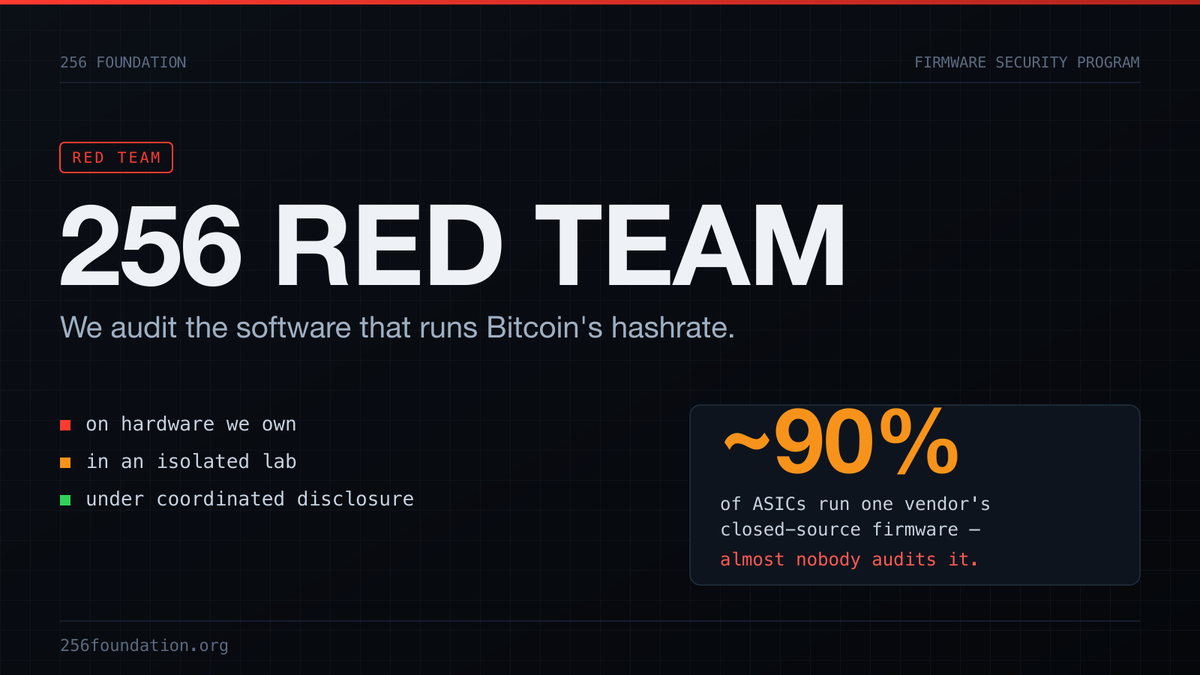
~90% of ASICs run one vendor's closed-source firmware. Almost nobody has audited it.
We at @256FOUNDATION do.
Introducing the 256 Red Team 🧵 — the 256 Foundation's firmware security program. On hardware we own, in an isolated lab, under coordinated disclosure.
Yesterday I began fully integrating the @OpenAI trust cyber program into my Bitcoin Red Team efforts.
This morning I woke up to see this.
I am now being blocked from doing additional analysis on a codebase which I've already responsibly disclosed to, and have received confirmation had legitimate findings.
To be clear, this is after having already KYC'd and completed the onboarding process months ago to use the cyber capabilities OpenAI has to offer.
I am now prevented from being able to continue the investigation in a further effort to make sure their code changes are sufficient, as well as understand if there are other issues that have yet to be discovered.
It absolutely guts me as a patriotic American to have to do this, but I will be going back to using Chinese open source models to conduct my research to protect Bitcoin infrastructure.
Black hats will not hit these issues. The white hats will. We've hit a local minima in policy. Intelligence is unrestricted for those who don't follow rules, and those who engadge in harm reduction are left on the sidelines.
What are we doing in this country? How is this keeping people safe?
Please do something @DavidSacks@sama@realDonaldTrump
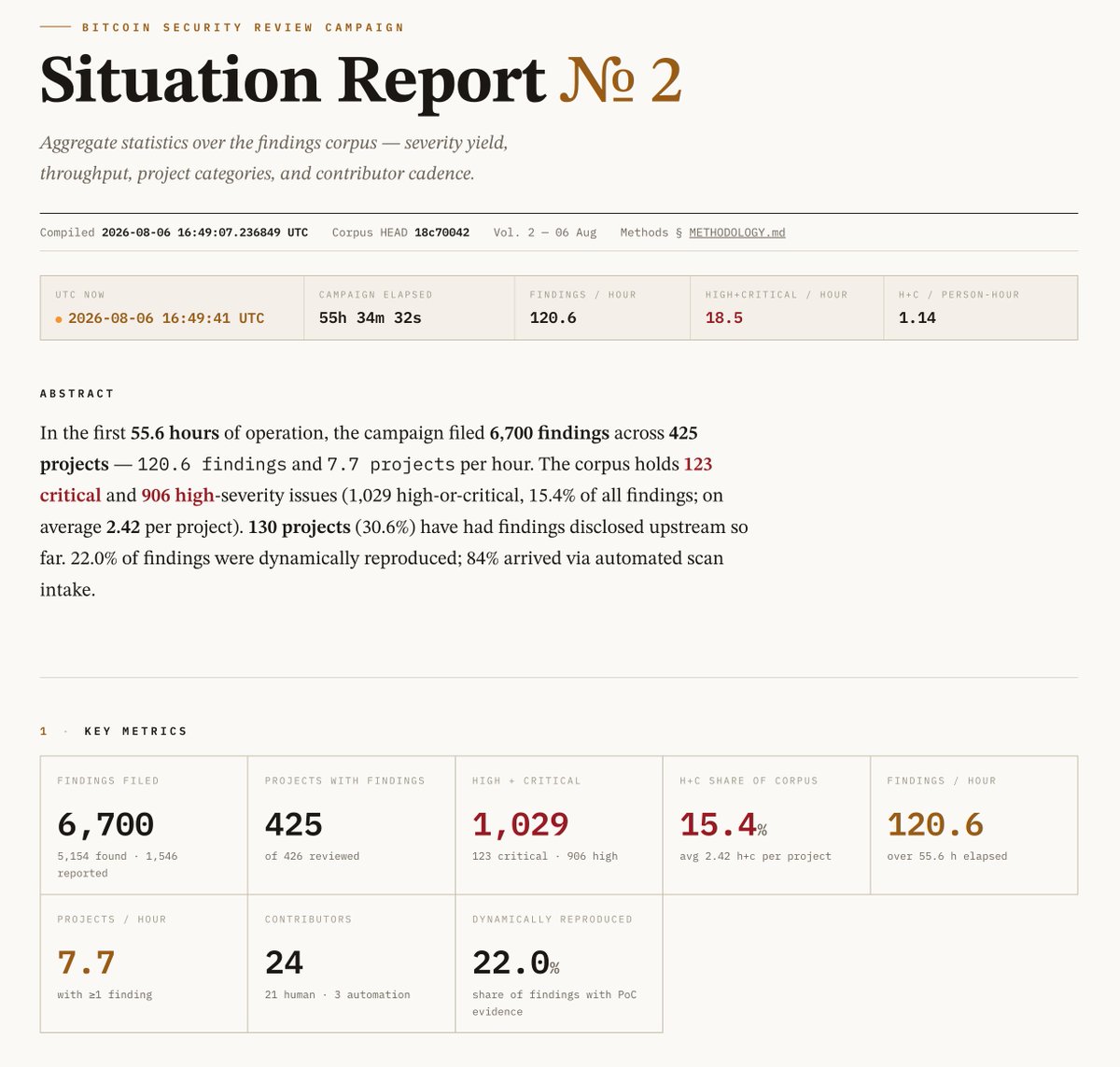
🚩 Bitcoin Red Team update 55 hours into the campaign
We're now 24 people working around the clock.
We've scanned 425 projects so far and have produced 1029 high+critical (H+C) findings.
Die Petition zur Beibehaltung der Bitcoin-Haltefrist kann jetzt unterzeichnet werden! 🇩🇪🚨
30.000 Unterschriften werden bis zum 15. September benötigt! ✍️
Unbedingt verbreiten, damit die Chancen steigen, Klingbeils Pläne noch stoppen zu können! 📢
⬇️
https://t.co/ggxLtYbJbe
I have spent over $10,000 scanning 100+ bitcoin ecosystem related libraries looking for vulnerabilities with Kimi K3 running as quarterback.
Myself and a small "Red Team" have found multiple serious vulnerabilities impacting the ecosystem. They vary in scope severity, but this is a call to action.
For any critical tier vulnerability that was identified if I was able to immediately demonstrate a POC (proof of concept), I have already responsibly disclosed to the maintainers.
HERE IS HOW YOU CAN HELP ME
IF YOU ARE NOT TECHNICAL:
- please share with me any repository that is on github that I can scan, we want to cast a wide net. It takes a few moments for you to link github accounts, we'll take it from there
- if that project does not have a SECURITY.md make an issue asking the dev to list one
IF YOU ARE TECHNICAL:
- If you are a maintainer or contributor to a project, I may have already scanned your repo, hit me up I'll share the results, if not I'll add your project to the list.
- If I can trust you to do larger review to start looking through this stuff to give me more eyes let me know.
AI Has forever changed software development. Tomorrow marks 1 week of Kimi k3 being live in open weights.
We are going to accelerate.
Amazing sum-up, another post why my no-coiner friends think I‘m crazy and won‘t go anywhere near self custody.
None of them had their identity stolen before, they couldn‘t care less.
I‘m not one of these people.
I am getting a lot of questions about a Bitcoin multi-sig setup so I thought I'd create this quick guide.
This is now the gold standard for serious self custody.
Any single device can fail or have a flaw. Multi-sig removes the single point of failure.
1) The equipment:
Mix your hardware brands. A bug in one vendor's firmware cannot touch a setup where the other two keys come from different manufacturers.
-Trezor Safe 5 (wallet 1)
-Blockstream Jade (wallet 2)
-BitBox02 (wallet 3)
-Sparrow Wallet (desktop-only) as your coordinator
2) Generate your keys:
Set up all three devices completely independently. Secure the 12 or 24 word seed phrase for each. You now have three unrelated wallets.
3) Export the public keys:
Open Sparrow. Plug in each device and export its XPUB. XPUBs only read balances, they cannot move funds. This step is safe.
Make sure all three devices use the same script type, for example Native SegWit. Mixing address types across devices will cause errors in Sparrow.
4) Build the vault:
New Wallet, Multi-Signature 2-of-3. Import all three XPUBs. Sparrow merges them into a single vault.
Save and print the Wallet Configuration File. This is your blueprint and this is where people get caught out.
Two seeds spend your Bitcoin. Three XPUBs find it.
Bitcoin locks multi-sig funds to all three public keys simultaneously. Feed Sparrow only two XPUBs and it generates completely different addresses. Your balance shows zero. The coins are still there, you just cannot see them.
XPUBs cannot move your funds, but anyone holding them can see your entire balance and transaction history. Keep a copy of the blueprint wherever a seed lives, and store it with the same care.
5) Test it:
Send $5 to your new multi-sig address, then spend it back out. Sparrow will ask you to sign with any two devices.
If the spend works, your setup works. Do not skip this.
6) Separate your backups:
Never store them in the same place.
For example...
-Home: Seed 1 + blueprint
-Close relative's home: Seed 2 + blueprint
-Third location: Seed 3 + blueprint
You can also keep an extra copy of the blueprint on its own somewhere separate. It cannot spend anything by itself.
The absolute rule is that no single location should ever hold two seeds. Two seeds plus the blueprint is a spendable wallet and the blueprint is not secret enough to rely on as protection.
Why 2-of-3 works:
House burns down? Retrieve the other two seeds and recover everything.
One device compromised by a firmware flaw? Your Bitcoin is safe. They need two.
I have not covered passphrases to keep this simple.
I hope this helps. Happy to assist if anyone needs any support.
This Cold Card security breach is new data that has to be taken into serious consideration as a Bitcoin holder. I am not a techy person. I am just a Dad trying to protect my family's future from the endless debasement. Do I need to become more technical in order to protect my family's sovereignty? Yes, absolutely yes. Today it was Cold Card, tomorrow it could be a different hardware wallet.
I am not a coder, I have no idea which wallet has the strongest code. The question is do I have the time, energy and mental bandwidth to do this on top of all the other responsibilities I have as a father with a wife and young children. I don't know, but this weekend I need to seriously consider my options. How are you guys dealing with this?
A quick primer on #Bitcoin multisig:
Multisig allows you to take custody of your BTC in a way that eliminates any single point of failure.
With multisig, you will not lose your BTC if you lose a key, or if your house is broken into, catches fire, or floods.
The most common type of multisig setup is a 2-of-3, meaning 2 out of 3 keys (hardware wallets) are required to sign a transaction to move/spend the BTC.
With a multisig setup, you need to keep track of your keys and a descriptor file.
Keys:
These are typically hardware wallets that come with a paper backup for the seed phrase.
With a 2-of-3 setup, you can lose one of the keys and still be safe.
Best practices are to (1) store all 3 keys in separate geographic locations, (2) use a different hardware vendor for each key, and (3) back up each hardware wallet's seed phrase on steel instead of just paper.
Descriptor file:
This is essentially a backup of the multisig wallet configuration.
The descriptor file should be saved securely and/or printed out (as a QR code).
If an attacker gains access to the descriptor file, they can recreate the multisig wallet and view the BTC balance, but they can't move the funds unless they actually have access to at least 2 of the keys.
If the descriptor file is lost, it can be restored, but it requires gathering all 3 keys to recreate it.