Bitcoin explained in 10 sentences.
1. To understand Bitcoin, you first have to understand the problem it solves: money controlled by people.
2. There is a money-power paradox: if someone has the power to control the money, someone has the power to corrupt it.
3. Every form of money before Bitcoin had a central seat where someone could control the money, and because of that, every form of money became corrupted, including today's money, which is controlled by governments and central banks, which enables them to create money out of thin air and destroy the purchasing power of your money.
4. Bitcoin is a new monetary system designed to remove that central seat of power and stop monetary corruption once and for all.
5. Satoshi Nakamoto, the creator of Bitcoin, saw the corruption of money as a *trust* problem; we must trust central banks and governments not to manipulate the money, but the history of their system is filled with breaches of that trust.
6. Satoshi's solution was simple: instead of relying on trust to run the money system, use proof.
7. Instead of trusting one central authority, like a bank or government, to make sure the system is running properly, Bitcoin spreads that job across thousands and thousands of computers around the world: participants use proof to demonstrate that they are following the rules, and each computer independently verifies that proof, only accepting activity that follows Bitcoin's rules and rejecting anything that doesn't.
8. The result is a monetary system where no single person, government, or institution can control and manipulate the money, because the power to enforce the rules is spread across the entire network rather than concentrated into one authority, and because nobody can get away with breaking the rules -- nobody can just appear at a press conference and claim that what they're doing is legitimate -- rather, they must provide proof that their work is legitimate, and the entire global network is always checking that their proof-of-work follows the rules.
9. Think about what this means: for thousands of years, humanity has lived in a world where the people controlling the money could change the rules of the game to benefit themselves, while everyone else had to deal with the consequences.
10. Imagine what would happen if we had a money system where everyone played by the same rules, where everyone HAD to be honest in order to participate, and where that reality could not be manipulated.
That's Bitcoin.
$DOG's town hall drew over 1,000.
People in other time zones can watch
the town hall recording later.
A room of 1,000 is better proof of
community than a loud timeline.
The replay reaches more time zones.
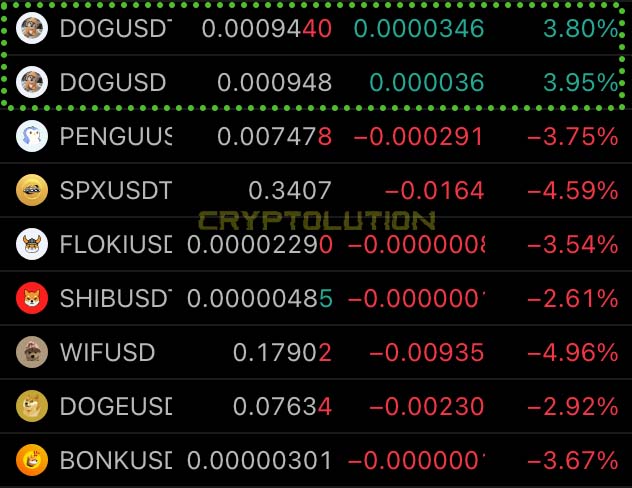
Bitget delisted solana:dog1viwbb2vWDpER5FrJ4YFG6gq6XuyFohUe9TXN65u because DOG wouldn't pay to play.
My conviction hasn’t changed.
Maybe this even strengthens the case for what DOG is building.
Of course we want more exchanges. Exchange count matters for practical liquidity, retail access, and price discovery.
But we also want the RIGHT exchanges. Ones that understand a decentralized, community-driven memecoin on Bitcoin. Exchanges like @krakenfx .
DOG wasn’t built around VC allocations or a paid KOL cabal. Its identity is rooted in distribution, community, and Bitcoin.
If an exchange requires money to list it, that exchange simply isn’t a fit. solana:dog1viwbb2vWDpER5FrJ4YFG6gq6XuyFohUe9TXN65u is changing the inudstry in this regard.
As an exchange, you don't interview solana:dog1viwbb2vWDpER5FrJ4YFG6gq6XuyFohUe9TXN65u army and extract money. solana:dog1viwbb2vWDpER5FrJ4YFG6gq6XuyFohUe9TXN65u army interviews you.
Does losing a trading venue help liquidity? No. But one exchange’s decision doesn’t erase the thesis.
My thought is that as Bitcoin grows, so does the opportunity for a native memecoin with a community that refuses to disappear.
That’s why DOG remains one of my highest-conviction altcoins.
In a sector flooded with paid promotion and liquidity extraction, proving a memecoin can grow without buying its way into everything matters.
DOG is challenging the pay-to-play model itself.
Quality attracts quality. Let the tourists leave. Keep building.