AI coding tools are useful. Reviewing what they changed is the hard part.
Aura IDE is an open-source desktop coding harness for builders who want an AI coding workflow they can inspect.
It helps you move from a plain-language change request to a reviewable result by keeping workspace context, proposed diffs, validation, and a completion receipt in one visible loop.
Key features:
• Visible work loop – follows Ask, Inspect, Execute, Review, Validate, and Done so each stage is explicit
• Reviewable diffs – shows proposed file writes for inspection and approval before they reach disk
• Project-aware validation – selects focused checks for the project and changed files, with failures kept visible
• Repo-aware context – combines language-aware code intelligence, local search, dependency context, and targeted reads
• Reusable agents and workflows – lets you compose permissioned agents into explicit workflows while Aura retains the final response
It’s open-source (MIT license).
Link in the reply 👇
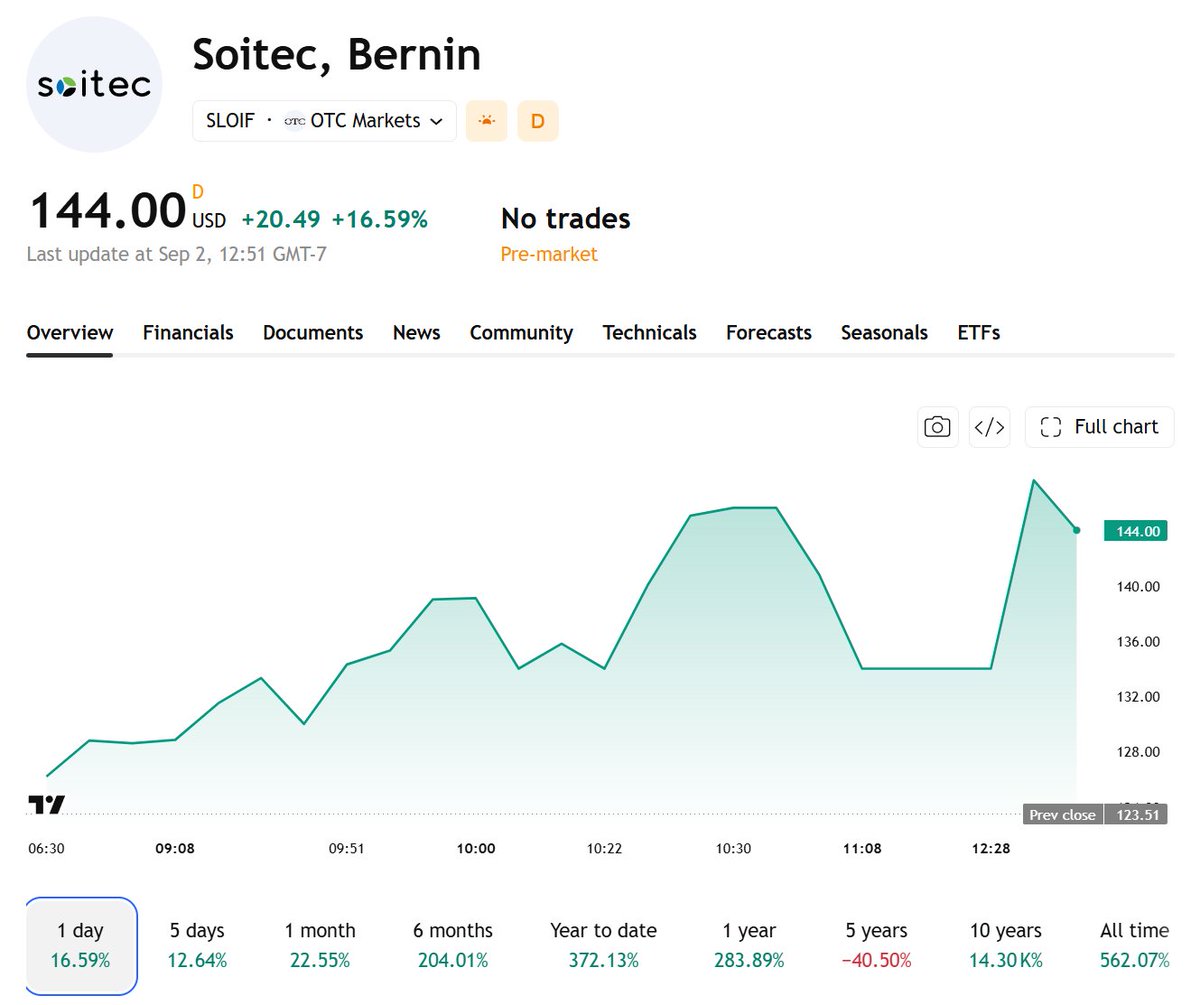
- $SOI.PA surged after Soitec raised its FY27 Q2 revenue growth outlook from more than 30% YoY to roughly 50%.
> This looks less like a simple semiconductor rebound and more like a genuine re-rating of Soitec from an RF-SOI/mobile story into an AI photonics infrastructure supplier.
> What matters is that the demand signal is now appearing at the wafer level. If Photonics-SOI substrates are already seeing this kind of growth before CPO and optical I/O fully ramp, the upstream SiPh supply chain could become increasingly important.
> In other words, the strength we have been seeing in $LITE, $COHR, $MRVL and $AVGO is now being confirmed one layer further upstream.
$PLTR is getting smacked today and is down ~6% after Google launched a new cybersecurity AI specifically aimed at government clients.
Google's tryna take Palantirs lunch.
Does this make you worry about your $PLTR position?
In case you're wondering while this steaming POS is being floated now, it's because SoftBank needs to refinance the $40B bridge loan it used to invest $30B into OpenAI before it matures in March 2027... otherwise the entire AI funding machinery starts breaking down
Buying Claude seats will not change the business.
Training Claude on your brand, pricing, positioning, and process can.
Generic prompts create generic output.
Skills turn repeatable work into an operating system for proposals, briefs, research, sales prep, and reporting.
https://t.co/WTAtsCrqKk
Your Claude agents shouldn’t pay to resend the same context every call.
Autocache is a self-hosted Anthropic API cache proxy for builders running Claude agents with repeated context.
It helps you apply Anthropic prompt caching without rewriting an existing client by analyzing requests and injecting cache-control fields at eligible breakpoints.
Key features:
• Drop-in proxy – point an Anthropic client’s base URL at Autocache instead of the direct API
• Automatic cache injection – analyzes system prompts, tool definitions, and text content blocks for cacheable context
• ROI response headers – exposes cache ratio, savings, and break-even data with the API response
• Tunable caching strategies – choose conservative, moderate, or aggressive behavior and configure thresholds
• Docker-based setup – run the published container or build the Go service directly
It’s open-source (MIT license).
Link in the reply 👇
This is super helpful for grok bot. I was planning on doing something similar but haven't gotten around to it.
give the room Alex's link and the platform sets itself up. very handy. and easy
🔗 GitHub: https://t.co/QyfqbmnFKr
---
✉️ If you’re into AI, ML, agents, and building real systems, join my newsletter (it’s free): https://t.co/zpXbSNVTis
BULLISH $LITE $AAOI $SIVE $IQE
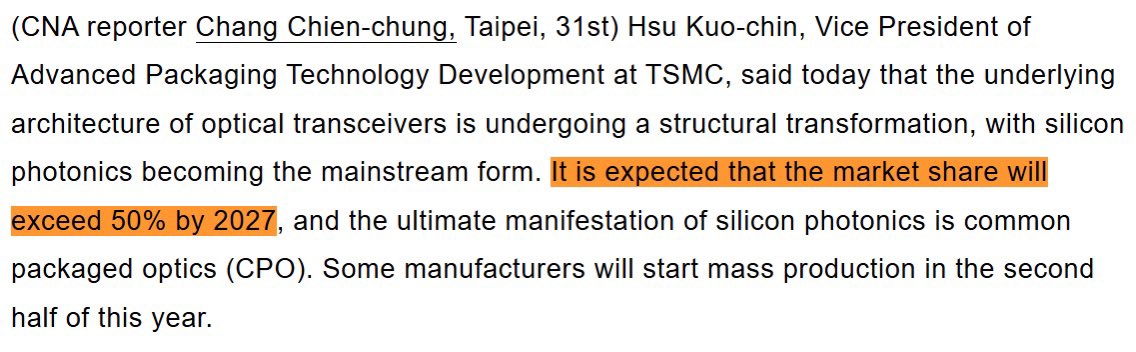
$TSM VP of Advanced Packaging today:
SiPh >50% of optical transceivers by 2027.
CPO is the end-state. Volume in H2 2026.
Bottleneck is lasers, fiber, connectors, test — not the foundry.
That’s the entire stack:
—> $LITE $AAOI $SIVE = InP lasers / ELS.
—> $IQE = InP epi under those lasers.
—> $COHR $AEHR $GLW $KEYS = rest of the constraint.
COUPE can scale the engine.
It cannot invent photons.
Everyone is calling the bottleneck, position accordingly.
— Outlier Capital
PS: I am long and bullish several stocks mentioned here, not advice. Thanks @ParadisLabs for sharing!
100 GW peak power X-ray pulses, shorter than an attosecond, generated by a tunable free electron laser:
https://t.co/R7exKMy3UP
3.5 GeV electrons are used to generate ~1 keV photons with an extraction efficiency around 0.1%
Local models are going to see massive growth over the next couple of years.
Companies want to own the data and the infrastructure.
That will lead to a lot more SLMs.
Companies training open source models on their own data and getting better outcomes.
🔗 GitHub: https://t.co/ulojQvnm9l
---
✉️ If you’re into AI, ML, agents, and building real systems, join my newsletter (it’s free): https://t.co/zpXbSNVTis
🇪🇸Spain would not fine anyone. It would cut the power.
A draft law is going to set new rules for data centres.
They would need 80% renewable power in every hour.
Servers must draw green energy the hour they run.
Projects already permitted would get 6 months to comply.
Building / powering data centres at scale is going to become more complicated.
Is it also going to be the trend beyond Spain?
https://t.co/DIf8Uv15b7
Here’s what launched this week:
— Gemini 3.5 Transcribe, our most precise speech-to-text model yet, designed to deliver intelligent transcriptions
— Gemini Omni 1.1 Flash, bringing expanded creative capabilities and controls for video generation and editing
— @GeminiApp’s Live experience, moving beyond conversation to complex tasks with new features like Daily Brief, Gemini Spark, Personal Intelligence, and @Gmail inbox management
— Expert Intelligence, a new cross-@Google initiative that lets you engage with and combine insights from trusted sources, starting with eligible @GooglePlay ebooks in @Gemini_Notebook
$AMZN just signed a definitive agreement to acquire DuckLabs, the Amsterdam company behind DuckDB.
For anyone unfamiliar, DuckDB is an in process analytical database that runs locally rather than in a cluster. It's become the default tool for a huge share of data engineers and analysts because it queries large datasets fast without any infrastructure at all. Enormous developer mindshare, almost no enterprise revenue.
What Amazon is buying is the team, not the technology. The open source project stays free under the independent DuckDB Foundation on an MIT license. Hannes Mühleisen and Mark Raasveldt keep leading both the team and the project's technical direction.
They've worked with AWS since 2024, so this is two years of collaboration turning into an acquisition.
Why it matters. Every AI workload needs data prepared and queried before a model ever touches it, and that layer is where a lot of the cost and friction lives. Warfield's framing was about empowering people to ask questions and build with data, which is exactly the bottleneck when you're trying to get value out of AI at enterprise scale.
Amazon is buying the fastest, simplest way people already work with data and putting it inside AWS.
A classic acqui-hire of a small team with outsized influence over how developers work. Those tend to be cheap relative to what they lock in.