Harvard just proved bedroom temperature controls sleep quality.
Participants fell asleep in 6.2 minutes when cool vs 20 minutes when warm.
Yet most people still don't optimize this simple factor.
Here's the exact temperature range that triggers deep, restful sleep: 🧵
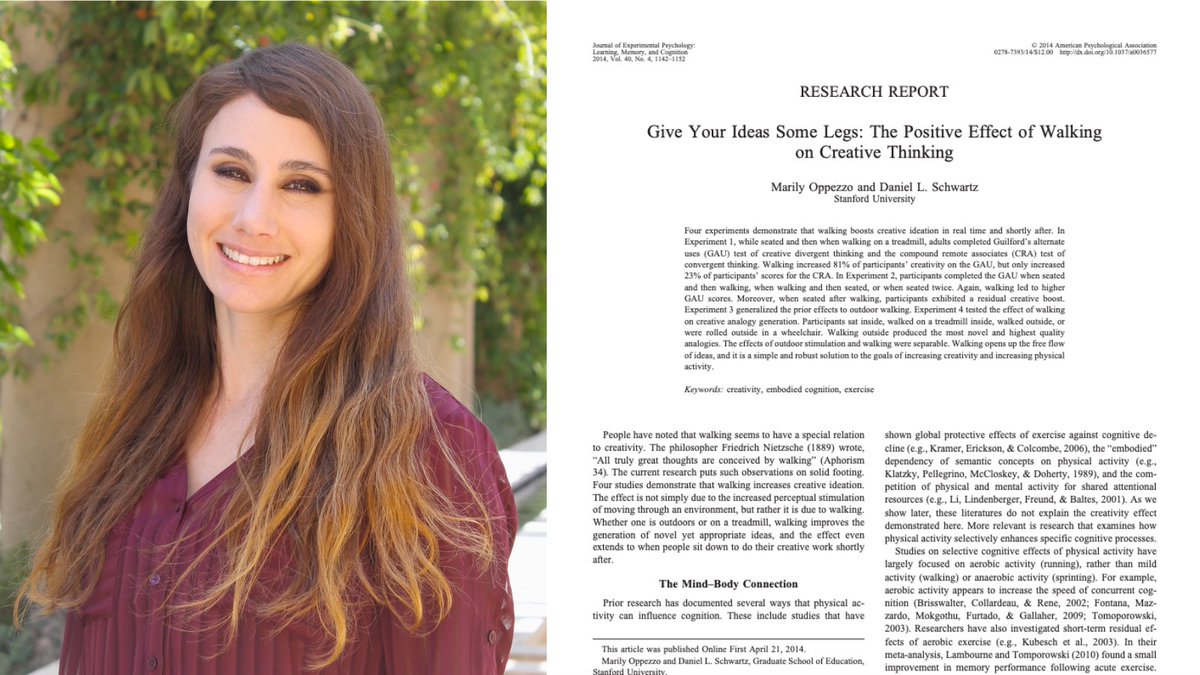
A Stanford psychologist spent 4 years proving that the simple act of walking generates 60% more creative ideas than sitting, and the experiment she designed to kill every alternative explanation is one of the most decisive findings in modern psychology.
Her name is Marily Oppezzo.
She got the idea for the study while walking with her advisor at Stanford to discuss her thesis topic, and the paper she eventually published in the Journal of Experimental Psychology in 2014 is sharp enough that it should have ended the seated meeting on the day it came out.
She ran 4 experiments on 176 people. Same person tested twice. Once sitting, once walking. The creativity tasks were the standard ones psychologists have used for decades to measure how good a brain is at generating novel useful ideas.
The result was almost too clean to publish.
81% of participants in the first experiment produced more creative ideas while walking than while sitting. In the second experiment, 88%. In the third, 100%. Every single person walked into a more creative version of themselves.
On average, people generated 60% more novel useful ideas the moment their legs started moving.
The skeptical question is the obvious one. Maybe it was the fresh air. Maybe it was the scenery passing by. Maybe it was the change of environment doing the work, not the walking itself.
Oppezzo killed every one of those explanations with one experimental decision.
She put people on a treadmill facing a blank wall. No scenery. No fresh air. No environmental change. Just legs moving in place while staring at white drywall. The 60% boost held.
Then she ran the experiment that closed the case completely. She took participants outside in two conditions. Half of them walked through a Stanford courtyard. The other half were pushed through the exact same courtyard in a wheelchair. Same outdoor stimulation. Same scenery passing at the same speed. The only difference was whether the legs were moving.
The walkers produced dramatically more novel high-quality ideas than the wheelchair group. The outdoors did almost nothing on its own. The walking did everything.
This is the part of the study that hit hardest when I read it the first time.
She also tested the opposite kind of thinking. Convergent thinking. The kind where there is one right answer and you have to narrow down to it.
Word puzzles where 3 words share a hidden fourth word that connects them. The seated participants did slightly better on these. Walkers got slightly worse.
Walking is not a general intelligence enhancer. It does one specific thing. It opens up the divergent search inside your brain. The part that generates options. The part that produces unexpected connections. The part that takes a problem and finds five ways into it instead of one.
When you need to converge on the single right answer, sit down. When you need to find the answer in the first place, get up.
The mechanism is now well understood. Walking selectively activates what neuroscientists call the default mode network, the system inside your brain that runs when you are not consciously focused on anything. The DMN is where mind-wandering happens. Where memories cross-reference each other. Where ideas that have been sitting in separate folders inside your head finally bump into each other.
When you sit at a desk and force yourself to concentrate, you suppress the DMN. When you walk at a natural pace, the executive part of your brain gets just busy enough handling the walking that the DMN comes online and starts doing the work that focus was blocking.
The most useful finding in the entire paper is the one almost nobody quotes.
The boost did not turn off the moment people stopped walking. Participants who walked first and then sat back down stayed elevated. Their next round of seated creativity work was still significantly better than people who had been sitting the whole time. The rest lingered for at least several minutes after the legs stopped moving.
You do not need to do creative work while walking. You need to walk before the creative work. The brain holds the state.
The history of this is the part that should haunt anyone who still does meetings in chairs.
Charles Darwin built a gravel loop behind his house in Kent called the Sandwalk and walked it 3 times a day for the rest of his life. The theory of evolution was developed one lap at a time on that path.
Nietzsche walked up to 10 hours a day during the years he wrote his most important books and openly said the work was conceived on his feet.
Beethoven composed for the morning and walked for 5 hours every afternoon with a pencil in his pocket for when something landed.
Kahneman said the best thinking of his Nobel Prize-winning career happened on leisurely walks with Amos Tversky. Steve Jobs refused to take important conversations sitting down. He held them on foot.
Every one of them was using the system Oppezzo would not measure until 2014. They just did not know what to call it.
The question worth sitting with is the one almost nobody asks.
Every meeting you have ever attended sitting around a table was a meeting held at a fraction of the brain power that was actually available to the people in the room. Every brainstorm that got stuck inside a conference room. Every problem you tried to solve at a desk and gave up on. Every idea you could not quite get to.
The intervention is the easiest one in modern science. No supplement. No app. No subscription. No training program. Just a pair of legs and 15 minutes.
The Stanford lab proved it. The philosophers knew it. The neuroscience explains it.
And almost everyone reading this is still trying to think their way out of problems sitting completely still.
In 2010, Stanford neurologist Dr Frank Longo gave a 2-hour lecture on how memory really works.
Everything you’ve learned about memory is mostly wrong.
His frameworks:
• The Magic 7 rule
• How sleep moves memories to storage
• Use it or lose it
15 lessons on memory:
German medical researchers have engineered a novel, injectable hydrogel designed to stimulate the biological regeneration of articular cartilage. This non-surgical approach aims to directly repair joint damage and restore natural cushioning without relying on invasive and costly joint replacement procedures.
Orthopedic experts note that osteoarthritis and cartilage degradation affect hundreds of millions globally, often leading to debilitating pain and limited mobility. By utilizing a bioactive matrix that encourages the body's own stem cells to multiply and differentiate into healthy tissue, this gel could drastically shift treatment paradigms away from artificial implants.
The underlying technology relies on a specialized polymer network that seamlessly mimics the natural extracellular environment of human joints. Once introduced to the affected area, it acts as a supportive structural scaffold, safely dissolving over time as fresh, healthy cartilage takes its place.
Early clinical observations report a significant reduction in chronic joint inflammation and a much faster return to pain-free movement for affected participants. Unlike traditional surgical interventions, which frequently require months of strenuous physical therapy, this minimally invasive procedure could allow for an incredibly rapid recovery window.
While currently advancing through rigorous regulatory testing phases, the successful commercialization of this regenerative therapy could save global healthcare systems billions in surgical and rehabilitation costs. It offers a highly promising future where debilitating joint conditions are managed with a simple outpatient visit, permanently restoring active lifestyles for aging populations and athletes alike.
If this non-surgical treatment becomes widely available, how would the ability to naturally regrow joint cartilage change your approach to staying active?
Kad onkolog kaže da kod mladih vidi rak debelog crijeva u četvrtom stadiju nakon C19 cijepljenja, onda to nije tema za podsmijeh nego za ozbiljnu istragu.
Na skupu “U središtu oluje”, 1. prosinca 2023. u Hrvatskom saboru, dr. William Makis javio se preko video veze i iznio tvrdnje koje bi u svakoj ozbiljnoj državi morale izazvati barem jedno: hitnu provjeru, a ne automatsko ruganje. U svom izlaganju rekao je da proučava agresivne karcinome koji se, po njegovim riječima, pojavljuju kod ljudi nakon primljenih cjepiva protiv COVID-19, te da ih opisuje kao izrazito agresivne i brzorastuće. Pritom je i sam naglasio da izraz “turbo rak” nije medicinski termin, nego naziv koji se proširio među pogo��enim ljudima i njihovim obiteljima.
A sada ključni dio — ono što je rekao o karcinomu debelog crijeva:
“Rak debelog crijeva prisutan je u četvrtoj fazi i kod ljudi u svojim dvadesetim i tridesetim godinama. Onkolozi ne očekuju da će ova mlada dobna skupina razviti rak debelog crijeva, a ti su se karcinomi već proširili na jetru, proširili su se na pluća ili kosti i prognoza je opet vrlo loša smrt, obično u manje od godinu dana.”
Možete se složiti s njegovim zaključcima ili ne. Ali jedno je neosporno: takvo upozorenje nije izgovorio anonimni profil s interneta, nego čovjek koji je u istom izlaganju rekao da je liječnik iz Edmontona, školovan na McGillu i Sveučilištu u Montrealu, s pet godina specijalizacije u nuklearnoj medicini, radiologiji i onkologiji, s više od 100 recenziranih publikacija, s više od 20.000 dijagnosticiranih pacijenata oboljelih od raka i nekoliko stotina liječenih pacijenata.
I upravo zato upozorenja ljudi poput njega treba slušati. Ne zato da bismo išta prihvatili na vjeru. Nego zato što ozbiljna medicina ne počinje cenzurom, nego pitanjem. Kad netko s takvim iskustvom govori o obrascu koji smatra alarmantnim, civiliziran odgovor nije etiketa. Civiliziran odgovor je provjera podataka, otvaranje registara, analiza trendova i javna rasprava bez dogme.
Jer realnost je jednostavna: ako su takva upozorenja pogrešna, to se mora dokazati poštenom analizom. A ako nisu, onda je šutnja već odavno prestala biti neutralna.
U to vrijeme napravio sam više intervjua i razgovora.
Pogledajte sve https://t.co/XnqJVlTLKb
'Normal Blood Pressure'...Big Pharma Keeps Moving The Goalpost.
1940: Normal 100+Plus Your Age/95
1970: Normal 160/90
2000: Normal 140/90
2017 & Now: Normal Needs To Be Less Than 120/80
Anti-Hypertensive Drugs worldwide achieved a revenue of $36.7 BILLION in 2024.
Blood Pressure Medications do not treat the root cause & inflict grave side effects resulting in more pills prescribed to counter negative side effects.
Making Big Pharma even more $$ profit for every additional Medication prescribed to mitigate the side effects from the original Hypertension Medications.
Very Low Blood Pressure is not healthy, causing more chronic illness & higher mortality.
Finding optimal Blood Pressure for you can be obtained by Diet & Lifestyle. No one has a blood pressure medication deficiency.
Adopting a whole food Low Carb Diet, prioritizing nutrient dense animal foods & eliminating Seed Oils, Processed Foods & Sugar will normalize Blood Pressure for your unique physiology.
Prioritizing Potassium & Magnesium is crucial. Both are involved in the body's Sodium Potassium Pump System. Supporting these important minerals by using unrefined mineral salt & electrolytes will also yield your own normal Blood Pressure.
Hypertension Medication Side Effects:
Chronic cough
Low sodium & potassium
Dizziness
Headaches
Dehydration
Muscle cramps
Gout
Insomnia, sleep changes & nightmares
Constipation
Tiredness or depression
Slow heartbeat
Symptoms of asthma
Sexual and/or erectile dysfunction
Heart palpitations
Fainting
Kidney dysfunction
Angioedema (swelling of face/tongue)
Joint pain
👇Higher BP In Older Adults Live Longer👇
https://t.co/WI2vpIR49j
👇200/100 Was Mild Hypertension in 1940👇
https://t.co/BmJ9LTNnEf
👇40 Year Blood Pressure Normal Numbers Shift👇
https://t.co/E1dIdDZmhP
Speaker: Dr Adam J Story
USAID gave George Soros's Open Society Foundation $5 million for its NGOs in tiny little Macedonia (population under 2 million), where the Soros NGOs trained citizens to protest using Saul Alinsky's Rules for Radicals.
This is Thomas Campbell.
A former NASA physicist who developed his Theory of Everything—unifying quantum physics & consciousness.
His model explains out-of-body experiences, remote viewing & dreams.
These 13 insights will shift how you see reality forever:🧵
🏙 Скопје, снимено од локација на Крстот на Водно, 13.25 часот, на 5 март 2025 година.
🔥 Можеби некој инспектор за животна средина ќе се заинтересира.
📷 Z. Stojanova
USAID has been funding similar protests to destabilize governments all over the world. I wouldn't be surpirsed if they're behind this as well. Here is but one example of our tax dollars at work in Macedonia:
https://t.co/Qs4TYDHk5a