🧩 Kotlin 2.4: una sintaxis para colecciones inspirada en Swift
Kotlin 2.4 incorpora una nueva forma de trabajar con colecciones que recuerda a patrones ya conocidos por los developers de Swift.
► Sintaxis más expresiva
► Menos código repetitivo
► Mejor legibilidad
► Nuevas utilidades para colecciones
👇🏻👇🏻👇🏻
→ https://t.co/7BQXqI8MEC ←
Today, we’re rolling out ACP Agent Registry in JetBrains IDEs.
Instead of manually setting up coding agents one by one, you can now browse what’s available and install them with a single click. Try different agents, see what’s best for your workflow, and switch as needed.
Thank you to @zeddotdev for a great collaboration 🙌
Full details in the blog post 👇
https://t.co/PGncxFYvQz
📢 Kotlin 2.4.0 is out! Here are some of the highlights:
✅ Language: Stable context parameters, explicit backing fields, and multiple features for annotation use-site targets.
✅ Standard library: Stabilized support for the UUID API and support for checking sorted order.
✅ Kotlin/JVM: Support for Java 26 and annotations in metadata enabled by default.
✅ Kotlin/Native: Support for Swift packages as dependencies, updates on Swift export, and the CMS GC enabled by default.
✅ Kotlin/Wasm: Incremental compilation enabled by default and support for WebAssembly Component Model.
✅ Kotlin/JS: Support for value class export and ES2015 features in JS code inlining.
✅ Gradle: Compatibility with Gradle 9.5.0.
✅ Maven: Automatic alignment between Java and JVM target versions.
✅ Kotlin compiler: More consistent inline function behavior during .klib compilation.
Learn more: https://t.co/8cT1Jicklk
Kotlin now has a formal security support policy for the standard library!
Starting with Kotlin 2.4:
✅ 18-month security support window
✅ Security fixes backported across supported release lines
✅ Clear support timelines for enterprise and regulated environments
Learn more: https://t.co/TrjhxL6ikE
🤖 Kotlin developers using Spring Data JPA and Hibernate will appreciate this new agent skill.
It helps AI assistants design entities, map relationships, fetch plans and indexes, and identify common persistence issues before they reach production.
See how it can help 👇
https://t.co/fzL5zuHjHH
Kotlin is moving toward name-based destructuring – new syntax that will make reordering and moving properties a breeze.
No worries: There will be a long migration period with compiler and IDE support.
Learn what’s changing and how the migration will work 👇
https://t.co/fAiCHBPZbL
🔐 Starting with Kotlin 2.4, the standard library includes an 18-month security support policy.
Security fixes will be backported to all active release lines within the support window.
👉 For more keynote highlights: https://t.co/gk8VQEtecp
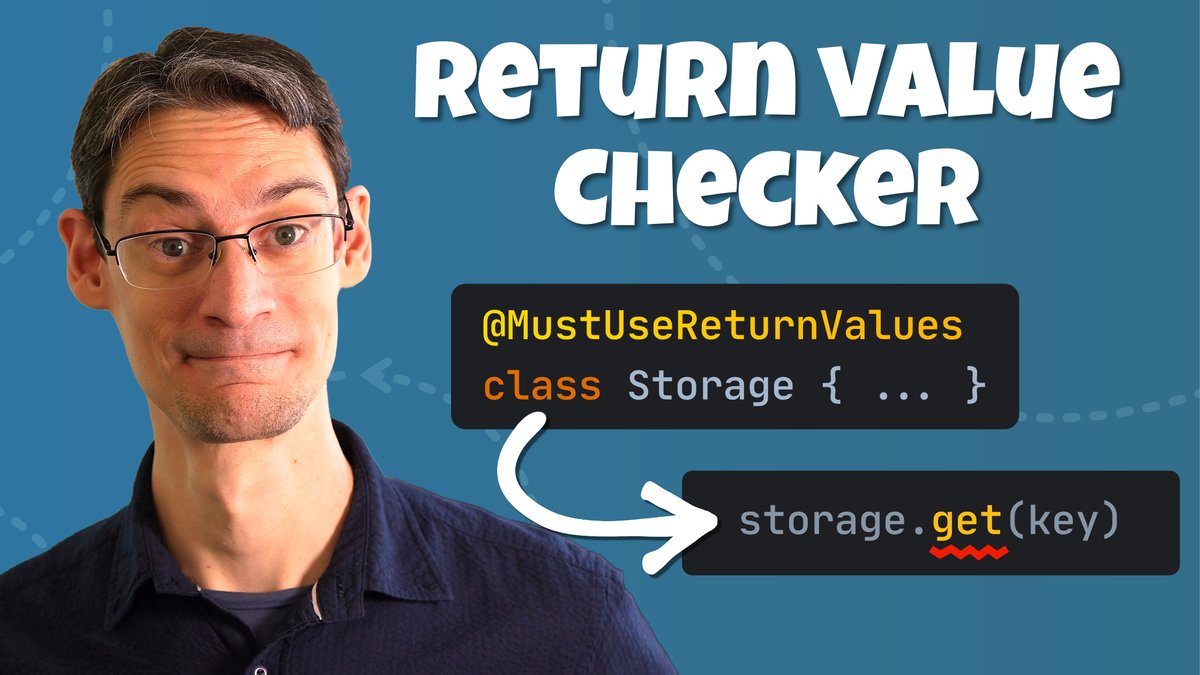
Kotlin's return value checker - lots of developers missed this one. In this video, I show how you can use it to expect call sites to use the values returned from your functions. See you at KotlinConf this week!
https://t.co/FTSTATj3LH
After years of waiting for this feature, we finally have it in Kotlin! Collection literals are supported as an experimental feature since Kotlin 2.4. The idea is simple: You can create a collection using a box bracket. Based on the specified type, a different collection type might be created, like a list or a set. If no type is specified, a list is created by default.
Collection literals associated with the of operator on a companion object. You can make them work for custom types by defining this operator. It mustn’t be an extension.
Collection literals require Kotlin 2.4 (such as "2.4.0-Beta2”), "-Xcollection-literals” compiler argument, and IntelliJ IDEA 2026.2 (which should be released in EAP around May 5th).
Here you can see them used in the KotlinConf application: https://t.co/lNjqfyIPkp
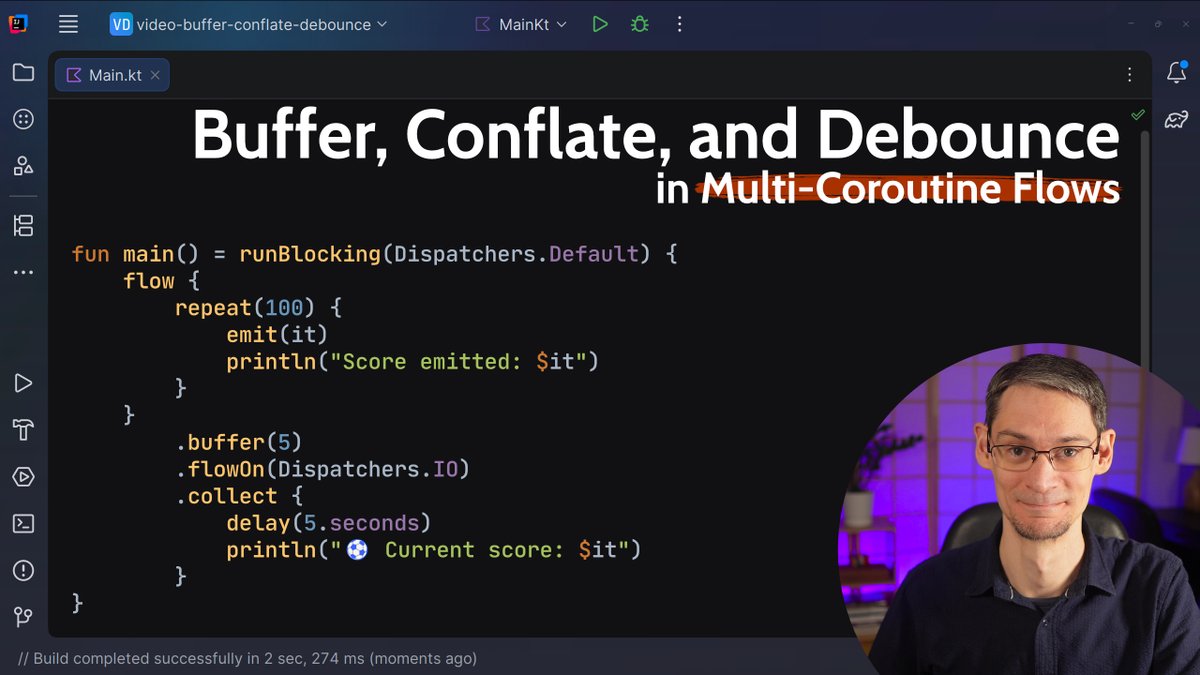
In Kotlin's Flow API, if you've got the emitter and collector running on different coroutines, you'll need a plan to handle those values that the collector can't keep up with!
In today's 8-minute video, we'll see how we can use buffers, conflation, and debouncing for different effects.
https://t.co/vorRG2NsIl
#Kotlin #AndroidDev
Have you tried name-based destructuring in Kotlin 2.3.20? In this 8-minute clip from the recent TypeAlias Show Livestream (link below), you can learn all about the three modes of this new experimental feature, and see how you can start using it (or migrating toward it!) in your own projects.
https://t.co/m1Oa9GXBWA
Another busy day at @spring_io!
Stop by the JetBrains booth to meet our team and hear what’s coming in IntelliJ IDEA.
🎤 Don’t miss today’s talk by @antonarhipov – DB-first Meets Code-first: Persistence Workflows in IntelliJ IDEA
🕘 9:00 am
Software is changing at a scale we haven’t seen in decades. If you manage engineers and haven’t coded in years, go build something with Claude, Codex, Cursor, or similar tools. Otherwise, your mental model of development process will become obsolete.