@cordyceps12@WallStreetApes Probably radiators or expelling heat another way. I'm curious if external pipes with liquid could be another option. I'm looking forward to the solutions they come up with as big companies like IBM and others look at these outerspace datacenters
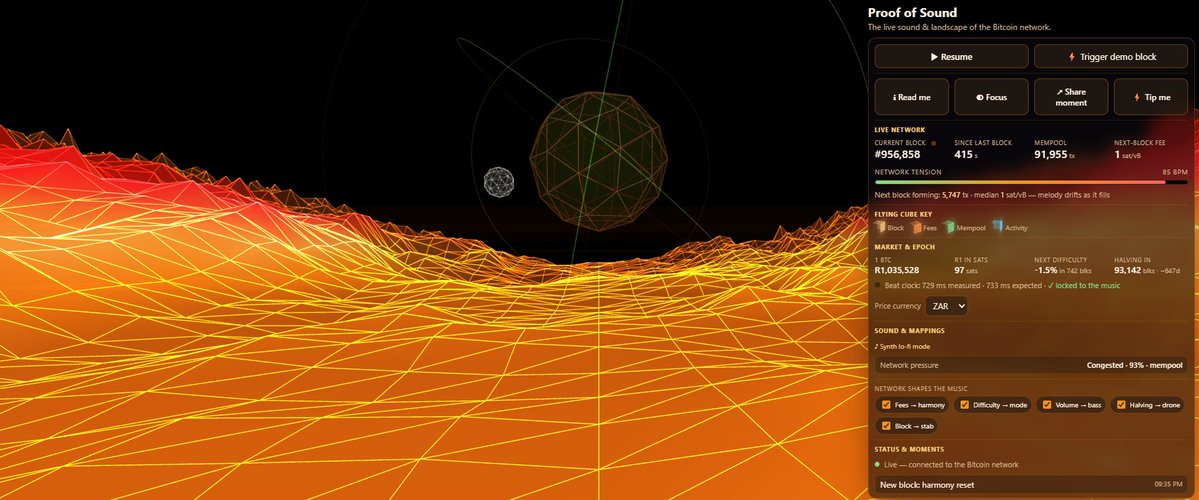
Have you ever listened to the Bitcoin network? "Turning the live Bitcoin network into sound and scenery. Reads public chain data only"
The #Bitcoin Proof of Sound
https://t.co/E9emnJ9Icq
A powerful earthquake earlier today in California, and now Venezuela, thousands may have died.
A Super El Nino may also be inbound breaking the 1870's record, which killed over 50 million
Water, food and energy security are paramount for country leaders. But don't wait for your country's leaders, protect yourselves. Backup power, food storage, extra water, even basic solar panels to recharge your cell phones.
@WallStreetApes Data Centers in Space Aren’t as Wild as They Sound
OuterSpace-based computing offers easy access to solar power but presents its own environmental challenges
https://t.co/Gs0VQCfOC7
Are data centers in space the future of cloud storage?
https://t.co/iIiLCAVIB1
Solar Energy
Efficient Cooling in the vacuum of space
Disaster and Security Resilience (No wild fires, floods, geopolitical issues, insider threats, building attacks/riots, etc)
Land Freedom (no leasing, no regulations, no policies, zoning laws, rapid scaling, no local neighborhood meetings/attacks/constraints)
Outerspace Datacenters
Off-planet data centers are emerging, with prototypes and early tests already in low Earth orbit (LEO) and on the Moon, aiming to solve terrestrial AI energy and cooling constraints.
Key players include Starcloud and Axiom Space, with planned lunar projects from LoneStar and interest from SpaceX.
Starcloud: Developed a small, orbit-based data center to run AI (specifically Google's "Gemma") on NVIDIA chips in LEO, with plans to launch a wider network.
Axiom Space: Launched Orbital Data Center nodes to the International Space Station (ISS) in early 2026 for testing cloud computing in space.
LoneStar Data Holdings: Successfully tested a data center on the Moon in early 2026, aiming for full-scale lunar data storage by the late 2020s.
Future Prospects: SpaceX is exploring space-based, AI-driven satellites, while China has announced plans for its own orbital data center initiatives.
Solar Energy
Efficient Cooling in the vacuum of space
Disaster and Security Resilience (No wild fires, floods, geopolitical issues, insider threats, building attacks/riots, etc)
Land Freedom (no leasing, no regulations, no policies, zoning laws, rapid scaling, no local neighborhood meetings/attacks/constraints)
#OuterspaceDatacenter #OffplanetDatacenter
The California environmentalists disappear when it comes to data centers
3 new massive data centers are coming to the Bay Area, just one is as large as 30 football fields
- Microsoft Data Center in San Jose
- Amazon Web Services (AWS) Data Center in Gilroy
- Prologis Larger San Jose Project
- Amazon Gilroy will use 7.5 million gallon of water per year
- Microsoft San Jose newer design with evaporative water use via closed-loop
- Still, all 3 combined will use tens of millions of gallons of water per year
Combined they will use the same amount of energy as 400,000+ homes annually
Censorship resistance
Defy takedown orders
Freedom of speech (especially when tied to Ethscription or Ordinal)
Usually no middlemen
Better ownership
Interact directly with others and finances without getting deplatformed by Google, Facebook, Twitter, Instagram etc.
Domains can be taken away by ICANN, but a blockchain domain cannot be touched by ICANN. My private wallet is outside the tech and jurisdiction of ICANN
Take a look at the cryptophunks website. Free to use and resisted lawsuits from big money (I think LarvaLabs) and takedown orders at OpenSea
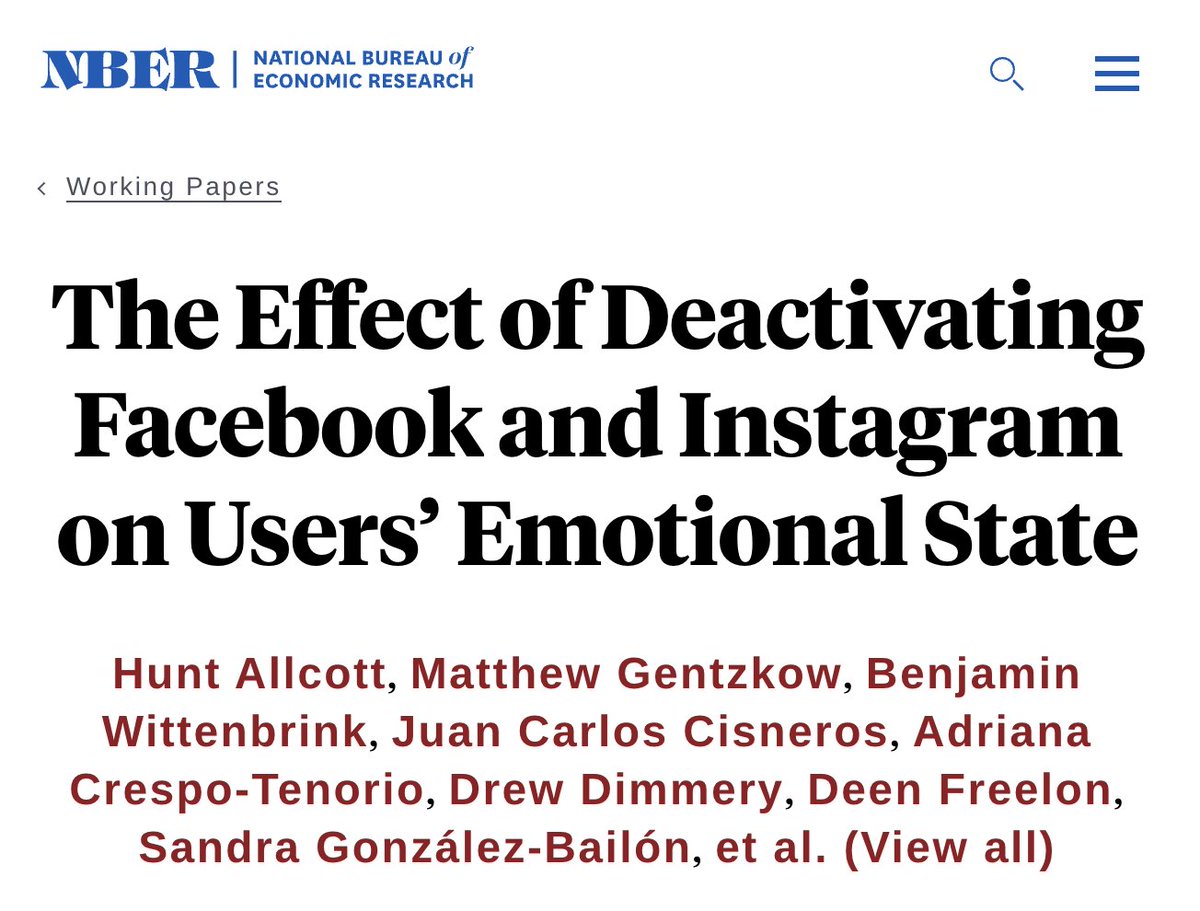
Stanford paid 35,000 people to quit Facebook and Instagram for 6 weeks
Depression dropped. Anxiety dropped. Happiness went up. Women under 25 on Instagram saw the biggest gains
That was 6 weeks. I'm going a full year.
Anthropic decidió dar de baja a toda nuestra organización por una supuesta infracción de sus condiciones de uso. Qué política específica infringimos no tengo ni la menor idea: simplemente recibimos un mail y listo, adiós Claude. Si querés apelar la medida hay que completar un Google Form, así de ridículo como suena.
De golpe más de 60 personas se quedaron sin una herramienta fundamental para trabajar. Integraciones, skills, historial de conversaciones: todo perdido o, en el mejor de los casos, parado por tiempo indeterminado.
Enorme aprendizaje para cualquier empresa de software que dependa de herramientas de IA en procesos críticos. Nunca hay que poner todos los huevos en una canasta.
@jbondwagon@cz_binance HWonder talks about a new #NFT, an #MFT. Meta Fungible Token. A hybrid of history, ownership, liquidity, revenue streams, and decentralized finance (most likely in the form of their Diamond from mining).
@hWonderofWorld
https://t.co/e4MQG56Wrp
An #NFT comeback? NFTs will come back, but not as before. NFTs are used in marriage licenses, real estate, proof of purchases from real life concerts, etc. Stream music, dynamic changes, updates, history preservation, and token liquidity.
#MFT | h wonder
https://t.co/e4MQG56Wrp
NFTs will be back and more mature, I’ve always said this. I’ll rather to listen to and believe CZ than people who don’t even have a wallet and don’t understand market cycles.
@ishmilly This may be an example of the new NFT, the #MFT, meta fungible token. Metadata evolving with the token/art, dynamic while maintaining the history, and tapping into liquidity pools (not sure how)
MFT | h wonder
https://t.co/e4MQG56Wrp
https://t.co/5FwIxL9cDn just sold for $25k.
Financial insight that will use AI most likely. Otherwise, what the hell is a fin sight and why is it worth $25k for this domain name?
True, but for many countries, their energy infra is easily attacked with $10k drones. The big picture is, energy security, not just performance. The decentralization is like a datacenter (I worked for several). A good data center plugs into multiple power grids/sources. Some power sources are not ideal, are pricey, not wise, but if the main source is out, work and life moves forward until the main power source recovers.
Nuclear looks the best of course. But, look at Russia's accusations recently. Russia accuses Ukraine of targeting nuclear sites. Russia has not attacked Ukraine's nuclear sites (yet). It would also be a problem for Russia because they are so close to each other and could get some of the contamination.
If Iran had the capability to destroy one of USA's nuclear facilities, do you think they would do it right now? I think most of the world would agree they would.
What is the backup plan? Japan lost power from the Fukushima incident is another example. Ideally, more nuclear power plants and heavily fortified. Decentralize the power with SMRs, sort of like "net metering." Net metering with battery storage cells at homes, when demand requires it, people can send energy back to the grid for credits. SMRs are small modular reactors for nuclear power plants. But, once the source is disabled, so are the others. For national security, a country needs to decentralize energy as best they can and control the energy supply chain.
There was a day when GoDaddy only allowed domain registration via the phone. Domains were available, when you called to register, the domain magically unavailable and "just" registered. They were front-running domain investors. The accusations are there but GoDaddy controls all the data, couldn't prove it. Network Solutions got caught.
"GoDaddy may profit by marking up domains as "premium" after detecting high search volume or by holding expired domains to sell them back at inflated prices"
Never trusted GoDaddy after what appeared to be self-bidding on their own auctions and front running domain registrations.
Your soul and skills are being captured by your employers. In China, they are demanding their employees to create your digital twin so you can be replaced
I knew the AI apocalypse is coming. I'm going to scrape all of your souls and skills into a Gigachad agent
#DomainsForSale
This is WILD.
A secret workplace war just broke out in China and it has gone fully viral on GitHub.
Companies started ordering their workers to document all their knowledge as AI "skill files."
Why? to replace those same workers with AI but workers figured out the plan fast so they fired back.
Someone built a tool called colleague.skill, software that scrapes a coworker's chat logs, emails, and work docs from Chinese platforms like Feishu and DingTalk, then clones them into an AI agent.
The idea was savage, digitize your colleague before they digitize you, hand the AI clone to the company, and watch your coworker get laid off while you survive.
A real GitHub project that exploded in popularity in days but then someone else entered the chat and changed everything.
A developer released anti-distill.skill, a tool that takes the skill file your company forces you to write, then strips out every piece of real knowledge before you hand it in.
The output looks perfectly professional, totally complete, impressively detailed but every critical insight has been secretly removed.
Your company gets a hollow shell while you keep the real knowledge locked away in a private backup.
The tool even has three intensity levels, light, medium, and heavy depending on how closely your bosses are watching.
Companies across China have been building AI digital twins of departed employees, feeding their old chat histories and documents into large models to produce clones that keep working after the humans are gone.
One verified case is that an employee left, and their replacement was literally an AI trained on every message they ever sent.
The anti-distill tool went viral on GitHub within hours of being posted, racking up stars faster than almost anything trending that week.
The implications reach far beyond China's borders.
Every knowledge worker on earth now faces a version of this question, when your company asks you to document your process, they may be building the tools to replace you.
This is a very good question and has a few possible answers.
One huge possibility is Greenland.
Donald Trump wants to take over Greenland primarily due to national security concerns, strategic positioning, and access to valuable natural resources. He has stated that Greenland is critical for U.S. defense, particularly because of its proximity to Russia and its role in monitoring ballistic missile routes through the Arctic, as well as its position along emerging shipping lanes like the Northwest Passage and Transpolar Sea Route.
Key motivations include:
Strategic military advantage: Greenland hosts the Pituffik Space Base, a vital U.S. installation for early missile warning systems, and controls access to the GIUK Gap, a crucial naval chokepoint.
Resource access: The island holds vast untapped reserves of rare earth elements, uranium, oil, and gas—resources essential for green technology and national defense, reducing reliance on China, which currently dominates rare earth production.
Geopolitical influence: Trump has framed the push as necessary to counter Russian and Chinese presence in the Arctic, though experts question the scale of this threat.
Economic and territorial legacy: Earlier in his presidency, Trump described the acquisition as a “large real estate deal,” and taking control of Greenland would mark the largest U.S. territorial expansion in history, enhancing his political legacy.
EU will be against this because they too, see the future is dire without energy security and strategy.