The demands are clear, end mass unemployment, employ everyone willing and able to work, and pay a living wage. Implement a basic income grant. End budget cuts, tax the rich so that the poor can live
#MTBPS2020
In 1987, the South African government replaced the power producer ESCOM with a new version called Eskom. However, this wasn’t just a name change—it was a significant shift in how the country handled electricity.
Along with the name change, the government passed a new law, the Eskom Act, which changed Eskom’s primary goal from serving the public to focusing on cost and efficiency, more like a business.
For over 60 years up to that point, ESCOM had followed a simple rule written into its Act: supply electricity “neither at a profit nor at a loss”. That meant the focus was on providing energy as a public service, not on making a profit.
But in 1987, that statute was thrown out. The new Eskom was expected to run like a company, and for the first time, private businesses—like the Chamber of Mines—got seats at the decision-making table.
Before this change, ESCOM had helped build South Africa’s economy. It provided cheap power, kept key sectors like electricity and rail in public hands, and helped the country grow from a rural colony into a regional power.
In the 1970s and 1980s, when sanctions made borrowing money from abroad difficult, ESCOM turned to local lenders and became South Africa’s biggest borrower. ESCOM didn’t just keep the lights on but also played a strategic role in the domestic economy.
ESCOM’s large local borrowings allowed the state to continue expanding electricity generation, maintain infrastructure, and support heavy industry—all of which were essential to keeping the economy functional under pressure.
By becoming South Africa’s biggest borrower, ESCOM provided a reliable demand for domestic savings. It issued bonds and other debt instruments that helped deepen local capital markets and gave institutional investors (like pension funds and banks) a stable, state-backed outlet for their money. This kept the financial system active despite isolation from global markets.
The electricity ESCOM provided through this locally financed expansion was also crucial for the mining sector, manufacturing, and other energy-intensive industries. These sectors—dominated by White capital—relied on cheap, stable electricity to remain globally competitive.
So, by sustaining the electricity supply without foreign loans, ESCOM helped preserve and strengthen the country’s economic base.
However, as Apartheid began to fall apart, the government started selling off state-owned assets. This was a strategic move. They knew a Black-led government was coming, so they wanted to ensure that new leaders wouldn’t have full control over key parts of the economy. Privatising these sectors made that possible.
Still, when the ANC took power, many expected things would change. But in 1996, the ANC adopted the GEAR plan—short for Growth, Employment, and Redistribution—which continued the same market-friendly approach. It focused more on investor confidence than public welfare, surprising even some White South Africans who thought the ANC would take a different path.
President Thabo Mbeki, in his 1999 State of the Nation address, stated, “To improve our competitiveness, we must lower input costs throughout the economy. Accordingly, we have decided to go over to a managed liberalisation of the energy, transport and telecommunications sectors”.
So, in 2001, Mbeki signed the Eskom Conversion Act. This turned Eskom into a tax-paying, profit-making company that could be listed on the stock exchange. It was no longer just a public utility—it was now a commercial business.
Control over Eskom was also moved from the Minister of Minerals and Energy to the Minister of Public Enterprises, whose job was to push privatisation. This change came alongside other economic reforms, like loosening controls on the Reserve Bank and selling off more state companies.
By forcing Eskom to behave like a for-profit company, the 1987 reforms planted the seeds for many of the problems we see today. The Apartheid government may have seen these issues coming—but keeping the economy in private hands was more important to them than making sure it worked for everyone.
When Eskom began operating like a business, it shifted its focus to areas where it could earn the most revenue—mostly urban centres and large industries. Poorer communities, especially in rural areas, were often left out because they weren’t seen as profitable markets.
This is similar to what we see with telecom companies like Vodacom and MTN, which are slow to build enough cell towers in rural areas because the people there don’t have the buying power to make those investments worthwhile.
As a result, these communities are left with weak signals, poor internet access, and unreliable communication—cutting them off from job opportunities, digital services, and participation in the broader economy. In the same way, the poor majority were sidelined from reliable energy access because their needs didn’t fit the profit model.
Electricity is essential for modern life—much like water or healthcare. When Eskom was run as a public utility, the goal was to provide power broadly and affordably. But when it became a commercial company, electricity turned into a product—something to be sold for profit.
This shift meant that the ability to pay began to shape access. For millions of poor households, it made electricity less of a right and more of a luxury.
Under ESCOM’s old model, wealthier users and industries effectively subsidised poorer ones through uniform pricing and cross-subsidies. After commercialisation, the logic changed: each user had to “pay their way”.
But in a country with deep income inequality, this meant poor households either paid a disproportionate share of their income for electricity—or got cut off. Cost recovery had replaced redistribution.
Moreover, commercial Eskom became more accountable to banks, credit agencies, and bondholders than to ordinary South Africans. Poor communities had little say in how electricity was priced or where it was delivered.
To fund massive projects, Eskom borrowed heavily from private markets. As the debt grew, so did electricity prices. Poor households paid more and more for power they often couldn’t afford, while the benefits of these megaprojects mostly went to industries.
Commercialisation was part of a bigger plan to lock in White economic power before Black majority rule. By putting key sectors under market control, the Apartheid state made it difficult—if not impossible—for a democratic government to use them for redistribution or development.
The irony is that while Eskom was turned into a profit-driven company, the social consequences—like disconnection, unrest, and service delivery protests—still fall on the State. In the end, commercialisation didn��t reduce the burden on the government—it just made it harder to serve the people who need it most.
The commercialisation of Eskom marked a critical turning point in South Africa’s energy and economic history. What was once a state utility built on the principle of delivering affordable power to all—“neither at a profit nor a loss”—was transformed into a semi-corporate entity chasing cost efficiency and commercial viability.
This shift had deep consequences for the poor majority, who were increasingly seen not as citizens with rights to basic infrastructure but as customers whose needs only mattered if they could pay.
The restructuring laid the groundwork for a broader neoliberal orientation: one that made essential services conditional on profitability rather than universal provision.
In this model, access is uneven, and exclusion is systemic—not because the technology doesn’t exist, but because commercial logic deems some lives unworthy of infrastructure.
Interestingly, by 2023, President Mbeki had flipped his stance on commercialising and privatising public utilities when he told the South African Association of Public Administration and Management‘s annual conference in Ekurhuleni that, “Relegating government functions to the private sector is dangerous... As the state becomes less and less capable, it is being increasingly bypassed by private actors.”
The lesson should be clear—without a strong, capable public sector grounded in the public interest, essential services like electricity will remain a luxury for some rather than a right for all.
We have been gagged! We cannot say by who or why. Attempts to silence public-interest journalism threaten everyone’s matters of public interestt. We’ll challenge this order with our attorneys at PowerLaw Africa. More information to follow.
https://t.co/ScQDsMPkEu
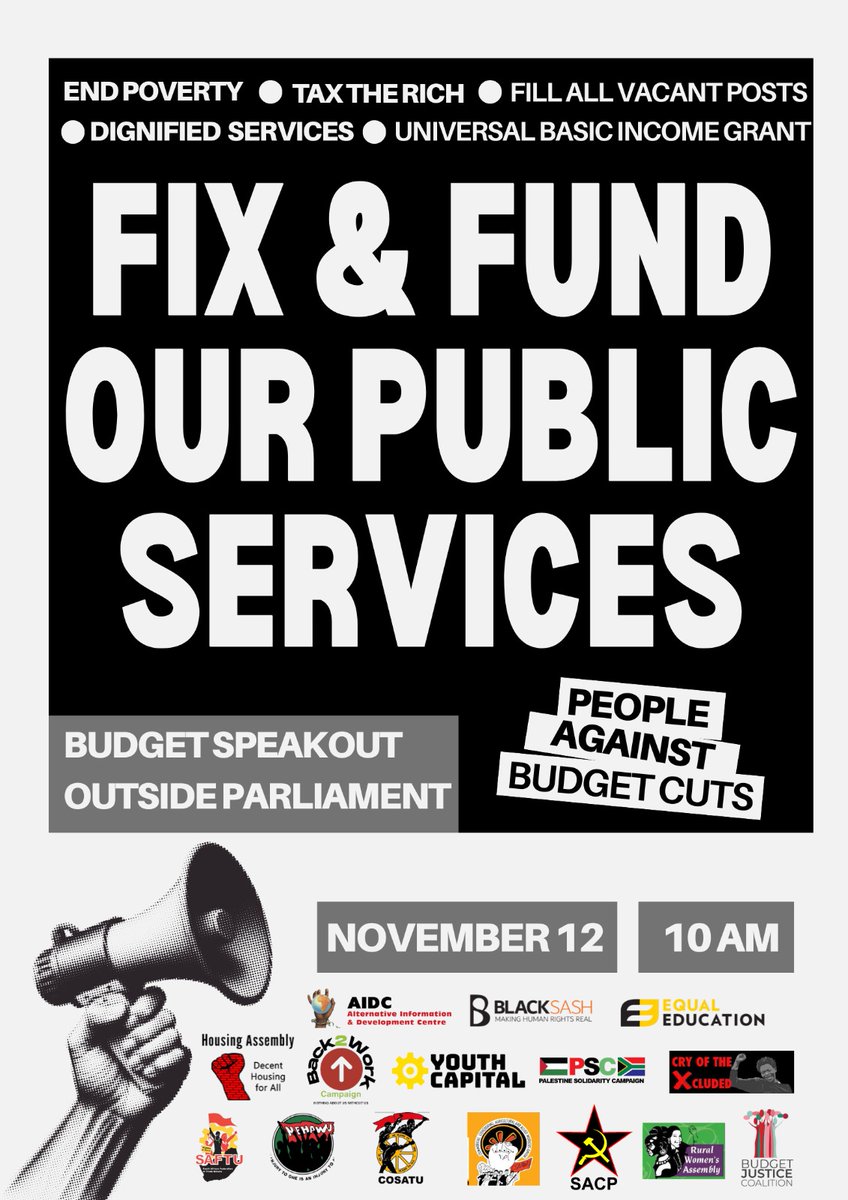
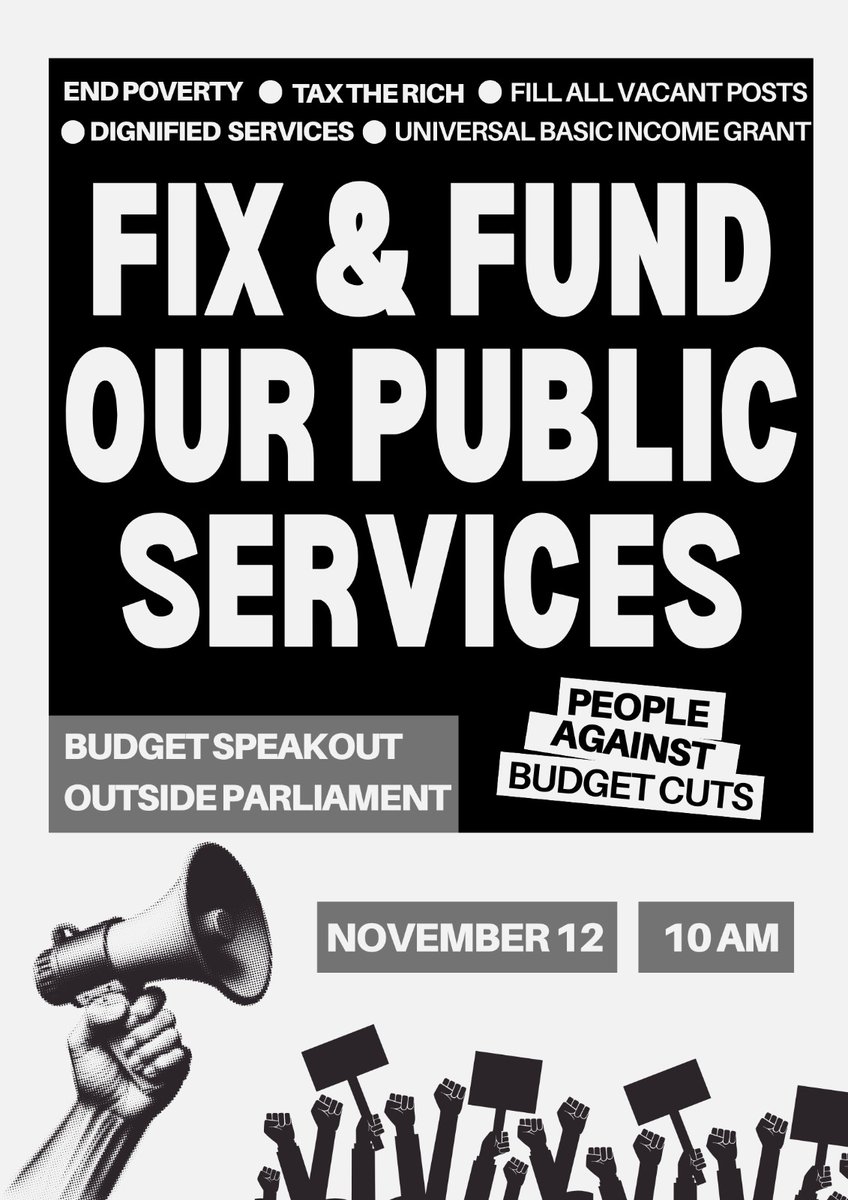
📌Join the Public Speakout Against Budget Cuts next Wednesday, 12 November, outside @ParliamentofRSA before the MTBPS to demand a budget that invests in learners. ✊🏾
🗓️ Wed, 12 Nov 2025
⏲️ 10:00 AM
📍Parliament
#EndBudgetCuts#FundOurFuture#NoMoreCuts
#PeopleAgainstBudgetCuts
#TaxTheRichNotThePoor
#SofundaSonke
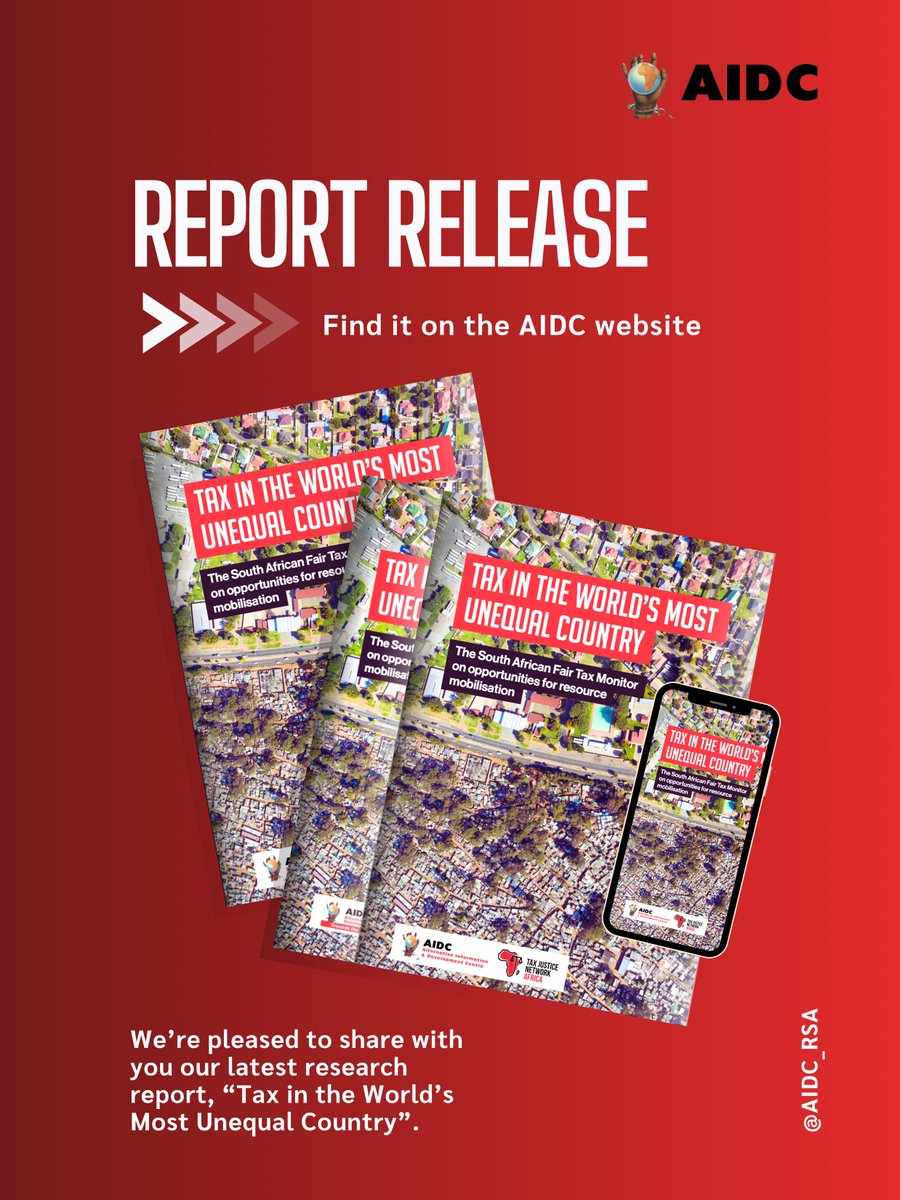
📢 We are excited to share our latest research report: 𝗧𝗮𝘅 ��𝗻 𝘁𝗵𝗲 𝗪𝗼𝗿𝗹𝗱’𝘀 𝗠𝗼𝘀𝘁 𝗨𝗻𝗲𝗾𝘂𝗮𝗹 𝗖𝗼𝘂𝗻𝘁𝗿𝘆: 𝗔 𝗦𝗼𝘂𝘁𝗵 𝗔𝗳𝗿𝗶𝗰𝗮𝗻 𝗙𝗮𝗶𝗿 𝗧𝗮𝘅 𝗠𝗼𝗻𝗶𝘁𝗼𝗿 𝗥𝗲𝗽𝗼𝗿𝘁 𝗼𝗻 𝗢𝗽𝗽𝗼𝗿𝘁𝘂𝗻𝗶𝘁𝗶𝗲𝘀 𝗳𝗼𝗿 𝗥𝗲𝘀𝗼𝘂𝗿𝗰𝗲 𝗠𝗼𝗯𝗶𝗹𝗶𝘀𝗮𝘁𝗶𝗼𝗻.
Ever wondered…Am I overtaxed? What are the richest of the rich really paying? Are big companies paying their fair share? Where is all the money going? Why is SARS not working properly? Does the government really need more money?
This report addresses these questions. With the #MTBPS2025 coming up, we hope this report will show that there are options to raise the revenue needed to meet people’s needs.
👉🏾 Download the report here: https://t.co/iB0RGqfvf8
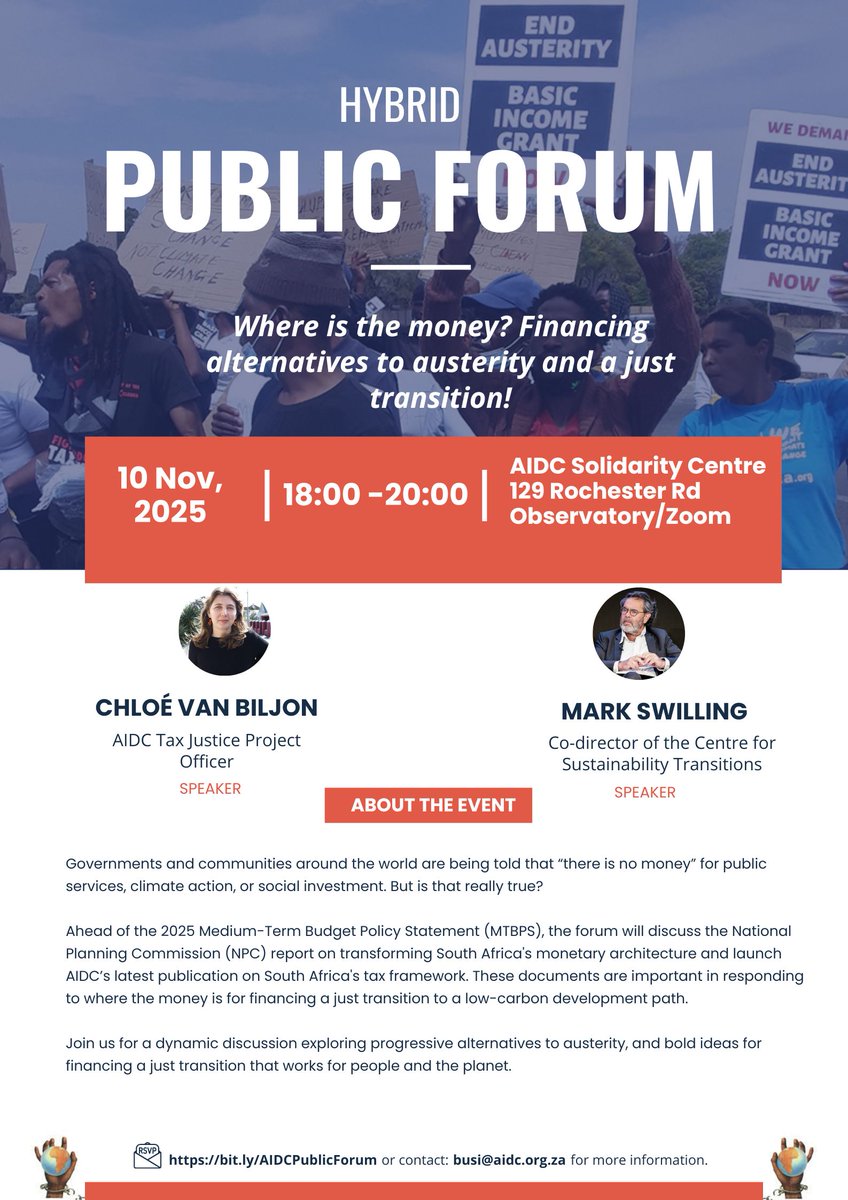
🇿🇦𝗣𝘂𝗯𝗹𝗶𝗰 𝗙𝗼𝗿𝘂𝗺: Join us on Monday, 10 Nov 2025, at 6 PM to explore how South Africa can finance a just transition to a low-carbon development path. We will discuss the National Planning Commission (NPC) report on transforming the country’s monetary architecture and launch AIDC’s latest publication on the tax framework ahead of the #2025MTBPS.
✍️🏾𝗥𝗲𝗴𝗶𝘀𝘁𝗲𝗿/𝗥𝗦𝗩𝗣 𝗵𝗲𝗿𝗲: https://t.co/yu4jXmmn0e
𝗦𝗔𝗩𝗘 𝗧𝗛𝗘 𝗗𝗔𝗧𝗘: Join us on December 11th at 17:00 SAST for a hybrid meeting linking COP30 in Brazil to the UN Tax Convention in Nairobi with our partners @AsianPeoplesMvt and @JusticaTrilhos. We will be discussing how the scramble for critical minerals is enabling corporate profiteering in the name of the energy transition, and why tax justice is crucial for a just transition.
✍️🏾𝗥𝗘𝗚𝗜𝗦𝗧𝗘𝗥 𝗛𝗘𝗥𝗘: https://t.co/W9VjAG5bSN
🚨 Attention Capetonians! Join the People Against Budget Cuts on Wednesday, November 12, for a Speak-Out outside the @ParliamentofRSA. Let’s reject the @GovernmentZA's austerity budget and fight for adequate funding for public services! ✊🏾
#EndBudgetCuts#PeoplesBudget
#MTBPS2025
Fishing communities united today as they marched to the Constitutional Court for the landmark case Wild Coast Communities vs Shell. They stand firm against Shell’s oil and gas exploration, prioritizing environmental and cultural preservation. 🌊✊
#ProtectOurCoast
#WildCoastJustice
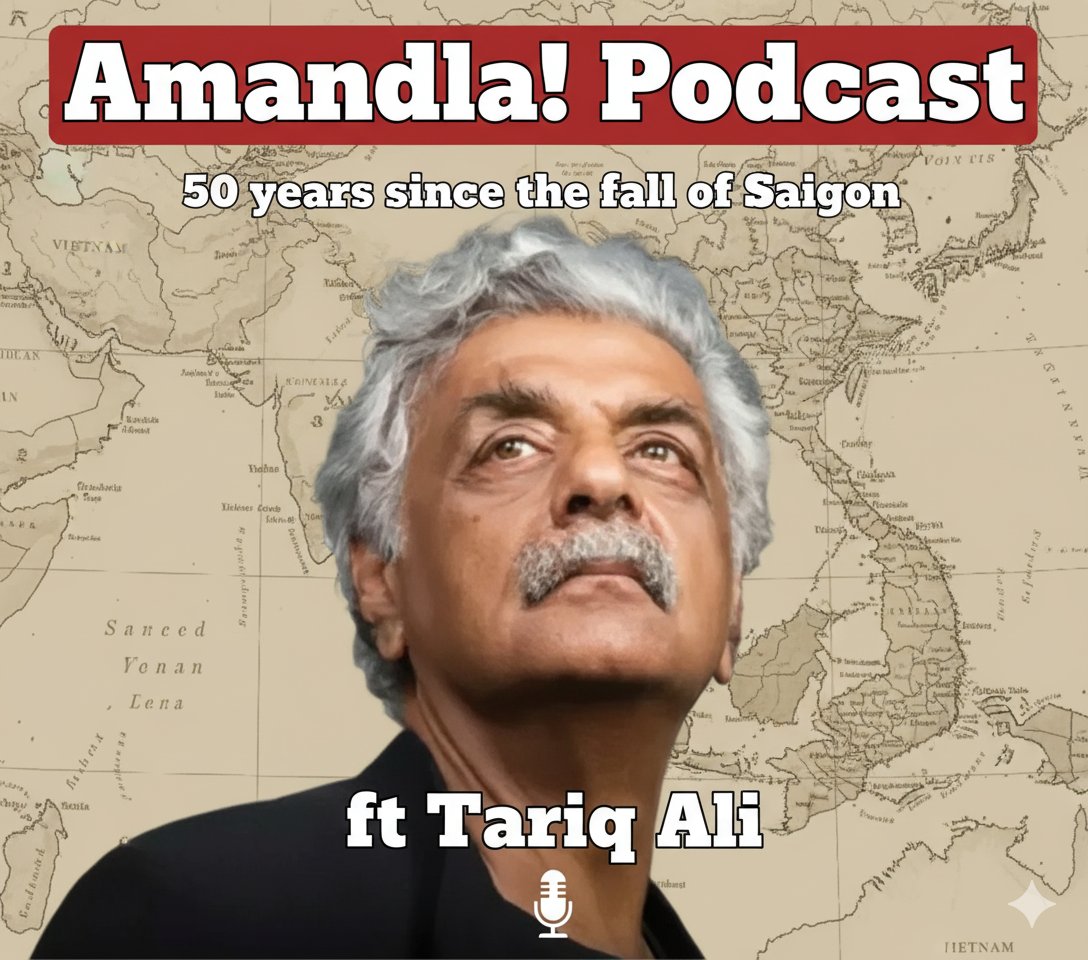
🎙️𝗣𝗢𝗗𝗖𝗔𝗦𝗧: Fifty years after the fall of Saigon, Amandla! Magazine interviews Tariq Ali, a leader of the anti-Vietnam War movement, about how this grassroots activism influenced the conduct and outcome of the war in Vietnam. Check out the interview linked below. ⤵️
#AmandlaMagazine
#VietnamWar
#Activism
https://t.co/NaS7JtqnwN
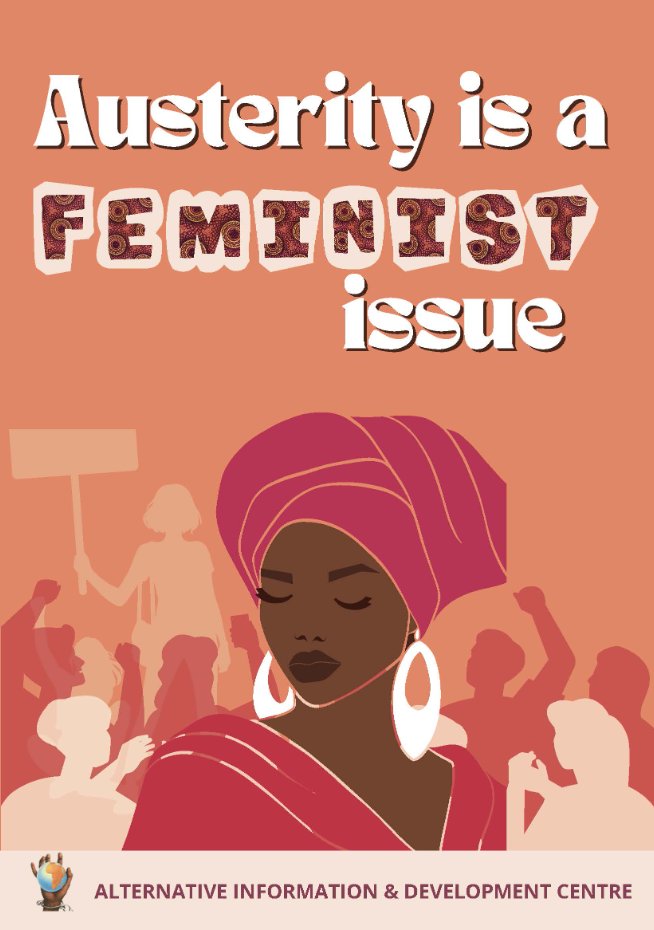
📌As we wrap up Women's Month, let's celebrate the resilience of women while acknowledging the ongoing challenges of apartheid and patriarchy in South Africa. Last year, we released a report highlighting the urgent need to reevaluate dominant macroeconomic frameworks, with a focus on the impact of austerity on gender and other social inequalities in policymaking. A feminist future requires fiscal and monetary policies that prioritise the well-being of all individuals, not just the powerful few. Read the full report below and join us in advocating for positive change!👇🏾👇🏾👇🏾
#Womandla ✊🏾
#WomensMonth2025
#NoToAusterity
#EndBudgetCuts
#AusterityIsAFeministIssue
https://t.co/JDb7CGexQm
Aliya Chikte stresses that economic justice and social protection must work together. Access to basic infrastructure, ECD, and fair compensation for essential workers like nurses and teachers are key. She calls for fair redistribution in an unequal economy to address systemic gendered disparities. #WomensMonth2025 #blacksash70
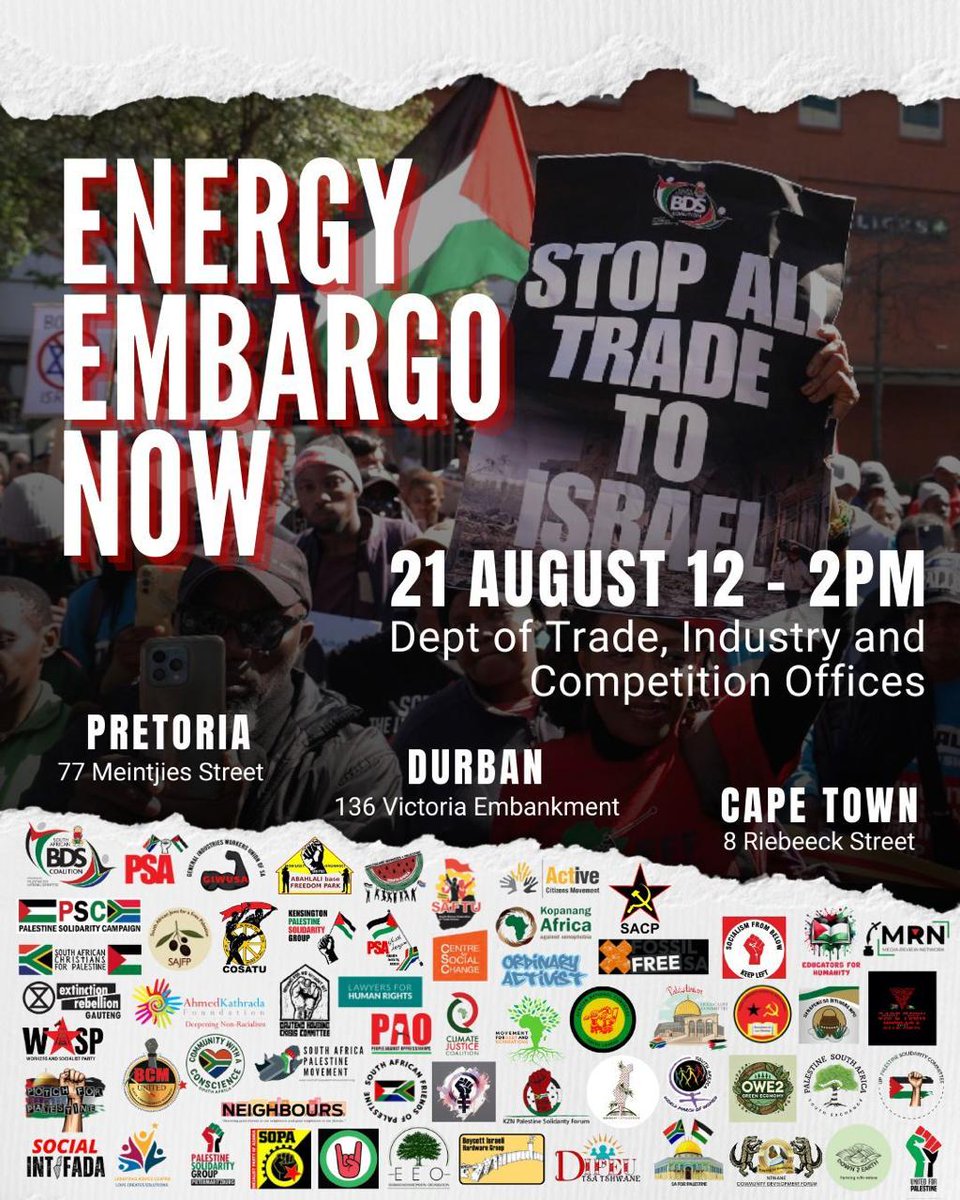
The next protest is tomorrow - August 21, 12-2pm - at Parks Tau’s trade ministry in Pretoria, Cape Town and Durban. Join us, stop the genocide!
https://t.co/IG4YZAZFex
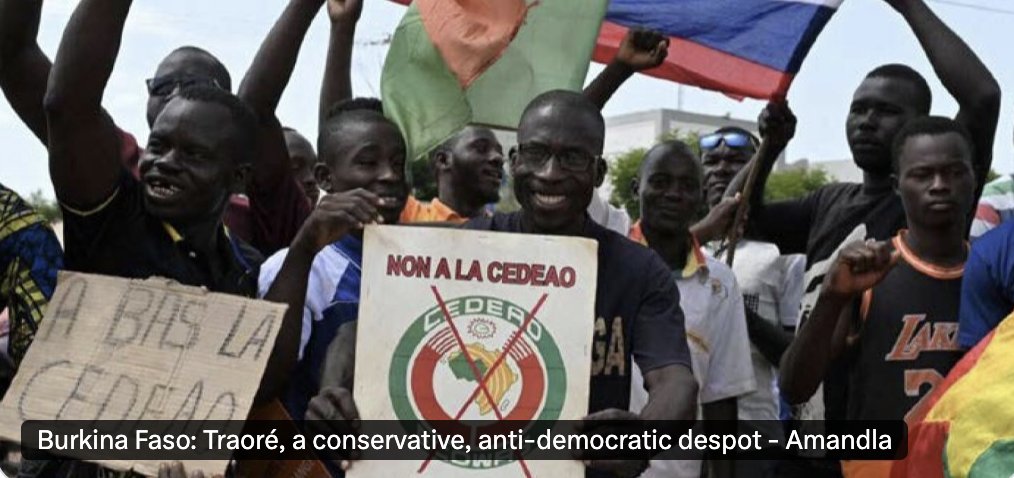
Amandla! spoke with political scientist Rahmane Idrissa, who shares crucial insights about the situation in Burkina Faso. He emphasises that this 'revolution' leans towards authoritarianism rather than democracy. Read more in the article linked below to understand the complexities. ⤵️
#AmandlaMagazine
#BurkinaFaso
#PoliticsToday
https://t.co/h25Gxj6Hrr
Feya Faku’s Memorial Service was held at The Market Theatre on Friday, July 25, 2025.
Through your music, you touched our souls and left a lasting impact. Your legacy continues to inspire others. The stage was your canvas, and you performed passionately and gracefully.
Rest in peace, my friend. Until we meet again!
BREAKING 🇵🇸🇧🇪 Two Israeli soliders have been arrested in Belgium, facing accusations of war crimes in Gaza following a complaint by @HindRFoundation and @GLAN_LAW.