Zcash $ZEC is easily the most underrated crypto right now. It brings privacy to money, which is a fundamental building block of a free and open society. Proud that @Gemini supports this noble project with @NYDFS approval.
@sunnydecree https://t.co/8kcSLEVCVF wird von Bainox AG betrieben, einziger regulierter Mining-Anbieter Europas mit transparentem Konzept für private wie institutionelle Kunden.
Wir stehen für Offenheit und laden alle ein, uns in Winterthur persönlich kennenzulernen.
Bitcoin Mining is NOT Solving Complex Math Problems
🎲 Beginner's guide to bitcoin mining and difficulty adjustment using a simple dice analogy.
Most people misunderstand what bitcoin miners actually do, and as a result they don't fully grasp the level of security provided by bitcoin's hashrate. In this article, we'll explain proof of work in a non-technical way so that you’ll be able to counter the misinformation about supercomputers and quantum computers attacking the bitcoin network in the future.
Simply put, mining is a lottery to create new blocks in the bitcoin blockchain. There are two main purposes for mining:
— To permanently add transactions to the blockchain without the permission of any entity.
— To fairly distribute the 21 million bitcoin supply by rewarding new coins to miners who spend real world resources (i.e. electricity) to secure the network.
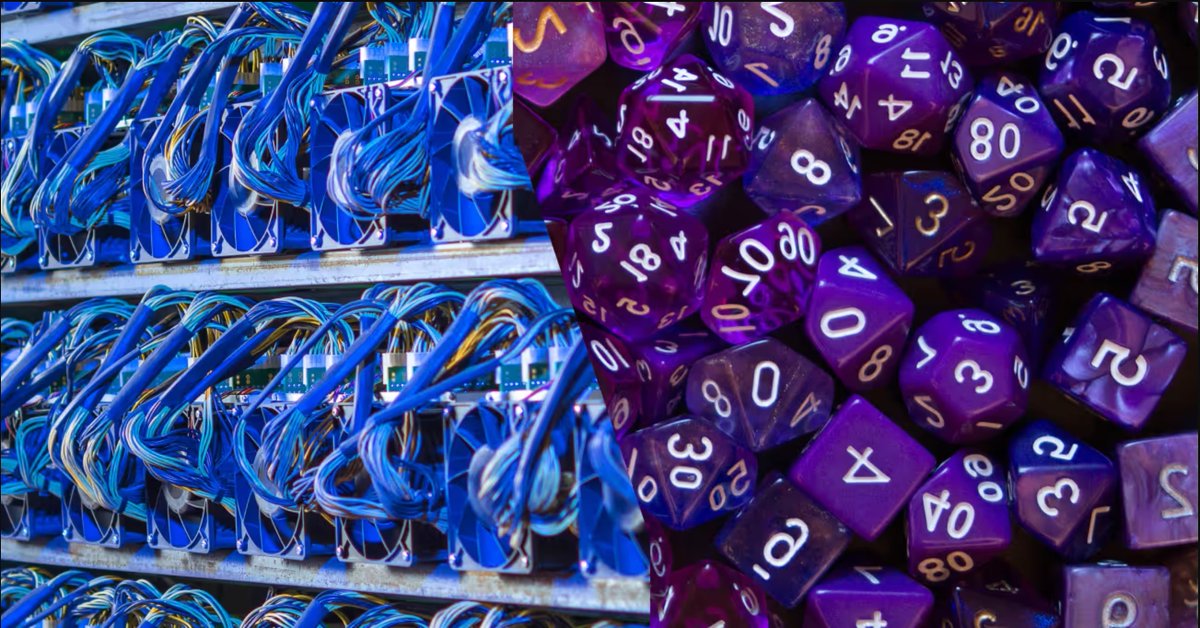
To understand what is actually happening in this lottery system, let's look at a simple analogy where every bitcoin hash is equivalent to a dice roll.
🍀 Luck, Gambling, and SHA256
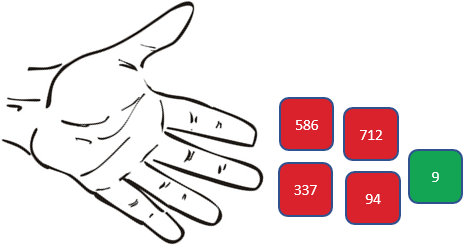
Imagine that miners in the bitcoin network are all individuals gambling at a casino. In this example, each of these gamblers have a 1000 sided dice. They roll their die as quickly as possible, trying to get a number less than 10. Statistically, this may take a very long time, but as more gamblers join the game, the time it takes to hit a number less than 10 gets reduced. In short, more gamblers equals quicker rounds.
Once somebody successfully rolls a number less than 10, all gamblers at the table can look down and verify the number. This lucky gambler takes the prize money and the next round begins.
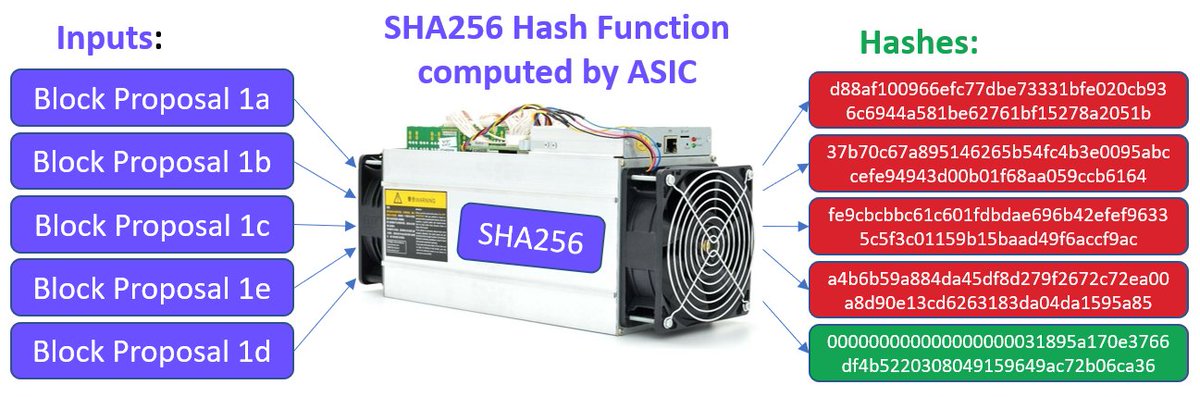
Ultimately, the process of mining bitcoin is very similar. All miners on the network are using Application Specific Integrated Circuits (ASICs), which are specialized computers designed to compute hashes as quickly as possible. To “compute a hash” simply means plugging any random input into a mathematical function and producing an output.
More hashes per second (i.e. higher hashrate) is equivalent to more dice rolls per second, and thus a greater probability of success. Miners propose a potential bitcoin block of transactions, and use this for an input. The block is plugged into the SHA256 hash function which yields a fixed-sized output, known as a hash. A single hash can be computed in less than a millisecond, as it involves no complex math.
If the hash value is lower than the bitcoin network difficulty, then the miner who proposed the block wins. If not, then the miner continues trying by computing more hashes. The successful miner’s block is then added to the blockchain, the miner is rewarded with newly issued bitcoin and transaction fees for their work, and the “next round” begins.
⚡️ ASICs vs. Supercomputers
Assigning the most powerful supercomputer to mine bitcoin would be comparable to hiring a grandmaster chess player to move a pile of bricks by hand. The job would get done eventually but the chess player is much better at thinking and playing chess than exerting energy to repetitively move bricks.
Likewise, combining the computing power of the most powerful supercomputers in the world and using them to mine bitcoin would essentially be pointless when compared to the ASIC machines used today. ASICs are designed to do one thing as quickly and efficiently as possible, whereas a supercomputer is designed to do complicated tasks or math problems. Since bitcoin mining is a lottery based on random trial and error rather than complex math, specialization (ASICs) beats general excellence (supercomputers) everytime.
🕰 Network Difficulty and 10-Minute Block Times
Now that you understand the randomness of miners finding a block, it is important to understand block time and difficulty. In our gambling example, imagine that anybody can join or leave the table at any time. If one person is rolling a 1000 sided die trying to get less than a 10 it will take them an average of 10 minutes to hit that number. Sometimes they’ll hit in 1 minute, other times it might take them 30.
If a new person steps up to the table and starts rolling, collectively it will take them an average of 5 minutes for somebody to win the round. If 20 people step up to the table, this time is significantly shortened. In order to keep the game interesting we want to average a winner every 10 minutes. To do this, we can simply adjust the dice target. As additional gamblers step up to the table, the rules will change (e.g. gamblers must now roll a number less than 5 to win) so that the average remains 10 minutes per round. As more gamblers join, the casino makes winning harder. If gamblers leave, they make it easier.
This is exactly how the bitcoin network regulates mining to maintain a steady issuance schedule of new BTC. Miners compute hashes below the target difficulty every 10 minutes on average. Every 2016 blocks (~2 weeks) the average for those blocks is calculated and the difficulty is adjusted to bring block times back to 10 minutes. If more miners join the network in this ~2 week period, the hashrate and difficulty will increase as a result.
Note: Nobody knows exactly why these arbitrary numbers were chosen. That said, it’s important that 10 minutes is long enough for miners and nodes to pass information around the world without internet speeds causing significant issues, and 2016 blocks is long enough to get a statistically accurate block time needed for the difficulty adjustment.
📉 Truly Transparent Supply
The difficulty adjustment described above make bitcoin the only asset with a truly fixed and known supply schedule. Since inception, we’ve known two things:
— There will never be more than 21 million coins.
— Every 10 minutes more bitcoin is newly issued as we approach that 21 million number.
In every other industry, (gold, auto, or even sandwich bags) the supply fluctuates based on demand. If demand increases for automobiles, then the manufacturer can increase production to match the demand. In bitcoin, supply is locked in and cannot change, therefore demand and price are tied more closely than any other industry or asset classes. This sounds very cut and dry, but it gets interesting when you try to understand what miners do with their newly issued coins and the impact this has on the market.
All Time High für Bitcoin! 🚀 Aber...
... ohne Bitcoin Miner keine Bitcoins!
Es ist beeindruckend, den Bitcoin-Kurs auf einem Allzeithoch zu sehen! Doch während die Welt von den Preistrends fasziniert ist, dürfen wir eines nicht vergessen: Ohne Bitcoin-Miner läuft das Netzwerk nicht!
Also, während die Welt den Bitcoin-Kurs feiert, denken wir bei Bainox auch an die wahren Helden im Hintergrund, die dafür sorgen, dass alles rund läuft: Die Bitcoin-Miner! 💻⚡
#Bitcoin #Krypto #Mining #Blockchain #DontForgetTheMiners #Bainox
Unser Pitch ist fertig! 🚀
Wir sind stolz, einen exklusiven Sneak Peek unseres Pitches zu teilen – einen Einblick in die Zukunft der digitalen Infrastruktur und nachhaltigen Energieproduktion. 🌱💡
Neugierig? Möchten Sie mehr erfahren und den vollständigen Pitch einsehen? Dann klicken Sie auf den Link und füllen Sie unser Formular aus: https://t.co/U9d1kJU6Vm 📈
Oder schreiben Sie uns direkt eine Nachricht hier auf X! 📬
Lassen Sie uns gemeinsam die Zukunft gestalten!
#Investieren #Innovation #Nachhaltigkeit #Energie #Technologie
Unsere Website erstrahlt in neuem Glanz! Für alle, die mehr über Bainox erfahren möchten: Wir zeigen nun noch klarer, wie wir Rechenleistung und nachhaltige Energienutzung auf innovative Weise kombinieren. Einblicke in unsere Technologie und unsere Vision einer umweltfreundlicheren Zukunft warten auf Sie.
Ein Besuch lohnt sich – schauen Sie gern vorbei und entdecken Sie, woran wir gerade arbeiten.
👉 Hier geht’s zur Website: https://t.co/38qcoRZQKz
#Bainox #Innovation #Rechenleistung #Nachhaltigkeit #DigitalAssetMining
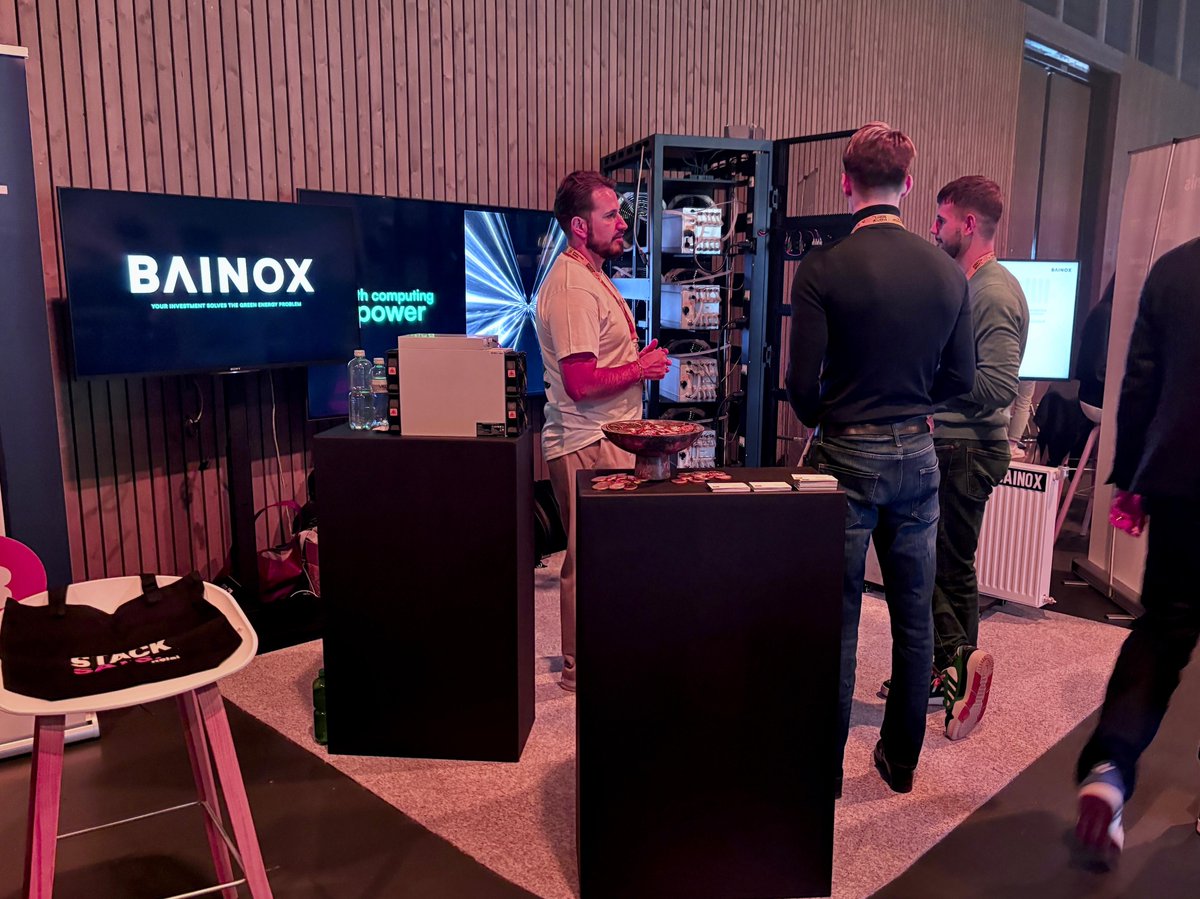
Bainox an der "Startup Nights" in Winterthur – Unser Recap ist jetzt online!
Wir hatten zwei fantastische Tage voller Innovation und Energie! 💡 Bei den Startup Nights in Winterthur konnten wir unsere hydro-cooled Server vorstellen, die eine nachhaltige Abwärmenutzung aufzeigen und Besucher mit unserem energieeffizienten Ansatz im Bereich Digital Asset Mining begeistern. Diese Gelegenheit hat uns gezeigt, wie gross das Interesse an nachhaltiger Energie ist – und wie dringend Lösungen wie unsere gebraucht werden!
Neugierig, wie wir das „Green Energy Problem“ lösen wollen und wie unsere Reise weitergeht? 🚀 Tauchen Sie in unsere Insights auf unserer Webseite ein und erfahren Sie mehr über unsere Vision und die aktuellen Schritte in Richtung einer grüneren Zukunft. Wir sind auf der Suche nach Investoren, die mit uns gemeinsam wachsen und die nächste Phase unserer Entwicklung gestalten wollen!
👉 Lesen Sie den vollen Beitrag hier: https://t.co/hyhzL1ICNg
#Bainox #StartupNights #DigitalAssetMining #Nachhaltigkeit #InvestorenSuche #Innovation #Energielösung #GreenEnergyProblem