The baby lying in the manger had created the mother who gave birth to him.
This is the profoundest of mysteries. The child Mary wrapped in swaddling clothes had eyes and ears, hands and feet, a heart and lungs, and blood pumping through his veins. He did not simply appear human. He was fully human. One of us.
Yet this child was unlike any other ever born. He was not only Mary's son, conceived and born in time, but also the Father's Son, begotten from eternity, through whom all things were made.
The woman who conceived him, nursed him, and cared for him had herself been created by the very Son she bore.
The baby wrapped in swaddling clothes was the Creator who wraps the world in light. The infant laid in a manger had created the very material from which that manger was made. The shepherds who came to see him, and the angels who sang his praises, were all his handiwork. Indeed, those very angels had been singing the praises of the Son of God in heaven since their creation. Now they sang over his birth on earth.
The one circumcised on the eighth day had commanded Abraham to circumcise his household. The giver of the law submitted to his own law.
The twelve-year-old sitting in the temple, listening to the teachers and asking them questions, was the Lord whose glory had filled Solomon's temple centuries before.
This is the mystery of the incarnation: he who is from eternity entered time, joining himself everlastingly to our human nature while remaining fully God.
The Creator entered his creation. He took on our flesh to be conceived, born, to live, teach, suffer, die, and rise again. He assumed our human nature in order to redeem it.
The eternal Son became one with us while remaining one with his Father. He joined our humanity to himself so that, as members of his body, we might share in his life.
The Son of God also became the Son of Mary so that we might become children of God.
@BethMooreLPM I am jealous. I'm lucky to make it to woods once per week. The healing power is incredible though! Maybe in 10 years when I finally get to retire...
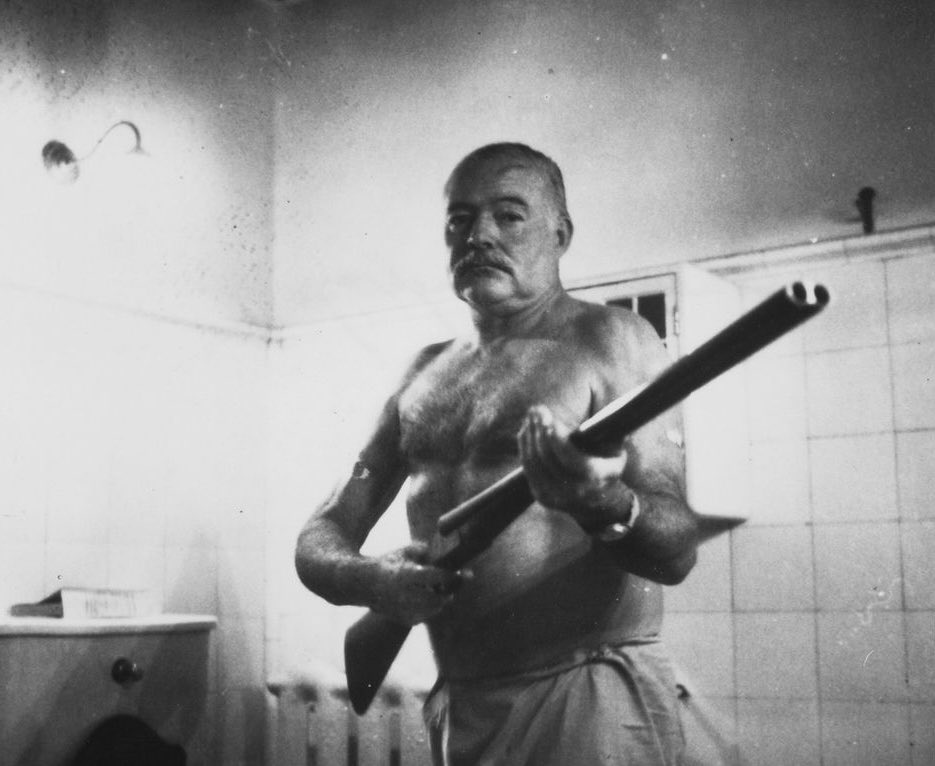
“Happiness in intelligent people is the rarest thing I know.”
- Ernest Hemingway
Ernest Hemingway (1899–1961) was a renowned American novelist, short-story author, and journalist celebrated for his concise, straightforward, and impactful prose. Born in Oak Park, Illinois, he began his career in journalism and served as an ambulance driver during World War I before emerging as one of the defining literary voices of the 20th century. His writing frequently examined courage, love, conflict, grief, isolation, and the resilience of the human spirit. Through his distinctive storytelling and profound exploration of human struggles, Hemingway left an enduring mark on literature and received the Nobel Prize in Literature in 1954.
A man walks into an interview for a prestigious job. When asked about his qualifications, rather than highlighting his strengths and accomplishments, he begins to list his scars, weaknesses, and all the ways life has beaten him down and humbled him.
Would he be hired? Um, no.
But that is basically the kind of "interview" Paul gives the Corinthian church. Rather than boasting of his strengths, in 2 Corinthians 11–12 he documents the suffering he endured as an apostle.
He boasts of his weaknesses because, for Christ's sake, he is content with "weaknesses, insults, hardships, persecutions, and calamities." For when Paul is weak, then he is strong (2 Cor. 12:10).
In the middle of this discussion, Paul says that to keep him from becoming conceited, "a thorn was given me in the flesh, a messenger of Satan to harass me" (12:7).
In Greek, the word for "messenger" [ἄγγελος] is also the word for "angel," and "harass" [κολαφίζω] means to strike, slap, or beat, such as when Jesus was "struck" (Matt. 26:67). We are also reminded of Job, whom Satan himself smote (Job 2:7).
Paul's experience echoes Psalm 140, where David speaks of evil men who "plan evil things," stir up wars, sharpen their tongues like serpents, and have "the venom of asps" under their lips (140:2–3). They have mouths from hell, perfectly at home in the face of a messenger of Satan, where lies reign supreme.
What David suffered, what Job suffered, and what Paul suffered was not good. But God used it for good. God does not get nervous when evil happens, wondering if he can somehow, someway, possibly bring good out of it. He knows he can.
He is the good God who has never met an evil he cannot turn around for the good of his people.
So let us boast not in ourselves but in our weaknesses, pointing instead to our gracious Savior, who endured the attacks of Satan, insults, lies, thorns, striking, and suffering to redeem us. The boast of the Christian life is Christ, not the Christian.
And remember: "the sufferings of this present time are not worth comparing with the glory that is to be revealed to us" (Rom. 8:18).
_____
We read both 2 Corinthians 12 and Psalm 140 today in Bible in One Year.
@BethMooreLPM Is it okay that my first exposure to the Nicene Creed was by the band Petra in their song Creed? I can't say the creed, but I can sing it!
@darlingjeromy@BethMooreLPM@birdchadlouis I have gained a new appreciation for the Catholic faith as my own faith has grown. I think we were fed a lot of negative propaganda in Gen X. I think some very good Popes have also helped. Anxious to see what a Chicago Pope will accomplish!
@rashmoosten@rick_morton@philvischer It doesn't matter. The orphans and widows are the losers either way. I could care less who is winning or losing the debate. Phil is right AND Rick is right. I'm a firm believer in Both/And. The church needs to get motivated and step up. The gov't needs to continue assistance.
Refugees are one of the most intensely screened populations admitted to the United States, with applicants rigorously vetted by DHS as well as other law enforcement, intelligence, and counterterrorism agencies.