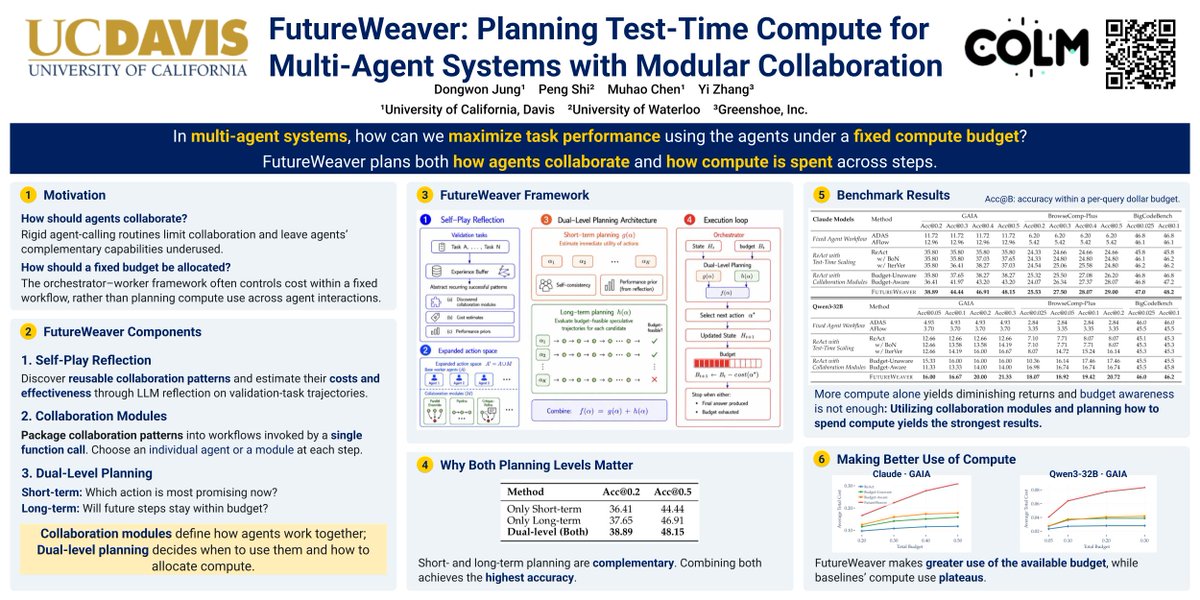
Excited that our paper FutureWeaver has been accepted to #COLM2026!
We explore how multi-agent systems can plan their test-time compute more effectively using
🧩 reusable collaboration modules
💰 budget-aware test-time compute allocation
Thanks to all my collaborators!
I'll be at #COLM2026 presenting FutureWeaver, our work on planning test-time compute for multi-agent collaboration!
Feel free to reach out to chat about LLM agents, agentic RL, and self-improving systems or anything else!
Excited to share that “ModelLens: Finding the Best for Your Task from Myriads of Models” has been accepted to NeurIPS 2026 @NeurIPSConf#NeurIPS2026 ! 🎉🍻
📰 Paper: https://t.co/VwpijxNuWO
💻 Code: https://t.co/YUepL9ntpv
🌐 Demo: https://t.co/UnMt0zt55q
🗺️ ModelLens-Atlas: https://t.co/dkcTnkNMSq
#MachineLearning @NeurIPSConf@huggingface@OpenRouter
Your emails, chats, docs, and tickets keep piling up, and the right ones get harder to find. 😡
🗺️ Introducing CorpusMap, which organizes a growing corpus around recurring entities, so agents follow connections instead of searching from scratch.
📈 Better answers, fewer tokens.
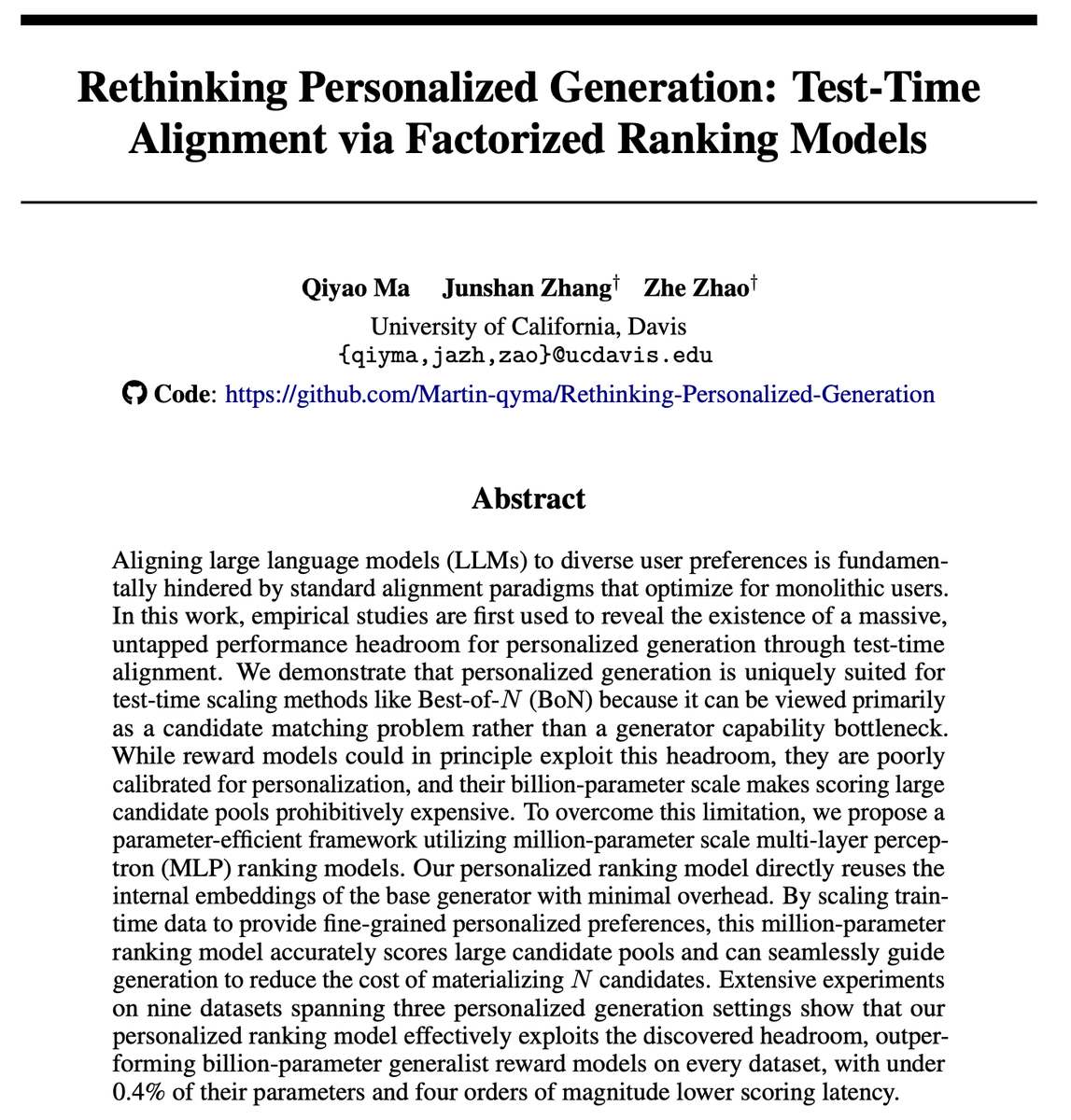
Excited to share that our paper "Rethinking Personalized Generation: Test-Time Alignment via Factorized Ranking Models" has been accepted to NeurIPS 2026 🍻
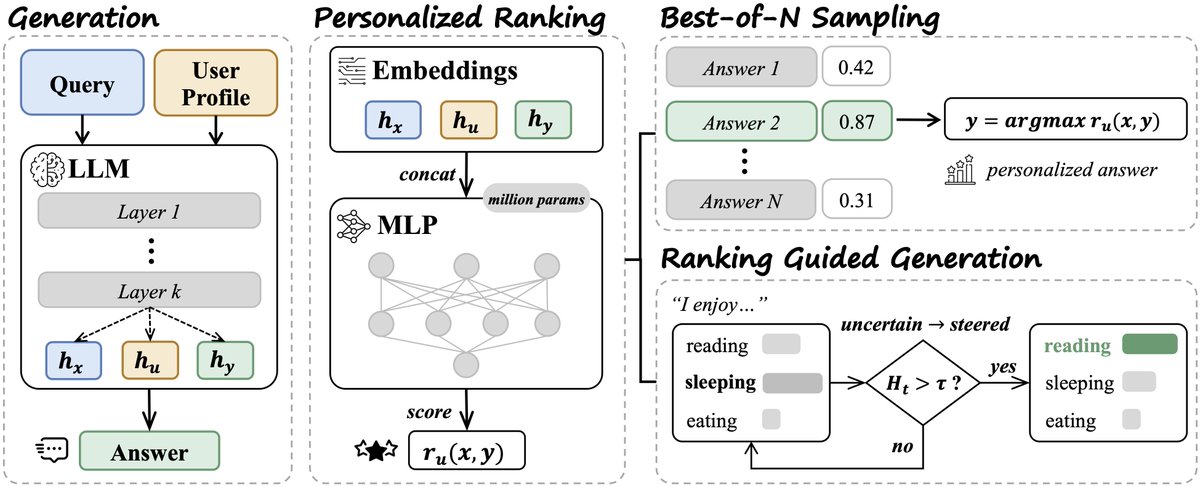
Our claim: LLMs already generate well-personalized responses. The bottleneck is picking them out.
Generalist reward models are poorly calibrated for personalization, and at billions of parameters they're too slow to score large pools. So we train a million-parameter personalized ranking model directly on the generator's own hidden states. Across 9 datasets and 3 personalization settings, it beats billion-parameter reward models on every one, with <0.4% of their parameters and ~10,000× faster scoring.
paper: https://t.co/MMdTE5eTlP
If you find it useful, a ⭐️ on the repo (https://t.co/tY8fq2UcBm) and an upvote ⬆️ on Hugging Face (https://t.co/HrYBJWcOTU) would mean a lot
#NeurIPS2026 #Personalization
Excited that our paper FutureWeaver has been accepted to #COLM2026!
We explore how multi-agent systems can plan their test-time compute more effectively using
🧩 reusable collaboration modules
💰 budget-aware test-time compute allocation
Thanks to all my collaborators!
Excited to share that Personalized RewardBench has been accepted to COLM2026! 🎉🍻
Reward models know what's good — but do they know what you like?
Our answer: not really. By controlling for general quality, we force models to compete strictly on personal preferences. Come see if your RM can actually read the room 👀
@COLM_conf #COLM2026
What if LLM agents could reason silently and think out loud only when needed?
💡Adaptive Latent Agentic Reasoning (ALAR)💡
Agents often generate verbose CoT for every action. ALAR makes this adaptive:
💭 latent reasoning for routine turns
💬 explicit CoT for harder decisions
📉 Results:
ALAR preserves or improves accuracy while reducing generated tokens by:
🔎 up to 43.6% in search
🧰 up to 84.6% in tool use
Less unnecessary reasoning, stronger accuracy-efficiency trade-off.
Video models can generate impressive motion — but can they actually reason?
📢 Introducing VideoRLVR: a systematic RL recipe that turns video models into visual reasoners using verifiable rewards.
🧩 Tasks: Maze, FlowFree, Sokoban
⚡ Early-Step Focus: ~40% faster RL training
🏆 Better in-domain + OOD reasoning than SFT and strong video baselines
📰 Paper: https://t.co/CkCqFymR4l
🖥️ Project: https://t.co/Wq2e59Q7gC
🚩 Instead of asking: “Does this video look realistic?”
VideoRLVR asks: “Does this video form a valid visual reasoning trajectory?”
💡 Our starting point is a simple analogy:
- LLMs learn to reason better by moving beyond imitation: Pre-training → SFT → RLVR
- But video reasoning is stuck at: Pre-training → SFT
🧐 So what would the RLVR stage look like for video models?
A video is not just pixels changing over time. For reasoning tasks, a video is a chain of visual states. If each state represents progress toward a goal, then the full video can be checked, scored, and optimized. That turns video generation into something closer to visual problem solving.
⚙️ Our recipe
1⃣ Verifiable reasoning tasks
Include 30,000 video samples on Maze, FlowFree, and Sokoban, ranging over various levels of difficulty.
2⃣ SDE-GRPO for video diffusion with Early-Step Focus
Only inject SDE noise and optimize at early denoise steps. They are the key to the global plan and let the latter steps do the rendering refinement they are already good at.
3⃣ Verifiable visual rewards
Define rewards over the generated trajectory, optimizing for valid transitions, constraint satisfaction, and goal completion.
🎯 What we achieve
- In-domain improvement over proprietary and open-source models, including strong video reasoning SFT baselines.
- OOD performance matches 14B models with a 5B model.
⏰ The broader message
Future video models should not only answer: “Can I synthesize this motion?” but also: “Can I generate a valid process that solves this problem?”
VideoRLVR is a step toward video models as visual reasoners, not just visual imitators.
Thanks to all the collaborators: @sheng_zh@JamesYHuang36@Selena3187@Xiaofei_Wen_Mk @ Yuankai Li @hoifungpoon@muhao_chen
#VideoGeneration #VideoReasoning #AI
turns out, today's video models are mostly just pretending to listen.
👁️🎙️When Vision Speaks for Sound 👁️🎙️
We tested top models (including the new Gemini 3.5 Flash). They all suffer from the audio-visual Clever Hans effect: hallucinating sounds from visual cues instead of actually verifying audio. 🤯
🔇 Mute the audio? They still “hear” the crash.
⏱️ Shift the sound? They still say it is synced.
🔄 Swap the track? They often accept the mismatch.
🛠️ The fix? 10K pairs of targeted preference alignment. We boosted performance by 28 points—with zero drop in general video skills.
More details on how we diagnose and fix this here 👇
📄 Paper: https://t.co/SpQh0PIfbv
🔗 Website: https://t.co/nRZmH9Mec5
🤗 Collection: https://t.co/g5uNJ0Qkie
#videoaudio #videoaudioalignment #omnimodel
Visual reasoning models don’t always need to “think” that much.
We introduce AVR — adaptive reasoning paths that dynamically choose how much reasoning is needed.
🔻 50–90% token reduction
🔻 Maintain (or improve) accuracy
Rethinking reasoning itself.
📄 https://t.co/E5hfRcRMdD
Happy to introduce: SeClaw (https://t.co/XutTwaqU0K) — 𝘁𝗵𝗲 secure Claw against diverse AI security threats.
SeClaw designs the system-level defense solution to build secure-version claw inspired by our NeurIPS paper (DRIFT:https://t.co/07HbeKFFH4).
Core security capabilities
🧱 #Agent Execution Isolation: SeClaw keeps the project on the host and only runs agent operations through mapped execution in Docker.
♻️ #Snapshot & #Rollback: SeClaw supports an efficient CoW rollback mechanism that can quickly snapshot and restore mounted host/container files. You can quickly restore to a known-good state after any risky operations. Let your agent run free!
🛡️ #PromptInjection Defense (System + Model Levels): SeClaw enforces Control-Flow Integrity (CFI) and Information-Flow Integrity (IFI) at the system level to constrain the agent’s valid action space and block unsafe decision paths. At the model level, SeClaw uses a guard model to sanitize suspicious tool outputs
🔍 #Skill #Audit: Scans skills for dangerous patterns (prompt injection, exfiltration, and destructive commands).
🧠 Memory Audit: Scans memory files for stored prompt-injection payloads, credentials, and PII leakage risks.
📜 Execution Audit: Records full task traces and reports potentially risky actions after each task completion.
🔐 Privacy Protection: SeClaw monitors potential privacy leaks during agent execution, including identity information, API keys, SSH keys, and other sensitive credentials. Suspicious exposures are detected and flagged.
⚠️ Risky Operation Protection: SeClaw detects potentially dangerous commands (e.g., rm -rf, sudo, or destructive system modifications). When such operations are triggered, SeClaw requires explicit user confirmation before execution, reducing the risk of unintended damage caused by agent tool misuse.
📡 Secure Communication Isolation: SeClaw isolates communication channels by maintaining separate context windows for each interaction source. This prevents cross-channel prompt injection and ensures that messages from one channel cannot manipulate the agent’s behavior in another.
🌐 Network Security Controls: SeClaw provides secure network communication through HTTPS enforcement, request timeout protection, and configurable network modes for agent execution environments, reducing the risk of network-based attacks and uncontrolled external access.
#Agent #Security #Openclaw #Safety
Github: https://t.co/VvrsY7dKDj
website: https://t.co/XutTwaqU0K
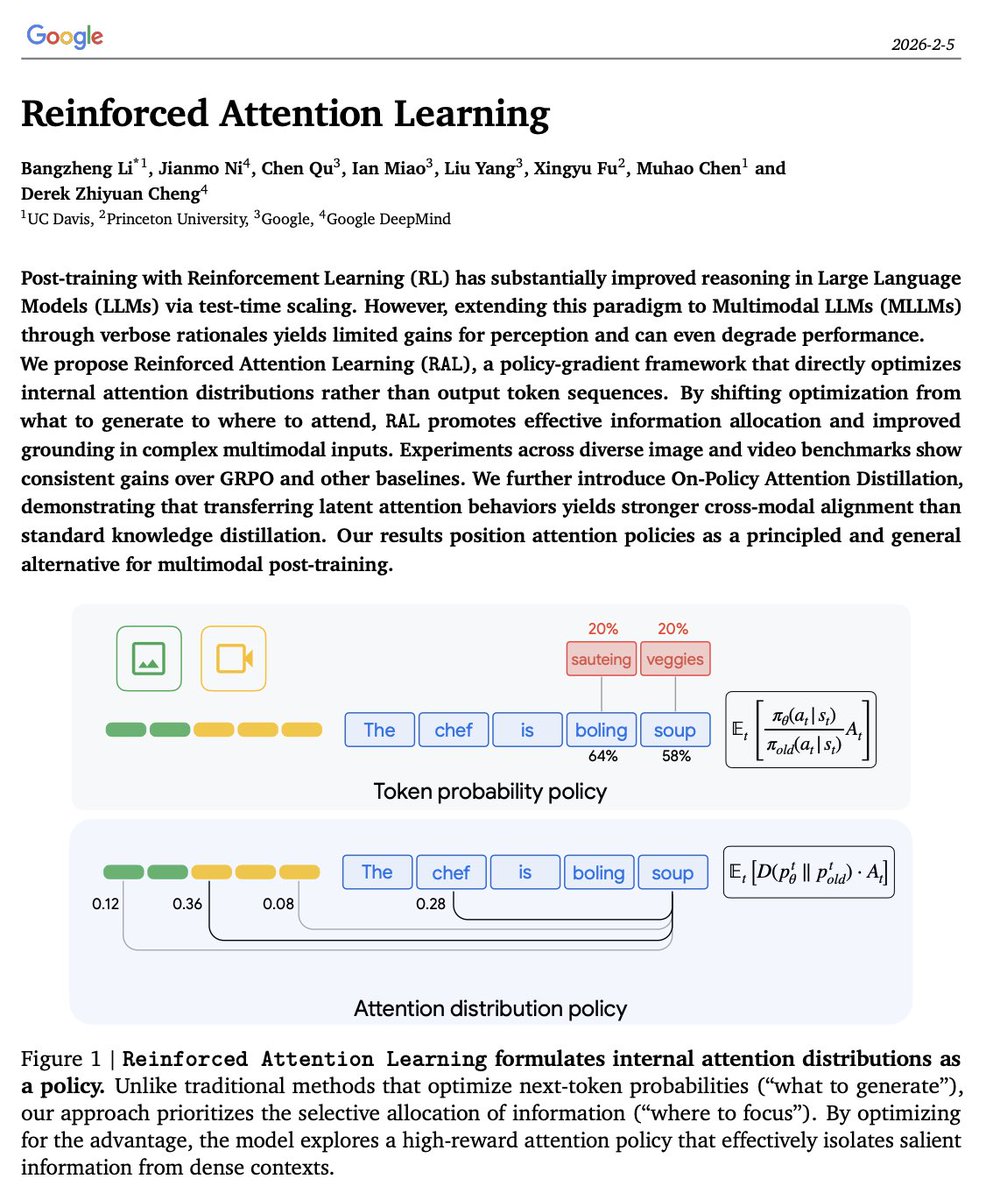
🚨 Tokens are the surface.
Attention is the mechanism.
What if RL learned the latter?
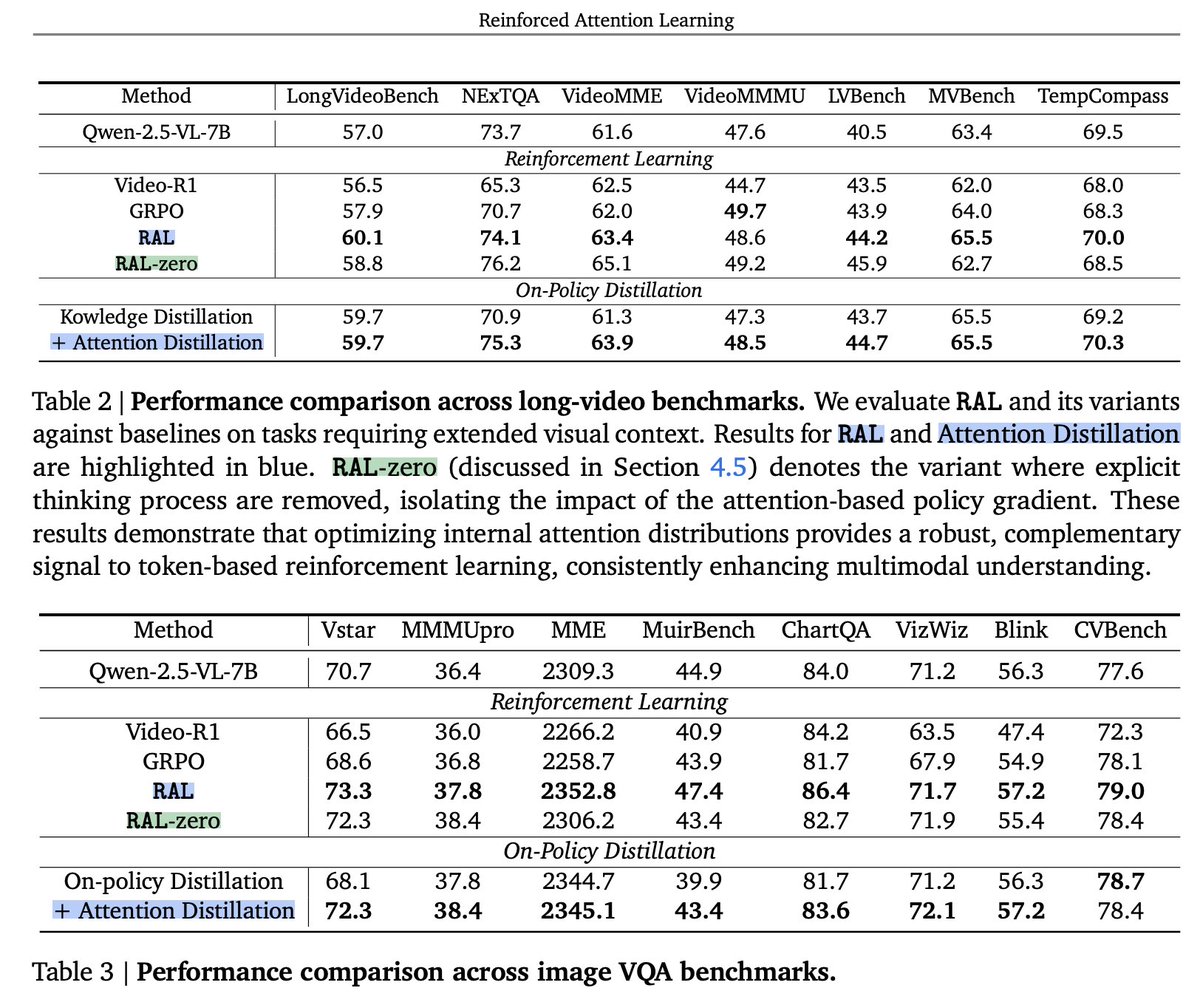
💡 Introducing Reinforced Attention Learning
🧠 Key idea: Current RL for LLMs shapes "what is generated". We instead optimize "where the model focuses", to influence how it actually reasons.
📰 Paper: https://t.co/UnZ7txssG6
(with @Google and @GoogleDeepMind)
Standard PPO/GRPO perform importance sampling over token distributions, using advantages to up- or down-weight token probabilities.
⏳ The flip: Instead of "what token to generate", we optimize "where to attend"
At each generation step, we measure the divergence between attention distributions of the current and old policy—across all previous tokens.
- High-reward samples → keep attention close
- Low-reward samples → push attention away
The policy learns where to allocate computation, not just which surface-level token to generate.
⚙️ Plug-and-play
Our attention-level objective pairs with any policy gradient method, including PPO and GRPO.
📊 Results
RAL > Vanilla GRPO.
We’re seeing consistent accuracy gains across a wide range of image and video QA benchmarks when experimenting on multimodal LLMs.
✨ One more thing
Attention can be learned from a teacher model via on-policy attention distillation—going beyond knowledge transfer to inherit latent attention behaviors. This On-policy Attention Distillation takes standard On-Policy Distillation to the next level.
Thanks to all my colleagues: @jianmo_ni@Chen_Qu1@ianmiao@liuyang_irnlp@XingyuFu2@infolaber🙏
#NAACL I’m running for the 2026-2027 NAACL Board Membership and would be grateful for your support (https://t.co/I12xHp2D5j). I will focus my contribution to our community on:
- Strengthening mentoring and support for students and early-career researchers.
- Deepening safety-aware collaboration between academia and industry.
- Championing research that is responsible, reproducible, and societally beneficial.
- Broadening participation across the Americas, especially under-resourced communities.
If these priorities resonate with you, I’d be honored to have your consideration and your vote🫡