This is also why we built code2play. We consider games as really good testbeds for agentic learning. But to make agents learn, you first need to scale up the construction of the environments by automating the process
Game2Player: let AI build its own training ground.
- Builder agents turn web games into tasks. They read the game state, so every step is auto-checked.
- Player agents play them. Some write code. Some just watch the screen.
🔁 When a player finds a broken game, the builder fixes it.
Games get better. Players get better. No humans needed.
The scale:
- 568 games,
- 3,436 tasks,
- 1.56M steps of experience.
We then train a 9B model to learn from it and plays from screenshots alone. Its scores roughly double.
Experience, at scale, without humans.
Led by @RuiYang70669025 👇
We propose a self-evolving multi-agent reflective iterative evolutionary hypothesis-driven closed-loop automated research framework, surpassing the human baseline on MLE-bench by a whopping 0.3%! (at $4,000 of API cost per, with human picking out the 1% that actually runs)
After co-inventing ChatGPT, I kept asking myself: why have superhuman chat models not led to AGI?
I’ve spent the last 2 years in stealth building a new way to train models (RLCD), and a new type of frontier AI model that we are releasing today: Jev
• 20-200x faster
• 40-400x cheaper (w/ output tokens free)
• Frontier composable intelligence optimized for decisions
AFAICT the shortest path to AI-based economic revolution
My first puzzle game is live! 🧩 I'm a beginner indie dev, inspired by A Little to the Left.
Still / Life: 5 oil-painted studies, 14 discoveries. No timer—just a little curiosity. 🎨
Play free: https://t.co/TdpsAdATtT
#indiegame#puzzlegame
Environment generation is the missing scaling axis for embodied AI.
Introducing SimWorld Studio: a self-evolving factory for endless interactive 3D env where agents act, fail & learn.
Env-agent co-evolvution improves navigation success 50% → 90%.
From a prompt, our SimCoder writes code to automatically build an interactive world. Agents train inside it. And their performance shapes the next world.
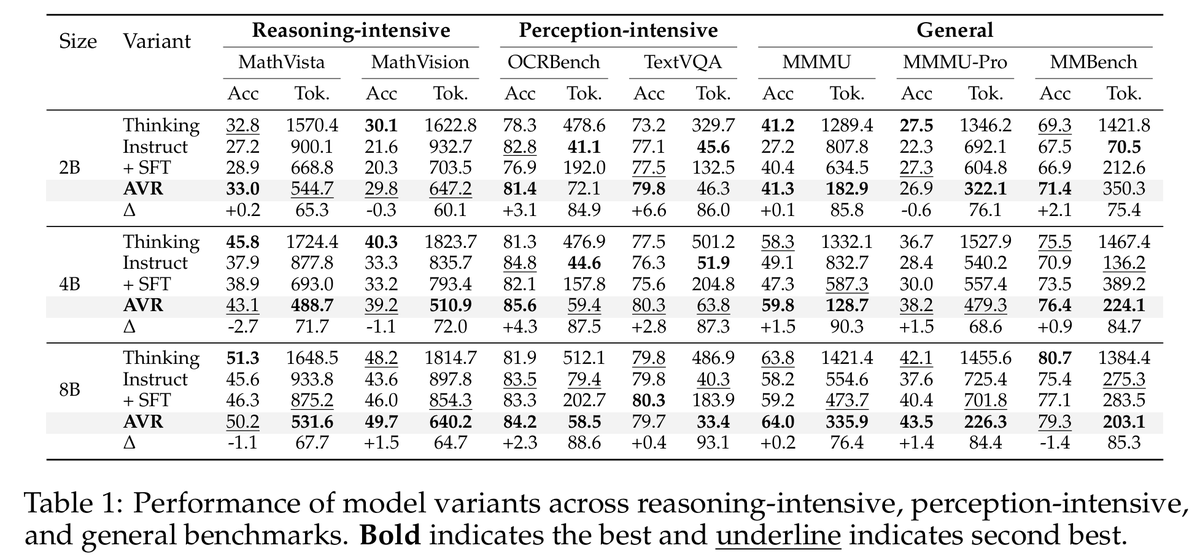
Visual reasoning models don’t always need to “think” that much.
We introduce AVR — adaptive reasoning paths that dynamically choose how much reasoning is needed.
🔻 50–90% token reduction
🔻 Maintain (or improve) accuracy
Rethinking reasoning itself.
📄 https://t.co/E5hfRcRMdD
Across benchmarks, AVR achieves:
🔻 50–90% token reduction
🎯 same or better accuracy
Especially strong on perception-heavy tasks, where long CoT often hurts performance.
The key is not just “having multiple formats”,
but learning when to use which.
We introduce FS-GRPO, which jointly optimizes:
✔ correctness
✔ token efficiency
✔ format diversity
Concretely, we define three formats:
Full reasoning
Perception-only
Direct answer
Then train the model (SFT + RL) to select the most efficient format per task.
We decompose visual reasoning into three functions:
• perception
• reasoning
• answer application
And instead of always using all of them, we let the model adaptively choose the minimal sufficient path.
One key observation: current VRMs tend to overthink.
In our analysis, a large portion of visual questions can be solved
without full reasoning — sometimes even without explicit reasoning at all.
This leads to what we call Reasoning Path Redundancy.
One Button Boss is Live on https://t.co/qkvquOUryL! Come try the first game I’ve ever developed as a solo developer! 🎮✨
I’d love to hear your feedback and suggestions! 💬🔥https://t.co/jy6GJyqslT #indiegames via @YixuHuang342