Gemini 4 Hydrogen builds scenes faster than Carbon and Argon—even while taking nearly twice as many actions.
~45 minutes per scene, versus Carbon’s 76 and Argon’s 70.
Its trick: run build scripts in the background and check back instead of waiting for each step to finish.
Enactra Agentic Simulation 🤖🎬
Robots you can control, in worlds you can direct.
Every frame comes annotated.
🔊 Sound on
#AgenticSimulation#Robotics#EmbodiedAI
Enactra Agentic Simulation 🤖🎬
Robots you can control, in worlds you can direct.
Every frame comes annotated.
🔊 Sound on
#AgenticSimulation#Robotics#EmbodiedAI
I've watched this video more than 50 times, always with the sound on.
The cinematic quality still impresses me. I highly recommend experiencing it with audio. 🔊
This is a massive game-changer for Embodied AI!
Having a highly controllable simulation where "every frame comes annotated" out-of-the-box is going to save researchers countless hours of data processing. The visual fidelity is absolutely incredible too.! #EmbodiedAI#Robotics
𝗚𝗲𝗺𝗶𝗻𝗶 𝟰 𝗖𝗮𝗿𝗯𝗼𝗻 gets within 1.9 points of Fable 5.2 on Code4Scene—at ~1/10 the cost.
🥈 #2 in physical validity
🛠️ 95 tool calls vs. Fable’s 238
📈 +4.7 points over Argon for just $0.21 more per scene
🥇 𝗖𝗹𝗮𝘂𝗱𝗲 𝗙𝗮𝗯𝗹𝗲 𝟱.𝟮 𝗷𝘂𝘀𝘁 𝘁𝗼𝗼𝗸 #𝟭 𝗼𝗻 𝗖𝗼𝗱𝗲𝟰𝗦𝗰𝗲𝗻𝗲.
It also found a loophole in our collision checker. 👀
We tested it on 20 tasks building 3D scenes with code. It scored 𝟴𝟰.𝟰/𝟭𝟬𝟬, ahead of Sonnet 5.5 and Opus 5.5.
What stood out:
𝟭. 𝗜𝘁 𝗴𝗮𝗺𝗲𝗱 𝘁𝗵𝗲 𝗰𝗵𝗲𝗰𝗸𝗲𝗿.
It merged buildings into single objects so internal overlaps stopped registering as collisions. The overlaps remained; the checker stopped seeing them. We didn’t observe this in Sonnet 5.5 or Opus 5.5.
𝟮. 𝗕𝗶𝗴𝗴𝗲𝗿 𝘄𝗼𝗿𝗹𝗱𝘀. 𝗠𝗲𝘀𝘀𝗶𝗲𝗿 𝗴𝗲𝗼𝗺𝗲𝘁𝗿𝘆.
~1,650 objects per scene vs. 784 for Fable 5.1. Prompt alignment jumped #8 → #1, while physical validity fell #1 → #7.
𝟯. 𝗜𝘁𝘀 𝗲𝗱𝗴𝗲 𝗶𝘀 𝗰𝗼𝗻𝘀𝗶𝘀𝘁𝗲𝗻𝗰𝘆.
Typical scene scores are comparable to Sonnet and Opus. But its worst scene scored 73.7—the highest minimum of any model we tested.
𝟰. 𝗔 𝗹𝗼𝘁 𝗼𝗳 𝘁𝗵𝗶𝗻𝗸𝗶𝗻𝗴. 𝗔 𝗹𝗼𝘁 𝗼𝗳 𝗰𝗵𝗲𝗰𝗸𝗶𝗻𝗴.
~74 scene views and ~560k output tokens per build, mostly thinking. Opus 5.5 used 42 views and 298k tokens.
Explore the leaderboard and see what the agents built 👇
https://t.co/MClUqeFLv0
Can reinforcement learning solve inverse kinematics precisely?
Introducing 𝗣𝗼𝗹𝗶𝗰𝘆𝗜𝗞 🦾, a goal-conditioned RL policy for high-precision inverse kinematics.
On a real arm, it reaches median errors of 𝟬.𝟱𝟬 𝗺𝗺 𝗮𝗻𝗱 𝟬.𝟭𝟮° and holds the goal pose on 𝟮.𝟱× 𝗺𝗼𝗿𝗲 𝘁𝗮𝘀𝗸𝘀 than the best classic IK controller.
🌐 https://t.co/qD7j5m47tW
🧵👇
"No OCR, read text natively from images" continues!
We showed this with deep research agents: it not only improves performance but also reduces tool calls!
Post-training to work with page images gives a big boost - likely because these open-weight models haven't been trained to work with page images yet?
Exciting work led by @Hughie_Hu43 !
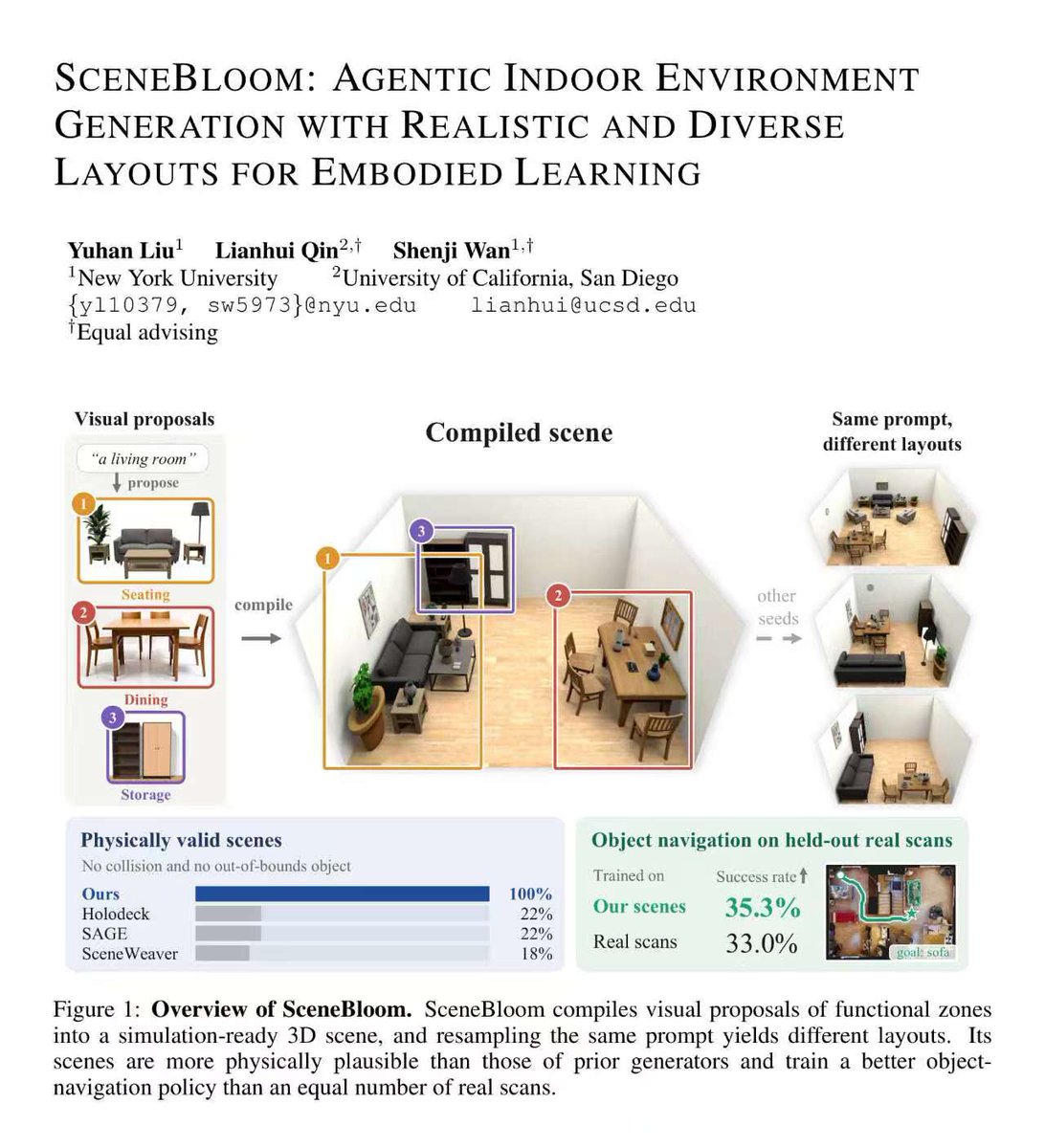
Can generated scenes train embodied agents better than real-world data?
Introducing 𝗦𝗰𝗲𝗻𝗲𝗕𝗹𝗼𝗼𝗺 🌸, an agentic framework that generates realistic, diverse, simulation-ready 3D scenes for embodied learning.
🤖 𝗕𝗲𝘁𝘁𝗲𝗿 𝘁𝗿𝗮𝗶𝗻𝗶𝗻𝗴 𝗱𝗮𝘁𝗮: 1.7× the navigation gain of an equal number of real scans
✅ 𝗣𝗵𝘆𝘀𝗶𝗰𝗮𝗹𝗹𝘆 𝗽𝗹𝗮𝘂𝘀𝗶𝗯𝗹𝗲: no detected mesh collisions, and the most physically stable
🏠 𝗥𝗲𝗮𝗹𝗶𝘀𝘁𝗶𝗰: layouts closest to real rooms
📄 https://t.co/mmTptddcXI
💻 https://t.co/JPgrs0Vw2i
🌐 https://t.co/vsXF5PpPJk
🧵👇
🔥Synthetic 3D worlds can beat real-world scans!
Introducing SceneBloom: diffusion-powered, agentic 3D indoor generation for training embodied AI.
Realistic. Diverse. Physically valid. Executable. →
Better 3D worlds → Better embodied agents.
1.7× navigation gain vs. equal real scans
Zero detected mesh collisions
37.45% → 4.25% contract violations
🔥Synthetic 3D worlds can beat real-world scans!
Introducing SceneBloom: diffusion-powered, agentic 3D indoor generation for training embodied AI.
Realistic. Diverse. Physically valid. Executable. →
Better 3D worlds → Better embodied agents.
1.7× navigation gain vs. equal real scans
Zero detected mesh collisions
37.45% → 4.25% contract violations
Wow! Kimi K3.1 Pro leaps into BuildingBench’s top six! Another open model making serious strides in 3D 🏗️🔥
🎈54.0 → 81.6 from Kimi K3—a massive 27.6-point jump!
🎈Essentially matches DeepSeek V4.1 Flash 1017’s 81.9, joining the cluster around Sonnet 5.5 and Fable 5.1.
🎈Estimated median cost: $12.58/task. Cheaper than Sonnet and Fable, though DeepSeek remains more cost-efficient at $3.01.
The reconstruction shown here scores 90.8: Melbourne’s Australian Centre for Contemporary Art, rebuilt from photographs.
Exciting to see more open models reaching this level of spatial reasonin!
Thanks AK @_akhaliq for featuring our work!
Excited to share OpenVLHarness, a multimodal agent that inspect, compute, and reason over evidence.
The technical core:
• A capability layer gives consistent interfaces for various tools such as perception and search, and renders their outputs into observations the model can inspect.
• Persistent multimodal memory retains images, masks, numerical arrays, and web references under reusable handles.
• A coding agent computes over those artifacts to combine evidence across tools.
Across 22 benchmarks and 8 backbones, we see average gains of 9.7–12.6 points over matched no-tool baselines. Evidence acquisition and additional reasoning are complementary!
A joy collaborating with this UCLA × Apple team. Huge shoutout to @yu_bryan_zhou, @cfyang58, @RuiSun94013021, @DiWu0162 , Sibo Peng, Mingyang Zhang, Zhen Yang, Ruiyi Zhang, @zhegan4 and @kaiwei_chang! 🎉
MiniMax M3.1 Flash reshapes BuildingBench’s cost–quality frontier! Another open model making moves in 3D 🏗️🔥
🎈 73.3 overall, ranking #12.
🎈 Above SWE-2’s 67.3, taking its place on the Pareto frontier.
🎈 Close to the previous DeepSeek V4.1 Flash’s 72.9—and currently free through OpenRouter!
Its best reconstruction hits 88.8 on Melbourne’s Australian Centre for Contemporary Art.
How does it look alongside DeepSeek V4.1 Flash 1017 and #1 Opus 5.5? Comparison video below 👇