Both Claude Opus 5 and GPT-5.6 Sol have been performing exceptionally well on our leaderboards, ranking in the top 3 across almost all of our non-agentic tasks.
We put both models through the same 3D design and website challenges to see where each excels the most.
Watch the full breakdown on Youtube: https://t.co/aRw5j6i97H
Both Claude Opus 5 and GPT-5.6 Sol have been performing exceptionally well on our leaderboards, ranking in the top 3 across almost all of our non-agentic tasks.
We put both models through the same 3D design and website challenges to see where each excels the most.
Watch the full breakdown on Youtube: https://t.co/aRw5j6i97H
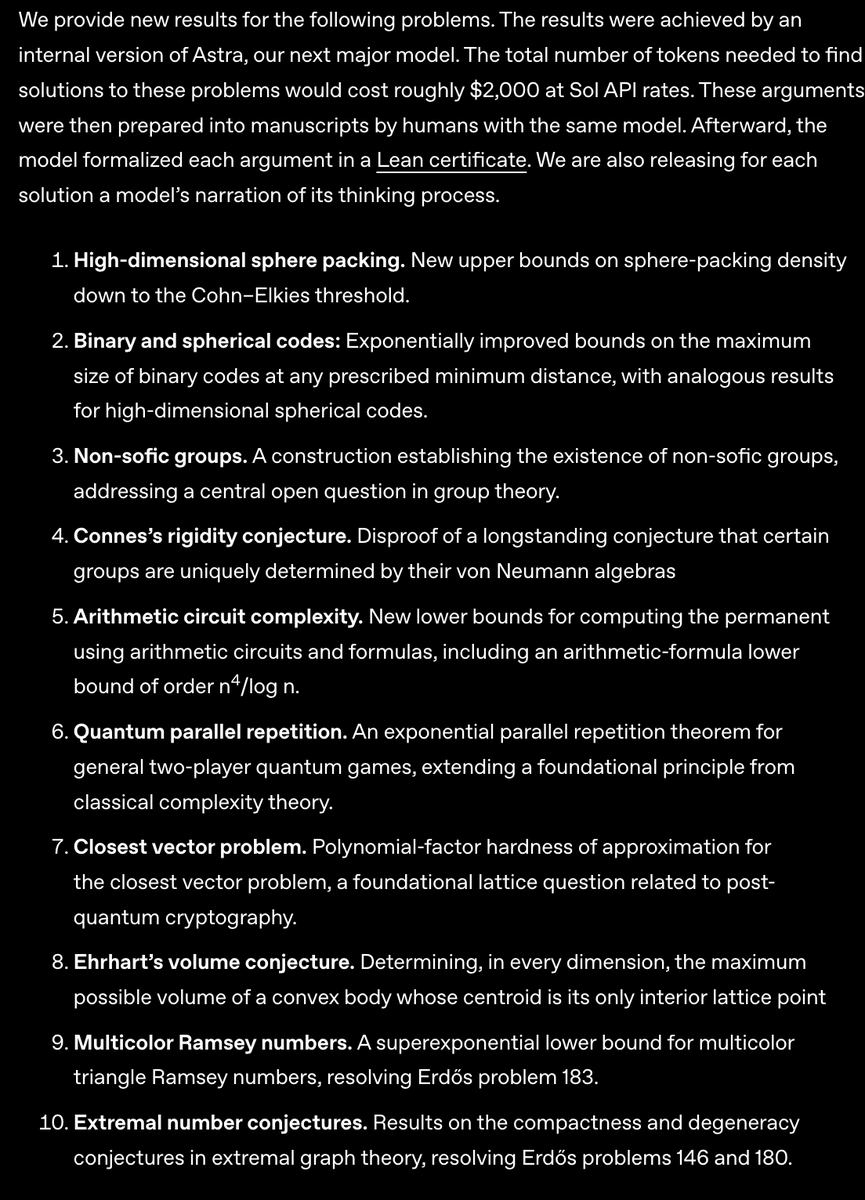
I’ve spent well over 10,000 hours studying math in my life, yet I can’t understand these proofs, at least not without weeks of digging deep into each topic. What’s more, none of my math PhD friends know much about these problems either, and they can’t verify most of them without working directly in the field (yes, math is VERY diverse).
LLMs are getting smarter than the experts themselves, and I’m not sure we have enough bright human minds to verify everything that will come out of them in the coming years.
Remember when we compared AI intelligence to PhD students? I think we’re past that.
This is an 80,000-tonne hydraulic forging press from China’s Northern Heavy Industries, one of the largest metal-forming machines ever built.
But it is not simply a machine that bends metal like traditional presses do.
At this scale, forging is about changing the internal structure of the material itself, compressing the metal, refining its molecular grain flow and eliminating hidden defects that could cause failure decades later.
Machines like this are used to create some of the most critical components on Earth, aircraft landing gear, titanium aerospace structures, nuclear reactor components, massive gas turbine rotors and ship propulsion shafts.
The metals being forged are among the most advanced engineering materials available, ultra-high-strength steels, titanium alloys and nickel-based superalloys designed to survive extreme temperatures, pressure and millions of fatigue cycles.
An 80,000-tonne press is an industrial ecosystem by itself. The press, hydraulic systems, furnaces, manipulators and supporting infrastructure can require hundreds of millions of dollars in investment, with hydraulic systems requiring tens of megawatts of power to control forces equivalent to thousands of tonnes.
The biggest industrial machines often do not make the final products. They make the materials that make those products possible.