1/ What moved people before states, markets, or borders? We turn ancient DNA into a direct measure of prehistoric migration. When two ancient individuals share a long segment of inherited DNA (identity-by-descent, IBD), they share a recent ancestor, so someone in that lineage moved between their burial sites. Counting these links between places, and dating them, gives a directional map of migration across 10,000 years of western Eurasia.
My 2026 development workflow is now, quite literally: I text a phone number and an AI swarm sends me a pull request 30 min later.
It is frankly mind-blowing how little friction there is in code development now thanks to AI tooling.
How this works:
I have a cloud server (Hetzner) running 24/7. On it runs a multi-agent system (OpenClaw/moltbot) that I can text with like any other contact on my phone. If I ask for something, it coordinates subagents to build it. This includes things like "what are the highest-priority open issues across my repositories?" or "can you send me a screenshot of the website preview?" (it can use a browser).
The system has its own GitHub account and email address. It has its own machine with root access, but has no access to my credentials or private information.
This system submits pull requests to my repositories exactly like any untrusted external contributor. I can then run CI, review, and merge it normally.
The result is: I describe what I want, and it texts me when the pull request is ready. I can ask it to investigate something, and it texts me back photos of plots. It can also monitor things and react (e.g., you could have it automatically draft a PR for every issue posted to a repo).
It's a surprisingly natural interface; it feels a bit like delegating to a colleague who can work independently.
The same way that Claude Code/Codex/etc eliminated the loop of copy-pasting build failures to ChatGPT, this sort of OpenClaw system seems to eliminate much of the remaining friction to building things with coding agents.
It is with heavy hearts that we say farewell to Professor Emeritus Benedict Gross, who passed away in December, 2025. We collected stories, anecdotes, and recollections about Gross’ impact on the lives of his friends, colleagues, and former students. https://t.co/udNgXKhLoM
Prof. Chen Ning Yang, a world-renowned physicist, Nobel Laureate in Physics, Academician of the Chinese Academy of Sciences, Professor at Tsinghua University, and Honorary Director of the Institute for Advanced Study at Tsinghua University, passed away in Beijing due to illness at the age of 103. His life stands as a timeless chapter in human history—one that shines not only for China but for the global community of thinkers and innovators. His legacy will live on forever.
🌍 New Tutorial Alert: Visualizing Google's AlphaEarth Satellite Embeddings in 3D! 🛰️🏙️
Google DeepMind has released AlphaEarth, a groundbreaking satellite embedding dataset on Google Earth Engine. It includes annual global embeddings from 2017 to 2024, where each pixel covers a 10×10 meter area.
In this tutorial, you'll learn how to:
✅ Access and visualize AlphaEarth embeddings in 3D
✅ Leverage them for machine learning and change detection
🎥 Watch the tutorial: https://t.co/boaoqylXIx
📘 Try the notebook: https://t.co/keXoFyYyCz
#GeoAI #geospatial #AI #Python #DeepLearning
In physics there is an elegant method for computing the correlation functions called generating function. The idea is simple - instead of computing correlators one by one - you define a function of a parameter and compute the average of that new function. Individual correlators can be obtained by taking derivatives of this generating function.
What does this have to do with neural networks?
I've decided to collect my DiD materials in a single place.
https://t.co/uaTEb0ZK9l
There, you will find
- 14 lectures of my comprehensive DiD course
- Shorter lectures/talks I have given on DiD
- My DiD R packages
- Some DiD checklists
- DiD materials from my friends
Enjoy!
This essay is charming and insightful, but it doesn't give any hint about how to *make* discoveries. For that, I would recommend this free PDF of a book by Professor Jack Oliver, one of the discoverers of plate tectonics. https://t.co/2pDYbJXfS8
📚 The @SFIPress’s latest project, “Foundational Papers in Complexity Science,” republishes 88 influential papers, providing contemporary insights into the field’s origins and evolution over the past century. From entropy to computation, these papers explore the fundamental pillars shaping our understanding of adaptive systems across biology, computation, and culture.
⚡ The first two volumes are out and available for purchase now, and the third and fourth volumes will be available this summer.
https://t.co/7GmaNnBrqm
One of my main motivations for founding Our World in Data was to overcome the mad reality in academia that much of the most important research and data is locked away behind paywalls.
I wanted research and data to be a public good, accessible to *everyone*.
If you find our work valuable, I would appreciate if you would pay us a little so that we can make good data and research accessible to everyone.
https://t.co/ThbH8dwAGg
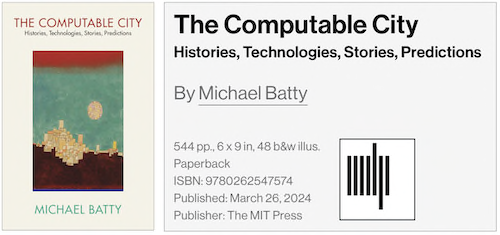
I don’t usually get a publication date for my work but MIT Press released my new book The Computable Citytoday (26th March). Entirely composed of words! No equations in sight ! https://t.co/gL7L8aHNC1 and at Amazon https://t.co/33Zd7jby7x
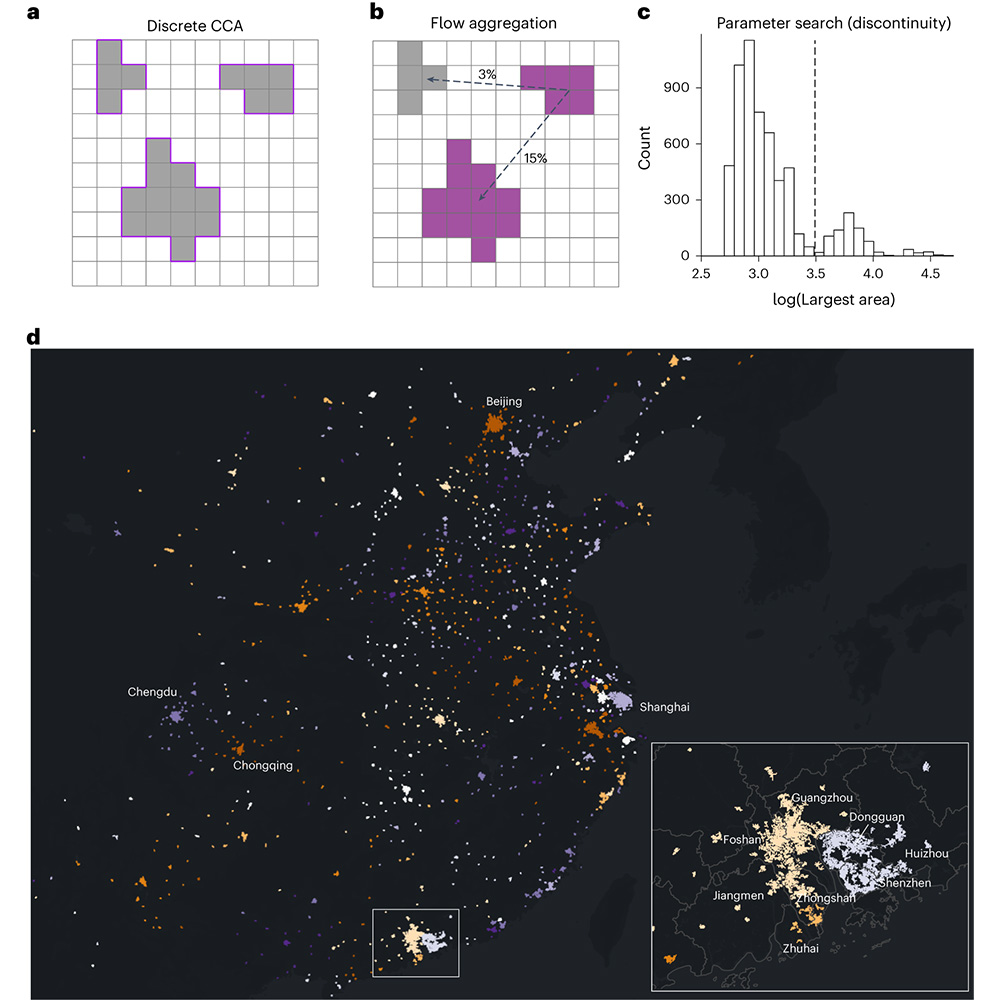
Or paper 'Defining a city—delineating urban areas using cell-phone data' ft. multiple SCL co-authors debuted in @Nature Cities yesterday.
This Perspective piece discusses how cell-phone data can be used to create an accurate, global definition of cities.
https://t.co/dt5KYTH6pq
Cell phone data could be the key to an accurate and timely definition of what a city is, argues a Perspective in @NatCities. The authors contend that an accurate and global definition of a city is crucial for the implementation of legislation and policies. https://t.co/Fq1W7zZEYR
These are 10 of my favourite #UrbanEconomics articles published in academic journals in 2023, continuing with a tradition from the last few years (order is alphabetical by first author, no ranking implied):
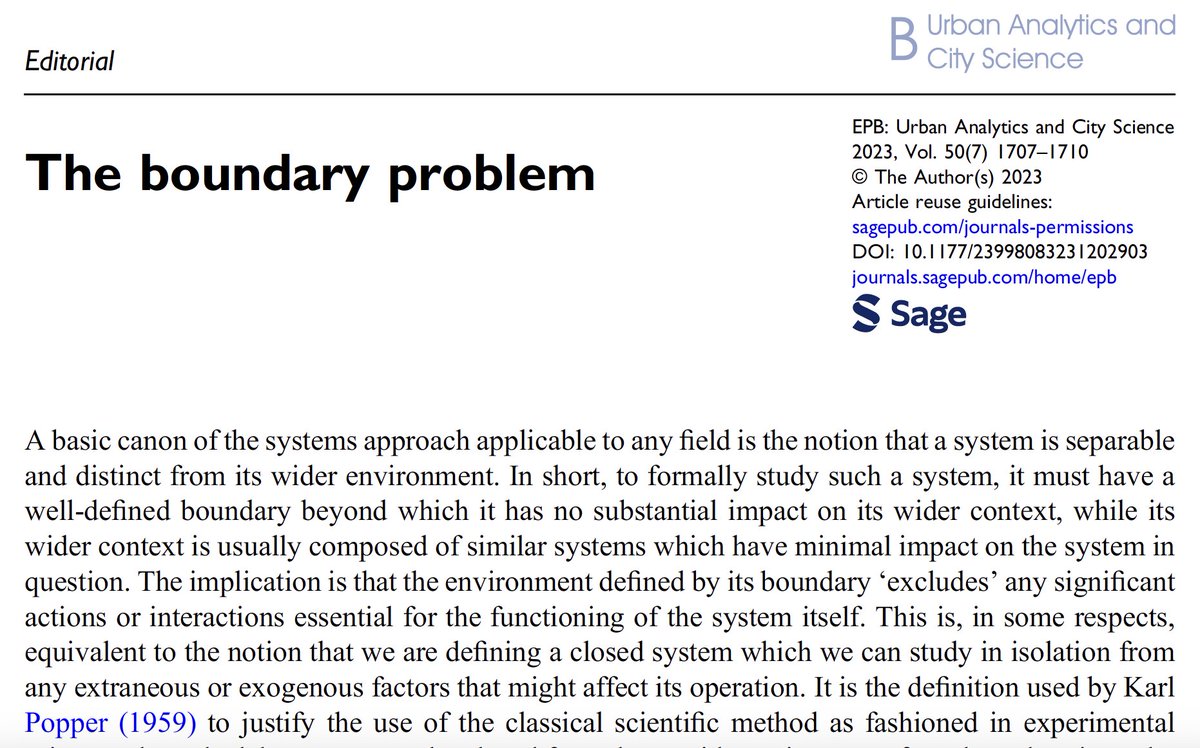
The boundary problem – how we do or don’t define the urban system - current editorial in Environment and Planning B – open access, downloadable from https://t.co/QB3z9NgfHi also see current contents of this issue https://t.co/aeLBzus562