Writer and Professor of English...
Retweets are for interest, not necessarily endorsement, of course.
Supporter of independent thought, free speech, and Astros
Una profesora de Stanford lleva 20 años estudiando por qué algunas personas tienen más suerte.
Su conclusión: la suerte no es azar. Es como el viento: hay que ponerle vela.
Si quisiera tener más suerte, haría estas 7 cosas:
1/ Salir de mi zona de confort con micro-riesgos.
Jordan Peterson on why creative people are the most valuable and most mistreated people in society:
1. artists and entrepreneurs are the same people. conservatives who dismiss art while celebrating capitalism have missed something fundamental. entrepreneurs provide all the vision for the capitalist system. artists are entrepreneurs. the people who drive economies forward are the people conservatives are most likely to tell their kids not to become.
2. the education system was designed in the late 1800s to produce obedient factory workers. desks in rows. sit down. shut up. do what you're told. move when the bell rings. that is a factory bell. the system worked perfectly for what it was built to do. the problem is the factories disappeared 100 years ago and nobody updated the system.
3. the correlation between grades and creativity at university is zero. not low. zero. creative people are not easy to grade so the system simply stops seeing them. by the time a creative person has been through school they have usually been told to stop daydreaming, pay attention, and behave. which is another way of saying stop being creative.
4. creativity does not emerge from freedom. it emerges from constraint. peterson uses the genie as the image. a genie is a god-like force compressed into a tiny bottle. to grant wishes it must be both extraordinarily constrained and completely free at the same time. give a creative person no problem to solve and they produce nothing. give them a serious constraint and they produce something nobody has ever seen before.
5. early trauma is one of the strongest predictors of creative output. hans eysenck, once the most cited psychologist in the world, found this in his study of genius. early loss forces a person to reconstruct themselves. that reconstruction process if combined with high intelligence and the right temperament produces creative production. this is not an argument for trauma. it is an explanation for why so many great artists had terrible early lives.
6. true creativity requires near genius level IQ. eysenck put it at roughly one in a thousand. peterson says people hate this finding because it does not make them feel good. but creativity at the highest level is not a skill you can learn. it is a capacity you either have or you don't. you can crush it easily. building it from scratch in someone who does not have it is a different matter entirely.
7. artists live on the edge between chaos and order. conservative people prefer the known. they master familiar territory and maintain it well. artists go to the edge of what is understood and push it outward into what is not. peterson says this is their biological niche. they are the visionaries who transform what we cannot yet see into something we can begin to perceive. every creative neighborhood in every city follows the same pattern. artists move into a rundown area, civilize it, the yuppies follow, the developers arrive, the artists get kicked out and go find the next rundown area.
8. when the impressionists first showed their work there were riots. the idea of perceiving the world that way was so radical it caused emotional fits in people who saw it. today everyone sees like an impressionist because their aesthetic saturated advertising, film, and architecture over the following century. artists do not decorate the world. they teach people how to see it. mondrian was playing with geometric squares in his studio. now mondrian buildings are everywhere in toronto.
9. the zebra story. biologists studying zebras in the wild marked one with a red spot so they could track it. the lions ate it immediately. lions cannot hunt a zebra they cannot identify. the herd is camouflage. the moment you stand out you become the target. peterson says this is biologically correct. the tall poppy gets cut. the head that rises above the rest is the first to fall. and yet the people who stand out are also the only ones who change anything.
<i>Frankie and Johnny:</i> A Waitress and a Cook and Taking Chances
My take on Frankie and Johnny at the Clair de Lune playing at @recroomhtx and running over at @HoustonPress
https://t.co/ejzfwpysi5
In the 1920s, a Stanford psychologist tracked genius children for 50 years.
Malcolm Gladwell breaks down what he discovered:
Rich families → successful. Poor families → failures.
Not average. Failures. Genius-level IQs that produced nothing.
He spent 60 minutes at Microsoft explaining why we're wrong about success:
The psychologist was named Terman. He gave IQ tests to 250,000 California schoolchildren.
He identified the top 0.1%. Kids with IQs of 140 and above.
His hypothesis: these children would become the leaders of academia, industry, and politics.
He tracked them. And tracked them. For decades.
The results split into three groups:
The top 15% achieved real prominence. The middle group had average, moderately successful professional lives.
And the bottom group? By any measure, failures.
The difference wasn't personality. Wasn't habits. Wasn't work ethic.
It was simple: the successful geniuses came from wealthy households. The failures came from poor families.
Poverty is such a powerful constraint that it can reduce a one-in-a-billion brain to a lifetime of worse than mediocrity.
There's a concept called "capitalization rate."
It asks a simple question: what percentage of people who are capable of doing something actually end up doing that thing?
In inner city Memphis, only 1 in 6 kids with athletic scholarships actually go to college.
If our capitalization rate for sports in the inner city is 16%, imagine how low it must be for everything else.
Here's something stranger.
Gladwell read the birth dates of the 2007 Czech Junior Hockey Team:
January 3rd. January 3rd. January 12th. February 8th. February 10th. February 17th. February 20th. February 24th. March 5th. March 10th. March 26th...
11 of the 20 players were born in January, February, or March.
This isn't unique to the Czechs. Every elite hockey team in the world shows the same pattern. Every elite soccer team too.
Why?
The eligibility cutoff for youth leagues is January 1st.
When you're 10 years old, a kid born in January has 10 months of maturity on a kid born in October. That's 3 or 4 inches of height. The difference between clumsy and coordinated.
So we look at a group of 10 year olds, pick the "best" ones, give them special coaching, extra practice, more games.
We think we're identifying talent. We're just identifying the oldest.
Then we give the oldest more opportunities, and 10 years later they really are the best.
Self-fulfilling prophecy.
The capitalization rate for hockey talent born in the second half of the year? Close to zero.
We're leaving half of all potential hockey players on the table because of an arbitrary date on a calendar.
Kids born in the youngest cohort of their school class are 11% less likely to go to college.
11% of human potential squandered because we organize elementary school without reference to biological maturity.
Now here's the part about math.
Asian kids dramatically outperform Western kids in mathematics. The gap is enormous and consistent across decades of testing.
Some people say it's genetic. It's not.
It's attitudinal.
When Asian kids face a math problem, they believe effort will solve it.
When Western kids face a math problem, they believe the answer depends on innate ability they either have or don't.
Here's the proof.
The international math tests include a 120-question survey. It asks about study habits, parental support, attitudes.
It's so long most kids don't finish it.
A researcher named Erling Boe decided to rank countries by what percentage of survey questions their kids completed.
Then he compared it to the ranking of countries by math performance.
The correlation was 0.98.
In the history of social science, there has never been a correlation that high.
If you want to know how good a country is at math, you don't need to ask any math questions. Just make kids sit down and focus on a task for an extended period of time.
If they can do it, they're good at math.
Why do Asian cultures have this attitude?
Gladwell's theory: rice farming.
His European ancestors in medieval England worked about 1,000 hours a year. Dawn to noon, five days a week. Winters off. Lots of holidays.
A peasant in South China or Japan in the same period worked 3,000 hours a year.
Rice farming isn't just harder than wheat farming. It's a completely different relationship with work.
There's a Chinese proverb: "A man who works dawn to dusk 360 days a year will not go hungry."
His English ancestors would have said: "A man who works 175 days a year, dawn to 11, may or may not be hungry."
If your culture does that for a thousand years, it becomes part of your makeup.
When your kids sit down to face a calculus problem, that legacy of persistence translates perfectly.
Now consider distance running.
In Kenya, there are roughly a million schoolboys between 10 and 17 running 10 to 12 miles a day.
In the United States, that number is probably 5,000.
Our capitalization rate for distance running is less than 1%.
Kenya's is probably 95%.
The difference isn't genetic. The difference is what the culture values and where it spends its attention.
Here's the most fascinating finding.
30% of American entrepreneurs have been diagnosed with a profound learning disability.
Richard Branson is dyslexic. Charles Schwab is dyslexic. John Chambers can barely read his own email.
This isn't coincidence. Their entrepreneurialism is a direct function of their disability.
How do you succeed if you can't read or write from early childhood?
You learn to delegate. You become a great oral communicator. You become a problem solver because your entire life is one big problem. You learn to lead.
80% of dyslexic entrepreneurs were captain of a high school sports team. Versus 30% of non-dyslexic entrepreneurs.
By the time they enter the real world, they've spent their whole life practicing the four skills at the core of entrepreneurial success: delegation, oral communication, problem solving, and leadership.
Ask them what role dyslexia played in their success and they don't say it was an obstacle.
They say it's the reason they succeeded.
A disadvantage that became an advantage.
Here's what Gladwell wants you to understand:
When we see differences in success, our default explanation is differences in ability.
We forget how much poverty, stupidity, and attitude constrain what people can become.
We refuse to admit that our own arbitrary rules are leaving talent on the table.
We cling to naive beliefs that our meritocracies are fair.
The capitalization argument is liberating.
It says you don't look at a struggling group and conclude they're incapable. It says problems that look genetic or innate are often just failures of exploitation.
It says we can make a profound difference in how well people turn out.
If we choose to pay attention.
Malcolm Gladwell revealed why you shouldn't go to Harvard:
1. America does not have a shortage of students who want science and math degrees. It has a shortage of students who finish them. Half of all high school seniors who intend to study STEM drop out by the end of their second year. The problem is not interest. It is persistence.
2. The obvious assumption is that smarter students persist longer. So Gladwell tested it. At Hartwick College, a small liberal arts school in New York, the top third of math SAT scorers took the majority of STEM degrees. The bottom third dropped out in large numbers. The data seemed to confirm it. Smarter kids stick around longer.
3. Then he looked at Harvard. The bottom third of Harvard's math SAT scores are equal to the top third at Hartwick. By the logic above, everyone at Harvard should graduate with a STEM degree. They are all brilliant. Nobody should be dropping out.
4. Harvard showed the exact same pattern as Hartwick. Top students graduated. Bottom students dropped out like flies. Even though the bottom Harvard students were objectively brilliant by any global standard. Something else entirely was driving the dropout rate.
5. That something is called relative deprivation theory. Human beings do not measure themselves against the world. They measure themselves against the people immediately around them. A Harvard student in the bottom third does not think I am in the top one percent of all students globally. They think that kid next to me keeps getting everything right and I keep getting it wrong. So they quit.
6. The research from UCLA puts a specific number on it. Your odds of graduating with a STEM degree fall by two percentage points for every ten point increase in the average SAT score of your peers. Choose Harvard over the University of Maryland and your chance of finishing a STEM degree drops by thirty percent. Thirty percent. Just to put a brand name on your resume.
7. Relative position matters more than absolute position when it comes to confidence, motivation, and self belief. The eightieth percentile student at Harvard looks up at the people above them and feels like they cannot compete. The number one student at a state school feels like they can conquer the world. That feeling drives everything.
8. The practical hiring implication is radical. Class rank matters more than institution name. Gladwell argues companies should have a don't ask don't tell policy for where someone went to college. Hiring only from top schools means missing the top students from every other school. That is not smart hiring. That is brand worship.
9. When choosing a college, never go to the best school you get into. Go to the school where you are guaranteed to be near the top of your class. Being a big fish in a smaller pond does not just feel better. It statistically produces better outcomes than being a small fish in the most prestigious pond available.
10. So why do we keep choosing Harvard over Maryland? Because we are flattered. Because the acceptance letter feels like validation. Because we make an irrational decision in a moment of enormous flattery and call it ambition. Gladwell's conclusion is simple and brutal. When we have the chance to join an elite institution we do things that are genuinely against our own interest and we feel great about it the whole time.
Our room for the coming days in Houston. I don’t even know what to say about this. This is just unreal. No words.
Huge huge thank you to JJ Watt for giving me and my friends the opportunity to stay at a place like this🙏🙏🙏
William Zinsser taught writing at Yale, then wrote the book that has fixed more bad writing than every English class combined.
Here are 10 cuts from "On Writing Well" that instantly make your writing twice as strong.
1) Delete every word doing no work
HOBBIES THAT MAKE YOU DANGEROUSLY SMART AND EDUCATED
1. Reading physical books — changes how you think and talk
2. Learning to cook properly — saves money, improves health
Thank you for going through the thread. Retweet the first tweet so you can share it with others.
Follow me at @readswithravi for more book reviews, lessons and recommendations.
https://t.co/Z6gas8Vskd
Jordan Peterson on why writing is the most powerful skill you can learn:
1. writing and thinking are the same thing. there is no difference between them. when you learn to write clearly you are not learning to express thoughts you already have. you are learning to have the thoughts in the first place.
2. universities never tell students why they are writing. the answer they get is you need the grade. the real answer is you need to learn to think. because thinking is what makes you act effectively in the world and win the battles you choose to fight.
3. if you can think, speak, and write you are absolutely dangerous. people give you money. they give you opportunities. you have influence. peterson says nothing can get in your way. that is what you are at university for.
4. the most articulate person in the room always wins the argument. peterson has watched staggeringly successful people his whole life. the common thread: you do not want to argue with them. not because they are aggressive. because their points are organized and yours probably aren't.
5. someone who cannot write has done almost everything wrong before they start. wrong words, wrong sentences, wrong paragraph order, wrong structure, wrong conclusion. peterson says marking a bad essay is agony because the answer to what did i do wrong is essentially everything.
I accidentally discovered how to read a complete book in 30 minutes.
A Harvard student showed me the workflow. Here's exactly what he does.
He doesn't open a book and start reading from page one.
He said that's the slowest, most inefficient way to absorb a book ever invented. You read linearly, your brain has no context for what matters, and by chapter four you've already forgotten chapter one.
He does something different.
He uploads the entire book into NotebookLM first.
Then he runs one prompt before touching a single page.
"What is the single central argument this book is making? What does the author believe that most people don't? And what are the 5 most important ideas I need to understand before everything else makes sense?"
That prompt does something most people don't realize. It gives your brain a skeleton before the flesh goes on. You are no longer reading to discover what the book is about. You already know. Now every page you read is confirming, extending, or challenging something you already hold in your head.
That is a completely different cognitive experience.
The second prompt is the one that saves the most time.
"Which chapters or sections contain the core ideas? Which ones are examples, case studies, or repetition of things already said?"
Most nonfiction books are 60 to 70 percent padding. Not because the authors are dishonest. Because publishers want 250 pages, not 80. The actual argument usually lives in four or five chapters. The rest is illustration.
NotebookLM tells him exactly which four chapters to read. He reads those. He skips the rest.
He is not missing anything. He is cutting everything that was never the point.
The third prompt is what separates this from summarizing.
After reading the core chapters, he goes back and asks: "What questions does this book not answer? What would a hostile critic say is wrong with the central argument? Where does the evidence feel weakest?"
This is the move that most people never make. They read. They absorb. They move on. They have opinions given to them by the author and they carry those opinions around as if they built them themselves.
He stress-tests the book before he closes it. He knows where it holds and where it doesn't. That is not reading. That is thinking with the book as a sparring partner.
The final prompt is the one I use every time now.
"If I had to explain this book's core idea to a smart 14-year-old in three sentences, what would I say? And what is the single most actionable thing the author wants the reader to do differently after finishing?"
That prompt forces compression. And compression forces understanding. You cannot compress what you do not actually understand.
I read four books last month this way.
I retained more from each one than I have from any book I read cover to cover in the last two years.
The average person reads a 300-page book in six hours and forgets most of it within a week. He reads the same book in 30 minutes and can still argue its central thesis six months later.
The book didn't change. The interface did.
Most people are reading books the way they were designed to be sold.
He reads them the way they were designed to be understood.
Dario Amodei, anthropic's CEO, just answered the question everyone is asking. should you still learn to code:
1. coding is going away first. the AI models are doing it already. the broader task of software engineering takes longer but that's going too. if you're learning to code purely for job security, you're learning the wrong thing.
2. even at 5% of the task you're still valuable. if AI does 95% and you do 5%, you become 20 times more productive. comparative advantage is surprisingly powerful even when the gap is massive.
3. the professions with the most runway are human-centered ones. things that mix people, the physical world, and analytical skills together. he uses the radiologist example. the doctor who understands patients and context, not just reads scans.
4. critical thinking might be the most important skill of the next decade. when AI can generate anything, the ability to tell what's real from what's fake becomes rare and valuable. you don't want false beliefs. you don't want to get scammed. that's his actual advice to a 25 year old.
5. AI can make you stupider if you use it carelessly. anthropic ran studies on this. depending on how you use the model, de-skilling in coding is measurable and real. the tool doesn't cause it. carelessness does.
6. the semiconductor space is his pick for a capitalistic win in the next decade. physical world, traditional engineering, direct AI tailwind. not software but chips.
A Russian psychologist spent 10 years proving that the act of talking to yourself out loud is one of the most powerful cognitive tools the human brain has, and almost nobody outside his field has read the work.
His name was Lev Vygotsky.
He worked in Moscow in the 1920s and died of tuberculosis in 1934 at the age of 37. He had no laboratory, no funding, almost no English readers, and a body of work that the Soviet government suppressed for two decades after he died.
He produced the foundational theory of how human cognition actually develops, and the central piece of that theory was a behavior almost every adult is faintly embarrassed about.
Vygotsky noticed that young children talk to themselves constantly. They narrate their own actions, they argue with imaginary opponents, they instruct themselves through tasks out loud.
The dominant theory at the time, from the Swiss psychologist Jean Piaget, said this was a sign of cognitive immaturity that children would eventually grow out of as they learned to think properly.
Vygotsky said the exact opposite.
He argued that this self-directed speech was the most important cognitive event in the entire developmental window, because it was the moment a child first started to use language as a tool to control their own mind. The child was not failing to think. The child was learning how to think by externalizing the process and listening to themselves do it.
He predicted that as children matured, this out-loud self-talk would not disappear. It would go underground. It would become silent inner speech, which is the running monologue every adult has inside their own head for the rest of their life.
The voice you hear when you read this sentence is the direct descendant of a four-year-old narrating their own block tower.
For 50 years almost nobody outside Russia had access to his work, and the few researchers who did pick it up could not get funding to test it. Then in the early 2000s the experiments finally started to pile up, and what they found was that Vygotsky had been right about something even more important than he knew.
The first major study came from Gary Lupyan at the University of Wisconsin and Daniel Swingley at the University of Pennsylvania in 2012. They ran a simple visual search experiment. Participants were shown 20 images at once and asked to find a specific object, like a banana or a chair. In one condition they searched silently. In the other condition they were told to say the name of the object out loud to themselves while looking for it.
The participants who spoke the target name out loud found the object significantly faster, with higher accuracy, than the participants who searched in silence. The effect was strongest when the spoken word matched a familiar object the brain already had a strong category for.
Saying the word out loud literally tuned the visual system to detect that thing better. The researchers called it the label feedback effect, and the implication was that the act of vocalizing a goal physically changes how the brain processes the world while pursuing it.
The second major study came out of the University of Michigan and Michigan State in 2017. The lead researchers were Ethan Kross and Jason Moser, and they used both EEG and fMRI to record what happens inside the brain when people talk to themselves while emotionally upset.
They asked participants to recall painful autobiographical memories and reflect on them in two different ways. Some used the first person, saying things like "why am I feeling this way." Others used the third person, referring to themselves by their own name, saying things like "why is John feeling this way."
The brain scans showed that the simple act of switching from first person to third person, even silently, decreased activity in the medial prefrontal cortex, the region responsible for rumination and self-referential pain. Within a single second of using their own name instead of the word I, participants showed measurably lower emotional reactivity. The shift required no extra cognitive effort. It cost the brain nothing. And it worked.
Kross described the mechanism in his interviews. Talking to yourself by name creates a small amount of psychological distance from your own experience. Your brain processes the situation more like a problem belonging to someone else, which means it can analyze it instead of drowning in it.
What Vygotsky had intuited in 1934 turned out to be even more powerful than the developmental theory he built it into. The voice you use to talk to yourself is not background noise. It is one of the most precise cognitive tools the brain has, and you can change how it works just by changing the pronoun you use.
People who talk through problems out loud are not anxious or unstable. They are running an externalized version of a process the rest of us are running silently and worse. The kindergartener narrating their block tower, the surgeon muttering through a procedure, the engineer pacing a hallway describing a bug to nobody, the athlete repeating a cue to themselves before a free throw, they are all using the same ancient mechanism that builds and steers human thought.
You can run the experiment yourself the next time you are stuck on something hard. Stop trying to solve it silently in your head. Say it out loud. Describe what you are seeing. Walk yourself through the steps as if you were explaining it to a colleague who is not in the room.
And when something genuinely upsets you, switch to your own name. Ask why this person is feeling this way, instead of why I am feeling this way.
The voice you have been told to keep quiet your entire life is one of the oldest pieces of cognitive technology you own.
Most people are still embarrassed to use it.
Aging doesn't guarantee a slow decline.
In fact...
How you function at 60, 70, or 80 is largely determined by a few measurable physical markers.
Miss these signals, and decline happens quietly.
Here are 8 metrics that predict how well you'll age (and how to improve them):👇
The reality is:
Aging poorly rarely comes from one catastrophic event. ❌
It comes from slow losses in:
- Strength
- Metabolism
- Cellular Resilience
...all of which compound over decades.
These 8 tests will help you determine whether you're gaining or losing ground: 👇👇
1️⃣ Metabolic Health Standards
Targets:
- Waist-to-Height Ratio: < 0.5
- Fasting Glucose: < 100 mg/dL
- HbA1c: ≤ 5.6
- FFMI: Men >19, Women >16
Nearly 88% of U.S. adults have at least one marker of metabolic dysfunction.
Waist-to-height ratio is one of the best predictors of metabolic disease.
Simply put:
Your waist should be less than half your height.
Above 0.5 often signals excess visceral fat and systemic inflammation.
Low FFMI suggests insufficient muscle to protect metabolism as you age.
2️⃣ Sit-to-Stand Power Test
The goal is simple:
You want to be able to stand up and sit down 5 times in under 12 seconds (with NO hands).
✅ This measures lower-body power AND mobility.
❌ Not just strength.
Power & mobility decline faster than strength with age.
A slow time indicates declining ability to generate force quickly and move through full-range-of-motion.
Both absolutely KEY for preventing falls.
3️⃣ Loaded Ruck Walk
Your goal:
To be able to walk 1 mile with 20–25% bodyweight in under 20 minutes, breathing through your nose only.
Most people can walk a mile.
Few can walk a mile under load while maintaining aerobic breathing.
This serves as a proxy for:
- Cardiovascular fitness
- Hip and leg strength
- Core stability
- Bone loading
Plus... it mirrors real-world demands.
4️⃣ Push-Up Test
Your goal:
- 20 push-ups (men)
- 10 push-ups (women)
A 2019 Harvard study found men who could do 40 push-ups had dramatically lower cardiovascular risk.
Push-ups measure upper-body endurance AND systemic fitness.
The bonus?
There's no equipment required.
5️⃣ Grip Strength
Your goal:
60-second dead hang
Grip strength is one of the strongest predictors of all-cause mortality.
It reflects total body strength AND neurological health.
If grip declines: 📉
Functional independence often follows.
6️⃣ Cardiovascular Capacity
Targets:
- VO₂max > 40 ml/kg/min
- OR 9–9:30 mile pace
- Resting heart rate < 60 bpm
VO₂max is one of the strongest predictors of longevity.
If climbing 3 flights of stairs leaves you winded...
Your aerobic system needs WORK.
Zone 2 cardio and occasional HIIT improve this rapidly.
7️⃣ Balance
Target:
Single-leg stand, eyes closed, 30 seconds
A 2023 study showed people unable to hold 10 seconds had nearly double the mortality risk over 7 years.
Balance is neurological. 🧠
And if you don’t train it... it declines.
Falls are one of the biggest causes of disability in aging adults.
8️⃣ Mobility (Sit-Rise Test)
Your goal:
Score ≥8 out of 10
Lower yourself to the floor cross-legged and stand back up without hands or knees.
Each support point costs a point.
A long-term study of 4,282 adults found low scorers were 5–6× more likely to die over 12 years.
This test combines:
- Balance
- Mobility
- Strength
- Coordination
⭐ The Bottom Line:
You don’t need perfect scores in these tests.
But you SHOULD know your numbers.
People rarely age poorly from one big mistake or accident.
They stay busy and successful…
…and quietly lose capacity in the systems that matter most when they’re 75 and trying to stay on their feet.
And 4⃣ best rules for improving these markers?
1⃣ Eat real, single ingredient foods
2⃣ Move for 30+ minutes daily
3⃣ Strength train 2-3x / week
4⃣ Sleep 7+ hours per night
That's it.
Simple, not always easy!
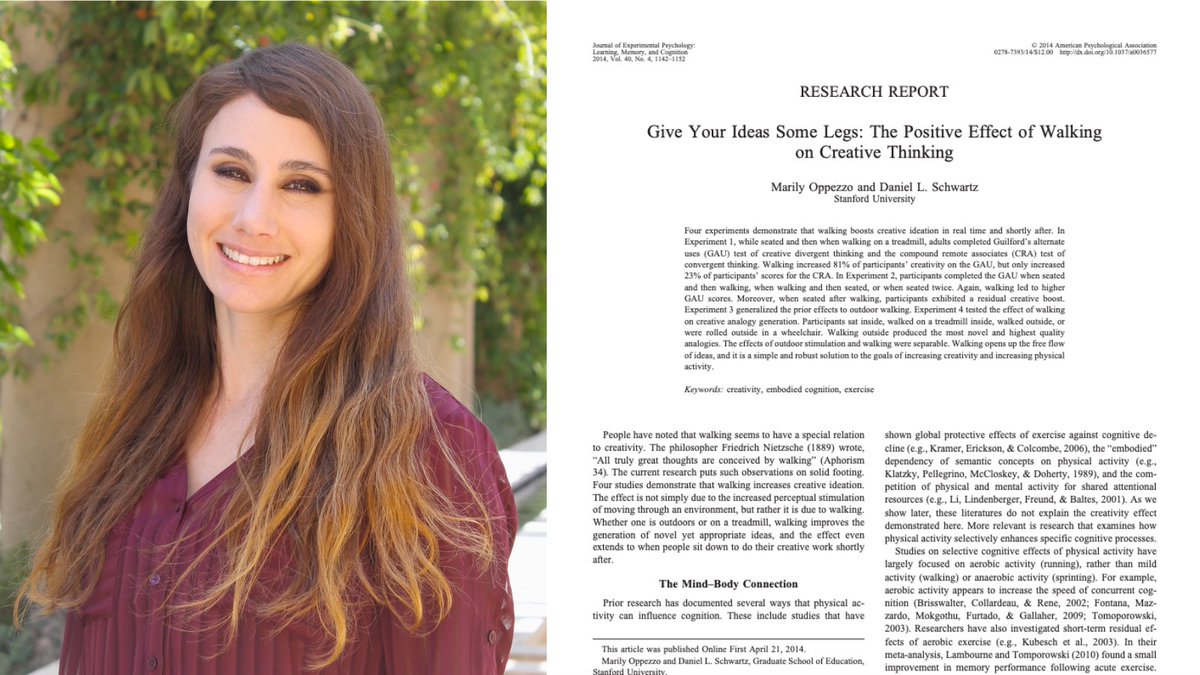
A Stanford psychologist spent 4 years proving that the simple act of walking generates 60% more creative ideas than sitting, and the experiment she designed to kill every alternative explanation is one of the most decisive findings in modern psychology.
Her name is Marily Oppezzo.
She got the idea for the study while walking with her advisor at Stanford to discuss her thesis topic, and the paper she eventually published in the Journal of Experimental Psychology in 2014 is sharp enough that it should have ended the seated meeting on the day it came out.
She ran 4 experiments on 176 people. Same person tested twice. Once sitting, once walking. The creativity tasks were the standard ones psychologists have used for decades to measure how good a brain is at generating novel useful ideas.
The result was almost too clean to publish.
81% of participants in the first experiment produced more creative ideas while walking than while sitting. In the second experiment, 88%. In the third, 100%. Every single person walked into a more creative version of themselves.
On average, people generated 60% more novel useful ideas the moment their legs started moving.
The skeptical question is the obvious one. Maybe it was the fresh air. Maybe it was the scenery passing by. Maybe it was the change of environment doing the work, not the walking itself.
Oppezzo killed every one of those explanations with one experimental decision.
She put people on a treadmill facing a blank wall. No scenery. No fresh air. No environmental change. Just legs moving in place while staring at white drywall. The 60% boost held.
Then she ran the experiment that closed the case completely. She took participants outside in two conditions. Half of them walked through a Stanford courtyard. The other half were pushed through the exact same courtyard in a wheelchair. Same outdoor stimulation. Same scenery passing at the same speed. The only difference was whether the legs were moving.
The walkers produced dramatically more novel high-quality ideas than the wheelchair group. The outdoors did almost nothing on its own. The walking did everything.
This is the part of the study that hit hardest when I read it the first time.
She also tested the opposite kind of thinking. Convergent thinking. The kind where there is one right answer and you have to narrow down to it.
Word puzzles where 3 words share a hidden fourth word that connects them. The seated participants did slightly better on these. Walkers got slightly worse.
Walking is not a general intelligence enhancer. It does one specific thing. It opens up the divergent search inside your brain. The part that generates options. The part that produces unexpected connections. The part that takes a problem and finds five ways into it instead of one.
When you need to converge on the single right answer, sit down. When you need to find the answer in the first place, get up.
The mechanism is now well understood. Walking selectively activates what neuroscientists call the default mode network, the system inside your brain that runs when you are not consciously focused on anything. The DMN is where mind-wandering happens. Where memories cross-reference each other. Where ideas that have been sitting in separate folders inside your head finally bump into each other.
When you sit at a desk and force yourself to concentrate, you suppress the DMN. When you walk at a natural pace, the executive part of your brain gets just busy enough handling the walking that the DMN comes online and starts doing the work that focus was blocking.
The most useful finding in the entire paper is the one almost nobody quotes.
The boost did not turn off the moment people stopped walking. Participants who walked first and then sat back down stayed elevated. Their next round of seated creativity work was still significantly better than people who had been sitting the whole time. The rest lingered for at least several minutes after the legs stopped moving.
You do not need to do creative work while walking. You need to walk before the creative work. The brain holds the state.
The history of this is the part that should haunt anyone who still does meetings in chairs.
Charles Darwin built a gravel loop behind his house in Kent called the Sandwalk and walked it 3 times a day for the rest of his life. The theory of evolution was developed one lap at a time on that path.
Nietzsche walked up to 10 hours a day during the years he wrote his most important books and openly said the work was conceived on his feet.
Beethoven composed for the morning and walked for 5 hours every afternoon with a pencil in his pocket for when something landed.
Kahneman said the best thinking of his Nobel Prize-winning career happened on leisurely walks with Amos Tversky. Steve Jobs refused to take important conversations sitting down. He held them on foot.
Every one of them was using the system Oppezzo would not measure until 2014. They just did not know what to call it.
The question worth sitting with is the one almost nobody asks.
Every meeting you have ever attended sitting around a table was a meeting held at a fraction of the brain power that was actually available to the people in the room. Every brainstorm that got stuck inside a conference room. Every problem you tried to solve at a desk and gave up on. Every idea you could not quite get to.
The intervention is the easiest one in modern science. No supplement. No app. No subscription. No training program. Just a pair of legs and 15 minutes.
The Stanford lab proved it. The philosophers knew it. The neuroscience explains it.
And almost everyone reading this is still trying to think their way out of problems sitting completely still.