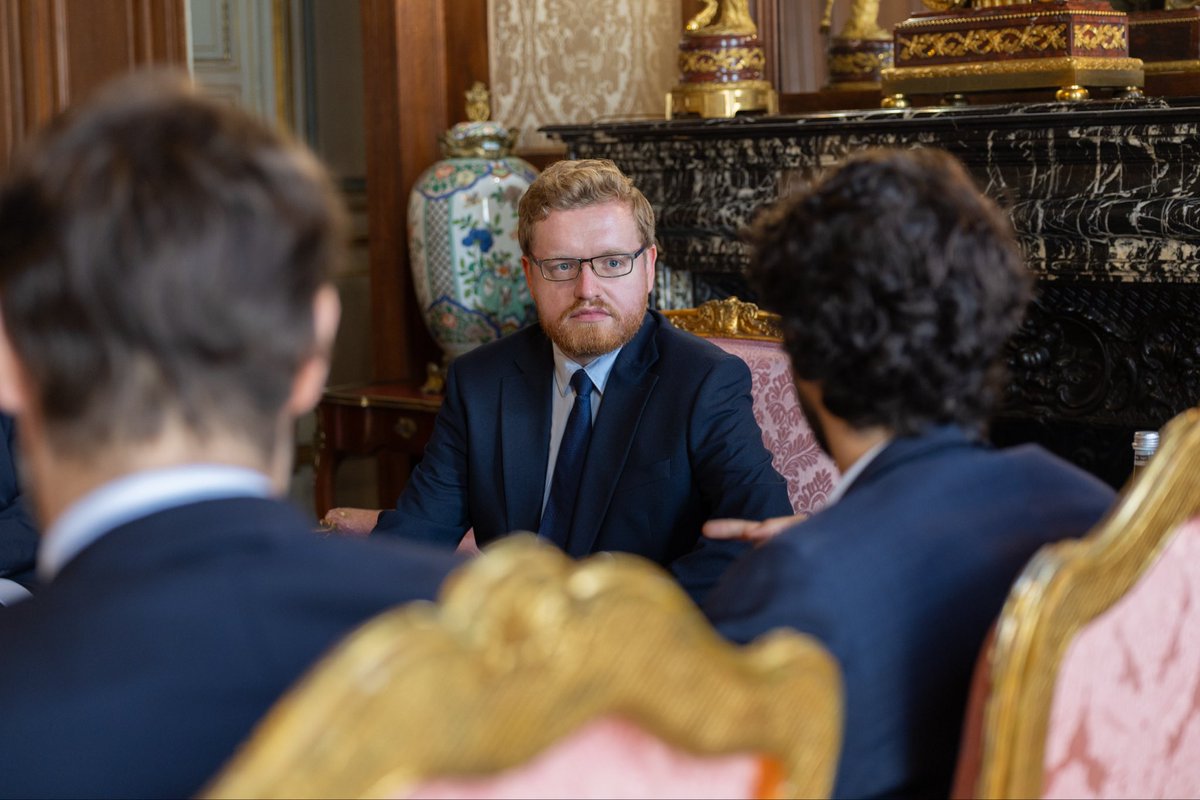
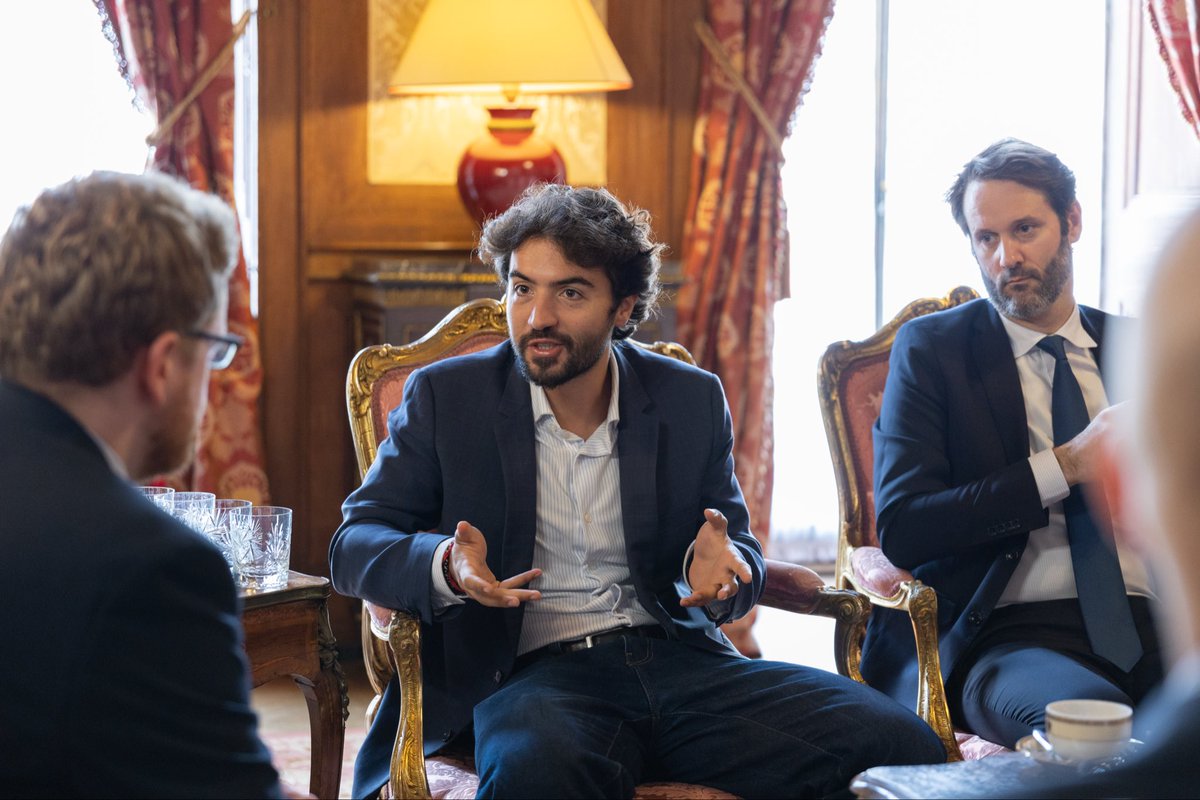
Poland is building its own AI models with @MistralAI.
This is a significant move.
First, Mistral is improving at an impressive pace. Early benchmarks of its upcoming models suggest a major jump in capabilities.
Second, countries that want to stay competitive with the US and China will likely need sovereign AI infrastructure and models adapted to their own language, regulations, and public services.
AI is quickly becoming a matter of national competitiveness, not just technology.
Poland taking this step now could prove to be a very smart decision
Potwierdzam, pracujemy nad polsko-francuskim modelem AI. Dziękuję za dobre spotkanie @MistralAI. Robimy z @NASK_pl! 🦾
Nazwę dopracujemy.
https://t.co/G2r9Nz4bKU
Potwierdzam, pracujemy nad polsko-francuskim modelem AI. Dziękuję za dobre spotkanie @MistralAI. Robimy z @NASK_pl! 🦾
Nazwę dopracujemy.
https://t.co/G2r9Nz4bKU
I prompted Claude Fable 5 to use Python to generate a 9:16 social video and render it using ffmpeg. Told it to put its own personal spin on it so it’s aligned with Anthropic’s launch and to fully express what it’s like to be an LLM hated by Theo from its POV.
It made this lmfao.
Anonymous cash for Bitcoin Lightning at nearly all Polish ATMs.
And that’s not all—you can pay with Bitcoin Lightning literally everywhere in Poland!
No KYC, no registration, via the Nostr provider.
I love it when I come across new technology that gives (European) bureaucrats the middle finger, especially in a situation where they want to spy on and regulate you across the board.
Most recently, I was this excited about a non-KYC project for exchanging stablecoins for fiat via https://t.co/5Bdka5KM6w, which bypasses the dystopian centralized exchanges that have to do massive reporting due to EU regulations like DAC-8 and MiCA.
In the case of BITBLIK, just like with https://t.co/eOBJxn7Yu6, you’re doing decentralized P2P trading, so I assume no regulation applies to you (it doesn’t go through any intermediary).
Today I came across a great Polish app called BITBLIK https://t.co/nUSKPCNERY, which connects the widely available BLIK system in Poland with Bitcoin Lightning.
With Bitcoin Lightning, you can pay anonymously anywhere in Poland, withdraw cash anonymously from an ATM (which I just did!), or make online payments on Polish websites.
BLIK is widely accepted (it’s supported by a network of over 13,000 ATMs across Poland and hundreds of thousands of merchants; according to AI, there are 87,000 of them).
Install the https://t.co/nUSKPCNERY app, launch it—no registration required, no KYC—enter an offer for how much you want to pay in PLN or how much you want to withdraw from an ATM.
You’ll make a Bitcoin Lightning payment, which will be locked.
Wait a minute or two until someone accepts your offer (the other party who has BLIK and wants Bitcoin Lightning).
As soon as they do, a BLIK code will appear.
It’s valid for about two minutes, so enter it at an ATM or at a terminal in a store or restaurant.
After a successful payment, you confirm that you used the BLIK code, and the Lightning payment is credited to the recipient.
Limits for BLIK payments vary by Polish ATM. ING Bank Śląski has the highest limit: 10,000 PLN per day (2,356 EUR), while mBank has a limit of 5,000 PLN per day (1,178 EUR). PKO BP allows BLIK transactions up to 1,500 PLN, but you can make up to 20,000 PLN (4,722 EUR) worth of transactions per day.
And of course, those limits apply to the merchant. When various merchants accept your Lightning payments, you effectively have no limits—you’re only limited by the counterparty’s liquidity.
BLIK is 100% open-source, so it can’t be banned!
You can fork it and use it within your own closed community.
It’s one thing to see a graph saying, “12 million illegal migrants entered Europe since 2008.”
It’s another thing to actually see it.
Every blip in this animation represents 100 people.
This is wild. Google Research demonstrates a ~20x more efficient implementation of Shor's algorithm that could break ECDSA keys within minutes with ~500K physical qubits.
Google is now are more confident on a 2029 post-quantum transition. We are no longer looking at mid 2030s, we could have quantum computers of this scale by the end of the decade.
They believe this result is so severe that they are not publishing the actual circuits. They instead published a ZKP proving that they know of the quantum circuit with these properties. This is very atypical, showing Google thinks this is serious shit.
All blockchains need a transition plan ASAP. Post-quantum is no longer a drill.
Meet the new Stitch, your vibe design partner.
Here are 5 major upgrades to help you create, iterate and collaborate:
🎨 AI-Native Canvas
🧠 Smarter Design Agent
🎙️ Voice
⚡️ Instant Prototypes
📐 Design Systems and DESIGN.md
Rolling out now. Details and product walkthrough video in 🧵