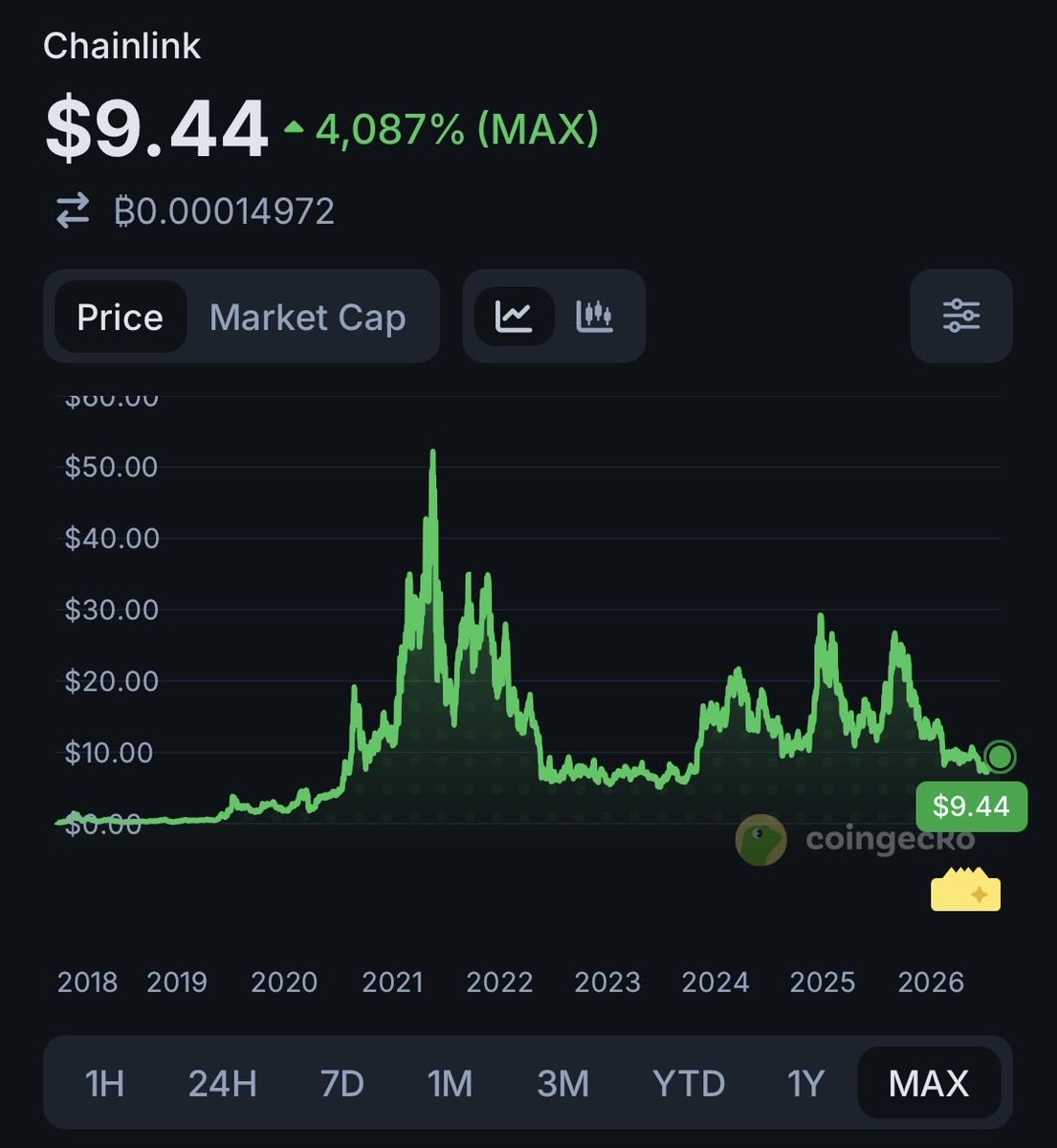
Only 1 Billion Chainlink ethereum:0x514910771af9ca656af840dff83e8264ecf986ca tokens. Forever. The window is closing fast to secure your stack, rest assured price will not stay low much longer. Hold tight marines.
Zoom out. We’re still at the generational bottom. A couple dollars is a rounding error where we’re going. Hold tight marines and enjoy the ride, you deserve it.
$100,000 invested 5 years from now in Link will be worth how much?
Only needs $130 to equal Nvidia’s gain.
My chips are on the table, hold tight marines.
@AdamLinkSmith 1 Billion Chainlink tokens. Total. Forever.
Around 59 million millionaires in the world.
That’s 17 Link tokens per millionaire.
Very few.
@nullpackets@bob4punk Unironically this. I’ve always wondered how *they* would elevate the price rapidly enough to price most out but in a way that’s inconspicuous to the rest of the market. Black swan market event plus fake alien invasion to distract from the singularity? 😉
Last time it was: “ToKeN nOt NeEdeD”
This time it is:
“Are $LINK holders just funding Chainlink Labs salaries?”
Every couple of years, the FUD around Tokenomics comes around, and ngl, it does get in your head a bit even if you understand.
But I actually think a lot of it comes from people trying to put Chainlink into a category it doesn’t fit into.
It’s not an L1 like $ETH or $SOL.
It’s not a memecoin where price = attention.
And it’s not equity in Chainlink Labs.
Chainlink is infrastructure.
And infrastructure always looks weird early.
Yes, CLL held a large treasury and yes, they sold tokens over the years.
On the surface that looks like dilution.
But what they were actually doing was bootstrapping a network before it had users.
Every major network in history had this phase.
Credit cards had to convince merchants before customers used them.
Cloud providers had to subsidise adoption before companies migrated.
Even the internet existed before real activity showed up.
My favourite analogy, though, is railroads.
In the 1800s, railroad companies built thousands of kilometres of track before there were enough passengers and freight to justify it.
For years, it looked like capital destruction.
Investors thought they were burning money paying workers to lay tracks into empty land.
But the tracks had to exist before the economy could run on them.
Cities formed because the railways were already there. Trade scaled because transport existed first.
Chainlink is doing the same for digital assets.
Chainlink needed:
• node operators
• security research
• integrations
• and institutions experimenting with on-chain finance
before there was any real transaction volume to charge for.
So LINK hasn’t been to fund CLL, it was funding the creation of a network.
LINK is not ownership in Chainlink Labs.
It’s the security backing inside the protocol.
With staking, node operators lock LINK as security.
With CCIP, cross-chain transactions are secured by that staked collateral.
And institutions don’t even need to buy LINK, they can pay in fiat or stables, which the protocol then purchases LINK to pay operators.
That flips the normal crypto model.
Most tokens rely on speculation first and hope usage follows.
Chainlink is having usage create demand.
So the real question isn’t “are they selling tokens?”
The real question is: if TradFi moves on-chain, what connects blockchains to banks?
Instos can’t just rely on “trust me.”
There has to be a security layer backing the system, and that security needs collateral.
LINK is the collateral.
That’s the thesis.
The biggest risk in my view and the risk that has many of you stressin, is timing.
Financial infrastructure moves slowly, and markets price narratives a lot faster than they price infrastructure.
Chainlink is plumbing.
And plumbing always looks unexciting, right until everything starts running through it.