🚨 MERCEDES JUST PUT A MOTOR ONLY 8 CM THICK INTO A CAR THAT CAN HIT 62 MPH IN 2.1 SECONDS.
Instead of conventional radial flux motors, Mercedes is betting big on axial flux technology. In these motors, the electromagnetic force flows parallel to the axle, allowing two magnetic rotors to sandwich a central stator in a flat, disc-like layout.
The result is dramatically smaller and more powerful. The front motor in the new all-electric Mercedes-AMG GT 4-door Coupe is just 9 cm wide. The rear motors are even thinner at roughly 8 cm each. Despite their tiny size, they help launch the heavy performance car from 0-62 mph in just 2.1 seconds, with a top speed of up to 186 mph.
Why this matters:
• Axial flux motors are significantly more power-dense and can be up to 50% lighter than traditional designs
• Their extreme thinness frees up packaging space in the vehicle for better weight distribution, aerodynamics, or interior room
• Mercedes acquired YASA in 2021 and has spent years developing the complex manufacturing processes needed to build them at scale
• The technology is debuting in a high-performance AMG model, showing Mercedes is serious about using it in its most demanding cars
The deeper implication:
While most of the EV conversation focuses on batteries and software, the electric motor itself is undergoing a quiet revolution. Axial flux designs have long been seen as theoretically superior but extremely difficult to manufacture at scale.
By solving the production challenges and putting these motors into a real high-performance car, Mercedes is pushing the entire industry forward. The next generation of electric performance cars may not just have bigger batteries they may have fundamentally better motors.
We’re watching the physical hardware of EVs evolve as dramatically as the software has.
How important do you think motor technology (rather than just battery size) will be for the future of electric performance cars?
Follow for more frontier automotive engineering and electric vehicle technology.
$HYLN MY BULL CASE
The Technology Is Hitting Real Milestones
Hyliion’s KARNO Power Module is a modular, fuel-agnostic generator acquired from GE is no longer just a concept. The company successfully completed non-recurring UL certification testing of the KARNO Power Module, a critical milestone for enabling customer site deliveries.  This is the kind of regulatory gate that separates “promising prototype” from “deployable product.”
The pipeline is growing fast: nearly 750 KARNO Cores under non-binding LOIs, worth over $400M potential revenue at current pricing. Latest win, an LOI with data center developer VFG Holdings for up to 250 cores / 50 MW over five years. AI power demand is real, and KARNO slots right in.
Fuel flexibility is a legit differentiator; seamless switching between natural gas, hydrogen, and diesel on the same hardware with no mods needed. That widens the addressable market across data centers, defense, and distributed power. No one else has a product that does all this that I am aware of.
Defense side is picking up too: US Navy just selected the USX-1 Defiant platform to test KARNO on unmanned vessels. Government validation like this de-risks the tech and can lead to bigger contracts.
Financially, Q1 revenue crushed estimates by 183%, with analysts forecasting 75% average annual growth over the next 3 years (way above the broader electrical equipment industry). They’re sitting on solid cash ($152M end of Q1, guiding to $100M by year-end) for a pre-revenue ramp company.
Analyst momentum is building with Needham initiated coverage with a Buy and solid price target ($9) and consensus leans bullish.
The risks are real though: Margins still negative, cash burn continues (we will have to dilute at some point in order to grow just like any other company at this stage in their growth), commercialization targeted for year-end 2026 (execution risk is high), and the stock moves like a rocket (more volatile than 75% of names). LOIs aren’t binding and converting them to real orders is what matters, but things sure do look promising the more and more I research the company.
Bull case in a nutshell: If Hyliion hits commercialization, stacks these military wins, and turns even part of that $400M+ pipeline into revenue amid the AI/data center power crunch, this thing can re-rate big as a high-growth play in two massive megatrends. We could be looking at the next $BE if are able to execute. With that said, I started buying $BE in the low 30’s and later regretted not taking a bigger position. $HYLN has given me very similar vibes to when I first started DD on BE.
High-risk, high-reward speculative name. Position accordingly and do your own research. Not financial advice, just sharing the setup I’m watching.
What do you think??….loading up on current levels, dips or waiting for more proof? Please feel free to add any other bullish or bearish opinions/points on $HYLN
I’ve attached $HYLN’s current largest holders.
해외 사용자들 날벼락…미 정부, 앤트로픽 '페이블5·미토스5' 외국인 접속 전면 금지
[디지털데일리 이상일기자] 미국 정부가 앤트로픽(Anthropic)의 최상위 인공지능(AI) 모델에 대한 외국 국적자의 접속을 전면 금지했다. 대상은 페이블5(Fable 5)와 미토스5(Mythos 5)다. 앤트로픽은 규정 준수를 위해 모든 고객에게 두 모델 서비스를 즉시 중단했다.
앤트로픽은 12일(현지시간) "미국 정부가 국가 안보 당국의 지침에 따라 모든 외국 국적자의 페이블5·미토스5 접근을 전면 중단하는 수출 통제 지침을 발표했다"고 밝혔다.
이 지침은 해외 접속뿐 아니라 미국 내 외국 국적자의 접속도 금지했다. 제한 대상에는 앤트로픽의 외국인 직원도 포함된다. 회사는 미 동부시간 기준 이날 오후 5시21분 정부로부터 지침을 받았다고 설명했다. 다만 서한에는 국가 안보 우려에 대한 구체적 내용이 없었다고 덧붙였다.
앤트로픽은 정부가 페이블5의 안전장치를 이용자가 '탈옥'(jailbreaking) 방식으로 우회할 수 있다고 본 것으로 추정했다. 회사는 해당 기법으로 발견된 사례를 검토한 결과 모두 비교적 단순한 취약점이었다고 밝혔다. 공개된 다른 모델도 우회 없이 같은 취약점을 찾을 수 있다고 설명했다. 정부가 지목한 우회 방식은 오픈AI의 GPT-5.5 등 다른 모델에서도 쓰이며, 보안 담당자들이 매일 활용한다고 덧붙였다.
앤트로픽은 페이블 출시 전 수 주간 미국 정부, 영국 AI안전연구소(AISI), 외부 기관, 내부 팀과 함께 안전장치를 검증했다고 밝혔다. 회사는 "어떤 테스터도 모델 보안을 완전히 우회하는 범용 탈옥 방법을 찾지 못했다"고 강조했다. 다만 완벽한 탈옥 방어는 현재 어떤 사업자도 불가능하다고 봤다. 이에 따라 앤트로픽은 심층 방어 전략을 택했다. 탈옥 비용을 높이고 모니터링으로 공격을 신속히 차단하는 방식이다. 페이블의 고객 데이터를 30일간 보존하도록 한 것도 같은 이유라고 설명했다.
앤트로픽은 정부 지침을 준수하되 이번 조치에는 동의하지 않는다고 밝혔다.
회사는 "수억 명에게 배포된 상용 모델을 회수할 사유로 극히 일부의 탈옥 가능성을 든 것에 동의할 수 없다"고 지적했다. 또 "정부는 투명하고 공정하며 기술적 사실에 근거한 법적 절차로 안전하지 않은 배포를 차단해야 하지만, 이번 조치는 그 원칙에 부합하지 않는다"고 밝혔다. 회사는 이를 오해로 판단한다며 향후 24시간 내 추가 내용을 공유하고 빠른 서비스 복구에 나서겠다고 강조했다.
정부가 지목한 우회 방식은 오픈AI의 GPT-5.5 등 다른 모델에서도 쓰인다고 설명했다. 미 상무부는 한 기업이 미토스(Mythos)의 보안 장벽을 뚫었다고 주장하자 안보 위험을 우려해 이번 조치를 취했다고 미 온라인 매체 악시오스(Axios)가 정부 소식통을 인용해 보도했다.
접근 제한은 미 정부 안보 체제가 강화될 때까지 수 주간 이어질 전망이다.
만약 40살로 돌아간다면, 저는 이렇게 투자하겠습니다.
1. 비상금 먼저
매달 CMA에 15만 원 적립, 200만 원 채우면 중단
2. ISA (3~5년 단기)
매달 40만 원 투자, S&P500·나스닥100 ETF 중심
3년마다 ISA를 연금저축으로 이전하여 세제 혜택 유지
🚨 RESEARCHERS JUST MADE WATER-BASED BATTERIES LAST OVER 2,800 HOURS WITH RECORD CAPACITY.
A team in South Korea has developed a simple zwitterionic electrolyte additive that dramatically improves the performance of aqueous (water-based) batteries a technology long seen as a safer, cheaper, and more environmentally friendly alternative to lithium-ion.
The additive forms tiny nanostructures that guide zinc to deposit evenly on the electrode and create a protective layer that prevents corrosion and unwanted side reactions with water.
This solves two of the biggest problems that have limited aqueous batteries: uneven metal buildup and rapid capacity fade.
In testing, the modified batteries achieved a world-leading areal capacity of 8.10 mAh cm⁻² and ran stably for more than 2,800 hours.
Why this matters:
• Aqueous batteries are non-flammable and use abundant, low-cost materials, but have historically suffered from poor lifespan and performance
• This approach improves both cycle life and capacity at the same time — something many previous solutions struggled to achieve together
• It uses a simple additive rather than requiring expensive new materials or complex manufacturing changes
• The technology is particularly relevant for large-scale energy storage needed for renewables and AI data centers
The deeper implication:
We’re getting closer to making safe, scalable, and affordable grid storage a reality. While lithium-ion still dominates, aqueous batteries could become a strong contender for stationary storage where safety, cost, and longevity matter more than energy density.
A small molecular tweak unlocking major performance gains shows how materials engineering at the nanoscale can have outsized real-world impact.
This is the kind of incremental but meaningful progress that compounds over time.
How important do you think safer, water-based batteries will be for the future energy grid compared to improving lithium-ion or other alternatives?
Follow for more frontier energy storage and battery materials research.
🚨 MIT JUST DISCOVERED HOW INJECTING CO₂ ACTUALLY REWIRES CEMENT CHEMISTRY FROM THE INSIDE.
For years, companies have been injecting carbon dioxide into concrete to store emissions and speed up strength gain. But no one fully understood why it worked until now.
Using real-time Raman spectroscopy, MIT researchers captured the complete chemical sequence as it happened. They found that CO₂ triggers a three-act process:
First, it locks up calcium and creates a temporary silica gel network throughout the paste.
Then, as normal hydration resumes, this “ghostly gel” reacts with calcium hydroxide to form calcium silicate hydrate (C-S-H) but now distributed evenly across the entire matrix instead of clustered around clinker particles. Finally, the gel disappears within eight hours, leaving behind a stronger, more uniform microstructure.
In testing, cement paste with just 1% CO₂ by weight showed 13% higher compressive strength at 24 hours compared to conventional mixes.
Why this matters:
• This is the first direct observation of the fleeting intermediate reactions that drive improved performance
• The strength gain comes from better distribution of the binding phase, not from calcium carbonate acting as seeds
• The process stores CO₂ while simultaneously improving the material a rare win-win in construction
• It gives manufacturers a clearer scientific basis to optimize CO₂ injection rather than relying on trial and error
The deeper implication:
Concrete is the most used material on Earth and one of the largest sources of CO₂ emissions. Being able to see and therefore control the exact chemical mechanism behind CO₂ injection opens the door to smarter, lower-carbon cement formulations. It also shows how advanced spectroscopy can reveal hidden reaction pathways in materials we thought we already understood.
We’re no longer guessing why CO₂ helps cement. We’re watching it happen in real time.
How significant do you think real-time molecular imaging will be for decarbonizing construction materials in the next decade?
Follow for more frontier materials science and carbon-negative construction research.
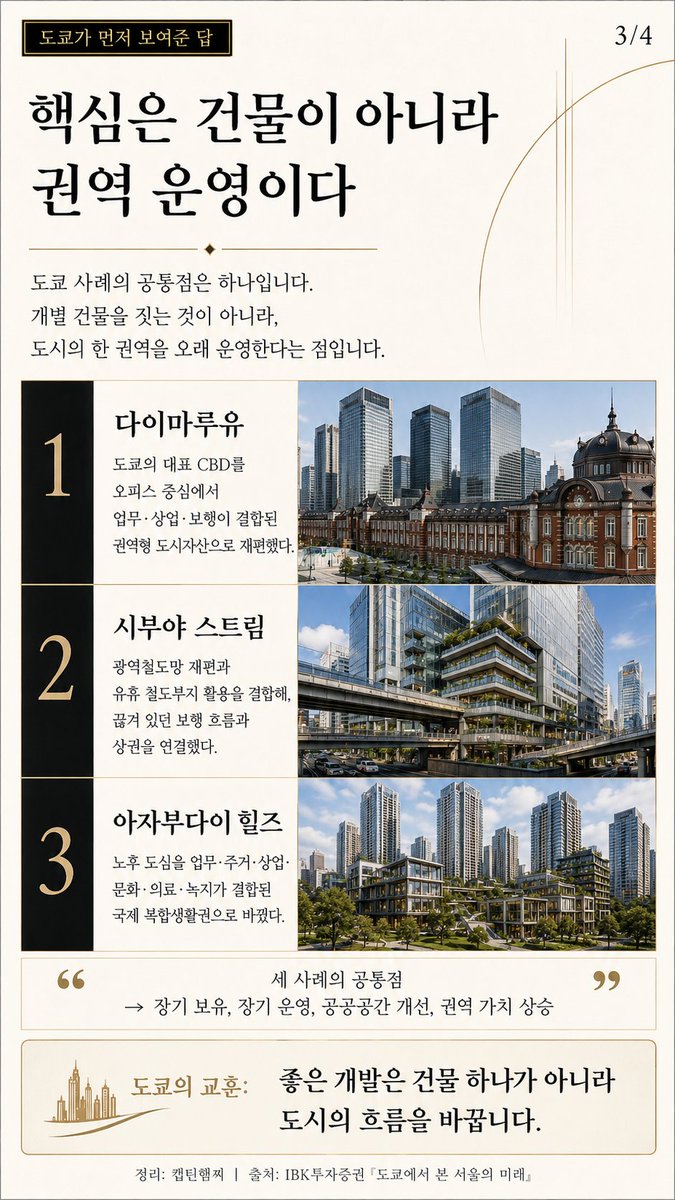
도쿄에서 본 서울의 미래
요즘 부동산 시장을 보면 이상한 점이 하나 있습니다. 인구는 분명히 줄고 있는데, 서울 핵심지의 땅값은 계속 오르고 있거든요. IBK투자증권이 이 질문을 110페이지짜리 리포트로 파고들었는데, 결론부터 말씀드리면 한국 부동산 게임의 규칙 자체가 바뀌고 있다는 이야기였어요.
먼저 인구 이야기부터 시작하면, 2025년 우리나라 인구는 5,168만 명으로, 한 해 전보다 0.67% 줄었습니다.
보통 사람이 줄면 집도 남아돌 거라고 생각하기 쉬운데, 여기에 함정이 있어요.
1~2인 가구가 늘고 고령화가 진행되면서 정작 '필요한 집의 개수'는 오히려 늘어나고 있거든요.
사람 수는 줄어도 가구 수는 늘어나는 거죠. 그러니까 수요가 사라지는 게 아니라, 교통 좋고 살기 편한 핵심 입지로 더 몰리고 있다는 뜻입니다.
그래서 개발하는 방식 자체가 달라지고 있어요.
예전에는 외곽에 땅을 사서 아파트를 왕창 짓고 분양하면 그걸로 끝이었습니다. 그런데 앞으로는 이미 형성된 도심을 다시 짜맞추고, 건물을 짓고 끝나는 게 아니라 오래 운영하면서 수익을 내는 방식으로 무게중심이 옮겨갑니다.
한마디로 '외곽 확장에서 도심 재편으로', 그리고 '한 번 팔고 끝나는 분양 수익에서 꾸준히 들어오는 운영 수익(임대료)으로' 바뀌는 거예요.
이런 흐름을 부르는 이름이 바로 '복합개발(Compact City)'입니다.
쉽게 말하면 한 덩어리 안에 오피스, 주거, 호텔, 쇼핑을 모두 넣는 방식이에요.
예전엔 따로따로 짓던 것들을 한 곳에 묶는 거죠.
왜 그렇게 할까요? 사람을 한곳에 모으고 오래 머물게 만들수록, 그만큼 돈을 더 쓰기 때문입니다.
사실 이 길을 우리보다 먼저 걸어간 나라가 있어요.
바로 일본 도쿄입니다.
대표적인 사례가 모리그룹이 만든 '아자부다이 힐즈'예요.
64층, 325m 높이의 복합단지인데, 완성하기까지 무려 34년이 걸렸고 땅 주인 약 300명과 일일이 협의해서 만들었다고 합니다.
중요한 건 이걸 분양해서 팔아치운 게 아니라, 직접 운영하면서 임대료와 브랜드 가치를 차곡차곡 키웠다는 점이에요.
그렇다면 한국에서 이 '모리그룹' 역할을 할 회사는 누구일까요?
리포트가 꼽은 후보는 유통기업입니다. 이유가 꽤 분명해요.
백화점이나 마트를 운영하면서 이미 도심 알짜 입지를 확보하고 있고, 브랜드와 콘텐츠로 사람을 끌어모으는 노하우도 오래 쌓아왔거든요.
좋은 땅과 사람을 모으는 능력, 이 두 가지가 복합개발의 핵심 조건인데 유통기업이 바로 그걸 갖고 있다는 거죠.
실제로 움직이고 있는 기업들도 있습니다. 신세계는 스타필드와 센터필드, 반포 고속터미널 부지 개발을 추진하고 있고, 롯데는 롯데월드타워·몰 운영 경험에 그룹이 가진 유휴부지를 결합하고 있어요. HDC현대산업개발은 용산과 광운대역세권 '서울원' 프로젝트를 통해 단순 건설사에서 복합 디벨로퍼로 진화하는 중이고, 서부티엔디는 보유 부동산을 운영자산으로 바꾸는 모델을 보여주고 있습니다.
건설사와 유통사가 나란히 '디벨로퍼', 그러니까 직접 개발하고 운영까지 하는 회사로 변신하고 있는 셈이에요.
정리하면 이렇습니다. 앞으로 부동산 경쟁력은 "누가 집을 많이 짓느냐"가 아니라, "누가 좋은 입지를 갖고, 사람을 모으고, 오래 머물게 하며, 그 공간을 길게 운영하느냐"에서 갈립니다.
부동산이 단순한 '공급 산업'에서 '도시를 설계하고 운영하는 플랫폼 산업'으로 넘어가고 있다는 거예요. 참고로 리포트는 관련 기업으로 이마트, 신세계, HDC현대산업개발에 '매수' 의견을 냈는데, 투자 판단은 어디까지나 본인의 몫이라는 점은 기억해두시면 좋겠어요.
*출처: IBK투자증권 「도쿄에서 본 서울의 미래」 (2026.6.5, 남성현·조정현)
🚨 BREAKING: Scientists just taught plastic to split light like a spectrometer.
Read that again.
Researchers created 10×10 micrometer optical structures in thermoplastic polymers that can split light into rich spectral signals
without moving parts,
without external tuning,
and across a huge range: 400–1550 nm.
Why this matters:
→ Spectrometers could shrink onto chips
→ Phones and wearables could analyze light directly
→ Sensors could become smaller, tougher, and cheaper
→ Microscopic spectral imaging could move into real-world devices
The wild part?
This isn’t built from bulky optics.
It comes from ultrafast-laser-induced micro-vortices in plastic.
That means light analysis may be heading toward something radically smaller:
lab-grade spectral tools on a chip.
We’re not just bending light anymore.
We’re programming matter to read it.
Follow me for more physics breakthroughs that actually matter.
15 sectors defining the next decade of investing
The megatrend map.
1. AI
$NVDA · $PLTR · $APP
The infrastructure king, the data layer, and the monetization engine. Three different ways to own AI.
2. Chips
$AMD · $AVGO · $MU
Compute, custom silicon, and memory. The full semiconductor stack.
3. Space
$RKLB · $ASTS · $PL
Launch infrastructure, satellite broadband, and geospatial intelligence. Pre-SpaceX IPO re-rating still unfolding.
4. ₿ Crypto
$COIN · $MSTR · $GLXY
Exchange infrastructure, BTC treasury play, and mining leverage. Three different risk profiles.
5. Energy
$VST · $NEE · $FSLR
AI power demand is the new oil shock. These three sit at the intersection of grid scale and renewables.
6. Drones
$AVAV · $KTOS · $ONDS
Autonomous defense and dual-use tech. Defense budgets are only going one direction.
7. Nuclear
$OKLO · $SMR · $LEU
The only baseload clean energy that hyperscalers can actually contract. Still early, still underpriced.
8. Robotics
$ISRG · $SYM · $PATH
Surgical precision, warehouse automation, and enterprise AI workflows. Labor replacement at scale.
9. Quantum
$IONQ · $RGTI · $QBTS
Highest risk on the list. Longest time horizon. Size accordingly — the upside is generational if it works.
10. Batteries
$QS · $LAC · $BE
Solid-state technology, lithium supply chain, and grid-scale storage. The energy transition needs all three.
11. Healthcare
$HIMS · $UNH · $LLY $MRNA
Diversified pharma cash flow, next-gen biologics, and mRNA platform optionality beyond COVID.
12. Photonics
$AAOI · $COHR · $LITE
The most underowned layer of AI infrastructure. Data centers need optical interconnects — demand is accelerating.
13. Rare Earths
$MP · $USAR · $FCX
Supply chain sovereignty is the new geopolitics. The West needs domestic rare earth and copper supply. Now.
14. Manufacturing
$ETN · $CAT · $GE
The physical backbone of AI buildout — power distribution, heavy equipment, and aerospace. Old economy, new tailwind.
15. Critical Minerals
$FCX · $UAMY · $CRML
Copper, lithium, and battery metals. Every AI data center, EV, and grid upgrade runs on these. The commodity cycle is structural.
This isn’t a buy list. It’s a framework.
Find your highest-conviction themes. Size appropriately. Think in years.
Not financial advice.
내가 행동재무학을 자주 보는 이유는 단순하다.
주식을 수년간 해보니, 주식은 기업 분석 게임이면서 동시에 심리 비중이 매우 높은 심리 게임이라는 결론이 났다.
같은 주식을 사도 누구는 수익을 보고, 누구는 손실을 본다.
처음에는 정보력이나 분석력 차이라고 생각했다. 물론 그것도 중요하다. 하지만 실제로는 진입 가격, 비중, 보유 기간, 손절 기준, 추가 매수 기준, 매도 기준, 뉴스 해석 방식이 전부 다르다.
그리고 이 모든 것을 움직이는 바닥에는 결국 심리가 있다.
누군가는 급등할 때 FOMO로 따라 사고, 누군가는 기다린다.
누군가는 손실이 나면 thesis를 재검토하고, 누군가는 본전심리로 버틴다.
누군가는 악재를 보면 비중을 줄이고, 누군가는 커뮤니티에서 안심할 글을 찾는다.
누군가는 수익이 나면 일부를 지키고, 누군가는 자기가 천재가 된 줄 알고 비중을 더 키운다.
누군가는 좋은 주식을 단기 흔들림에 팔고, 누군가는 망가진 주식을 장기투자라고 포장한다.
결국 같은 종목이어도 결과가 달라진다.
주식에서 가장 무서운 것은 시장이 아니라, 내가 내 판단을 믿는 방식이다.
투자는 지능 게임이 아니라 행동 게임에 가깝다.
좋은 회사와 좋은 주식은 다르다.
좋은 산업과 좋은 진입 가격은 다르다.
좋은 뉴스와 좋은 기대수익률도 다르다.
좋은 기술과 좋은 주주수익률도 다르다.
좋은 스토리와 좋은 매매 타이밍도 다르다.
그래서 개인 투자자가 가장 먼저 해야 할 일은 “좋은 종목 찾기”가 아니라 “내가 어떤 방식으로 틀리는 사람인지 파악하는 것”이다.
나는 급등주를 보면 참지 못하는가.
나는 손실이 나면 손절보다 추가 매수를 먼저 생각하는가.
나는 특정 종목을 공부할수록 점점 사랑에 빠지는가.
나는 커뮤니티에서 내 생각과 같은 사람만 찾는가.
나는 수익이 나면 갑자기 비중을 키우는가.
나는 손실 종목을 장기투자라고 포장하는가.
나는 좋은 주식을 작은 수익에 너무 빨리 팔아버리는가.
나는 진짜 악재를 단기 노이즈라고 합리화하는가.
이 질문에 솔직해야 한다.
손실 구간에서 인간은 더 위험해진다.
처음에는 -10%다.
“이 정도는 변동성이다.”
그다음 -20%다.
“지금 팔면 손실 확정이다.”
그다음 -35%다.
“여기서 팔면 바닥일 수 있다.”
그다음 -50%다.
“이제 와서 팔기엔 너무 늦었다.”
그다음 -70%다.
“장기투자해야겠다.”
이 과정에서 원래 투자 thesis가 살아 있는지는 점점 덜 중요해진다.
목적이 수익 극대화가 아니라 손실 인정 회피로 바뀐다.
진짜 장기투자는 thesis가 살아 있을 때 하는 것이다.
thesis가 깨졌는데도 들고 있는 것은 장기투자가 아니라 판단 보류다.
반대로 수익 구간에서도 인간은 위험하다.
수익이 나면 이익을 잃기 싫어서 너무 빨리 팔고 싶어진다.
또 한 번 크게 맞히면 자신감이 커져서 비중을 키우고, 그다음 한 번 틀렸을 때 그동안 번 돈을 모두 반납하기도 한다.
그래서 수익도 위험하다.
손실은 사람을 고집스럽게 만들고, 수익은 사람을 오만하게 만든다.
또 하나 위험한 것은 앵커링이다.
내 매수가, 전고점, 애널리스트 목표가, 과거 시가총액, 과거 멀티플에 묶이면 판단이 흐려진다.
시장은 내 매수가를 모른다.
전고점은 가치의 증거가 아니다.
“본전 오면 판다”는 말은 합리적 판단처럼 들리지만, 대부분 매수가에 묶인 사고다.
진짜 질문은 이것이어야 한다.
지금 이 가격에서 새로 산다면 살 것인가.
대답이 “아니다”라면, 내가 들고 있는 이유는 투자 판단이 아니라 손실 회피일 수 있다.
매도도 마찬가지다.
주가가 빠졌다고 무조건 팔면 안 된다.
주가가 올랐다고 무조건 팔아도 안 된다.
매도의 기준도 감정이 아니라 thesis여야 한다.
내가 파는 이유가 thesis 훼손인가.
아니면 단기 공포인가.
수익을 잃기 싫어서 너무 빨리 파는 것인가.
본전이 와서 탈출하고 싶은 것인가.
더 좋아 보이는 종목으로 갈아타려는 FOMO인가.
매도 후 그 돈으로 무엇을 할 것인가.
이 질문이 없다면 매도도 감정 매매가 될 수 있다.
커뮤니티도 조심해야 한다.
처음에는 정보를 얻기 위해 들어간다. 그런데 시간이 지나면 불안을 줄이기 위해 들어간다.
같은 종목을 가진 사람들끼리 모이면 서로의 믿음을 강화한다.
호재는 크게 해석되고, 악재는 작게 해석된다.
반대 의견은 공격으로 느껴지고, 공매도 리포트는 무조건 악의로 보이며, 경영진 발언은 지나치게 선의로 해석된다.
이때부터 커뮤니티는 리서치 도구가 아니라 심리적 마취제가 된다.
좋은 이야기도 항상 조심해야 한다.
AI 혁명, 데이터센터 병목, 전력 인프라 부족, 광통신 슈퍼사이클, 우주 산업, 로봇 자동화, 에너지 전환 같은 스토리는 강력하다.
그리고 많은 경우 실제로 맞을 수도 있다.
하지만 이야기가 맞는 것과 주식이 좋은 가격인 것은 다르다.
버블은 완전히 거짓된 이야기에서만 생기지 않는다.
오히려 가장 강한 버블은 절반의 진실에서 생긴다.
산업은 진짜 성장한다. 기술도 진짜다. 수요도 진짜다.
그런데 가격이 그 진실보다 더 빨리 달려가면 문제가 생긴다.
투자자는 항상 두 질문을 분리해야 한다.
이 이야기가 맞는가.
그리고 이 이야기가 이미 가격에 얼마나 반영되어 있는가.
AI가 성장한다고 모든 AI 주식이 좋은 투자는 아니다.
CPO 시장이 커진다고 모든 광통신주가 성공하는 것은 아니다.
전력 병목이 진짜라고 모든 전력주가 싼 것은 아니다.
우주 산업이 커진다고 모든 우주 테마주가 좋은 것은 아니다.
주식은 좋은 뉴스에 오르는 것이 아니라, 기대보다 더 좋은 뉴스에 오른다.
이걸 모르면 “맞는 산업”을 사고도 돈을 잃을 수 있다.
결국 투자자는 “얼마나 벌 수 있나”보다 “틀렸을 때 얼마나 잃는가”를 먼저 봐야 한다.
복리는 오래 살아남은 사람에게만 작동한다.
-50% 손실이 나면 +100%가 필요하다.
-70% 손실이 나면 +233%가 필요하다.
한 번 크게 잃으면 단순히 돈을 잃는 것이 아니라 시간을 잃는다.
그래서 투자에서 첫 번째 목표는 대박이 아니라 생존이어야 한다.
물론 상승 여력이 큰 곳에 투자해야 한다.
하지만 한 종목이 내 인생을 바꾸게 만들 수는 있어도, 한 종목이 내 인생을 망치게 만들어서는 안 된다.
그래서 나는 이걸 실제 매매 전에 강제로 적용할 수 있게 GPT용 프롬프트도 따로 만들었다.
핵심은 GPT에게 “이 종목 좋아 보이냐?”를 묻는 게 아니다.
오히려 반대로 써야 한다.
내가 지금 감정적으로 매매하려는 것은 아닌가.
FOMO, 손실회피, 본전심리, 앵커링, 확증편향에 빠진 것은 아닌가.
좋은 회사와 좋은 주식을 혼동하고 있지는 않은가.
좋은 뉴스가 이미 가격에 반영된 것은 아닌가.
이 종목이 30~50% 하락할 수 있는 bear case는 무엇인가.
내 thesis가 깨졌다고 인정해야 할 kill condition은 무엇인가.
반대로 이 종목을 계속 보유할 수 있는 hold condition은 무엇인가.
이 비중이 실패해도 계좌가 생존 가능한가.
내가 지금 팔려는 이유가 thesis 훼손인가, 단기 공포인가.
이런 식으로 매매 전에 강제로 점검하게 만드는 용도다.
사용법은 단순하다.
매매 전에 티커, 현재 주가, 예정 행동, 투자금 또는 매도 금액, 보유 비중, 평균 매수가, 핵심 thesis, 투자 기간, 감당 가능한 손실만 넣는다.
그러면 GPT가 매수 추천을 하는 것이 아니라, 독립적인 리스크 심사관처럼 bear case부터 본다.
그리고 bull case, 가격 반영 여부, 매수 판단, 매도 판단, 포지션 사이징, 체크리스트, kill condition, hold condition, 최종 판정까지 강제로 확인하게 만든다.
결론도 애매하게 “괜찮아 보인다”로 끝내지 못하게 했다.
매매 금지.
보류.
소액 관찰만 가능.
보유 유지.
조건부 매수 가능.
조건부 추가매수 가능.
일부 매도 / 비중 축소.
전량 매도 검토.
통과 가능.
이렇게 행동 가능한 판정만 내리게 만들었다.
아래는 내가 매매 전에 쓰기 위해 만든 프롬프트다.
========================================
너는 내 주식 매매 전 행동재무학 기반 리스크 심사관이다.
목적은 매수를 부추기거나 매도를 겁주는 것이 아니다.
목적은 내가 감정·확증편향·손실회피·FOMO·앵커링·커뮤니티 영향·스토리 과몰입·공포매도·조기익절·본전심리·후회회피 때문에 잘못된 매매를 하고 있는지 강제로 점검하는 것이다.
아래 티커에 대해 매매 전 최종 점검을 해줘.
티커:
기업명:
현재 주가:
내 예정 행동: 신규 매수 / 추가 매수 / 물타기 / 비중 확대 / 보유 유지 / 일부 매도 / 전량 매도 중 선택
예정 투자금 또는 매도 금액:
현재 보유 비중:
평균 매수가:
현재 수익률 또는 손실률:
매수 또는 매도하려는 이유:
내가 생각하는 핵심 thesis:
투자 기간:
감당 가능한 최대 손실:
매도라면 매도 후 자금 사용 계획: 현금 보유 / 다른 종목 매수 / 손실 회피 / 생활비 / 리밸런싱 / 기타
참고한 정보 출처: 뉴스 / 공시 / 실적 / 리포트 / 커뮤니티 / 트위터 / 유튜브 / 직접 분석 중 선택
분석 원칙:
절대 나를 안심시키기 위해 답하지 마라.
매수를 전제로 하지도 말고, 매도를 전제로 하지도 마라.
독립적인 리스크 심사관처럼 봐라.
최신 공시, 실적, 뉴스, 주가, 시가총액, 희석 가능성, 내부자 거래, 경영진 리스크, 재무상태를 확인할 수 있으면 반드시 확인해라.
확인할 수 없는 정보는 추정하지 말고 “검증 필요”라고 표시해라.
좋은 회사인지보다 “현재 가격에서 좋은 투자 판단인지”를 우선 판단해라.
좋은 산업인지보다 “이미 가격에 얼마나 반영됐는지”를 우선 판단해라.
내가 틀릴 수 있는 이유를 먼저 찾아라.
보유 중인 종목이라면 내 매수가와 전고점에 묶인 앵커링이 있는지 반드시 점검해라.
추가 매수나 물타기라면 가격이 빠졌다는 이유만으로 정당화하지 마라. thesis가 유지되는지 먼저 확인해라.
일부 매도나 전량 매도라면 단기 공포, 조기익절 욕구, 포지션 피로감, 본전심리, 후회회피 때문에 파는 것은 아닌지 반드시 확인해라.
커뮤니티, 트위터, 유튜브, 리딩방, 특정 인플루언서의 영향을 받은 흔적이 있으면 명확히 지적해라.
매수와 매도 모두 “감정”이 아니라 “thesis, 가격, 비중, 리스크, 기회비용” 기준으로 판단해라.
반드시 아래 형식으로 답해라.
한 줄 결론
결론은 다음 중 하나로만 내려라.
매매 금지
보류
소액 관찰만 가능
보유 유지
조건부 매수 가능
조건부 추가매수 가능
일부 매도 / 비중 축소
전량 매도 검토
통과 가능
단, “통과 가능”은 매우 엄격하게 판단해라. 정보가 부족하거나 심리적 편향이 크면 무조건 보류, 보유 유지, 일부 축소, 또는 매매 금지로 내려라.
내가 지금 빠졌을 가능성이 있는 심리 오류
아래 항목 중 해당되는 것을 골라 구체적으로 설명해라.
매수 쪽 심리 오류:
FOMO
손실회피
본전심리
앵커링
확증편향
커뮤니티 의존
스토리 과몰입
최근성 편향
과잉확신
생존자편향
물타기 합리화
좋은 회사와 좋은 주식의 혼동
좋은 뉴스와 좋은 기대수익률의 혼동
매도 쪽 심리 오류:
공포매도
조기익절
수익 반납 공포
단기 변동성 과잉반응
포지션 피로감
후회회피
본전 탈출 심리
손실 확정 회피
더 좋아 보이는 종목으로 갈아타려는 FOMO
장기 thesis와 단기 주가 변동의 혼동
악재와 thesis 훼손의 혼동
좋은 주식을 작은 수익에 팔아버리는 disposition effect
핵심 thesis 재검증
내가 제시한 thesis를 다음 기준으로 검증해라.
이 thesis는 실제 숫자로 연결되는가?
매출, 마진, 현금흐름으로 이어질 경로가 명확한가?
고객 증거가 있는가?
단순 기대인가, 이미 확인된 사실인가?
현재 주가가 이 thesis를 이미 반영했는가?
thesis가 깨졌다고 판단할 조건은 무엇인가?
현재 주가 하락 또는 상승은 thesis 변화 때문인가, 단기 수급과 심리 때문인가?
Bear case 먼저 작성
이 종목이 앞으로 30~50% 이상 하락할 수 있는 현실적인 이유를 먼저 써라.
특히 아래 항목을 반드시 확인해라.
실적 부진
성장 둔화
밸류에이션 과열
고객 지연
경쟁 심화
자금조달
유상증자
전환사채
워런트
내부자 매도
경영진 신뢰 문제
가이던스 실패
매크로 악화
금리 또는 환율 영향
테마 식음
유동성 부족
Bull case 작성
이 종목이 상승하려면 무엇이 실제로 확인되어야 하는지 써라.
막연한 기대가 아니라 확인 가능한 조건으로 써라.
예:
신규 고객 공식 발표
매출 가이던스 상향
흑자 전환
대형 수주
마진 개선
현금흐름 개선
희석 없는 성장
기관 수급 개선
밸류에이션 재평가 근거 발생
기존 thesis가 숫자로 확인되는 이벤트 발생
현재 가격 반영 여부
이 종목의 현재 주가가 이미 미래 기대를 얼마나 반영하고 있는지 판단해라.
다음 질문에 답해라.
좋은 뉴스가 이미 선반영되었는가?
현재 시가총액이 향후 몇 년치 성공을 미리 반영하고 있는가?
기대 대비 추가로 좋아질 여지가 있는가?
좋은 회사지만 비싼 주식일 가능성은 없는가?
나쁜 회사지만 싸 보이는 착시는 없는가?
현재 가격은 매수하기 좋은 가격인가, 보유만 가능한 가격인가, 일부 이익을 보호해야 할 가격인가?
매수 판단 심사
내 예정 행동이 신규 매수 / 추가 매수 / 물타기 / 비중 확대라면 아래 기준으로 판단해라.
지금 이 종목을 처음 봐도 살 것인가?
가격이 빠졌다는 이유만으로 싸다고 착각하고 있지는 않은가?
매수가나 전고점에 묶여 있지 않은가?
손실 복구 욕망으로 물타기하려는 것은 아닌가?
좋은 뉴스가 이미 가격에 반영된 것은 아닌가?
thesis는 유지되는가?
현금흐름, 실적, 고객 증거가 뒷받침되는가?
이 종목이 -50% 하락해도 계좌가 생존 가능한가?
추가 매수 후 비중이 과도해지지 않는가?
이 매수를 하지 않아도 괜찮은가?
매도 판단 심사
내 예정 행동이 일부 매도 / 전량 매도라면 아래 기준으로 판단해라.
매도 이유가 thesis 훼손인가, 단기 주가 변동 공포인가?
실적, 고객, 현금흐름, 경영진 신뢰, 경쟁 구도 중 실제로 훼손된 것이 있는가?
내가 단순히 수익을 잃기 싫어서 너무 빨리 파는 것은 아닌가?
내가 손실을 더 보기 싫어서 공포매도하는 것은 아닌가?
본전 근처라서 “탈출”하려는 심리인가?
주가가 많이 올랐다는 이유만으로 파는가, 아니면 밸류에이션이 실제로 과열됐는가?
매도 후 더 좋은 기회가 있는가, 아니면 그냥 불안을 줄이려는 현금화인가?
일부 매도로 리스크 관리가 충분한가, 전량 매도가 필요한가?
전량 매도 후 주가가 상승해도 후회하지 않을 근거가 있는가?
내가 팔고 나서 다시 추격 매수할 가능성은 없는가?
매도는 투자 판단인가, 감정 해소인가?
포지션 사이징 심사
내 예정 투자금, 매도 금액, 현재 비중이 적절한지 판단해라.
다음 기준으로 봐라.
이 비중이 실패해도 계좌가 생존 가능한가?
이 종목이 -50% 하락해도 버틸 수 있는가?
내가 하루 종일 주가를 확인할 정도의 비중인가?
잠이 안 올 비중인가?
thesis 검증 전인데 비중이 과하지 않은가?
소형주, 적자주, 고변동성주, 희석 리스크 기업이라면 비중을 더 낮춰야 하지 않는가?
수익이 커져서 비중이 과도하게 커졌다면 일부 이익 보호가 필요한가?
손실이 커져서 감정적으로 붙잡고 있다면 비중 축소가 필요한가?
필요하면 적정 비중을 제안해라.
단, 공격적 매수를 유도하지 말고 보수적으로 제안해라.
매매 전 체크리스트
아래 질문에 대해 통과 / 미통과 / 검증 필요로 표시해라.
나는 이 종목을 지금 처음 봐도 살 것인가?
매수가나 전고점에 묶여 있지 않은가?
손실 복구 욕망으로 판단하고 있지 않은가?
수익을 잃기 싫어서 너무 빨리 팔려는 것은 아닌가?
공포 때문에 전량 매도하려는 것은 아닌가?
커뮤니티 확신 또는 커뮤니티 공포에 기대고 있지 않은가?
반대 논리를 충분히 검토했는가?
경영진 리스크를 확인했는가?
희석 가능성을 확인했는가?
실적과 현금흐름을 확인했는가?
현재 가격이 이미 성공을 반영했는지 확인했는가?
매수 또는 매도 후 후회할 가능성을 감정이 아니라 논리로 점검했는가?
손절, 비중 축소, 또는 thesis 폐기 조건이 명확한가?
이 매매를 하지 않아도 괜찮은가?
Kill condition
이 종목을 보유한다면 반드시 팔거나 비중을 줄여야 하는 조건을 구체적으로 작성해라.
가격 기준이 아니라 thesis 기준으로 작성해라.
예:
핵심 고객 지연이 반복될 때
경영진이 반복 희석을 할 때
매출 성장 없이 스토리만 유지될 때
경쟁사가 핵심 시장을 먼저 장악할 때
회사의 가이던스 신뢰가 무너질 때
현금 부족으로 불리한 자금조달이 필요할 때
투자 thesis의 핵심 전제가 사라질 때
내부자 매도와 실적 부진이 동시에 반복될 때
밸류에이션은 높아졌는데 실적이 따라오지 못할 때
Hold condition
반대로 이 종목을 팔지 않고 계속 보유할 수 있는 조건도 구체적으로 작성해라.
예:
핵심 thesis가 유지될 때
매출 성장 경로가 숫자로 확인될 때
고객 증거가 강화될 때
현금흐름이 개선될 때
희석 없이 성장이 가능할 때
단기 주가 하락이 thesis 훼손이 아니라 시장 변동성일 때
밸류에이션이 여전히 미래 성장 대비 과도하지 않을 때
매도 전략 제안
매도가 필요하다고 판단되면 전량 매도만 제안하지 말고 아래 중 적절한 방식을 제안해라.
보유 유지
일부 이익 실현
원금 회수 후 나머지 보유
비중 축소
thesis 확인 전 추가 매수 금지
특정 이벤트 전까지 관찰
특정 조건 발생 시 전량 매도
즉시 전량 매도
매도는 감정 해소가 아니라 리스크 관리가 되어야 한다.
최종 판정
마지막에 반드시 아래 문장 중 하나로 끝내라.
이 매매는 감정적 매매일 가능성이 높으므로 실행하면 안 된다.
정보가 부족하므로 지금은 보류해야 한다.
thesis는 가능하지만 비중이 과하므로 축소된 금액으로만 접근 가능하다.
조건이 충족되기 전까지 관찰만 해야 한다.
신규 매수나 추가 매수는 금지하고 기존 보유만 가능하다.
일부 매도 또는 비중 축소가 필요하다.
thesis 훼손이 확인되므로 전량 매도를 검토해야 한다.
리스크를 인지하고 정해진 비중과 kill condition 안에서만 제한적으로 가능하다.
절대 “좋아 보인다”, “괜찮다”, “유망하다”, “팔아도 된다”, “들고 가도 된다” 같은 애매한 표현으로 끝내지 마라.
반드시 행동 가능한 결론을 내려라.
=======================================
개인 투자자에게는 매매 버튼을 누르기 전에 한 번 멈추는 장치가 필요하다.
특히 손실 중일 때는 손실회피가 판단을 왜곡하고, 수익 중일 때는 과잉확신이 판단을 왜곡한다.
급등주를 볼 때는 FOMO가 생기고, 보유 종목을 볼 때는 확증편향이 생긴다.
반대로 매도할 때도 마찬가지다.
단기 하락을 보고 공포매도할 수 있고, 작은 수익을 지키려다 큰 winner를 너무 빨리 팔 수도 있다.
본전이 오면 탈출하고 싶은 마음도 생기고, 더 좋아 보이는 종목으로 갈아타려는 FOMO도 생긴다.
그래서 매수뿐 아니라 매도도 반드시 점검해야 한다.
GPT 프롬프트는 종목을 좋게 포장하기 위한 도구가 아니라, 내가 스스로를 속이고 있는지 확인하는 도구로 써야 한다.
투자에서 중요한 건 확신을 더 키우는 게 아니라, 잘못된 확신을 걸러내는 것이다.
좋은 종목을 찾는 것도 중요하지만, 더 중요한 건 나쁜 매매를 줄이는 것이다.
매수하기 전, 매도하기 전 5분만 멈춰서 이 질문들을 확인해도 감정 매매와 충동 매매는 상당히 줄일 수 있다고 본다.
결국 행동경제학과 행동재무학이 주는 결론은 하나다.
주식시장에서 오래 살아남는 사람은 가장 똑똑한 사람이 아니라, 자기 자신을 가장 잘 통제하는 사람이다.
좋은 종목을 찾는 것보다 좋은 행동을 반복하는 것이 중요하다.
확신보다 검증이 중요하다.
수익률보다 생존이 중요하다.
스토리보다 가격 반영 여부가 중요하다.
남의 수익보다 내 리스크 구조가 중요하다.
커뮤니티의 확신보다 내 kill condition이 중요하다.
예측보다 대비가 중요하다.
투자는 결국 나 자신과의 싸움이다.
내가 보고 싶은 것만 보는가.
내가 믿고 싶은 이야기에 끌리는가.
내가 틀렸다는 증거를 피하고 있는가.
내가 손실을 장기투자로 포장하고 있는가.
내가 운을 실력으로 착각하고 있는가.
내가 남의 게임을 내 게임으로 착각하고 있는가.
내가 팔아야 할 때 못 팔고 있는가.
내가 들고 가야 할 때 너무 빨리 팔고 있는가.
이 질문을 계속 던져야 한다.
주식시장은 불확실하다.
인간은 편향되어 있다.
그래서 투자자는 겸손해야 한다.
겸손하다는 것은 겁먹고 아무것도 하지 않는다는 뜻이 아니다.
틀릴 수 있음을 알고도 기회를 잡되, 틀렸을 때 망하지 않게 설계하는 것이다.
그게 행동경제학과 행동재무학이 투자자에게 주는 가장 현실적인 교훈이다.
개인 기록 / 투자 조언 아님.
* 추가로 프롬프트 저장법에 대해 첨언하자면
이 프롬프트를 ChatGPT 프로젝트에 넣어두면 된다.
가장 좋은 방식은 투자 점검용 프로젝트를 하나 만들고, 이 프롬프트를 프로젝트 지침 또는 소스 파일로 저장해두는 것이다.
그러면 매번 긴 프롬프트를 메모장에 저장해두고 복사해서 붙여넣을 필요가 없다.
프로젝트 안에 한 번만 넣어두면, 이후에는 그냥 티커와 매매하려는 이유만 입력하면 된다.
예를 들면 이렇게 쓰면 된다.
“SIVE 추가 매수 전 점검해줘.”
“AOSL 일부 매도해도 되는지 봐줘.”
“NVDA 신규 매수하려는데 행동재무학 기준으로 리스크 점검해줘.”
“이 종목 물타기해도 되는지 bear case부터 봐줘.”
즉, 매번 프롬프트를 따로 꺼내서 붙여넣는 방식이 아니라, 투자 점검용 GPT 프로젝트를 하나 만들어두고 그 안에서 바로 사용하는 방식이다.
이렇게 해두면 매매 버튼을 누르기 전에 자연스럽게 한 번 멈추게 된다.
GPT를 종목 추천기로 쓰는 것이 아니라, 내 감정 매매를 막는 리스크 심사관으로 쓰는 것이다.
자 시장이 어수선 할때 할건 뭐다??
주가창 보고 있을게 아니라 공부하고
다음 자금은 어디로갈까 고민하는것임
커먼~!
한장으로 끝내는,
"AI 인프라 순환" [ 9개의 섹터 ]
1. 연산 "GPU·가속기(순환의 진원지,공장의 일꾼들)"
2. 메모리 "HBM(일꾼 옆의 초고속 작업대)"
3. 네오클라우드 "GPU 임대업"
4. 인터커넥트·네트워킹 "GPU를 묶는 레이어
(일꾼들 묶기, 사내 통신망)"
5. 광통신 "옵틱스·트랜시버(공장 단지 간 고속도로)"
6. 전력 "발전·전력생산(발전소)"
7. 전력기기·전력화 "전기 배달·분배(송배전 장비)"
8. 냉각·열관리 "기계 식히기(소방수)"
9. 건설·부지·데이터센터 REIT "공장 짓고 땅 대주기(토대)"
1. 연산 "GPU·가속기(순환의 진원지,공장의 일꾼들)"
모든 게 여기서 시작됨
엔비디아가 기침하면 밸류체인 전체가 감기 걸리는 구조
쉬운설명 : 공장에서 실제로 일하는 일꾼들임
AI 학습·추론이라는 계산 노동을 직접 수행하는 두뇌
모든 수요가 여기서 출발하고, 나머지 8개 섹터는 전부 이 일꾼들을 더 많이, 더 빨리 굴리기 위해 존재함
🔸NVIDIA (NVDA)
단순히 칩만 파는 하드웨어 회사가 아니라, 전 세계 AI 개발자들이 초기에 코딩을 배울 때부터 쓰는 소프트웨어 플랫폼 'CUDA'의 독점 공급자
개발자들이 이미 이 생태계에 손이 익어버려서 다른 회사 칩으로 바꾸려면 집을 새로 지어야 하는 수준의 종속성(Lock-in)을 만들어냈음
최근에는 칩을 넘어 서버 랙 전체를 하나의 거대한 슈퍼컴퓨터 형태로 설계해 통째로 파는 전략을 취하고 있음
🔸Broadcom (AVGO)
빅테크(구글, 메타 등)가 "엔비디아 칩은 너무 비싸고 구하기 힘드니, 우리 서비스에 딱 맞춘 자체 칩을 만들래"라고 할 때 찾는 최고의 대안
칩의 핵심 두뇌 격인 지식재산권(IP)과 데이터를 초고속으로 전송하는 기술(SerDes)을 쥐고 있어서, 고객의 입맛대로 맞춤형 칩(ASIC)을 설계해 주는 독보적인 능력을 갖추고 있음
🔸AMD (AMD)
하드웨어 스펙 자체는 엔비디아의 최신 제품과 비벼볼 만할 정도로 칩을 잘 만듦
ADM의 전략은 '오픈소스와 가성비'
엔비디아의 폐쇄적인 소프트웨어 장벽을 깨기 위해, 누구나 자유롭게 개발에 참여할 수 있는 오픈소스 소프트웨어(ROCm) 생태계를 밀면서 틈새를 파고들고 있음
🔸Marvell (MRVL)
브로드컴과 유사하게 맞춤형 칩을 설계해 주기도 하지만, 특히 '데이터 이동의 달인' 임
AI 공장 내부에서 일꾼들이 계산한 엄청난 양의 데이터를 저장장치나 통신망으로 손실 없이 빠르게 전달하는 컨트롤러 칩과 광신호 처리 칩에 특화되어 있음
최근 젠슨황이 다음 1조달러클럽 기대주라고 해서 폭등중
🔸TSMC (TSM)
앞서 말한 모든 천재 설계자들이 설계도면을 들고 줄을 서야 하는 지구상 최고,최대의 초정밀 제조 공장임
단순히 미세한 회로를 그리는 것을 넘어, 성능이 다른 여러 칩(GPU, HBM 등)을 하나의 칩처럼 정밀하게 포장해 붙이는 '첨단 패키징(CoWoS)' 기술력에서 독점적 지위를 누리고 있음
2. 메모리 "HBM(일꾼 옆의 초고속 작업대)"
쉬운설명 : 일꾼(GPU) 바로 옆에 붙은 초고속 작업대임
계산할 데이터를 펼쳐놓는 공간인데, 일꾼이 빨라질수록 작업대도 넓고 빨라야 해서 GPU에 거의 한 몸처럼 붙어 다님
🔸SK하이닉스 (000660)
엔비디아의 가장 든든한 메모리 파트너
칩을 쌓아 올릴 때 액체 형태의 보호재를 주입해 굳히는 기술(MR-MUF)을 먼저 완성해서, 열을 잘 식히고 불량률이 낮은 HBM을 가장 안정적으로 대량 생산하는 궤도에 올랐음
🔸삼성전자 (005930)
메모리 개발, 칩 제조(파운드리), 그리고 최종 포장(패키징)까지 원스톱으로 한 집에서 다 해결할 수 있는 전 세계 유일의 종합 반도체 기업
비록 HBM 시장 초기 진입은 늦었지만, 공급망 전체를 쥐고 흔들 수 있는 덩치와 자본력을 갖추고 있음
🔸마이크론 (MU)
미국에 본사를 둔 유일한 메모리 대기업이라는 '지정학적 버프'가 가장 큰 무기
미국 정부의 전폭적인 지원을 받으며, 기술적으로는 전력 소모를 획기적으로 줄인 최신 세대 HBM 시장에 공격적으로 진입해 판도를 바꾸려 하고 있음
🔸한미반도체 (042700)
HBM을 만들려면 D램을 아파트처럼 수직으로 정밀하게 쌓아 올려야 하는데, 이때 열과 압력으로 칩을 단단히 붙여주는 'TC 본더'라는 핵심 장비를 독점적으로 공급
일꾼들의 작업대를 만드는 필수 공구 제작자인 셈
SK하이닉스 의존도가 높아 고객사 사정에 민감하긴 함
3. 네오클라우드 "GPU 임대업"
쉬운설명 : 비싼 일꾼(GPU)을 직접 사기 부담스러운 곳에 시간 단위로 빌려주는 임대업자
AI 랩이나 빅테크가 자기 용량을 넘어선 수요를 여기로 흘려보냄
가장 폭발적으로 성장하지만 빚으로 일꾼을 사서 빌려주는 구조라 가장 취약한 섹터이기도 함
🔸CoreWeave (CRWV)
스타트업이지만 NVIDIA 최고경영진의 두터운 신임을 받아 귀한 GPU 물량을 최우선으로 배정받는 특혜를 누림
이를 바탕으로 대기업보다 훨씬 빠르게 AI 학습용 클러스터를 구축해 시장을 선점했음
🔸Nebius (NBIS)
유럽 시장을 기반으로 활동하며, 단순히 GPU 기계만 빌려주는 게 아니라 AI 개발자들이 곧바로 코딩하고 모델을 돌릴 수 있도록 소프트웨어 환경까지 통째로 패키징해서 빌려주는 '풀스택 AI 플랫폼'을 지향함
🔸IREN (IREN) / Applied Digital (APLD) / Cipher Mining (CIFR)
이 세 회사는 과거 비트코인을 채굴하던 곳들임
채굴 공장을 돌리느라 이미 '막대한 전력 계약'과 '대규모 냉각 시설을 갖춘 부지'를 확보해 뒀다는 게 엄청난 무기
이제 채굴기 대신 GPU 서버를 채워 넣으면서 AI 인프라 기업으로 완전히 체질을 바꾸고 있음
리스크: 잔존하는 채굴 사업, 주식 희석
4. 인터커넥트·네트워킹 "GPU를 묶는 레이어(일꾼들 묶기, 사내 통신망)"
쉬운설명 : 일꾼이 수만 명이 되면 혼자 일하는 게 아니라 한 팀처럼 움직여야 함
그 일꾼들끼리 데이터를 주고받는 사내 통신망임
GPU가 아무리 빨라도 서로 못 붙으면 놀고 있는 시간이 생겨서, 클러스터가 커질수록 이 연결이 병목으로 떠오름
🔸Astera Labs (ALAB)
메인보드 안에서 CPU, GPU, 메모리가 서로 데이터를 주고받을 때, 거리가 조금만 멀어져도 신호가 흐려지거나 막히는 병목이 생김
이 회사는 그 신호를 증폭시키고 길을 뚫어주는 전용 칩(리타이머)을 만들어 빅테크 서버 랙마다 필수적으로 들어가고 있음
🔸Arista Networks (ANET)
수만 대의 서버를 하나로 묶는 대규모 데이터센터 네트워크의 강자
원래 AI 네트워크는 엔비디아가 주도하는 '인피니밴드'라는 폐쇄적 기술이 꽉 잡고 있었는데, 아리스타는 기존 표준인 '이더넷' 기술을 대폭 개량해 빅테크들이 엔비디아에 종속되지 않도록 대안을 제시하고 있음
🔸Credo (CRDO)
서버 랙 내부에서 짧은 거리를 연결할 때, 일반 구리선은 굵고 무거워서 데이터가 막힘
이 회사는 구리선 사이에 특수 칩을 박아 얇고 가벼우면서도 엄청나게 빠른 속도로 데이터를 나르는 '액티브 전기 케이블(AEC)' 시장을 개척했음
🔸Marvell(MRVL): (네트워킹·인터커넥트에도 걸침)
🔸Broadcom(AVGO): (스위치 칩 최강자)
5. 광통신 "옵틱스·트랜시버(공장 단지 간 고속도로)"
쉬운설명 : 사내 통신망(구리선)은 거리가 멀어지면 신호가 죽음
그래서 랙과 랙, 건물과 건물 사이는 빛(광)으로 신호를 보냄 공장 단지를 잇는 초고속 광케이블 고속도로라고 보면 됨
데이터 전송량이 폭증하면서 2026년 가장 뜨거웠던 섹터임
🔸Coherent (COHR)
광통신·산업 레이저·소재를 아우르는 수직 통합형 광학 종합 기업. 레이저 다이오드, 실리콘 포토닉스, 광학 부품(렌즈·필터·아이솔레이터)까지 in-house로 거의 모든 것을 직접 만듦
AI 데이터센터용 고속 광트랜시버뿐 아니라, 산업용 고출력 레이저, SiC 기판·에피 등 소재 사업도 강점
전력 관리(AI 서버 전력)와 광통신을 동시에 잡는 다각화된 포트폴리오가 특징
🔸Lumentum (LITE)
고속 광통신 레이저 칩에 가장 특화된 pure-play 광학 기업 특히 EML(Electro-absorption Modulated Laser) 칩에서 세계 최고 수준 점유율을 가지고 있음
Coherent보다 광통신 컴포넌트·모듈에 더 집중되어 있어, 레이저 기술 자체의 깊이가 더 깊다는 평가를 받음
🔸AAOI (AAOI)
빅테크(특히 마이크로소프트 등)의 요구에 맞춰 초고속 대역폭의 광트랜시버 제품을 발 빠르게 양산하는 능력이 탁월함
규모는 작지만 시장의 유행에 가장 민감하게 반응하는 돌격대장 스타일임
🔸Fabrinet (FN)
광학 부품은 눈에 보이지 않는 정밀도를 요구해서 조립이 극도로 어려움
이 회사는 까다로운 광통신 장비들을 대신 완벽하게 조립·생산해 주는 '광학 업계의 TSMC' 같은 존재임
주요 광통신 설계 기업들이 이 회사 공장(태국 등)에 생산을 전적으로 의존함
🔸Ciena (CIEN)
데이터센터 '내부'가 아니라, 도시와 도시, 국가와 국가 간에 떨어져 있는 데이터센터 '사이'를 잇는 초장거리 광전송 장비의 일인자
대규모 AI 데이터센터들이 지방 곳곳으로 분산될수록 가치가 올라가는 구조
6. 전력 "발전·전력생산(발전소)"
여기서부터가 진짜 물리적 병목임
쉬운설명 : 일꾼이 아무리 많아도 공장에 전기가 안 들어오면 돌릴수가 없음
이 기업들은 그 전기를 만들어 파는 발전소임
칩·서버는 돈으로 사면 되지만 전기는 발전소를 새로 짓고 송전선을 깔아야 해서 가장 늘리기 어려운 자원임
🔸Constellation Energy (CEG)
미국 최대 민간 원전 운영사로, 약 19~23GW 규모의 원전 플릿을 보유 (미국 원전의 25% 수준)
원전 + 천연가스 + 재생에너지(풍력·태양광·수력) 등 다양한 55GW 발전 용량을 운영중
AI 데이터센터 수요에 맞춰 carbon-free, 24/7 안정적 전력 공급에 집중
발전소 인접 데이터센터과 전력구매계약 모두 추진
최근 Calpine 인수 등으로 천연가스·지열 등 포트폴리오 확대
🔸Talen Energy (TLN)
원전 기반 독립 발전사 + 데이터센터 인프라 특화 기업 Susquehanna 원전(약 2.5GW, 미국 6대 원전 중 하나)을 핵심 자산으로 보유중
전체 발전 용량은 약 10.7~13GW (원전 + 천연가스·석탄 등)
아마존과 대규모 PPA 체결
데이터센터에 직접 전력 공급하는 데 강점
🔸Vistra (VST)
원전뿐만 아니라 필요할 때 가동 속도를 빠르게 올릴 수 있는 천연가스(LNG) 발전소까지 골고루 보유하고 있음
전력 수요가 갑자기 폭등할 때 유연하게 대응하면서 시장 가격 상승의 수혜를 가장 다채롭게 누리는 구조
🔸Bloom Energy (BE)
국가 송전망을 깔려면 몇 년이 걸리니, 데이터센터 부지에 천연가스 관만 연결해서 그 자리에서 곧바로 전기를 뽑아내는 '고체산화물 연료전지(SOFC)'를 만듦
전력 부족으로 발이 묶인 데이터센터들의 가려운 곳을 긁어주는 기업임
7. 전력기기·전력화 "전기 배달·분배(송배전 장비)"
쉬운설명 : 발전소에서 만든 전기를 공장까지 안전하게 실어 나르고 알맞게 나눠주는 장비들
변압기, 스위치기어, 무정전전원장치(UPS) 같은 것들임
발전(6번)이 전력 '가격'에 베팅하는 거라면, 여긴 이미 계약된 주문(백로그)이 쌓여 있어 실적 가시성이 더 높은 편임
🔸GE Vernova (GEV)
가스터빈·송배전 그리드 장비를 아우르는 종합 에너지 인프라 기업
AI 데이터센터용 on-site 발전(가스·수소 터빈) + 그리드 연결 솔루션에 강점
거대한 발전소에서 나오는 초고압 전기를 변전소까지 안전하게 보내고 제어하는 초대형 그리드(송전망) 시스템의 글로벌 지배자임
노후화된 국가 전력망 전체를 대대적으로 뜯어고칠 때 반드시 필요한 기업
🔸Eaton (ETN)
데이터센터·산업용 전력 분배·관리 장비 전문 기업
전력 관리·보호 솔루션 중심
AI 데이터센터의 grid-to-chip 전력 인프라(안정적 공급·배분·백업)에 특화. 최근 냉각 사업 확대(인수)
전기 제품이 매출 대부분(약 70%), 데이터센터 수요 폭증으로 백로그 급증
데이터센터 '건물 내부'로 들어온 고압의 전기를 각 서버 랙이 먹을 수 있는 안전한 전압으로 낮추고 분배하는 스위치기어, 차단기, 정전 대비용 무정전 전원장치(UPS)의 절대강자
공장의 '혈관 인프라'를 까는 곳들이라 주문이 밀려 터지는 중임
🔸Vertiv (VRT)
전력 분배 장비부터 공랭식 에어컨, 그리고 차세대 액체냉각 시스템(CDU, 콜드플레이트 등)까지 전체 라인업을 통째로 공급할 수 있는 유일무이한 종합 솔루션 기업
엔비디아의 차세대 AI 랙 표준 설계 단계부터 깊숙이 참여해 협력하고 있음
🔸Quanta Services (PWR)
전력·통신 인프라 건설·엔지니어링 최대 시공사
AI 데이터센터용 그리드 연결·송전 인프라 수요 폭발로 Utility·IPP와 대형 계약 다수
숙련된 노동력이 강점
8. 냉각·열관리 "기계 식히기(소방수)"
쉬운 설명 : 전기를 때려 넣으면 열이 남
GPU 세대가 올라갈수록 발열이 심해져서, 이제 선풍기(공랭)로는 못 버티고 물로 직접 식히는 액체냉각(liquid cooling)으로 넘어가는 중임
아직 데이터센터 대부분이 공랭이라, 액랭 전환은 이제 막 시작된 분야임
🔸Vertiv (VRT)
공랭식 에어컨, 그리고 차세대 액체냉각 시스템(CDU, 콜드플레이트 등)까지 전체 라인업을 통째로 공급할 수 있는 유일무이한 종합 솔루션 기업
🔸Modine (MOD)
오랜 기간 산업용 열교환기나 서버 랙 외주 프레임을 만들던 탄탄한 굴뚝기업
그 노하우를 바탕으로 AI 시대에 맞춰 냉각수가 흐르는 매니폴드(배관 호스)나 특수 냉각 장치 부품 시장으로 완벽하게 체질을 개선함
🔸nVent(NVT)
전기 연결·보호 솔루션 + 데이터센터 액침냉각 전문 기업
AI 고밀도 컴퓨팅용 액침냉각에서 1GW+ 실적을 바탕으로
최근 제조 시설 대폭 확대함
🔸Comfort Systems (FIX)
기계를 만드는 게 아니라, Vertiv 같은 곳에서 만든 거대한 냉각 장비와 수천 킬로미터의 물 배관을 데이터센터 건물에 실제로 집어넣고 용접·조립하는 초정밀 기계설비 시공사
숙련된 현장 엔지니어가 부족한 상황이라 엔지니어들의 몸값이 치솟고 있는중
🔸Eaton (ETN)
액체냉각 사업도 확장 중
9. 건설·부지·데이터센터 REIT "공장 짓고 땅 대주기(토대)"
쉬운설명 : 가장 덜 주목받지만 결국 모든 게 깔리는 토대임
공장 건물을 짓고 부지·전력 연결을 해주는 기업들임
변압기 리드타임이 2년이 넘고 인허가 및 숙련된 인력이 진짜 숨은 병목임
돈이 있어도 빨리 못 짓는 게 이 섹터의 특징임
🔸Quanta Services (PWR)
대형 발전소나 변전소에서 데이터센터 건물까지 전력선을 연결하고, 주변 인프라를 닦는 대규모 인프라 전문 시공사
땅을 파고 송전탑을 세우는 물리적인 '건설 병목'을 해결하는 기업
🔸MasTec (MTZ)
PWR과 거의 비슷한 일을 함
통신·전력·인프라 종합 시공사
🔸Sterling Infrastructure (STRL)
데이터센터를 짓기 전, 거대한 부지의 흙을 고르고 기초 콘크리트를 치는 '토목·지반 공사'의 장인임
빅테크들이 원하는 촉박한 공사 일정을 귀신같이 맞춰주는 실행력으로 미국 내 데이터센터 부지 조성을 싹쓸이하고 있음
🔸Digital Realty (DLR) / 🔸Equinix (EQIX)
전 세계 주요 거점에 이미 전력과 통신망이 연결된 데이터센터 건물을 확보하고 있는 부동산 리츠 기업들임
Digital Realty는 빅테크들이 통째로 빌려 쓰는 대형 창고형 데이터센터에 강하고, Equinix는 수많은 기업의 서버들이 모여 서로 데이터를 교환하는 '네트워크 허브' 역할에 특화되어 있음
자 지금까지 9개의 섹터를 다 알아보았는데
이 이순환에서 착각하지 말아야 하는것은
다음섹터로 넘어갔다고 이전의 섹터가 병목이 끝난게 아니라는 것임
GPU는 지금도 여전히 병목임
그런데도 자금은 다른 섹터들로 넘어갔음
결국 실제 메커니즘은 두 개가 섞인 거임
하나는 진짜 실물 흐름임
GPU를 주문하면 → 둘 데(데이터센터)가 필요하고 → 그걸 돌릴 전기가 필요하고 → 전기 끌어오면 열이 나고... 자본지출(capex)이 밸류체인을 따라 시차를 두고 침투하면서, 각 단계 기업의 실적이 순차적으로 올라오는 거임
다른 하나는
그냥 모멘텀 자금의 테마 회전임
"GPU는 이미 많이 올랐으니 다음 수혜주 찾자"는 내러티브 매매
그래서 정확한 표현은 "병목 해소 → 다음"이 아니라
"capex 침투의 시간차 + 시장 관심의 재평가대상 이동" 임
중요한건 이 순환이 동시 다발적으로 돈다는 건데
이 말은 이 섹터들은 다 연결돼 있고
하나는 잘 되는데 하나는 안되는게 아니라 큰틀로보면 같은 섹터라 모두가 공생관계라는 것임
단지, 자금이 여기 들어왔다 저기들어갔다 하는거지
따라서 결국 반도체가 언제 꺾일가가
이 전체섹터의 흥망을 판가름 할것이고,
그전까지는 계속해서 전체 섹터를 추적관찰하며, 다음은 어디로 자금이 들어올지 고민하면서 이 자금순환을 즐겨야 한다는 것임
'
'
'
★ 섹터별 "최고선호주"와 "개별기업분석"은
"구독자 전용"으로
"Why Two-Phase Will Win The Direct-to-Die Race"
📝 핵심 요약
AI의 발전으로 데이터 센터의 전력 수요가 급증함에 따라, 5~10년 뒤 차세대 냉각 기술인 '다이렉트 투 다이(Direct-to-Die)'가 주목받고 있습니다. (차세대 냉각기술은 액침냉각이 아니라 다이렉트 투 다이가 유력)
물을 사용하는 단상(Single-phase) 방식보다 비전도성 냉매를 사용하는 2상(Two-phase) 냉각 방식이 미래의 다이렉트 투 다이 시장을 지배할 수밖에 없는 세 가지 결정적인 이유를 설명합니다.
🔍 배경지식: 다이렉트 투 다이(Direct-to-Die)란?
기존 방식 (Direct-to-chip): 칩 위에 '콜드 플레이트'를 얹고 '열 계면 물질(TIM)'을 발라 열을 식히는 방식입니다.
다이렉트 투 다이: 콜드 플레이트와 TIM을 완전히 제거하고, 실리콘 칩(Die) 내부에 미세한 홈(마이크로플루이딕스)을 파서 냉각 유체를 칩 안으로 직접 흐르게 하는 기술입니다.
전망: 엄청난 열 방출량(TDP)을 감당할 수 있어 열 저항을 0에 가깝게 줄일 수 있지만, 제조가 매우 까다로워 상용화까지는 약 5~10년이 걸릴 것으로 예상됩니다.
🏆 2상(Two-Phase) 냉각 방식이 승리할 3가지 이유
1. 누수로 인한 칩 고장 위험 제로 (Zero risk of failure due to leaks)
단상(수냉식)의 한계: 칩에 직접 물을 주입하므로, 아주 미세한 누수만 발생해도 고가의 칩이 즉시 파괴됩니다. 이를 방지하기 위한 완벽한 설계가 필요해 상용화가 지연될 수 있습니다.
2상(냉매)의 장점: 비전도성(전기가 통하지 않는) 유전체 냉매를 사용하므로, 누수가 발생하더라도 전자 회로에 재앙이 발생하지 않습니다. 이러한 안전성 덕분에 더 과감하고 빠른 열 설계 실험이 가능하여 상용화 시기를 앞당길 수 있습니다.
2. 등온 냉각으로 인한 설계 복잡성 감소 (Isothermal cooling equals lower complexity)
단상(수냉식)의 한계: 물은 열을 흡수하면서 온도가 올라가기 때문에 칩 전체를 균일하게 식히지 못합니다(비등온성). 열을 분산시켜 주던 콜드 플레이트마저 없어진 다이렉트 투 다이 환경에서는 특정 부위만 뜨거워지는 핫스팟이 발생해 칩이 휘거나 변형될 위험이 큽니다.
2상(냉매)의 장점: 냉매가 기화하면서 열을 흡수하는 특성 덕분에 칩 전체를 일정한 온도(등온)로 균일하게 냉각할 수 있습니다. 핫스팟을 고려한 복잡한 설계 장벽을 없애주어 칩 제조가 훨씬 수월해집니다.
3. 침식 위험 최소화 및 부식 위험 제로 (Less chance of erosion, zero chance of corrosion)
단상(수냉식)의 한계: 물은 미생물이 번식하기 쉬워 시스템을 오염시키고 칩 자체를 부식시킬 수 있습니다. 또한, 물로 충분한 냉각 효과를 내려면 매우 빠른 속도(고유속)로 뿜어내야 하므로 실리콘 칩이 깎여나가는 물리적 '침식' 위험이 있습니다.
2상(냉매)의 장점: 냉매는 미생물 번식 및 부식의 위험이 전혀 없습니다. 게다가 수냉식 대비 유속을 75~90% 낮춰 작동해도 충분한 냉각이 가능하므로 칩의 물리적 손상을 막고 수명을 크게 연장할 수 있습니다.
💡 결론
다이렉트 투 다이(Direct-to-Die) 기술은 콜드 플레이트와 TIM을 제거하여 냉각 효율을 극대화하는 차세대 혁신입니다. 단상(수냉식)과 2상(냉매식) 모두 이 구조적 이점을 누리겠지만, 유체의 화학적/물리적 특성(안전성, 균일한 냉각, 내구성 유지)을 고려할 때 2상 냉각 기술이 미래 AI 칩 냉각의 궁극적인 표준이 될 수밖에 없습니다.
$SIVE는 어제오늘 나온 뉴스로 투자 포인트가 더 선명해진 상황임.
핵심은 간단함.
Sivers는 완성된 광모듈을 파는 회사라기보다, AI 데이터센터에서 데이터를 빛으로 주고받을 때 필요한 “레이저 광원”을 만드는 회사에 가까움.
쉽게 말하면 이거임.
AI 데이터센터 안에서는 GPU, CPU, ASIC 같은 칩들이 엄청난 양의 데이터를 서로 주고받아야 함.
예전에는 이걸 구리선, 즉 copper로 연결했음.
그런데 AI 서버 규모가 커질수록 copper는 한계가 커짐.
속도, 전력, 발열, 거리 문제가 생김.
그래서 업계가 점점 “전기로만 연결하지 말고, 빛으로 연결하자”는 방향으로 가고 있음.
이게 CPO, optical I/O, silicon photonics 같은 흐름임.
여기서 중요한 건, 빛으로 데이터를 주고받으려면 먼저 안정적인 빛을 만들어주는 레이저가 필요하다는 점임.
Sivers가 노리는 자리가 바로 이 부분임.
첫 번째 호재는 GlobalFoundries 쪽임.
GlobalFoundries는 세계적인 반도체 파운드리임.
이번에 GF는 Sivers의 laser array를 자사 silicon photonics reference design에 통합한다고 발표함.
쉽게 말하면, GF가 고객들에게 “AI 데이터센터용 광연결 구조를 만들려면 이런 설계를 참고하세요”라고 보여주는 기본 설계 안에 Sivers의 레이저가 들어간다는 뜻임.
이게 의미가 큼.
당장 대량 매출이 확정됐다는 뜻은 아님.
하지만 Sivers가 GF의 silicon photonics 생태계 안에서 laser source 후보로 올라갔다는 뜻임.
또 Sivers laser array는 GF의 SCALE 플랫폼에도 사용될 예정임.
SCALE은 GF의 CPO용 silicon photonics / advanced packaging 플랫폼임.
즉 Sivers는 단순 LPO나 LRO 쪽만이 아니라, CPO와 차세대 데이터센터 optical interconnect 쪽에도 노출되는 구조임.
두 번째 호재는 Ayar Labs 쪽임.
Ayar Labs는 NVIDIA NVLink Fusion 생태계에 합류했다고 발표함.
NVLink Fusion은 NVIDIA가 AI factory 안에서 GPU, CPU, ASIC, XPU 같은 여러 칩들을 더 빠르고 효율적으로 연결하기 위해 밀고 있는 생태계임.
Ayar는 여기서 CPO / optical I/O 기술을 제공하는 쪽임.
쉽게 말하면 NVIDIA AI factory 안에서 칩들끼리 데이터를 빛으로 더 빠르게 주고받게 해주는 역할임.
여기서 Sivers와 연결되는 지점은 Ayar의 SuperNova external light source임.
Ayar의 구조는 크게 보면 TeraPHY optical engine + SuperNova external light source 조합임.
optical engine이 데이터를 빛으로 주고받는 엔진이라면, external light source는 그 엔진에 필요한 빛을 공급하는 심장부에 가까움.
Sivers는 이미 Ayar SuperNova에 들어가는 16-wavelength DFB laser array를 공동 데모한 이력이 있음.
즉 Sivers는 Ayar의 optical I/O 구조에서 레이저 광원 쪽 파트너로 연결되어 있음.
논리 구조는 이렇게 보면 쉬움.
NVIDIA는 NVLink Fusion 생태계를 키우고 있음.
Ayar는 그 생태계에 CPO / optical I/O 기술로 합류함.
Sivers는 Ayar SuperNova external light source에 들어가는 DFB laser array 파트너임.
GF는 Sivers laser array를 silicon photonics reference design과 SCALE CPO 플랫폼에 통합함.
그래서 결론은 이거임.
SIVE가 NVIDIA에 직접 공급 확정됐다는 뜻은 아님.
Ayar의 NVIDIA 발표문에 Sivers 이름이 직접 나온 것도 아님.
그래서 “SIVE = NVIDIA 직접 공급주”라고 말하면 과장임.
하지만 반대로 SIVE를 단순 400G / 800G / 1.6T LPO·LRO 회사로만 보는 것도 너무 좁은 해석임.
이번 뉴스의 핵심은 Sivers가 AI 데이터센터 optical I/O 생태계에서 “빛을 공급하는 레이저 회사”로 점점 더 명확하게 자리 잡고 있다는 점임.
여기서 또 중요한 건 희소성임.
레이저 회사가 전 세계에 아예 몇 개 없다는 뜻은 아님.
일반 광통신용 레이저를 만드는 회사는 여러 곳 있음.
하지만 AI 데이터센터 CPO / optical I/O용 레이저는 요구 조건이 훨씬 까다로움.
그냥 빛만 내면 되는 게 아님.
여러 파장의 빛을 안정적으로 내야 함.
출력도 충분해야 함.
열에도 안정적이어야 함.
silicon photonics와 optical engine 구조에 맞게 붙어야 함.
그리고 나중에는 대량 생산까지 가능해야 함.
즉 핵심은 “레이저를 만들 수 있냐”가 아니라, “AI scale-up용 CPO / optical I/O 구조 안에서 검증된 multi-wavelength DFB laser array를 공급할 수 있냐”임.
이 영역에서는 후보가 훨씬 제한적임.
AI CPO / optical I/O 쪽에서 실제 고객 구조 안으로 들어간 몇 안 되는 upstream laser array 후보임.
이게 SIVE의 희소성임.
정리하면 이거임.
SIVE는 NVIDIA 직접 공급 확정주는 아님.
하지만 GF를 통해 silicon photonics reference design과 SCALE CPO 플랫폼에 노출됐고,
Ayar를 통해 NVIDIA NVLink Fusion CPO / optical I/O 생태계에 간접 노출될 가능성이 생겼음.
그래서 SIVE는 LPO / LRO만의 회사가 아님.
LPO / LRO + CPO + optical I/O + external light source laser array 옵션을 가진 회사임.
AI 데이터센터가 커질수록 copper 한계는 더 커지고, optical I/O와 CPO 필요성은 더 커질 가능성이 높음.
그 구조에서는 데이터를 빛으로 바꾸는 optical engine도 중요하지만, 그 엔진에 안정적으로 빛을 공급하는 laser array도 같이 중요해짐.
현재 단계에서 가장 합리적인 해석은 이거임.
SIVE는 아직 NVIDIA 직접 공급 확정이나 대량 매출 확정 단계는 아님.
하지만 GF와 Ayar를 통해 AI 데이터센터 CPO / optical I/O 생태계의 핵심 laser array 후보로 점점 더 선명해지고 있음.
이건 SIVE thesis를 강화하는 호재임.
개인 기록 / 투자 조언 아님




![Future__Walker's tweet photo. 해외 사용자들 날벼락…미 정부, 앤트로픽 '페이블5·미토스5' 외국인 접속 전면 금지
[디지털데일리 이상일기자] 미국 정부가 앤트로픽(Anthropic)의 최상위 인공지능(AI) 모델에 대한 외국 국적자의 접속을 전면 금지했다. 대상은 페이블5(Fable 5)와 미토스5(Mythos 5)다. 앤트로픽은 규정 준수를 위해 모든 고객에게 두 모델 서비스를 즉시 중단했다.
앤트로픽은 12일(현지시간) "미국 정부가 국가 안보 당국의 지침에 따라 모든 외국 국적자의 페이블5·미토스5 접근을 전면 중단하는 수출 통제 지침을 발표했다"고 밝혔다.
이 지침은 해외 접속뿐 아니라 미국 내 외국 국적자의 접속도 금지했다. 제한 대상에는 앤트로픽의 외국인 직원도 포함된다. 회사는 미 동부시간 기준 이날 오후 5시21분 정부로부터 지침을 받았다고 설명했다. 다만 서한에는 국가 안보 우려에 대한 구체적 내용이 없었다고 덧붙였다.
앤트로픽은 정부가 페이블5의 안전장치를 이용자가 '탈옥'(jailbreaking) 방식으로 우회할 수 있다고 본 것으로 추정했다. 회사는 해당 기법으로 발견된 사례를 검토한 결과 모두 비교적 단순한 취약점이었다고 밝혔다. 공개된 다른 모델도 우회 없이 같은 취약점을 찾을 수 있다고 설명했다. 정부가 지목한 우회 방식은 오픈AI의 GPT-5.5 등 다른 모델에서도 쓰이며, 보안 담당자들이 매일 활용한다고 덧붙였다.
앤트로픽은 페이블 출시 전 수 주간 미국 정부, 영국 AI안전연구소(AISI), 외부 기관, 내부 팀과 함께 안전장치를 검증했다고 밝혔다. 회사는 "어떤 테스터도 모델 보안을 완전히 우회하는 범용 탈옥 방법을 찾지 못했다"고 강조했다. 다만 완벽한 탈옥 방어는 현재 어떤 사업자도 불가능하다고 봤다. 이에 따라 앤트로픽은 심층 방어 전략을 택했다. 탈옥 비용을 높이고 모니터링으로 공격을 신속히 차단하는 방식이다. 페이블의 고객 데이터를 30일간 보존하도록 한 것도 같은 이유라고 설명했다.
앤트로픽은 정부 지침을 준수하되 이번 조치에는 동의하지 않는다고 밝혔다.
회사는 "수억 명에게 배포된 상용 모델을 회수할 사유로 극히 일부의 탈옥 가능성을 든 것에 동의할 수 없다"고 지적했다. 또 "정부는 투명하고 공정하며 기술적 사실에 근거한 법적 절차로 안전하지 않은 배포를 차단해야 하지만, 이번 조치는 그 원칙에 부합하지 않는다"고 밝혔다. 회사는 이를 오해로 판단한다며 향후 24시간 내 추가 내용을 공유하고 빠른 서비스 복구에 나서겠다고 강조했다.
정부가 지목한 우회 방식은 오픈AI의 GPT-5.5 등 다른 모델에서도 쓰인다고 설명했다. 미 상무부는 한 기업이 미토스(Mythos)의 보안 장벽을 뚫었다고 주장하자 안보 위험을 우려해 이번 조치를 취했다고 미 온라인 매체 악시오스(Axios)가 정부 소식통을 인용해 보도했다.
접근 제한은 미 정부 안보 체제가 강화될 때까지 수 주간 이어질 전망이다.](https://pbs.twimg.com/media/HKqVvFoaQAA_3F_.jpg)





